


There’s a revolution taking place in the energy saving sector that has the potential to deliver huge energy and carbon savings thanks to clever tech harnessing the power of some of the smallest structures on earth.
Nanoparticles are an already established technology delivering benefits in a variety of fields, from paints to glass, aerospace to medicine. Their use isn’t new within heating applications but fresh thinking and scientific advancements mean these tiny particles now hold the power to deliver substantial carbon and energy savings for heating and cooling systems which use water as their primary heat transfer fluid.
Think data centres, hospitals, schools, accommodation blocks, public buildings, care homes, swimming pools, even ice rinks, commercial greenhouses and social housing; the use of nano-tech heat transfer fluid – as a direct replacement for water and inhibitor in heating and cooling systems – speaks to net zero strategies, decarbonisation targets, legislative drivers, reputational benefits, CSR ambitions, fuel poverty and the overall management of energy bills.
This fresh approach makes savings of between 20% and 35% achievable on energy usage and carbon emissions, and all from a heat transfer fluid that simply replaces water within hydronic HVAC systems. The technology is backed by sound scientific principles and evidence supported by worldwide installations that have, in some cases, returned almost 50% energy savings. The approach is compatible with most HVAC systems and no major plant or system changes are required.
How does it work?
Nano-particles are tiny, with many millions suspended in a stable state within the heat transfer fluid. It’s an accepted scientific principle that material properties change as their size approaches the atomic scale, with surface area to volume ratio increasing. A cup of nano particles offers roughly the same surface area as almost two football pitches. Increased surface area equals increased heat transfer capability and heating/cooling systems work more quickly and efficiently. Put simply, spaces reach the desired temperature more quickly.
Because HVAC cycling and plant run-time is reduced, equipment lifespan is increased and maintenance requirements lessened, all adding to costs savings. Furthermore, we’ve had instances where installing nano-tech heat transfer fluid has increased the heating/cooling capacity of existing plant sufficiently to avoid capital investment in new plant to cope with increased demand.
Non-Newtonian
Nano-tech heat transfer fluid is non-Newtonian and the standard rules, guidelines and laws of physics governing water do not apply. Its viscosity reduces under shear stress and there are, as yet, no standardised tests to measure its efficacy for moving heat. The fluid breaks the rules in a positive way, delivering results unachievable with water alone and offering building owners and managers a straight-forward way to improve energy efficiency, save on bills and cost-effectively reduce greenhouse gas emissions.
Installation
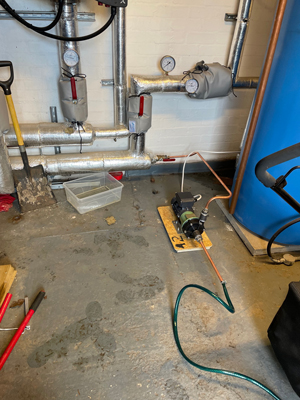
There are two key elements of installation – assessing system volume and ensuring it is clean (which usually means flushing to remove sludge and inhibitors. This process can also help ascertain volume if unknown). The heating/cooling system needs to be in reasonable condition with no history of leaks. Remedial work required, for example the fitting of thermostats radiator valves, should be carried out prior to installation to ensure increased heat output can be managed. Boiler sequencing/thermostats will also need adjusting accordingly. The nano-tech heat transfer fluid protects against calcification, corrosion, freezing, bacteria and algae growth so no additional inhibitor is required.
Results
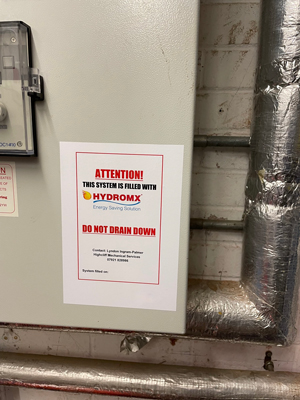
Nano-tech heat transfer solution Hydromx was installed into five schools in Essex as part of a pilot project by the Chelmsford Diocese, which is working towards Net Zero. Of the five, three recorded before and after energy usage statistics revealing gas consumption savings of between 37.5% and 47% from November 2022 to January 2023 when compared to the previous year (with an HDD – Heating Degree Day – calculation applied). ROI ranges from 1.42 years to 2.18 years. It should be noted that the schools now have TRVs fitted to ensure optimum savings and, coupled with the Hydromx installation, there has been a significant focus on energy saving within each, leading to these outstanding results, including the reduction in carbon emissions of around seven tonnes per site.
So effective was the installation in to one school that TRVs had to be retrofitted throughout to manage the increased heat output. “Everyone was sweltering and every classroom had its windows open. It really has made a big difference,” said a school spokesman. As well as fitting TRVs, the school’s boiler sequencing and timing required adjusting to reflect the system’s improved efficiency, all of which resulted in savings of 47% being achieved. The headmaster reported that the school ‘felt hot rather than luke warm’, with comfortable heating levels achieved in areas that had previously been hard to keep warm.
