

Energy efficient heating for sustainable living in Sheffield

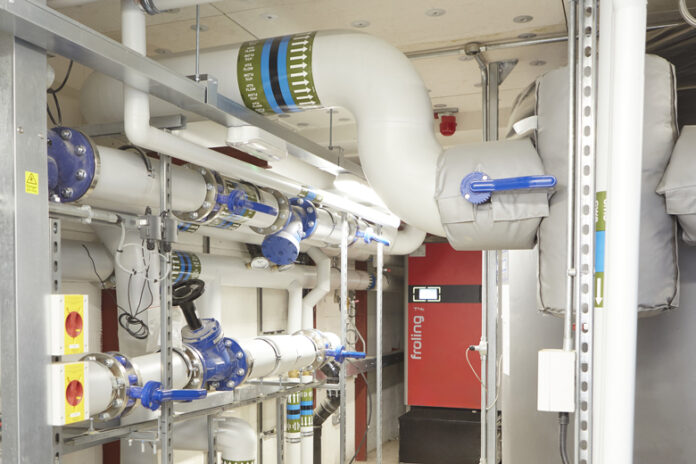
Inside the plant room: The heating system is powered by a biomass boiler. Images supplied by Taconova.

Taconova installs 229 Heat Interface Units in new residential development

A new £37m residential development in Sheffield is benefiting from sustainable and efficient heating, courtesy of Taconova’s market-leading Heat Interface Units (HIUs).

The Ironworks: Redefining Urban Living

Situated on Scotland Street, the Ironworks has been developed by Rise Homes and brings much-needed quality rented accommodation to Sheffield.

Building work began in January 2021 on the site of the former Queens Hotel, and in September 2023, Rise Homes and Taconova were joined by the Mayor of Sheffield to open the new 12-storey Ironworks building.

Inside The Ironworks

This development encompasses 229 furnished apartments, comprising 144 one-bedroom, 80 two-bedroom, and 5 two-bedroom duplex units. A focus on sustainability is evident, with each unit connected to the building’s communal biomass boiler-powered heating system.

Taconova’s TacoTherm H 3000E Heat Interface Unit neatly positioned in the utility cupboard inside the apartment.

The Heating System

Water heated by the basement biomass boiler circulates through the building’s risers and into the Heat Interface Unit (HIU) in each of the 229 apartments. The HIUs ensure efficient and consistent heating and domestic hot water provision, maintaining optimal temperature and flow for the residents.

TacoTherm H 3000E: The Core of Heating

Each flat features a TacoTherm H 3000E Heat Interface Unit. This HIU is an electronically controlled, compact, and connection-ready all-in-one unit that offers indirect heat transfer for heating and domestic hot water.

The 229 HIUs had to be supplied, installed, and commissioned within a three-month window. Taconova delivered 50 HIUs per week, and the contractor installed them in the utility cupboard of each apartment.

The TacoTherm H 3000E has been designed specifically for multi-storey residential buildings and provides an operating pressure of 6 bar. It has an operating temperature of 90°C and generates hot water temperatures of up to 60°C.

The TacoTherm H 3000E is highly efficient and has an overall Volume Weighted Average Return Temperature (VWART) figure of 26, making it a market leader – as independently tested by BESA (Building Engineering Services Association).

More Than Just Hardware

One of the standout benefits of opting for an electronically controlled HIU is the availability of data.

The initial specification for this project was for Heat Interface Units only. However, the TacoTherm H 3000E offers much more than just hardware. The HIU has a smart meter which enables remote monitoring and analysis of heat consumption. The meter gathers information from across the network, from the plant room to the HIU. With this data, the system’s efficiency can be tracked, and improvements may be made based on the information. Likewise, if there are any inefficiencies or faults, these can be identified, pinpointed, and rectified quickly.

The Ironworks management chose to also install the suggested smart heating controls and offer the controls to the residents through a smartphone or tablet app. These controls mean heating can be switched on or off remotely, potentially saving energy.

Rigorous Quality Assurance

Acceptance Test: Good Performance

Before the project was completed, Taconova conducted testing on each HIU. This service formed part of the Taconova’s commitment to ensuring the HIUs function to the correct specification. The testing analysed the operating pressure, temperature, and hot water temperatures in each apartment and measured the overall efficiency of the heating system during a 48-hour period. The results were then measured against set parameters.

After Taconova’s engineers had completed the adjustments and remedial work, the tests were conducted again. Improvements were evident and the scheme was performing according to the set design parameters and achieved overall network compliance.

On-going Monitoring for Sustainable Living

As part of its commitment to customer service and sustainability, Taconova will continue to monitor and improve the heating system for the lifetime of the scheme. It is well documented that the efficiency of a newly built property drops substantially after the first 12-month operation, so it’s important to monitor the efficiency of the whole heating system beyond the initial year.

The ongoing monitoring provides complete oversight of the whole system, not just the HIUs. Therefore, it is possible to recommend improvements to ensure that the network remains at the optimum efficiency level. For example, adjusting the plant room temperature during the summer and winter can optimise the system and improve efficiency.

As well as providing constant monitoring and improvement suggestions, Taconova will also support Ironworks with annual servicing of the HIUs, as part of the service level agreement.

A Greener Future

Exciting plans for the future reveal that things could get even greener if the Ironworks development can join the Sheffield City District Heating Network.

This district heating network is one of the largest city heat networks in the UK and currently supplies 2,800 homes and 140 commercial buildings, saving 21,000 tonnes of CO2 emissions annually.

The focal point of the network is the city’s incinerator which burns 120,000 tonnes of municipal waste each year, producing up to 60MW of thermal energy. With an expansion and improvement to the network, it is hoped that the Ironworks will be able to benefit from the waste heat generated from Sheffield’s incinerator.

Joining the network will mean the Ironworks can replace the biomass boiler and utilise waste heat from the network, further enhancing the building’s green credentials.

The indirect TacoTherm H 3000E HIU is future-ready and will seamlessly transition to the heat network and deliver efficient heating to the residents in the building. Thanks to the HIU’s pre-fitted heat meter, the residents’ heat consumption will be calculated based on what they use. Switching to the heat network will mean a lower heating tariff compared to the biomass boiler, so residents’ energy bills will also be lower.

Innovative heating solutions like Taconova’s indirect TacoTherm H 3000E HIUs are part of the company’s mission to offer reliable, low-maintenance, and highly efficient heating solutions that save customers time, effort, and money. To find out more, please visit: www.taconova.com.

References / links:

TacoTherm_H_3000E_e.pdf (taconova.com)

BESA Testing for HIU (hubspotusercontent-eu1.net)

Sheffield City District Heating Network (vitalenergi.co.uk)

Vital Energi sign pioneering collaboration agreement with the University of Birmingham

Image shows: Professor Yulong Ding and Chris Taylor

Vital Energi have signed a collaboration agreement with the University of Birmingham to develop and commercialise a range of innovative thermal storage solutions, which will help accelerate decarbonisation within the heating and cooling sector.

Vital Energi and the University of Birmingham will work together over an initial four years to continue the development of thermal storage Intellectual Property (IP) with a view to bringing a number of products to market. As part of the agreement, the University has assigned several IP rights, including a number of patents, to Vital Energi.

The implementation of thermal energy storage is imperative to address the challenges posed by intermittent renewables and enhance the overall reliability and sustainability of energy systems. Just as decarbonisation of electrical generation necessitated the huge growth in electrical storage over the last 10 years, it is expected that thermal energy storage will emerge over the next decade as a key enabler in accelerating the electrification of heat which will form the core of heat decarbonisation.

The collaboration will leverage the combined strengths of Vital Energi’s industry experience and the expertise in the team led by Professor Yulong Ding, Chamberlain Chair of Chemical Engineering and the founder of Birmingham Centre for Energy Storage. By fostering a dynamic exchange of ideas and knowledge, both entities aim to accelerate the pace of innovation and commercialisation of thermal storage solutions.

Vital Energi are committed to providing clients and end users with the most efficient and economic decarbonisation solutions and recognise the pivotal role that thermal storage plays in the future to ensure efficient utilisation of energy resources. This collaboration aligns with their aim of delivering environmentally conscious and technologically advanced solutions that address the challenges of today’s rapidly evolving energy landscape.

Vital Energi’s Technical Development Director, Chris Taylor, said:

“We see thermal energy storage as a core component in the decarbonisation of the heating and cooling sector. Through this collaboration, we aim to bring innovative energy storage to the market and tackle some of the obstacles introduced by an evolving energy system.

“This is an exciting time for Vital and we believe we have found the perfect partners in Professor Ding and his team at the University of Birmingham, and look forward to working together to commercialise their concepts.”

Professor Ding, who is known for inventing novel, commercialisable, technologies for electrical and thermal energy storage, has published over 450 technical papers and filed some 100 patent applications over the past 35 years.  

“Globally, thermal energy accounts for over 50% of final energy consumption and is responsible for more than 40% of energy-related carbon dioxide emissions, making it central to achieving net zero emissions.  While it is the hardest-to-decarbonise sector, thermal energy storage can help us address this challenge, and I am looking forward to working with Vital Energi to make this happen,” said Professor Ding.  

Professor Martin Freer, Director of the Birmingham Energy Institute at the University of Birmingham, added:  “This partnership is really exciting as it allows a pathway for the discoveries of Professor Ding and his team to deliver impact in the development of the UK’s energy system in the much-needed area of energy storage.

“The University of Birmingham’s research is world leading in this area and it presents the opportunity with Vital Energi, who have been fantastic partners, to deliver world leading energy solutions.” 

About Vital Energi

Vital Energi provide a comprehensive range of energy related services, systems, and solutions. With over 30 years’ experience, they have in-house capability to design, install, and operate decentralised energy generation and multi-utility network distribution schemes, including some of the UK’s largest and longest established district heating networks. As well as providing tailored energy management schemes to manage, measure, and reduce energy consumption, they design and install the latest renewable and low carbon technologies, from heat pumps and solar PV farms, to battery storage and waste heat recovery, and they have started to build their first Waste to Energy plant at a site in Drakelow, Derbyshire. Their solutions provide long term cost benefits for clients across a broad range of sectors, including healthcare, education, industry, commercial, new build, and existing residential. 

If you would like to know more about Vital Energi please visit: www.vitalenergi.co.uk.

About the University of Birmingham

The University of Birmingham is ranked amongst the world’s top 100 institutions. Its work brings people from across the world to Birmingham, including researchers, teachers and more than 8,000 international students from over 150 countries.

University of Birmingham Enterprise helps students and researchers turn their ideas into new services, products and enterprises that meet real-world needs. We also provide incubation and bio-incubation, support innovators and entrepreneurs with mentoring, advice and training, and manage the University’s Academic Consultancy Service.

Heat pump versus boilers: How do they compare?

Jon Bonnar

After the energy price cap rose by 5% last month – increasing the average annual bill by £94 a month – you might be looking for a cheaper way to heat your home.

One solution could be installing a heat pump, which operates using electricity rather than gas or oil, as is the case with conventional boilers. But while heat pumps promise to save you money over the long term you may be worried about the higher upfront costs – and whether they’re actually cheaper to run compared with a boiler. 

Comparing the cost between a heat pump and a conventional boiler depends on a variety of factors, including the type of heat pump or boiler, energy prices, installation costs, and where you live. Jon Bonnar, Managing Director at Cotswold Energy, shares everything you need to know:

Energy efficiency and reduced energy costs

Heat accounts for nearly half of all energy consumption and 40%1 of energy-related carbon dioxide emissions. This is mostly from traditional heating systems, which rely on valuable resources like oil, coal and natural gas.

Heat pumps are more environmentally friendly because they capture heat that already exists, rather than generating new heat. This means the system itself doesn’t require fuel or emit any carbon dioxide.

While heat pumps do run off electricity, which emits carbon, the quantity of heat they produce is much greater than the quantity of electricity they use, making them highly efficient. Plus, as more electricity is generated from renewable energy sources, the electricity used to power heat pumps is becoming cleaner, making it an even more eco-friendly alternative.

This also means that, compared to a conventional boiler, heat pumps are more cost-effective. After the initial outlay, the energy savings of a heat pump nearly always outweigh the initial cost in the long run.

Typically, our clients save approximately 10% off versus what they were paying on their gas heating bill over a year. Those using solar-powered electricity will save even more. There are significant savings to be made (between 40% and 60%) compared to an oil or liquefied petroleum gas (LPG) boiler too.

However, it’s always worth comparing the costs of gas and electricity in your own area to understand the cost difference.

Installation costs

The cost of a heat pump varies between properties depending on type, size and age, but you can expect to pay between £3,000 and £8,000 on average if you take advantage of the government’s Boiler Upgrade Scheme and apply for a £7,500 grant to install a heat pump.

In comparison, a new gas boiler may set you back around £3,000.

The government has just announced a further £1.5billion of funding for their Boiler Upgrade Scheme from 2025-2028, making it much easier for those wanting to make the switch.

Different types of heat pumps come with varying costs, so prices do vary depending on the type of heat pump you’re looking to install. A ground-source heat pump, for example, might involve extensive work and expenses including drilling and excavation, so is likely to come with a higher upfront cost.

More information on the various grants and support available can be found here.

Long-term savings

For those consumers who do have the finances available to opt for a heat pump, the savings in the medium and longer term will help mitigate the bigger upfront cost, particularly when gas prices have been at historically high levels.

Long-term savings will vary between properties depending on how much energy (electricity) is required to run the heat pump. This would depend on the size of your home, whether it’s well-insulated or not and what temperature you want your home to reach.

Still, after the initial outlay of a heat pump, the energy savings that come with the system nearly always outweigh the initial cost of a heat pump in the long run.

Typically, our clients save approximately 10% off their gas heating bills over a year, but this varies between tariffs. Those using solar-powered electricity will save even more. Plus, if gas prices continue to rise at a faster rate than electricity, then savings will only increase.

Increased home value

As well as reducing energy bills, installing a heat pump could increase the value of your home. In fact, a study by WWF and ScottishPower found that low-carbon improvements could increase property value by up to £10,000.

In addition to this, research by estate agents Savills found that 71% of buyers in 2022 said that EPC ratings and energy efficiency are key to their decision-making when it comes to choosing a new home.

They also found that homes with heat pumps, specifically, demand an impressive 59% premium compared to regional averages.

1 How to cut carbon out of your heating – BBC

UK’s largest voltage optimisation project completed

Harvester. (Image supplied by Powerdown220)

Voltage optimisation (VO) specialist Powerdown220 has completed the UK’s largest ever VO rollout for pub and restaurant chain, Mitchells & Butlers. The year-long project involved VO installations at over 1,100 sites and is already delivering significant energy savings.

Mitchells & Butlers decided to invest in VO to lower its energy bills and reduce its carbon footprint. The large pub and restaurant chain, which owns popular brands like Harvester and Toby Carvery, chose VO specialist Powerdown220 to manage the project.

The average UK voltage supply is 242 volts, but most equipment is designed to work optimally at 220 volts. VO is a technology that lowers incoming voltage from the National Grid, and has proven effective at delivering cost savings for businesses who are large consumers of electricity.

After an extensive survey of Mitchells & Butlers estate, 1,125 sites were identified as suitable for VO, making this the largest multi-site project of its kind ever attempted in the UK. At the peak of the project, up to sixty machines were being installed every week.

‘‘I didn’t realise beforehand that this would be the biggest project of its kind in the UK, but that fact puts it all into perspective,’’ reflected Dale Fenton, energy manager at Mitchells & Butlers.

The company was looking to invest in a technology that would deliver cost savings and improve its sustainability and found VO to be a technology that ‘‘ticked both boxes.’’

The unprecedented scale of the project meant unique challenges. Ensuring sufficient resources were available and manufacturing output was maintained required careful forward planning. Powerdown220 also drew up on its relationship with Ashcrofts, which carried out 40 per cent of the installations.

‘‘We are enormously proud to have completed a project of this scale and delighted that Mitchells & Butlers placed their trust in us,’’ commented James Goody, director at Powerdown220.  ‘‘The experience of successfully completing this rollout in such a short period of time has also provided unique opportunities for learning, which we can now carry forward.’’

Powerdown220 provides VO to businesses across the UK. To quickly discover if your company can benefit from VO, use the savings calculator on www.powerdown220.com

New badge for energy assessors to promote their broader retrofit and net zero carbon-ready skills

Photo: Elmhurst Energy

A new competency scheme for energy efficiency professionals aims to promote their skills and experience to a fast-growing market in net zero carbon-ready buildings and retrofit.

Elmhurst Energy will announce its new Better Buildings Consultant scheme at its National Conference, in Leicester, on Tuesday 27 February.

The initiative answers a need from building owners, social landlords, facilities managers, and homeowners to make it easier to identify qualified professionals with skills, knowledge and experience in low carbon retrofit and the best route to achieving net zero standards.

It follows a 2021 estimate from CITB that the UK must train 12,000 workers every year until 2025, rising to 30,000 every year until 2030-2035, to achieve its net zero and retrofit targets.

Stuart Fairlie, managing director at Elmhurst Energy, the UK’s largest accreditation scheme for energy assessors, said:

“As a nation, we’ve never been so acutely aware of the need to make our homes and buildings more energy efficient. But to deliver this we need a fully competent and growing workforce who are equipped with the training and accreditation necessary to help us reach net zero standards, reduce demand on the grid and improve the resilience of our built environment.

“We are also still facing an energy price cap that is more than 59 per cent (£700) above the summer 2021 levels. The cost-of-living issue has not gone away, so many councils, housing associations, landlords and homeowners will be looking to future-proof their homes, so they are warmer and cheaper to heat long-term.

“A Better Buildings Consultant simply gives commercial and private customers extra assurance that their chosen energy efficiency professional has a holistic understanding of all these issues and the right competencies and technical experience to cover a broader range of requirements.”

The Better Buildings Consultant badge will increase visibility among industry and homeowners through Elmhurst’s Find an Assessor tool, which attracts more than 7,000 monthly visitors.

The Better Buildings Consultant scheme is open to the 15,000-plus Elmhurst members who have an accreditation in energy assessment and a competency or accreditation in a second professional discipline, such as:

  • Retrofit assessment and co-ordination
  • Overheating risk assessments
  • Psi-value calculation
  • U-value calculation
  • Legionella risk assessment.
  • Airtightness
  • Energy Savings Opportunity Scheme (ESOS)
  • Ventilation
  • Thermography

To achieve the badge, applicants will also need to pass a further competency test. Once qualified, they will be listed as a Better Buildings Consultant with Elmhurst, and will also receive access to tailored marketing resources.

As the launchpad for the new Better Buildings Consultant scheme, Elmhurst’s national conference will also deliver the latest on the Home Energy Model currently being consulted on by the Department for Energy Security and Net Zero, plus the Future Homes and Building Standards consultations, and an update on non-domestic policy and regulatory developments.

Registrations are still open to attend the Conference, to be held at King Power Stadium, Filbert Way, Leicester, LE2 7FL.

Whitecroft Lighting Goes Nuclear at Hinkley Point C

Photo: EDF
  • UK manufacturer is the first supplier to be approved for the UK nuclear industry
  • 40,000 Energy efficient LEDs will save enough power each day to run 3,000 homes

UK commercial lighting manufacturer, Whitecroft Lighting, has secured a landmark contract to supply 40,000 low-energy LED lights to the nation’s newest nuclear power station, Hinkley Point C, in Somerset.

Whitecroft Lighting is the first supplier to have its LED lighting system approved for use in the UK nuclear industry.

The culmination of six years of research, collaboration and customised testing, the Greater Manchester-based company has designed and manufactured a unique LED lighting system.  

Although high-quality, energy efficient LED lighting has become the new standard across most industries in the UK, the nuclear industry still mainly uses traditional fluorescent lighting.

LED technology needed to be approved for the UK nuclear industry. Working with EDF, Whitecroft had to test the lighting and supporting electronics to ensure it could operate in areas containing radiation and higher-than-normal heat levels.

Tony Male, Whitecroft Lighting’s Regional Sales Manager, Wales and West says: “This is a landmark moment for Whitecroft UK lighting.

“No credible testing or research existed for LED lighting in these challenging environments, so Whitecroft led an accelerated testing regime that simulated years of constant exposure to radiation at varying levels in each zone.

“Whitecroft embraced this as an opportunity to be part of one of Europe’s largest infrastructure projects, break new ground for lighting, and set new standards for the UK nuclear energy industry for years to come.”

As part of the construction of Hinkley Point C, EDF was keen to find a UK lighting manufacturer that could make an LED work in this environment, with Whitecroft developing the ideal solution, supported by the Hinkley Point Supply Chain.

Following extensive work undertaken by Whitecroft’s specialist research and development team, LEDs can now be specified for Hinkley Point C and future nuclear projects.

Around 40,000 LED luminaires will eventually be installed across 90% of the Hinkley Point C estate, in a broad range of buildings and facilities, including some specialist environments such as the power generation halls.

The Whitecroft Lighting Hinkley Point C development team (L to R), Lee Tupman, Technical Manager; John Earley, Product Design Manager; & Tony Male, Regional Sales Manager Photo: Whitecroft Lighting

Tony Male continues: “The unique nuclear-approved LED luminaires manufactured for the project will be around 40% more energy efficient than traditional fluorescent lighting, and the 40,000 LED luminaires supplied will save around 11,200 KWh each day, or the equivalent of the power needed to run around 3,000 average family sized homes.”

An important legacy for Whitecroft Lighting’s investment in research and development for the Hinkley Point C project is that future nuclear energy developments across the UK will also be able to share in the benefits of high-quality and energy efficient lighting.

Tony adds: “Some obvious potential candidates include Sizewell C in Suffolk, which will be a close copy of Hinkley Point C, and so will benefit from many of the same components.

“There will also hopefully be opportunities to collaborate with the much-talked-about ‘mini’ or ‘modular’ nuclear power stations currently being proposed as the next step in transitioning away from fossil fuel-dependent energy generation.”

Whitecroft Lighting is part of the Fagerhult Group, has 343 employees and turns over £55m. The company undertakes all R&D, product design and manufacturing in its UK HQ and neighbouring 10,000 sqm manufacturing facility.

To find out more about Whitecroft Lighting Ltd visit www.whitecroftlighting.com

Green energy test bed to launch in Greater Manchester

Mayor of Greater Manchester, Andy Burnham (left), shakes hands with Neil Kirkby, Managing Director of Enterprise at SSE Energy Solutions

SSE Energy Solutions and Greater Manchester Combined Authority sign strategic partnership

Energy infrastructure developer, SSE Energy Solutions, has signed an agreement with the Greater Manchester Combined Authority (GMCA) to use the region as a test bed for pioneering projects which will accelerate its journey to net zero.

The Memorandum of Understanding (MOU) announced on Monday 12th February will see the mass deployment of investment in the decarbonisation of power, heat, and transport across Greater Manchester, as well as helping to create a ‘green skills workforce’ with long-term, high-quality careers in the low carbon sector.

The five-year MOU will also seek to strengthen research and innovation clusters, building an ecosystem that connects people, ideas, and sectors to accelerate green energy projects, including ground and roof solar arrays, low carbon district heat networks, and EV and e-HGV charging hubs. 

SSE has already developed strong relationships with key stakeholders in the region, including the Green Skills Academy, Manchester Metropolitan University’s Fuel Cell Innovation Centre, and Greater Manchester’s Energy Innovation Agency. This multi-sector collaboration supports companies working in areas such as smart building technology, energy efficiency, and EV charging infrastructure.

The GMCA has set an ambitious target to achieve net zero by 2038. Meanwhile, SSE has increased clean energy investments by 65% to a total of £20.5bn by 2027 and is spending more than £10m a day to unleash the low-carbon infrastructure that the UK needs for its net zero transition.

Neil Kirkby, Managing Director of Enterprise at SSE Energy Solutions, said:

“If we are to reach our net zero targets here in the UK, we are going to need a workforce skilled to fill the STEM jobs that will be needed to facilitate the transition to renewable energy. Secondly, we need to ensure we take the public on the journey with us.

“We believe strongly in a just and fair transition to net zero and decarbonising the country presents opportunities to support communities with regeneration, economic investment, and the creation of sustainable, long-term jobs.

“This agreement with the GMCA means we can work together to deliver innovative green energy projects, designed and built by local people who will directly benefit from them. This is exactly what the Social Value strategy we have here at SSE is all about.” 

Mayor of Greater Manchester, Andy Burnham, said:

“The green transition presents a massive opportunity to reindustrialise places like Greater Manchester. We want our economy to prosper, and our target is to become a carbon neutral city-region by 2038 – growing our low carbon industries can help us to do both.

“To realise our ambitions, we need to build relationships with partners in industry. This agreement will see us work closely with SSE Energy Solutions to find mutual benefits in a wide range of areas, including clean energy projects, careers and skills development, and research and innovation.”

Rinnai goes electric on water heating products to existing Natural Gas, Hydrogen blends ready and BioLPG units

Now available from Rinnai are electric additions to the comprehensive range of heating and hot water heating systems and units. UK energy strategists believe that clean and sustainable electrification is presently one of the best modes of reducing carbon emissions, maximise efficiencies and to also lower end-user customer costs.

Rinnai has, therefore, adapted its extensive product range to include electric versions and to develop modern technologies in offering continuous flows of product innovation. More new launches are expected in the first part of this year.

Rinnai’s Infinit-E range is an optional three-phase all-electric water storage heater for commercial hot water applications. All electric storage water heaters are designed with flexibility in mind. All units are fitted with between one and six titanium elements. The KW rating within the Infinit-E range is scalable from 12kw to 72kw ensuring that our appliances are suitable for a wide variety of applications. 

Each cylinder is manufactured with stainless steel adding durability and enabling extensive warranties. The use of stainless steel also makes the Infinit-E range lightweight and easily manoeuvrable when compared to glass-lined variants. The empty weight of the Infinit-E is 54kg maximum. 

All electrical elements can be fitted to a single-phase supply, should site limitations dictate. Each element within the appliance range has its own controllable thermostat with a temperature range of between 49 and 90 degrees Celsius. All elements are fuse protected and there is no need for expensive sacrificial anodes due to a tough stainless-steel build. 

All-electric systems can benefit from our modulating smart electric cylinder range – ensuring that the only direct electricity used is to fill the performance gap from the renewable heat source. Rinnai’s electrical hybrid solar heating and hot water systems deliver identical performance when compared to traditional options. 

Rinnai’s range of electric products include monobloc air source heat pumps that are available in an assortment of variants, from 4kW to 110kW. Rinnai’s heat pump technology ensures that up to and including seven units can be cascaded together. A cascaded system means that multiple heat pumps can work in conjunction allowing for a level of functioning synchronicity that produces greater operational performance for larger commercial applications.

The HPI models omit minimum acoustics via an installed ultra-low sound capability making Rinnai heat pumps suitable for any area with prohibitive sound legislation. Rinnai’s HPI range operates within compliance of all stringent sound standards ensuring low-sound functionality. 

All Rinnai commercial heat pumps use LOW-GWP including R32 and R290, renowned for reducing electricity consumption by up to 10% and for holding a lower global warming potential (GWP). Rinnai’s HPI heat pump range is ratified with an ERP rating of A +++ and includes an operational ability to switch between settings of heating, hot water, and cooling. 

Rinnai’s HPI air source heat pumps, hybrid formations, electrical formats and hydrogen gas mix powered water heaters are part of the H3 range of products. All new models are designed to embolden decarbonisation, energy efficiency and reduce customer costs by offering practical, affordable, and feasible solutions to all UK customers.

Rinnai is determined to offer UK customers assorted options of carbon reducing technology that ensures an improved healthy lifestyle. Rinnai is also keen on informing all UK customers in major changes and developments concerning the international energy market that may affect purchase or power options in the near and far future. For the latest blog and vlog information on products and policy visit www.rinnaiuk.com and subscribe to the Rinnai newsletter.

EnOcean develops sustainable solutions for global megatrends and sets course for accelerated growth

EnOcean has developed sustainable solutions for the global megatrends of energy management, office space optimization and wellbeing and has aligned its strategy for accelerated growth. Owners and tenants of houses, buildings, and industrial facilities can realize smarter and more sustainable working and living conditions and thus significantly reduce energy consumption and CO2 emissions. As a pioneer and market leader in energy harvesting and sensor-to-cloud solutions for sustainable Internet of Things (IoT) applications, EnOcean sees significant growth opportunities, particularly in the retrofitting and energy optimization of existing buildings.

Alternative energy sources and IoT solutions to reduce energy consumption and CO2 emissions

The requirements for sustainable energy use are increasing worldwide due to climate change, new working and living environments, and legal regulations. “Against this backdrop, we have developed IoT-based solutions for the key global megatrends of energy management, office space optimization and wellbeing. With these, owners and tenants of houses, buildings and industrial facilities can use alternative energy sources, realize smarter and more sustainable working and living environments and ultimately significantly reduce energy consumption and CO2 emissions,” explains Raoul Wijgergangs, CEO of EnOcean. The most important keys to greater efficiency, productivity and environmental friendliness are energy harvesting from alternative energy sources in the environment and the smart use of sustainable IoT solutions. “With our energy harvesting technology, high-quality sensors, the cloud-based IoT connector, an end-to-end approach, and a large partner ecosystem, we have strategically developed our business model and aligned it with global megatrends. In doing so, we want to ensure the continued growth of EnOcean and make an important contribution to a future worth living for generations to come, taking into account economic, ecological and social aspects,” says Wijgergangs.

Global megatrends: energy management, space optimization and wellbeing

Owners and tenants of houses, buildings and industrial facilities around the world are facing the major challenge of reducing energy consumption and CO2 emissions.

  • Energy management: Regarding sustainable energy management, EnOcean ensures multi-layered energy optimization based on current data. Manufacturers of switches can thus drive intelligently controlled light and heating switch-offs to save energy in unused rooms, for example.
  • Office space optimization: EnOcean also offers new concepts for optimized space utilization based on new work models such as desk sharing. This can ensure a flexible, healthy and comfortable working environment. It also optimizes energy costs, drives building automation, and aligns the office and building landscape more effectively and efficiently.
  • Wellbeing: Automated adjustment of temperature, lighting, or even air conditions significantly improves wellbeing and productivity in working environments.

“Modern energy use through alternative and self-sufficient energy sources and sustainable IoT solutions are a win-win situation for companies and the environment. Our solutions not only open up value-adding options for owners and tenants, for example through predictive maintenance and condition-based servicing, but also reduce energy consumption and CO2 emissions in particular. 20 million sensors sold have already saved 1.484.000 tons of CO2,” emphasizes Wijgergangs.

Light + Building: Focus on sustainable solutions

“With our solutions, we create sustainable added value for intelligent building automation in compliance with national and international legal regulations. Our wireless, battery-free and maintenance-free sensors for energy harvesting and our cloud-based IoT connector help to analyze the collected data and make informed decisions to optimize building performance,” says Wijgergangs. At Light + Building in Frankfurt am Main (March 3 to 8, 2024, booth 9.0 D 10), EnOcean will underline its motto “Sustainable IoT for Healthy and Green Buildings” by showcasing its sensors as well as its SmartServer.

About EnOcean

EnOcean is the pioneer of energy harvesting and sensor-to-cloud solutions for sustainable Internet of Things (IoT) applications. For more than 20 years, EnOcean has been producing maintenance-free wireless switches and sensors, which gain their energy from the surroundings – from movement, light, or temperature changes. The combination of miniaturized energy converters, ultra-low power electronics, robust radio technology, and open multi-protocol connectivity solutions based on open standards (EnOcean, Zigbee, Bluetooth®, BACnet, Modbus, LON, and IAP) forms the foundation for smart buildings, services, and production processes in the IoT. The sustainable EnOcean solutions are used in building automation, smart homes, LED lighting control, and industrial applications to optimize the CO2-footprint of buildings. EnOcean is a strong partner for more than 500 leading product manufacturers and has completed more than a million buildings worldwide.

For more information, please visit www.enocean.com

EDF signs a market-leading solar and battery optimisation deal

  • EDF will trade, optimise and offtake renewable energy from a combined 50MW of battery and 66MWp of solar co-located at Warley, UK.
  • The deal represents one of the UK’s largest combined hybrid offtake and optimisation agreements.
  • Deployment of the battery and solar assets is part of a portfolio that DIF Infrastructure VII and ib vogt invested into in 2022 and secured a market leading portfolio financing earlier in 2023.
  • The deal reinforces EDF’s position as the largest buyer of power from independent renewable generators in GB.

EDF, Britain’s biggest generator of zero carbon electricity, together with DIF and ib vogt will trade, optimise and offtake the physical energy from solar and battery assets with a combined 116MWs sharing a transmission grid connection at Warley UK.

The deal will see EDF manage the co-located assets together in real time, making efficient use of the shared transmission level grid connection for the assets. The combined capacity of 116MW will make Warley one of the UK’s largest co-located sites once operational in 2024. Over a 10-year term, EDF will offtake the physical energy produced by the solar farm and optimise the 50 MW battery through its proprietary Powershift platform, leveraging EDF’s trading expertise to provide access to all revenue streams available to a battery, which currently includes the balancing mechanism, wholesale optimisation and ancillary services.

With EDF providing both offtake and battery optimisation services for this large co-located site, the deal represents one of the first of its kind in the UK. Through maximising the efficiency and performance of both assets, the partnership will provide the grid with essential flexibility, as well as a reliable and secure source of energy.

EDF is a leading provider of route-to-market services for storage developers and investors and is committed to the long-term future of energy storage systems, with more than 1GB of battery optimisation contracts signed.

EDF is also one of the UK’s largest investors in renewables, with more than 1GW of renewable generation in operation and over 5GW in construction and is the largest buyer of renewable power from independent renewable generators in GB.

Stuart Fenner, Director of Wholesale Market Service Commercial, at EDF said: “We are very pleased that we have been chosen to deliver trading, optimisation and offtake services for one of the UK’s largest co-located solar and battery sites. This unique deal exemplifies the innovation needed to address our energy challenges, which will help to secure green energy for the future and deliver on our commitment to help Britain achieve net zero.”

EDF is helping Britain achieve Net Zero by leading the transition to a cleaner, low emission, electric future and tackling climate change. It is the UK’s largest producer of low-carbon electricity and supplies millions of customers with electricity and gas.