
Aira launches state-of-the-art heat pump with smart home energy solution

Swedish clean energy-tech champion, Aira has launched the Aira Heat Pump, complete with the latest smart technology to take Europe off gas and accelerate the electrification of home heating.

In the UK there are still 25 million oil and gas boilers heating homes. The Government is propelling the transition to heat pumps by offering consumers a ยฃ7,500 grant, while VAT has also been eliminated on any clean energy improvements to homes until 31st March 2027. Recent research from Aira revealed that 11% of adults in the UK are considering installing a heat pump in 2024, which equates to nearly 6 million people. This demonstrates the significant market potential, of which Aira plans to serve one million households, while employing 8,000 clean energy-tech roles over the next decade.

The Aira Heat Pump and complete service offering is set to disrupt the industry, with an affordable monthly payment plan, zero upfront costs and a 15-year โ€˜Comfort Guaranteeโ€™, which is inclusive of performance, product and installation warranty. With this approach, Aira is making the next generation of clean energy-tech accessible to millions, saving customers up to 25% on their heating costs from day one, whilst reducing household CO2 emissions by at least 75% – with emission savings rising to 100% if the heat pump is powered by green energy electricity. The installation of a heat pump is also proven to increase property value by up to ยฃ8,000 in the UK (1).

In design, its sleek, Scandi look delivers a timeless feel that will stay contemporary throughout its lifetime, complete with intuitive light cues, soft edges and colour palette that is designed to fit naturally into its surrounding environment, much like the quiet running sound.

The Aira Heat Pump takes a digital first approach, removing displays and putting customers in control of all settings via a thermostat and smart app that they can control anytime, anywhere. The system is always improving thanks to โ€˜Aira Intelligenceโ€™, a set of smart, connected features that continuously learn the customerโ€™s routine and household habits to precision plan heating and hot water.

While new to market, Aira has a strong foundation of heat pump knowledge due to its Scandi heritage and roots in Sweden, where heat pump penetration is at 60% and only 1% of the countryโ€™s total CO2 emissions come from residential heating. The product and engineering team have been working on heat pumps for over 20+ years and have used their expertise and deep understanding of the technology to create the new Aira Heat Pump.

Aira is backed by leading climate tech investors across Europe, the US and Asia, helping to accelerate Aira’s strategy to drive the much-needed decarbonisation and electrification of residential heating across Europe. The funding has helped to fast-track the development of Airaโ€™s clean energy-tech portfolio, an ecosystem of products to complement the Aira Heat Pump.

Martin Lewerth, Aira Group Chief Executive Officer, said: โ€œThe launch of our new Aira Heat Pump marks a key milestone in Airaโ€™s journey to serve five million customers across Europe over the next decade. Through this, we are helping more households unlock significant savings and reduce carbon emissions – all whilst adding value to their home with a state-of-the-art heat pump. Heat pumps have been around in Scandinavia for decades and we are excited to bring contemporary heat pump design and technology to wider Europe. The time to switch is now, because a warm home shouldnโ€™t cost the earth.โ€

Kaj af Kleen, Aira Chief Product and Technology Officer, said: โ€œMarking a new era in home heating, the Aira Heat Pump is the perfect replacement for any gas or oil boiler. Throughout the development process, our design team were laser focused on one goal: to make a simple system that any individual or family would love to live with. We have developed an intuitive app that works to control your home heating and provides customers with peace-of-mind through the inclusion of features that help drive even greater efficiencies, helping them to save money and CO2 emissions. We set out to design the next generation of heat pumps – a beautifully designed and intelligent system, available in a range of sizes fit for any home – and that is what weโ€™ve done.โ€

For more information, please visit www.airahome.com

Spring date set for Wolverhampton solar farm

Wolverhampton solar farm

A solar farm which will power Wolverhamptonโ€™s New Cross Hospital for three quarters of the year is set to be up and running this spring.

The Royal Wolverhampton NHS Trust (RWT), City of Wolverhampton Council, and project partners including Vital Energi, have built the solar farm at a former landfill site the size of 22 football pitches, adjacent to Bentley Way, Wednesfield. It is set to open in April.

The facility will power the entire hospital site with self-generated renewable energy for around 288 days a year, and save the Trust around ยฃ15-20 million over the next 20 years โ€“ money which will be put back into frontline healthcare.

The solar farm will produce 6.9MWp of renewable energy to New Cross Hospital and will generate an estimated carbon saving of 1,583 tonnes of CO2e per annum.

More than 15,000 electricity generating solar panels have been installed at the site by main contractor Vital Energi.

Work to secure the 40-plus acre brownfield site included protecting badger setts, and removing methane.

The project, combined with existing green technologies, allows the Trust to move away from reliance on the national grid and to reduce its exposure to rising electricity costs in the next two decades. It also supports the Trustโ€™s goal of reducing its carbon emissions by 25 per cent by 2025, and of reaching net zero carbon emissions by 2040.

Stew Watson, Director of Estates Development at RWT, said: โ€œThis investment is a huge boost to help us achieve that.

โ€œOur primary focus is always on the patient and these works ensure the Trust saves money on future energy bills, which we can then subsequently invest across other healthcare services.โ€

Professor David Loughton CBE, Group Chief Executive at RWT, said: โ€œAs the largest employer in Wolverhampton, we take sustainability very seriously and are committed to continually working to reduce our carbon footprint.

โ€œWe have taken a number of steps to reduce and better manage our energy consumption and operate in a sustainable manner.

โ€œOne of these steps is to look at using renewable energy so we are very pleased the development will be opening soon and delighted at the way the partnerships have worked out.โ€

L-R: Jon Gwynne (CEF), Ashley Malin, Professor David Loughton CBE, Stew Watson

Ashley Malin, Managing Director at Vital Energi, added: โ€œWeโ€™re delighted to have transformed a former coal mine and landfill site into this impressive solar farm, which is the largest single source of green energy on a hospital site within the UK.

โ€œThe clean energy will power the air source heat pumps within the hospital, and significantly reduce the hospitalโ€™s carbon footprint.โ€

Work has also been completed on the underground cabling to connect the hospital to the solar farm, which covers a distance of one and a half miles.

RWT has received around ยฃ15m in grant funding for the project. This comprised contributions from the governmentโ€™s Levelling-Up fund, the NHS and Salix Finance, a government-funded body.

The Trust also received a further ยฃ33m to carry out green energy works as part of the Department of Business, Energy, and Industrial Strategyโ€™s Public Sector Decarbonisation Scheme.

About Vital Energi

Vital Energi provide a comprehensive range of energy related services, systems, and solutions. With over 30 yearsโ€™ experience, they have in-house capability to design, install, and operate decentralised energy generation and multi-utility network distribution schemes, including some of the UKโ€™s largest and longest established district heating networks. As well as providing tailored energy management schemes to manage, measure, and reduce energy consumption, they design and install the latest renewable and low carbon technologies, from heat pumps and solar PV farms, to battery storage and waste heat recovery, and they have started to build their first Waste to Energy plant at a site in Drakelow, Derbyshire. Their solutions provide long term cost benefits for clients across a broad range of sectors, including healthcare, education, industry, commercial, new build, and existing residential. 

Innovators to collaborate with UK Power Networks thanks to new funding

Luca Grella, head of innovation at UK Power Networks

UK Power Networks has underlined its commitment to innovating for the future by securing funding for a dozen new groundbreaking projects.ย 

The projects will now enter their initial discovery phase through Ofgem and Innovate UKโ€™s Strategic Innovation Fund (SIF). If successful, they will help both customers and the wider electricity sector accelerate their Net Zero plans, build network resilience, access lower costs and streamline maintenance activities.

Building on the 13 projects already underway from SIFโ€™s 2023 funding round, UK Power Networks now runs nearly a quarter of the electricity and gas sectorโ€™s SIF projects.

The funding allows electricity and gas firms to work in partnership with independent innovators. The 12 newly-funded projects will see more than 20 industry-leading innovators partner with UK Power Networks.

The projects include:

  • Electric Thames: exploring the viability of electric-powered boats on the River Thames, and the possibility of boat power feeding the electricity grid to increase energy flexibility and reduce peak electricity demand
  • KnowMyFlex: a proposal to create Energy Flexibility Certificates, similar to energy performance certificate (or EPC) ratings, to show the existing and future flexibility potential of homes and buildings, helping customers engage with flexibility to reduce their bills
  • WASH: an advanced study into the ways heat can be efficiently captured from waste water and used to help district heat networks decarbonise

Luca Grella, head of innovation at UK Power Networks, said: โ€œWeโ€™ve made remarkable strides during our first year with the SIF programme and are excited to be heading into a second with a new wave of projects which have exciting potential to make a real impact on both our communities and the way we work. 

โ€œThis funding is allowing us to continue building strong bonds with some of the brightest minds in the sector. Our project collaborators play a key role in helping us deliver tangible benefits for our customers, and we canโ€™t wait to reap the rewards of these partnerships.โ€

To date, the company has successfully transitioned 58 innovation projects to its business-as-usual workflow, saving customers more than ยฃ425million over the past eight years.

Launched in 2021, the SIF fund is expected to invest ยฃ450million by 2026. Delivered in partnership with Innovate UK, the SIF programme taps into the best of UK and international innovation and aims to align with other public innovation funding for the benefit of customers across the United Kingdom.

Which technology is best at reducing energy costs? – Solar power, cogeneration or voltage optimisation?

Choice overload is the name given to the phenomena where an abundance of choice overwhelms our cognitive ability to make effective decisions. The end result is often no decision at all, or at best a choice that is suboptimal. Businesses making decisions about cutting energy costs may face this dilemma when surveying the options available to them. In this article, Stuart Hawkwood, founder of Powerdown220, compares the pros and cons of three different technologies that can help organisations reduce their energy bills.

There are many technologies out there which have the potential to reduce energy costs. In this situation, it is easier to stick to the more familiar or widely known options, like solar panels, which are now visible on many rooftops, or combined heat and power (CHP), which is backed by government support.

However, donโ€™t let too many choices blind you to the presence of lesser-known alternatives that might deliver more value for money. Voltage optimisation is one technology that can give both solar power and CHP a run for their money and might be able to provide you with a quicker return on investment (ROI). Hereโ€™s a summary of what all three technologies have to offer:

Harnessing the power of the sun: solar power

Solar power is a sustainable and environmentally friendly energy source. It harnesses energy from the sun, which is abundant and inexhaustible, in contrast to fossil fuels. Once installed, solar panels generate electricity and although there are maintenance and replacement costs to be considered, the energy generated is free. This can significantly reduce a businessโ€™s energy bills and provide long-term cost savings. By reducing or eliminating the need for grid-generated electricity, solar power reduces a business’s carbon footprint, which can be a big selling point for sustainability managers and environmentally conscious consumers.

A major drawback is the high upfront cost of purchasing and installing the solar panels, which can be substantial. This may be a barrier to entry for small and medium-sized enterprises. A significant amount of roof or ground space is also required, which may not be feasible for all businesses.

Another drawback is that as solar panels are reliant on sunlight, energy generation is intermittent. This means that energy production drops during cloudy days and at night, which necessitates energy storage solutions such as batteries, further adding to the costs.

Cogeneration (CHP): efficiency through combined heat and power

Cogeneration systems simultaneously produce electricity and useful heat from a single fuel source, resulting in greater energy efficiency when compared to separate power generation and heating systems. By capturing and utilising the heat that is a natural byproduct of the electricity generation process, CHP can reduce carbon emissions by 30 per cent when compared to the separate means of conventional generation via a boiler and a power station.

CHP systems can lead to substantial savings by reducing the amount of energy required from the grid, ultimately reducing energy bills. The reliability of these systems is another advantage, which makes them ideal for businesses with critical power needs like hospitals or data centres.

However, although the government has heavily backed this technology due to these benefits, like all technologies it has some drawbacks and not all businesses can benefit from CHP. The economics and practicality of this technology depend on factors like the facilityโ€™s heating and electricity needs, location and access to suitable fuels.

Another factor to consider is the complexity of CHP systems. This means they often require specialised maintenance, which increases the operational cost and the need for skilled personnel. Finally, while CHP systems are efficient, the environmental benefits may be limited if fossil fuels are used as the primary energy source.

Voltage optimisation: the best kept secret?

The most surprising thing about voltage optimisation (VO) is that, just like the science behind it, it is not a new technology. Itโ€™s a mature technology that is proven to reduce energy consumption by lowering your supply voltage from the grid to match the requirements of your equipment. This typically results in savings on your energy bills of between seven and twelve per cent, but savings of up to twenty per cent are also possible. In a climate of rising energy bills, it is an effective way of future-proofing your business against increasing costs.

Lowering your voltage to match the requirements of your facility and its equipment also extends the lifespan of that equipment, providing further savings on maintenance.

The compatibility of the equipment is another benefit. Although this article has presented the three technologies as potential rivals, VO is a versatile technology that can be easily integrated into electrical systems, making it suitable for a wide range of businesses and capable of being paired with other technologies like solar power, CHP and other forms of renewable generation.

The key benefit of VO when compared with solar power and CHP is that VO typically offers a rapid return on investment (ROI). With the ROI being between one and three years, it is a very attractive option for cost-conscious businesses. Due to the science of VO, calculating your return on investment is usually a straightforward process and a good supplier should be willing to provide a savings guarantee after having completed a technical survey.

However, it is worth acknowledging that compared to solar power and CHP, although voltage optimisation does result in significant energy savings, it does not match the energy production capabilities offered by these more celebrated technologies. Furthermore, although reducing energy consumption is positive from a sustainability perspective, it is better for lowering costs and its direct environmental impact is therefore more limited.

While solar power and CHP are undoubtedly valuable energy technologies, VO deserves a closer look for businesses who are keen to cut costs. Although too much choice can be overwhelming, it is certainly worth adding VO to the conversation. The guaranteed savings and rapid ROI could make VO the leading choice for businesses wanting to future-proof themselves in the face of rising energy prices and it can be effectively paired with other technologies like solar power too.

If you want to find out how much your business could save from voltage optimisation, you can fill out Powerdown220โ€™s free calculator and find out in just two minutes by visiting powerdown220.co.uk

Onsite generation: making it work for business

Jodie Eaton

In this article, Jodie Eaton, CEO of Shell Energy UK, explores the opportunities presented by onsite energy generation and provides guidance to help major energy users make the right decisions, when it comes to investing and making progress towards long-term objectives.

As major energy users look to build resilience, better manage risk and take a tighter control of costs, onsite generation is becoming increasingly attractive as part of a wider portfolio of energy solutions. According to a recent survey of energy-intensive businesses in the UK, the majority are already investing in managing energy demand.

In fact, more than half of the businesses surveyed reported investing in ways to control energy demand, with 45% already engaged in onsite generation initiatives.[1] So, what are the options, how can it fit in to wider decarbonisation plans, and what support do businesses need?

Increasing onsite renewables is also a priority for the Governmentโ€™s new Solar Power Taskforce[2] which set out its plans to drive take-up of more rooftop solar on commercial sites in line with targets to increase solar capacity nearly fivefold, to 70GW by 2035.

What is onsite energy generation?

As the name suggests, onsite energy generation is the name given to power generated at a particular location, rather than purchased from the grid. In the UK, the most common onsite energy generation solution is rooftop solar, but small-scale wind power generation is also possible depending on available space.

Energy generation often goes hand-in-hand with energy storage, such as batteries or even vehicles, with businesses able to sell any excess energy unable to be stored back to the grid. While on-site storage is currently the least used carbon reduction strategy,[3] it is widely considered the number one priority for the future โ€“ with nearly half of businesses surveyed currently planning or trialling this solution.

For businesses that have a high operational demand for energy. investing in onsite generation can be an attractive option. Not only can it be more cost effective, but when combined with storage solutions, it can also improve supply resilience by reducing dependence on the grid.

What do businesses need to consider before investing in onsite generation?

More than half of the businesses we surveyed were committed to controlling and managing demand. The adage that the cheapest unit of energy is the one you donโ€™t use is as relevant as it has always been, and a combination of volatile energy prices and supply security concerns have pushed energy higher up the list of operational concerns.

When considering investing in onsite energy generation, understanding your current and future energy needs and how well your demand is optimised will be crucial to making the right choices for your business, helping you scope the size and type of generation asset best suited to you.

The technology you decide on for onsite generation will very much depend on the unique needs of your business, so research is vital โ€“ as is seeking expert advice. Most of the companies we surveyed (60%) work with their energy suppliers to unpick the options and ensure their investment is well placed and will deliver against their long-term objectives.

Options that will also deliver decarbonisation benefits include solar panels and heat pumps, with some potential for anaerobic digestion and wind power. The pros and cons of each need to be thoroughly investigated and then aligned to priorities.

A feasibility study if you are considering rooftop solar for example, will help to determine exactly how much energy you can generate and store on site and how much that delivers against overall requirements.

For larger businesses, the drivers can range from compliance with regulatory decarbonisation targets, resilience and self-sufficiency in energy (if supply is compromised), or sometimes businesses are purely looking at long-term energy cost savings. Each priority will favour different options. Itโ€™s also important to gain a full understanding of any limitations a potential solution may have as well, so you know exactly what to expect from your investment.

Another factor that businesses need to consider is how they will fund investment into onsite generation. The business case is vital to get board level buy-in. You need to factor in the potential for reducing energy costs, how such investment can mitigate the potential risks of outages and the implications of that, and how such an investment will help to achieve business decarbonisation goals.

For those companies that decide that they canโ€™t currently commit to onsite generation for practical or cost reasons, there remains the option to invest in power purchase agreements (PPAs), where you buy renewable energy from an asset built by a third party. This option has the potential to deliver reductions on energy bills, as well as measurable decarbonisation benefits.

Making the right decision

Expert advice is available from the Shell Energy team, who can provide guidance for your business in reaching its decarbonisation goals. For more information, visit www.uk.shellenergy.com.


[1] Shell Energy surveyed 100 decision makers in energy-intensive businesses (June 2023)

[2] โ€˜Untapped potentialโ€™ of commercial buildings could revolutionise UK solar power – GOV.UK (www.gov.uk)

[3] Shell Energy surveyed 100 decision makers in energy-intensive businesses (June 2023)

Hydrogen – a Sustainable Choice?ย 

By Pete Seddon, Technical Manager, Rinnai

As global economies continue to identify and incorporate clean and sustainable energies into respective national options, hydrogen has emerged as a potential source of energy capable of decarbonising and delivering power to domestic and commercial applications.

Despite the Whitby and Redcar Hydrogen Village Trial cancellations the UK government has taken a strategic policy decision to support hydrogen gas blending of up to 20%. 

But many people ask: Is hydrogen heating really the safe and sustainable choice for your DHW and commercial heating projects?

In order to achieve the lowest possible carbon outputs on a national, continental and global scale there will, inevitably, be significant changes to infrastructure โ€“ in such arenas as generation and distribution. These changes will take decades to implement. What is also inevitable is that shared technology-in appliances, fuels, and their variants – will end a reliance on the mass production of a major and singular energy source. Hydrogen, along with all other fuels, could play a major role.

Hydrogen has some specific advantages over fossil fuels. Hydrogen produces zero carbon emissions and can be produced utilizing renewable resources such as wind and solar power. Hydrogen usage can assist in creating healthier local air quality and assist in the necessary reduction of UK fossil fuel reliance. 

However, there are some real and perceived safety issues that surround hydrogenโ€™s mass deployment. Hydrogen is highly flammable and requires careful handling and storage, as do all domestic and commercially used gases worldwide.

Additionally, construction of hydrogen infrastructure is currently incomplete and could demand existing in-building pipework to be connected to existing commercial heating systems, meaning hydrogen may not be accessible or cost-effective for every building.

Due to concerns regarding hydrogen usage we move to explore the safety aspects of hydrogen heating.

Understanding the safety of hydrogen commercial heatingย 

There are numerous reports that both support safety risks and advantages associated with hydrogen heating. The UK government will decide on the feasibility of hydrogen heating in 2026, whilst the HSE (Health and Safey Executive) will provide an authoritative and impartial report on all safety aspects concerning 100% hydrogen distribution across Great Britain.

The support provided by the HSE will feed into Government policy decisions in 2026 based upon the HSEโ€™s 2023 call for evidence on hydrogen heating. The HSE will also work alongside OFGEM, gas operators and the Department for Energy Security and Net Zero regarding potential neighbourhood hydrogen heating trials and evidence supporting hydrogen usage across other regions in the UK. 

The primary focus of the HSE is to ensure that network operators possess a full understanding of all risks associated with hydrogen heating, storage and distribution. The HSE has also set up a future hydrogen regulatory workstream to assess the suitability of HSE enforced regulations. This work will consider the regulatory and legislative changes that will be required to enable a potential larger roll out of 100% hydrogen for heating. 

The HSE will also develop options for any necessary amendments to the health and safety regulatory frameworks. This will contribute to potential policy options for future safety regulation in the final quarter of 2024, followed by written advice to the Department for Energy Security and Net Zero in March 2025 ahead of the final decision on hydrogen for heating in 2026. Therefore, if greater volumes of hydrogen do enter the UK gas distribution network it will only be after a complete safety review. 

Case studies: Successful implementation of hydrogen heating and hydrogen DHW 

Two examples of hydrogen implementation case studies will be used to understand the practical applications and benefits of hydrogen heating. These case studies demonstrate that hydrogen heating is not just a theoretical concept, but a practical and viable solution for reducing carbon emissions and transitioning to a more sustainable energy system. 

Case Study 1: The Netherlands โ€“ www.hystock.nlย ย 

The Netherlands has taken a leading role in exploring hydrogen heating. The HyStock initiative aims to produce and store hydrogen using excess renewable energy. Stored hydrogen is used to provide heat and power during periods of high demand reducing national reliance on fossil fuels.  

Case Study 2: Japan 

Japan can also be considered a global leader in hydrogen exploration as a sustainable heating solution. The city of Fukuoka has launched a pilot project in which renewably generated hydrogen provides properties both heating and hot water. The project has shown promising results in terms of reducing carbon emissions and increasing energy efficiency. 

Conclusion:ย ย 

Hydrogen heating has potential to be a safe and sustainable energy option, however a final decision will only be made after a robust and detailed safety review is presented alongside a comprehensive structure of regulatory framework. Hydrogen offers environmental benefits such as zero carbon emissions and renewable sustainability that reduces fossil fuel utilization, however safety considerations and limited infrastructure are areas that require further development and study.  

For details on Hydrogen developments at Rinnai UK visit Hydrogen Sustainability :: Rinnai UK

All Rinnai I2HY20 water heaters are certified for use of 20% blended natural gas and hydrogen and come with market leading warranties for more information call us 0300 373 0660 or leave your details via the following form today,

Help me choose a product :: Rinnai UK

Useful resourcesย ย 

https://www.nwhydrogenalliance.co.uk/

https://hydrogen-uk.org/

Visit www.rinnai-uk.co.uk Or email engineer@rinaiuk.comย ย 

National chain of gyms installs Rinnai Air Source Heat Pumps

One of the UKโ€™s biggest chain of gyms and leisure centres has switched to using products from the Rinnai range of commercial air source heat pumps – and electric cylinders – as a major part of hybrid heating and hot water systems at sites up and down the country. The innovative new range of air source heat pumps utilize R290, a LOW scoring GWP (Global Warming Potential) refrigerant. 

Ease of install was cited as a major reason for the switch away from one of the major heat pump brands.

The installation team was quoted as stating that โ€˜Setting up was straightforward and simplified, this was owing to the easy navigation through parameters that enabled their part of commissioning to be shortened. When commissioning other brands there were numerous parameters and set points, in fact there are layers and layers of them โ€“ this means that if one is set incorrectly then it can lead to extensive, expensive time on site in rectifying a small issueโ€™.

He added, as the Rinnai systems are provided complete with heat pump, controls, cylinders, valves and auxiliary heat sources along with schematics and telephone support the installation was hugely streamlined.

Rinnaiโ€™s R290 air source heat pump range is available in 11 different sizes, from 6 kW up to 50 kW. All units arrive with control systems that allows real time programming and customization enabling specific customer requirements to be met. 

R290 allows for several operational benefits: energy efficiency is improved by 10%, hot water temperatures of up to 75 degrees Celsius can be achieved and R290 usage provides compliance alongside the European F-Gas Regulation which focuses on phasing down refrigerant environmental impact.  

To preview this exciting new range visit and receive an information pack for all new Rinnai products visit https://www.rinnai-uk.co.uk/contact-us/request-brochure and leave your details.

As well as providing an extensive list of low carbon technologies Rinnai also offers a range of online customer services that assist in customer choice and information. 

Rinnaiโ€™s carbon calculation service considers design from a holistic perspective of capital expenditure, operational expenditure, and carbon savings. Rinnaiโ€™s carbon calculation service will compare a customerโ€™s current heating or DHW system to Rinnaiโ€™s product portfolio of low carbon, high performance, heating systems that are all proven to reduce cost. This feature will enable customers to view proven benefits when investing in a Rinnai system and understand the practical, technical, and economical benefits achievable from Rinnai system specifications.  

Rinnai low-GWP range of heat pumps demonstrate Rinnaiโ€™s continuous dedication to producing low cost, highly efficient and thoroughly robust appliances that reduces operational expenditure and carbon emissions.          

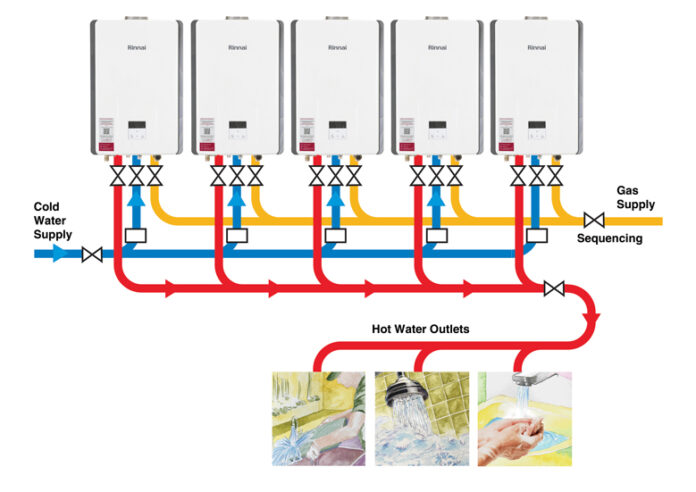
A hybrid (or dual fuel) heating system combines both a high efficiency continuous flow water heater or a hydrogen blend ready 20% water heater with a renewable heating system such as a heat pump or a Solar Thermal arrangement. 

Widespread use of hybrid heating and hot water systems are increasingly relevant to the heating industry as the UK Government aims to reduce national reliance on fossil fuels. A hybrid system can meet all objectives in terms of being practical, economical and technically feasible. 

A hybrid system would be an ideal option for projects looking to replace or upgrade their hot water system with a more energy efficient and cleaner solution. A hybrid system provides designers, property owners and managers with the familiarity of the continuous flow water heating system and renewable energy generated by a heat pump or solar thermal array.  

Rinnaiโ€™s Hybrid solution is market leading technology owing to its ability toย conserve energy. This is achieved by each gas fired water heater reading the temperature of the preheated hot water and modulating the gas input to boost required water temperature. This means that the renewable gains are maximised and the use of natural gas or hydrogen in the future is optimised.ย For more insights on Hybrid systems visit https://www.rinnai-uk.co.uk/products/commercial/hybrid-heating-and-hot-water-2

Consultants, specifiers and contractors should seek manufacturers and suppliers with systems technology that is equipped with smart controls and adjusts performance on a constant basis in the drive to lowering carbon outputs yet retaining the need to create a healthier way of living. 

Huge CO2 emissions reduction opportunity with commercial buildings retrofit finance

Retrofit for Purpose โ€“ a new insight study from Siemens Financial Services (SFS) – assesses the volume of carbon emissions buildings owners could save through energy-efficiency-as-a-service schemes.

Specifically, the paper estimates emissions for the worldโ€™s four highest-volume emitter geographies โ€“ USA (71.35 MtCO2e), China (71.45), Europe (52.86), and India (14.91). Given these four areas are responsible for the majority of global CO2 emissions,[1] this equates to more than 8% of global annual CO2 emissions reduction targets, as defined by the International Panel on Climate Change (IPCC).

Renovating existing building stock to a zero-carbon-ready level is a key priority for achieving the sector’s decarbonization targets. However, rising inflation, hardening interest rates, increased fuel costs, and supply chain disruption are all factors negatively impacting adoption rates. The report therefore evidences the enabling role of flexible private sector financing arrangements to maintain crucial investment momentum, drawing on many real-world examples of implementation from around the globe. 

Comprehensive retrofits of commercial buildings โ€“ including offices, hospitals, factories, warehouses, and educational establishments โ€“ can reduce their energy use by up to 40 percent but are not happening anywhere near the scale needed to meet climate goals, notes the report. This is likely due to the considerable investment required to retrofit new technologies.

Thatโ€™s where arrangements known as energy-efficiency-as-a-service are helping private and public sector organizations to retrofit the existing non-residential building stock in an affordable and cash-flow friendly way. These innovative financing schemes can secure operational cost reductions without putting pressure on capital resources, avoid putting capital at risk, and ensure expected savings are realized.

At the technology component level, financing tools are available to help vendors and distributors add value with cash flow capabilities for their buyers. For larger installations or systems, smart financing arrangements can be flexed and tailored to align costs with the rate of benefit gained from the energy-efficient technology.

โ€œWith climate targets looming large, itโ€™s important we continue support and enable the decarbonization of buildings. Not only are they a serious contributor to global greenhouse gas emissions, if left unchecked these emissions are projected to double by 2050,โ€ says Toby Horne, Siemens Infrastructure Financing Partner, Siemens Financial Services, UK. โ€œSpecialist finance solutions are intelligently designed to factor in savings, making them budget-friendly enablers of the green transition.โ€

Methodology

Data from national/regional statistical institutes on annual energy consumption by non-residential buildings built prior to 2010 was used to model CO2 emissions of buildings likely to benefit from deep retrofit for energy-efficiency. This was then reduced by highest likely implementation levels of such deep retrofit. Likely energy savings from deep retrofit were calculated using the lowest end of official average ranges. The resulting figures provide a highly conservative annual estimate of the energy savings achievable through deep retrofit, which can be financed through energy-efficiency-as-a-service financing techniques.

Download a copy of the Whitepaper: www.siemens.com/smart-buildings-retrofit

Visit for further information about SFS: www.siemens.com/finance


[1] https://www.visualcapitalist.com/carbon-emissions-by-country-2022/

Digital twin technology is paving the way to net zero

Adam Aziz

Written by Adam Aziz, Analyst at DAI Magister

Digital twin technology offers a way of revolutionising our approach to energy efficiency and will be a powerful complementary force alongside developments in the physical technologies driving the energy transition. These digital replicas of physical assets and processes, built on sophisticated mathematical models, go beyond static simulations by incorporating live data and allowing highly complex systems to be evaluated in real-time. The technology allows us accelerate design, predict failure & maintenance, and optimise the performance of energy assets much more effectively than conventional methods allow โ€“ digital twins have revealed that there is some low hanging fruit in the form of easily achievable energy efficiency gains, and will play a crucial role in achieving our net zero 2050 targets.

Whatโ€™s next for digital twins in 2024?

Companies specialising in digital twin technology have attracted over $1.2bn* in funding over the past two years, with several companies securing funding rounds above the $10 million mark. Despite growing attention to the technology, the industry remains nascent, with few instances of rounds above $30 million.

With key players continuing to mature & demonstrate the impact of their technology against the backdrop of more favourable market conditions, we expect a more robust fundraising market with larger funding rounds as competitors build market share.

The companies poised to succeed in this market will be those with early commercial traction and seasoned management teams with domain expertise in their target markets. Such expertise is crucial given the complex nature of problems and solutions in play.

Energy generation and storage

Several pioneering companies are harnessing digital twin technology to revolutionise the optimisation of energy assets. The technology can be deployed throughout the entire lifecycle of an asset, enhancing design, predicting potential failures before they occur, and significantly prolonging asset longevity.

Energy transmission

Digital twin technology is also being applied to complex issues in energy transmission, tackling key challenges in energy infrastructure from network design to resilience requirements and maintenance challenges.

Harnessing the power of digital twins for a net zero future

Advances in artificial intelligence and greater access to data are key enabling factors in the development of digital twin technology, addressing a market that is expected to grow at over 40% per annum to $130 billion by 2030. As these trends continue to play out, we expect to see a substantial increase in the application of digital twin technology in the energy sector. The energy management system market alone (where digital twins are a key enabling technology) is expected to reach $60bn by 2025, driven by rising investments in renewable energy infrastructure and the growing adoption of digitalisation in the energy sector. This growth reflects the significant demand for solutions that enhance operational efficiency, reduce carbon emissions, and support sustainable energy practices.

Digital twin technology has a pivotal role to play in enabling our path to net zero by tackling the core problem, our consumption of energy, at the source. The technology can unlock efficiency gains throughout the value chain from the design of energy assets to the optimisation of energy systems in operation and life extension of critical infrastructure. The core technology is applicable to a wide range of optimisation problems and as a software solution, can easily be deployed across a broad spectrum of project sizes at minimum incremental cost โ€“ this enables asset owners and operators of all sizes to enhance the efficiency of their asset base.

Furthermore, the ability of digital twins to simulate various scenarios and predict performance outcomes allows energy companies to make informed decisions that align with sustainability goals. Whether itโ€™s optimising the performance of renewable energy assets, improving grid management, or enhancing energy storage systems, digital twin technology offers valuable tools for driving efficiency and reducing environmental impact.

This dual benefit of reducing environmental and economic burdens will continue to fuel significant market interest in the coming years, with investors keeping a close eye on companies with seasoned management teams, a proven track record of commercial success, and a clear path to scaling profitably.

In a world where water scarcity is intensifying, the UKโ€™s universities have a crucial role to play

Neil Pendle

Neil Pendle, Managing Director, Waterscan.

Universities, as major water consumers, have a substantial responsibility to minimise water usage and embrace sustainable practices. Their position at the forefront of environmental scholarship and innovation should necessitate that their own infrastructure is operated in ways that align with the research they produce. Higher education is also a sector in which the UK has a leading global reputation and represents a key part of the national economy. In this context, there are opportunities for these prestigious institutions to show environmental leadership and further enhance their standing.

Four common challenges in university water conservationย 

University campuses hold immense potential for implementing water-saving measures that can yield substantial benefits, including reduced water bills, minimized environmental impact, and a smaller carbon footprint. Yet, despite the scope for sizeable consumption reduction, universities face unique challenges in this area: 

  • Complex infrastructure: University campuses are often composed of numerous buildings, facilities, and infrastructure systems, making water usage management complex. Aging plumbing systems, multiple water sources, and decentralized decision-making can hinder coordinated water-saving efforts. 
  • Varied water needs: Water consumption patterns vary across different university departments and facilities. Science labs, medical facilities, and sports complexes typically have higher water demands due to specific activities and equipment. Student housing and dining facilities have very different consumption profiles, but still contribute considerably to overall water usage, as showers, laundry, and kitchen operations in these areas require substantial volumes of water. 
  • Funding constraints: Water conservation initiatives often require upfront investments in infrastructure upgrades, retrofits, and technology installations. Budget limitations can hinder the implementation of more extensive water management systems. 
  • Challenging stakeholders: Students are often vocal and passionate about their concerns. Sustainability and the environment are important topics to them and despite the current challenges of the economy, most don’t want to see environmental targets comprised for savings.

Improving water usage can be a significant task for any industry, but for higher education in particular, these unique challenges are often dealt with by a small team with competing priorities. As a result, water can often end up as lower priority as individuals tackle more ‘public’ issues such as savings, carbon emissions and waste. But reviewing water can actually lead to improvements in all these areas.

Develop a water management strategyย ย 

To reap these rewards, universities can develop and execute comprehensive strategies โ€“ outlining goals, targets, and action plans โ€“ and achieve sustainable water management.ย 

Five ideas for effective water managementย ย 

  1. Conduct water audits: 
    Identify departments and facilities with the highest water consumption through detailed water audits and data analysis, which can be beneficial for informing strategic targets and detecting leaks. Combining clear data with onsite knowledge can ensure that the actions taken are right for your university, as every organisation is different.
  2. Target water-saving measures:  
    Having a clear idea of consumption, helps with prioritising water-saving measures in areas with the most significant impact on overall consumption. For example: water-efficient fixtures โ€“ such as low-flow faucets, showerheads, and water-efficient toilets โ€“ reduce water usage in bathrooms and kitchens. 
  3. Explore water storage and recycling:  
    Consider greywater recycling systems, which reuse wastewater from sinks, showers, and washing machines for toilet flushing and irrigation โ€“ reducing reliance on freshwater. Attenuation not only helps to reduce flooding, but also reduces peak demand and the need for treatment. 
  4. Embrace technology: 
    Utilise smart leak detection systems and water monitoring tools to identify and address leaks promptly. This will prevent unnecessary water loss and enhance the approach to ideas one and two. Install smart irrigation systems that adjust watering schedules based on real-time weather data and soil moisture conditions. This will minimise water wasted on landscaped areas and sports fields, and recycle the stored water mentioned in idea three.
  5. Encourage behavioural changes:  
    Promote water-saving practices among students, faculty, and staff through educational campaigns, awareness programs, and incentives. 

Conclusionย 

As high-profile institutions whose students go on to play important roles in all manner of industries and professions around the world, universities can make a vital contribution to addressing the global water crisis and promoting sustainability. By implementing effective water conservation strategies, universities can not only reduce their environmental impact and lower their operational costs, but also serve as role models for sustainable practices in their local communities and beyond.

www.waterscan.com