

Reflections on public sector decarbonisation

Stephanie Parker

Comment by Stephanie Parker, Senior Advisor Decarbonisation – Complex Sites at Energy Systems Catapult.

Decarbonising the public sector estate was never going to be a quickfire success. We knew when we launched the Public Sector Decarbonisation Guidance that we’d need to reflect on what was working, what needs tweaking, and what more can be done to respond to the pain points, challenges, and successes experienced by public sector organisations, their supply chain, and leading bodies such as the Net Zero Hubs and Salix.

To further our understanding, we carried out two listening surveys and offered respondents the opportunity to speak to us directly. These surveys reached over 230 colleagues across the public sector and the supply chain, and we directly spoke with 37 respondents to gauge their views on decarbonisation on the front line. One was aimed at early users of the Public Sector Decarbonisation Guidance, the other was aimed at the wider sector.

I’ve crunched the numbers, listened to what was said, and put together my top five takeaways from the survey, giving us a brilliant temperature test on the state of public sector decarbonisation in 2024.

Public sector colleagues are passionate about tackling climate change

When we set out to do the surveys, we wanted to supplement the results with face-to-face conversations to add colour and vital information, not just for us and our programme, but also for the Department for Energy Security and Net Zero (DESNZ) who fund our work.

We had no idea how great the response would be, with over half of respondents saying they would be willing to talk to us! In the end we couldn’t speak to everyone, but I’d like to extend my personal thanks to those who offered to speak with us and to those we did speak to. The conversations were invaluable and demonstrated the passion that public sector colleagues have for decarbonisation.

To shift the dial, we need to tackle four common challenges

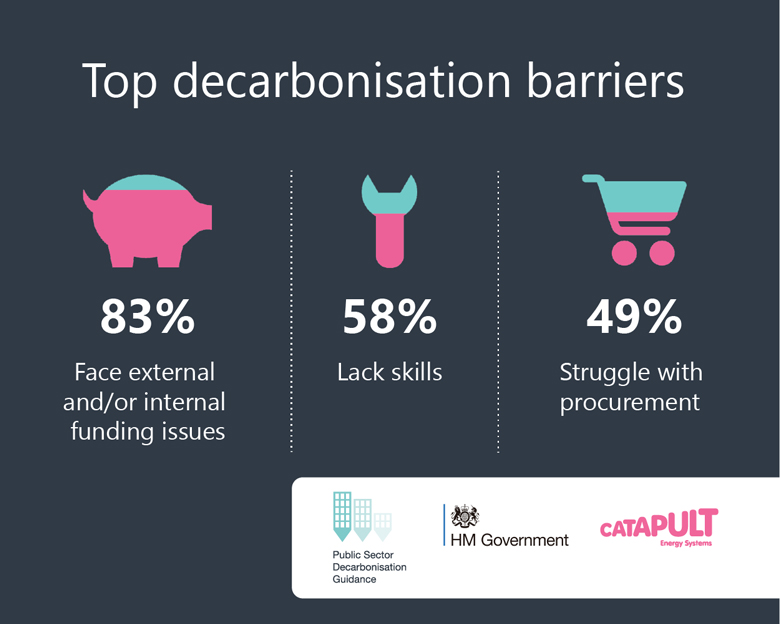
Unsurprisingly, access to funding came out on top as the most pressing challenge facing all organisation types. This common thread unites colleagues from across the public sector. However, there is more to the story and more other common threads than you might imagine. Procurement and finding the right delivery partners, the need for upskilling and moving from developing your strategy into undertaking feasibility and design studies, or ‘knowing where to start’ were flagged up most commonly by survey respondents.

Insight like this helps us to continue targeting the Public Sector Decarbonisation Guidance so that it is tackling the big issues and helps us work out who we need to partner with to shift the dial.

The need for upskilling

This is the topic where the discussions with survey respondents were so valuable, and a few issues rose consistently to the top. Colleagues are struggling to get buy in and sign off for decarbonisation projects and felt they needed upskilling to enable them to convincingly make the case for decarbonisation to senior decision makers. We are writing new guidance to address this, watch this space! It covers the common types of decarbonisation projects, their benefits and considerations and support to help you influence across your organisation, as well as tips to help you gain sign off.

Colleagues also felt that engaging with the supply chain was challenging. In particular, making sure they had the skills and knowledge needed to write clear tender documents for support or solutions they needed. Additionally, they felt they lacked the technical skills needed to be able to challenge solutions and options presented by consultants and others in the supply chain. We are prioritising work in this area too!

Decarbonising complex public sector buildings is really hard

The conversations with respondents brought to life the challenges of making decarbonisation happen at scale and pace. Longstanding challenges such as the age and condition of the estate, complex stakeholder relationships to manage, the sheer variety of public sector buildings, and the vital services that are delivered from them day in day out and often 24/7 all make prioritisation, and then delivery of, decarbonisation projects a huge challenge.

Now more than ever we need bold strategies, backed up with ambitious projects led by enthusiastic, skilled people. Hats off to those already making it happen on the ground.

Public Sector Decarbonisation Guidance is shaping the pursuit of Net Zero

Here at the Catapult, we try to be as user-focused as possible and produce impactful material that drives the UK towards Net Zero. It’s still nerve wracking when you directly ask for feedback! Thankfully, we seem to be doing the right things. 93% of early users who had used our guidance said they would recommend it to their peers, 86% said the resources couldn’t be improved and 84% said that they had made progress thanks to the guidance.

If this prompts your thoughts, or if you have feedback on how we can improve our Guidance further, please email: psdecarbguidance@es.catapult.org.uk

If you would like more tailored support combined with local knowledge, contact your relevant Net Zero Hub, visit their websites:

For more information, check out the Public Sector Decarbonisation Guidance: https://es.catapult.org.uk/tools-and-labs/public-sector-decarbonisation-guidance/
This article appeared in the .

Buying and Using Utilities Live, MEUC’s Spring Conference and Exhibition

Empowering Your Utility Management Journey

In today’s rapidly evolving landscape of energy and water management, staying ahead requires not just adaptation, but proactive engagement with the latest innovations and strategies. Fortunately, MEUC’s Buying and Using Utilities Live event, taking place on Thursday, April 25, 2024, at the prestigious IET Savoy Place in London, offers a unique opportunity to do just that.

This premier event, part of the esteemed “Buying and Using Utilities Live” series, promises attendees a deep dive into the cutting-edge developments shaping utility management. From insightful presentations to invaluable networking opportunities, here’s why you shouldn’t miss out on this empowering experience.

Insightful Content: With a lineup of industry leaders and policy experts, MEUC’s event offers a comprehensive exploration of the future of energy and water management. From discussions on achieving a 100% renewable future to insights into carbon reporting best practices, attendees will gain invaluable knowledge to steer their utility management strategies toward success.

Networking Opportunities: Connect with peers, experts, and solution providers to exchange experiences and forge collaborations. MEUC’s event provides a fertile ground for sharing ideas, exploring partnerships, and uncovering new opportunities in the realm of utility management.

Actionable Strategies: Leave equipped with practical tools and knowledge to enhance your utility management approach. Whether it’s optimising energy procurement in volatile markets or leveraging emerging technologies for sustainable energy and water management, MEUC’s event ensures attendees walk away with actionable insights ready for implementation.

The event’s agenda is packed with thought-provoking sessions featuring industry veterans and sustainability champions. From discussions on green hydrogen and renewable energy growth to navigating energy markets in times of uncertainty, each session promises to deliver invaluable insights and strategies.

Session titles:

  • The Future of Energy: Navigating a Net-Zero World
  • Embracing the Green Transition: Charting the course for a 100% renewable future.
  • Carbon Reporting: Best Practices and Compliance
  • From Reporting to Real Impact: Driving Transparency and Action in Carbon Reduction Initiatives
  • Effective Energy Procurement in Volatile Markets
  • Stability in the Storm: Navigating Energy Markets in Times of Political and Economic Uncertainty
  • Emerging Technologies in Energy and Water Management

Moreover, MEUC’s exhibition features companies providing supply, procurement, and management expertise and services. With a curated list of supporters, attendees will have access to a wealth of resources to support their utility management endeavours.

Don’t miss out on this opportunity to empower your utility management journey. Register now to secure your place and take the next step toward shaping a sustainable and efficient future in energy and water management. Join us on April 25 at the IET Savoy Place in London, and be part of the conversation driving innovation and progress in utility management. Invest in your future today.

Register now https://meucnetwork.co.uk/events/spring-conf24/?ueid=34r13yuj

This article appeared in the .

Europe’s Most Efficient Distribution Transformer

The European Commission estimates that 2.9% of all energy generated across EU27 and the UK is wasted through transformer losses. This amounts to 93TWh which is equivalent to the electricity consumed in Denmark over three years.

Network losses account for 1.5% of the UK’s greenhouse gas (GHG) emissions. 25% of these emissions are caused by distribution transformer losses. Due to the inefficiencies of old transformer designs and the level of losses associated with them, Ecodesign regulations were launched to minimise the energy waste of transformers.

Ecodesign Regulations for Transformer Losses

EU Commission Regulation (EU) No 548/20141 and Amendment (EU) 2019/17832, which were then adopted by the UK, introduced requirements for Load and No-Load Losses for distribution and power transformers placed in the market or put into service within the region. Tier 1 came into effect in 2015 and Tier 2 followed in 2021 with stricter energy loss requirements ensuring that transformers installed on the network are built with efficiency in mind.

Wilson Power Solutions, a transformer manufacturer based in Leeds, launched Europe’s most energy-efficient distribution transformer last month. Wilson e4 Ultimate Low Loss Amorphous® Transformer is a breakthrough in transformer efficiency introducing 27% lower combined losses than Ecodesign Tier 2.

Table 1: No Load Loss (NLL), Load Loss (LL) pre Ecodesign regulation, as per the regulation and Wilson e4 Ultimate Low Loss Amorphous® Transformer

All new transformer installations in the UK have had to follow Ecodesign Tier 2 standards since July 2021. Upgrading to the Ultimate Low Loss transformer incurs additional CAPEX investment but that is offset in a two-year payback period based on a 70% load factor and £0.25/kWh. Payback calculations are recommended and there are many online tools to help organisations look at the full lifetime costs of owning that transformer. The paybacks are generally more favourable with transformers that are highly loaded or with organisations that pay more electricity tariff than others.

Amorphous Metals Explained

The traditional transformer core technology consists of stacks of laminations that are made from silicon steel with an almost uniform crystalline structure, referred to as Cold Rolled Grain Oriented Silicon Steel (CRGO). CRGO transformers have reached their full potential making it difficult to further reduce the losses without incurring significantly higher costs.

Amorphous metals are made of alloys that have a random molecular structure caused by the rapid cooling of molten metals that prevents crystallisation and leaves a vitrified structure in the form of thin strips. Due to the random molecular structure, friction is reduced in the magnetisation demagnetisations of the core resulting in less heat dissipation which boosts the transformer’s overall efficiency.

Transformer Losses

Energy waste through transformers is mainly split into two main types: Load Losses and No-Load Losses. It is pertinent to address both to improve the efficiency of the transformer. Load Losses are sometimes referred to as winding losses and are a result of the load on the transformer. These losses depend on the current flow through the transformer windings and occur due to their resistance. No-Load Losses are dependent on the core material, and they are present 24/7 from the moment of energisation regardless of the load.

Due to the random molecular structure of Amorphous metal core, there is less friction during the magnetisation and demagnetisation resulting in less energy waste in the form of heat. This results in less hysteresis losses in the transformer.

The resistivity of the core is proportionate to the square of the thickness of its laminations. The strip thickness of Amorphous laminations is 0.025mm (10 times less than CRGO) and has a 0.32g/cm3 lower density compared to conventional CRGO. This results in less Eddy Current Losses which are caused by the induced currents of the transformer core due to alternating magnetic fields.

Untapped Decarbonisation Potential

Through a Freedom of Information request we submitted to Ofgem, we found out that the average age of a distribution transformer in the UK is 63 years old. Despite durable design capabilities allowing transformers to live much longer than anticipated, older designs paid no regard to efficiency. Conventionally, the older the transformer, the more energy it wastes.

Looking at the Life Cycle Assessment (LCA), on average, 95% of carbon is emitted during the operational and maintenance phase of the transformer. Hence, the energy efficiency of the transformer design is paramount to decarbonisation. And this means old transformer assets have a significant role to play through upgrading and replacement programs.

When conducting a life cycle cost analysis associated with replacing old transformers, it is important to understand that the benefit goes beyond the financial feasibility extending to carbon reduction and reliability advantages. The table below shows the potential energy, carbon, and financial savings from replacing old transformers with Wilson e4 Ultimate Low Loss Amorphous® Transformer.

Table 2: Energy, carbon, and financial savings of replacing old transformer with Wilson e4 (combined losses of 6070W). Based on a 1000kVA transformer, 70% load factor and 25p/kWh.
Ayah Alfawaris

Website: www.Wilsonpowersolutions.co.uk

Author: Ayah Alfawaris, Head of Group Sustainability & Marketing

This article appeared as the cover story in the .

Retrofit battery storage solutions from Ecobat Battery

The production and storage of energy, particularly electrical energy, is of increasing concern to both building developers and environmentally conscious home owners, but how is it best achieved?

Despite the often windy conditions and comparative lack of sunshine compared to our southern European neighbours, in the majority of locations, solar remains the most practical solution for harvesting electrical energy and with the ongoing technical development that increases the efficiency of every new panel being brought to market, it becomes an increasingly attractive option.

However, to ensure the system is complete, the storage of the energy is equally important as its generation and thankfully, due to its specialist knowledge and diverse product portfolio, Ecobat Battery can offer an incredibly wide range of power storage solutions, to address each application.

At the forefront of power storage technology is EcoFlow, an innovative specialist that has a wide range of products that offer an alternative power storage solution to a traditional battery.

In the domestic new build/renovation environment, the EcoFlow PowerOcean DC Fit is a persuasive option as it sits between the solar panels and an existing inverter. This is made possible by its unique coupling technology and means that it can be seamlessly installed without any extra certification and instantly add a power storage capacity to the home, maximising the efficiency of the user’s existing solar system, which can be called upon for instant power, stored for later use or sale back into the national grid.

The PowerOcean DC Fit is a modular system available with one, two or three advanced 5kWh LFP battery packs, each of which has an 800V high voltage battery to independently start both single-phase or three-phase solar inverters. With trusted LFP battery chemistry from CATL and a comprehensive range of active and passive safety measures, it delivers unrivalled battery reliability and performance

Utilising EcoFlow’s pioneering self-adaptive control algorithm, the PowerOcean DC Fit solution also smartly mitigates the risk of oscillation between the solar coupled battery system and the third party solar inverter, with up to 15kW solar input bypass power per string.

In addition, unlike many other battery solutions on the market, the PowerOcean DC Fit connects its batteries directly to solar ports, and as there is no need to replace the existing solar inverter or change the wiring on the AC side, the entire system is unparalleled in its ease of installation.

As well as being quick to install, it can be located inside or outside and features Smart monitoring via a web portal or an App, has an integrated battery management system, is equipped with an auto heat module to ensure efficient winter operation and has fire suppression built in.

In short, for installation in applications that produce solar energy for domestic consumption and sale to the national grid, the EcoFlow PowerOcean DC Fit is a truly great solution as it enables the effective and efficient storage of excess energy that can be used either for resale or for periods when solar production is not possible.

Further information can be found at: https://www.ecobatbattery.com/ecoflow-power-ocean-dc-fit/

This article appeared in the .

Delays, uncertainty and a looming general election burden all strands of UK energy market

Chris Goggin

Chris Goggin looks at the current state play in the UK energy, heating and hot water provision marketplace

Commercial heating and hot water provision sectors currently exist in a state of uncertainty in relation to customer costs, outside investment, future direction and implementation of national legislation that encourages decarbonisation. Further turbulence will be exacerbated by the certainty of a UK general election and a possible change of government which could signal a redrafting of national energy policy.

Over a year the current UK government and opposition parties have reneged on several ecological pledges and appears to have lost momentum in implementing national decarbonisation. Shifts in policy has resulted in creating confusion for investors inside the UK energy market. And, in the meantime, life goes on as the population still requires heating and hot water provision, through new build and replacement. UK national energy acquisition, property regulations and UK gas boiler manufacture are areas of the UK energy market that have experienced recent reversals in terms of active or in-coming legislation.

One of the UK’s biggest insurance company’s – Aviva – was quoted in The Times as saying: “the government increasingly focuses on short-term energy security over long-term sustainability.”   

As European and American big business have embraced large renewable projects, UK political indecision, ever rising global energy costs and the question of supply security has led to a lack of investment within large scale UK renewable projects. Also published in the same Times article as above, Aviva believe that “the recent dilution in government net zero targets is an even bigger challenge and creates uncertainty.”

The Energy Transition Readiness Index 2023 is a measurement of a regions ability to transition towards NetZero. It is a report compiled for potential investors to evaluate a country’s viability towards profiteering from renewable electricity. The latest report   believes that investors will only be attracted towards UK projects if they can observe clear and succinct governance as well as regulatory stability. Presently there is not enough evidence of either to entice outside capital investment.

The UK government has had to offer £800 million to support new offshore wind farms as the amount of capital incentives offered in the previous round of CfD offshore wind auctions failed to attract a single bid. 

Concurrent with this is the MEES situation. These are regulations which ensure that all buildings are in ownership of an EPC (Energy Performance Certificate) with an “E” as its lowest rating. Further amendments drafted in 2021 aimed for Minimum Energy Efficiency Standards to be raised to “D” in 2025 and “C” in 2030.

This would have meant that landlords who privately own and rent property across the UK would have had to legally meet energy efficiency standards to continue renting to customers.

However, the UK government has scrapped these plans as implementation would have meant extra costs to both landlord and property rental customer. A redrafting of MEES regulations is expected and will likely impose clean energy standards on rented property.

Also, there is the ‘ban’ on gas boilers being installed at off-grid sites has been lengthened from 2026 to 2035. The “boiler tax” has also been delayed. This proposed tax system would have been imposed on gas boiler manufacturers that failed to substitute several percentage points of boiler sales for heat pump sales, resulting in a £3,000 fine for each missed installation.

A potential new government later this year could also introduce further change to the UK energy market by way of a new direction in policy and cost. As one observer said about the current parlous state of play in the UK now as being akin to ‘all the runners are lined up for a sprint start to a very quick finish line’.

Specifiers, contractors, installers and UK property owners should seek manufacturers of hot water and heating products that can offer a wide range of appliances in the variety of energy vectors to produce low carbon solutions for all residential, industrial and commercial properties. It is likely that the UK will hold on to natural gas for the moment whilst purposely manoeuvring different energies and production into play on a mass scale – be they wind, solar, DME, BioLPG.

 www.rinnaiuk.com

This article appeared in the .

New modular Water-to-Water Heat Pump design increases system flexibility and performance.

Copyright Picture: Daikin Europe

Daikin has announced the release of a new range of environmentally friendly R-32 Water-to-Water heat pumps and Condenserless chillers with Daikin design scroll compressors.  

Available from April 2024, the new EW*T~Q-X*A1 range will feature a new modular approach to system design, which introduces additional flexibility in configuration. Breaking away from the more traditional ‘package’ solution, the modular approach allows the required capacity to be reached by combining smaller units piped together and controlled as a single entity while optimising the system footprint. Modular construction offers significant additional benefits in placement and installation, making units easier to transport, handle and position with the added advantage of allowing a full Plug & Play solution when including the Daikin Manifold Kit and Pump Module to a system.

Extensive application flexibility

The new EW(W/H)T~Q-X*A1 heat pump versions can ensure heating or cooling operation under many different conditions. Hot water can be produced up to +60°C; whilst chilled water is supplied in the range from -15°C (water-glycol mixture) to +30 °C evaporator leaving water temperature.

Consequently, the range of applications that can be covered is wide and includes comfort heating, space and process cooling, and heat recovery.

Composed of three base modules offering 100, 125 and 160 kW capacities respectively, the range features Daikin DOL scroll compressors and is available in two sound versions including a reduced sound variant which is suitable for noise-sensitive indoor/outdoor installations associated with residential, hotel and hospital applications.

Unit configurations by type include:

  • EWWT~G- Water-to-Water Heat Pump with inversion on water side
  • EWHT~Q- Water-to-Water Heat Pump with inversion on refrigerant side (100 kW only)
  • EWLT~Q-  Condenserless Chiller (Requiring third party heat rejection)

The benefits of modularity

Scalability

Thanks to its modularity, the new EW*T~Q-X*A1 offers the potential for scalability, reducing initial investment costs while opening up the possibility for future expansion with additional modules installed as building occupancy increases. The introduction of a common scroll layout ensures greater compatibility, helping to promote system longevity and making future system upgrades less complicated. The modules can be combined as a side-by-side array or stacked to minimise space requirements, especially useful for retrofit applications.

Compactness

The main module is very compact and can be easily transported and positioned within the installation space. A single module has a footprint of 120 cm wide, 130 cm deep and 100 cm high, allowing for easy handling with a forklift without the need for unloading with a crane, as would often be the case when using a traditional large capacity package solution.

Plug & play installation

Installation can be further simplified by employing the Daikin Manifold Kit, designed to simplify the process of connecting the water side piping of modules together.  Each manifold is equipped as standard with manual isolation valves for all connections, permitting the exclusion of each module from the hydronic system in case of maintenance without the need to isolate the entire network.

Moreover, a dedicated Pump Module equipped with inverter pumps can easily be added to an array of modules for full flexibility.  This module includes an expansion tank compatible with a volume of 18 litres.

Additional options and Accessories offered with this new range include the possibility for single power supply and addition of items such as Daikin on-site Remote Monitoring, Power Factor Correction, Variable Primary Flow, and much more.

The EW*T~Q-X*A1 unit controller comprises a numerical display and is supplied with an intuitive interface which allows the user to configure, operate and service the unit with ease.  Master/Slave sequencing up to four units and Modbus RTU MSTP connectivity are supplied as Standard.  Inclusion of EKCBMS accessory allows for Modbus TCP, BACnet MSTP/IP external BMS communication.

Lower operating costs

Thanks to its modular design, the new EW*T~Q-X*A1 can closely follow the cooling and heating load profile of the building. This is particularly relevant, as it ensures low operating costs of the HVAC plant at part load conditions, which is a typical characteristic of comfort applications. The same is not true for traditional package chillers, as in part load conditions the package chiller cannot deliver the required load according to EN14825. This means that the chiller would have to perform a series of on-off cycles, introducing inefficiency in the operation.

Delivering outstanding energy performance with limited environmental impact

Daikin is committed to continuous design improvement aimed at reducing the environmental impact of its cooling, heating and refrigeration solutions. Daikin BLUEVOLUTION chillers use R-32 refrigerant, which has a Global Warming Potential (GWP) of 675, just one-third of R-410A. This, in conjunction with high-energy efficiency, has the potential to reduce a building’s carbon footprint substantially. The reduction in required refrigerant charge enabled by the use of R-32 offers further efficiencies while reducing installation and service costs.

Read more on www.daikin.eu and www.daikin.com

Copyright pictures: Daikin Europe

Toshiba Carrier UK Launches Embedded Building Management Solution

Toshiba Carrier UK has introduced its Interactive Intelligence II embedded Building Management Solution (BMS) – a powerful web-based solution providing centralised control and monitoring of systems and equipment. Toshiba Carrier UK Ltd (TCUK) is part of Carrier Global Corporation (NYSE: CARR), global leader in intelligent climate and energy solutions.

The updated embedded solution controls and monitors all aspects of an air conditioning system and is installed in a customer’s premises, enabling systems to be optimised for occupant comfort and energy efficiency. Built on a web-based platform using the controller supports the latest web-browsing technologies, it also allows communication to other standard BMS protocols, ensuring seamless accessibility for both Toshiba and third-party systems, without the need for additional and expensive gateways or dedicated PCs.

“Building Management Systems are traditionally based on dedicated PC-type hardware platforms that operate with specific communications protocols, which can limit their range of application,” said Fraser Hymas, Toshiba Carrier UK’s Controls System Manager. “Toshiba’s new embedded controller uses a web-based platform that is compatible with all standard protocols, enabling it to be used with all types of equipment, regardless of make.”

He added: “As well as being highly flexible, the new embedded system is much more cost-effective than a conventional dedicated hardware BMS, which opens the way to widespread use of powerful BMS control and monitoring across all building types and sizes, offering state-of-the-art control and monitoring functions previously only cost effective for large buildings and users.”

Fully enclosed in a DIN rail mountable enclosure this offers many options for fixing in different locations. The new solution eliminates the need for a dedicated PC and additional gateways, providing a compact and efficient one-box solution as it is fully networkable. The device can be programmed to support up to 128 indoor units, which can be further expanded by utilising additional modules, enabling this cost-effective and versatile BMS to be used on small, medium and large projects.

The new powerful control system offers the ultimate in flexibility by being fully compatible with Modbus, BACnet, Analogue and Digital I/O, and can seamlessly control and monitor Toshiba’s range of air conditioning systems, such as the high performance R32 VRF System (SHRM Advance), as well as other third-party equipment.

Graphic displays are fully customisable, enabling a high level of creativity in the way data is presented, allowing users to tailor the interface to their unique preferences and requirements. The web-based solution facilitates remote access, enabling users to monitor and control the system via the internet.

For more information, visit www.toshiba-aircon.co.uk/.

Authorising Engineer (Water) – Friend or Foe, Part 2

Roy Sullivan

In part one of this series, Roy Sullivan of The Water Hygiene Centre discussed some examples of how an Authorising Engineer for Water Systems, AE(W), may be called upon by the organisations they are appointed by and how the AE(W) ultimately can help improve levels of compliance within organisations.

Here in Part 2 he discusses how an Authorising Engineer (Water) may assist the organisations they serve.

Authorising Engineer (AEW) as a Friend: One definition of the word “friend” taken from the Oxford English Dictionary is “a person who is not an enemy or who is on the same side”. 

As an AE(W), our goal of “maintaining a safe service” is the same as the organisations we support, and we are therefore “on the same side”.

“a person who is not an enemy or who is on the same side”. 

Source: Oxford English Dictionary

 Authorising Engineer (Water) Support

The support provided by an AE(W) will come in the form of both quick fixes and long-term support.  This will be in the form of helping to deliver policy & procedures, annual Water Safety Audits, active participation in Water Safety Group meetings, Legionella training, incident investigation, review of Legionella risk assessments, Water Safety Plans & procedures, appraisal of individuals before their appointment to RP/AP, and Projects Design Review for projects.

One example of this invaluable support is something that we have experienced with many organisations. This could be almost any healthcare organisation. The scenario goes like this:

The organisation has a ‘Water Safety Plan’, comprising of safe water policy & procedures, up-to-date Legionella risk assessments, schematic drawings, and a scheme of control measures that have been implemented across all of their sites. The scheme appears to be effective at all sites except one. One site repeatedly tests positive for Legionella bacteria despite the usual remedial actions and best intentions.

As the Authorising Engineer (Water) we would want to support our client in finding the root cause and advise on the appropriate action to take. This would typically involve a site visit, an inspection of the water system, and a review of recent monitoring records for that particular system. Often these are things that bacterial and engineering risk assessments should have picked up but, for whatever reason, have not. This may include a review of the current risk assessment as a result of finding evidence that the control scheme is not effective. We’re often told that the AE(W) should not undertake risk assessments, but it is the AE(W) who has the necessary skills and experience to review and unravel the evidence when the standard precautions are ineffective.

Problems with Legionella bacteria colonising water systems have a root cause, if you don’t know what it is, it probably means you haven’t found it yet. Investigations prompted by the Authorising Engineer (Water) will often uncover faults such as:

  • Poor temperature control,
  • Inadequate circulation in hot water return pipework,
  • Poor flow rates, 
  • TMV faults,
  • Previously unidentified dead-legs,
  • Infrequent use, hidden components such as flexible hoses, partially closed valves etc.

Sometimes speaking to local staff raises questions about system performance, usage patterns, or potential sources of contamination. Human error often plays a part as actual investigations have discovered:

One of a pair of calorifiers was found to be operating below the target temperature of 60°C due to a failed primary heating system. The other calorifier was compensating for the failure and inadequate monitoring did not detect the temperature deficit leading to water at an incorrect temperature entering the distribution system.

Extensive and obvious dead-end pipework was found in an office meeting room that had been overlooked by the risk assessor. The block was formerly a ward, and the meeting room was once the bathroom – highlighting the need for risk assessors to consider the history of the building and adapt their survey accordingly.

Flexible hoses were discovered behind IPS panels in a refurbished ward area. On review the hoses had been identified in the previous legionella risk assessment but, contrary to the recommended actions, had not been removed. Managers should ensure that there are processes in place to check that work has been completed satisfactorily and not rely only on computer read-outs.

In another case, water samples destined for Legionella analysis took up to 7 days to be delivered to the laboratory despite guidelines stating that samples preferably should be delivered to the laboratory within 24 hours and that analysis should commence within a maximum of 72 hours. The outcome of any delay was unreliable results and wasted resources.

In these troublesome and often complex instances, the experience of the Authorising Engineer (Water) combined with the Authorised Person’s knowledge of the site is a powerful force, but even then, it is often the plumber, estates engineer, or the cleaner- the eyes and ears on the ground, who hold the key to uncovering the fault.

There is sometimes tension or mistrust between trades staff and their managers, as an Authorising Engineer (Water) it can help not to take sides and befriend everyone….. but perhaps trust no one entirely! If there’s one thing this shows, it’s that as an AE(W) we often come against poor communication within the organisations we serve.

Authorising Engineer (Water) as a Foe

For all the ways that we aim to help our colleagues, sometimes it may be necessary to lock horns. This can happen in a variety of ways but here are some examples:

  • Sometimes it is necessary for an Authorising Engineer (Water) to tell clients home truths about the performance of the service;
  • Records are not good enough;
  • Candidate not suitable for the role of Authorised Person;
  • Maybe the DP is ignoring or playing down the risks when communicating to the board;
  • A letter of escalation may be issued, highlighting the areas of concern and suggested actions to rectify.

An Authorising Engineer (Water) can be the bearer of bad news:

  • Poor audit report;
  • Sample results show system is colonised;
  • System is beyond repair;
  • Missing Water Safety Records;
  • Expensive actions required;
  • In extreme circumstances an AE (W) may be called upon to be a whistle-blower when organisations are failing.
  • Everyone has heard the story of the Emperor’s new clothes… An AE (W) intends to act as a friend and although “friends don’t like to tell” it is sometimes only a true friend who will explain harsh realities. When these circumstances occur, it can be a “bitter pill” and may result in a tense relationship until the situation is fully explained.

In another scenario, an Authorising Engineer (Water) could be considered an enemy if they are not acting impartially, for example when the AE(W) has a vested interest in up-selling services that are not included in their role.

As Authorising Engineers we have a duty and personal and corporate standards to uphold that comes with the role to provide an informed view of compliance within the organisation. Professionally, that view must be impartial and accurate to the extent that it won’t always go down well with our friends.

The work of an AE (W) can help clients avoid long-term problems, but it sometimes creates difficulties for individuals & teams in the short term. To help minimise these events AEs should:

  • Engage with as many stakeholders as possible through the Water Safety Group and other opportunities;
  • Encourage self-sufficiency in their clients – don’t make yourself indispensable for the wrong reasons.

The AE (W), regardless of discipline, is there to support as a ‘friend’ but may be considered a ‘foe’ by some if they don’t like the message you deliver.

SSE Energy Solutions explores sustainable heat project with University of Warwick

SSE Energy Solutions has announced that it is exploring the feasibility of supplying the University of Warwick with low-carbon sustainable heat from a shallow geothermal ground source.

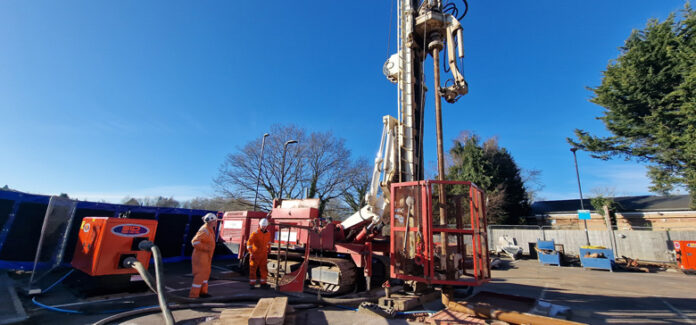
SSE is coordinating a programme to drill test boreholes at two different locations on campus and is carrying out various tests throughout the process to validate the feasibility of a scheme that will use ground source heat pumps to provide sustainable heat.

If these tests prove successful, sub-surface ground water with all-year-round consistent temperature could supply two energy-efficient ground source heat pump energy centres for both the University’s existing heat network and new developments on campus.

The project involves tapping into the earth’s natural thermal energy, a completely renewable and green energy source, at depths of up to 350 metres. This could help the University of Warwick achieve its 2030 net zero target by reducing the natural gas currently burned to provide heat.

As part of the study, SSE Energy Solutions is working with the University of Warwick to establish the best low-carbon solution, through technology selection and a phased, modular approach.

In managing this feasibility project, SSE Energy Solutions hopes the eventual outputs could be replicable across other UK campuses if successful, helping the higher education sector to decarbonise more affordably.

Jody Pittaway, Sector Director for Heat Networks, SSE Energy Solutions said:

“We have developed strong expertise in the long-term operation of large-scale open-loop heat pumps in the UK, and we are pleased to bring that expertise to our current feasibility study with the University of Warwick. These initial tests are a first step on the road to heat decarbonisation. They will give the university essential information to facilitate the energy centre design and help to deliver the University’s 2030 decarbonisation goals.”

Avi Baidya, Client & Business Development lead for the University sector, SSE Energy Solutions said:

“As an alumnus of Warwick University, I’m thrilled with the University’s ongoing commitment to innovation, sustainability, and decarbonisation. This is perfectly matched by SSE Energy Solutions’ own objectives to drive decarbonisation and promote positive change in the higher education sector across the UK.”

Parvez Islam, Director of Environmental Sustainability and Infrastructure at the University of Warwick, said:

“The University of Warwick has an ambitious 10-year programme which will see a mix of new buildings, refurbishment of existing buildings and major facilities, and infrastructure upgrades. Our ambition is for these world-class facilities to be connected to a new innovative energy system, supplied by sustainable, low carbon heat.

“The University’s ‘ makes a commitment to five goals. We aim to meet Net Zero Scope 1+2 emissions by 2030, Net Zero Scope 3 emissions by 2030, achieve Biodiversity Net Gain, embed sustainability into the curriculum, and progress the UN Sustainable Development Goals through research.

“We are delivering our strategy through the pathways of Research, Education, Operations and Engagement. The current ground source heat investigations are a key part of achieving our 2030 net zero target.”

What’s holding back hydrogen?

Making green hydrogen viable requires a global effort

Despite a constantly growing list of hydrogen-fueled projects across the energy, manufacturing and automotive sectors, the molecule’s potential seems to be lagging. According to the International Energy Agency, despite its green credentials, there’s a distinct lack of financial support from governments and other investors. Here, Mike Torbitt, managing director of resistor manufacturer Cressall, explores the reasons for hydrogen’s stalled rollout and how resistor technologies can lead to greater progress.

Hydrogen has long held a special promise, having been touted as a game-changer across various industries. Renewable hydrogen has the potential to decarbonise energy consumption in line with Net Zero targets, particularly for hard-to-abate sectors to enable a clean and resilient energy system. Yet, despite a surge in hydrogen projects, its full potential remains largely untapped.

Hydrogen’s hurdles

Hydrogen boasts abundant clean energy potential. Its deployment is at a crossroads — there is a growing and gradually maturing pipeline of projects and supportive decarbonisation regulations, but there is also a number of hurdles. There are over 1,400 hydrogen projects underway, which will produce 45 million tons of clean hydrogen a year by 2030, according to the Hydrogen Council’s December 2023 update.

In recent years, the potential of hydrogen in achieving Net Zero has captured the attention of policy makers and industry players around the world. But for it to be clean, it’s important to consider which type of hydrogen is in use. Across global hydrogen production, 900 megatonnes of CO2 are emitted each year — roughly the same quantity of emissions produced by the UK and Indonesia combined according to the Carbon Trust.

To shift the hydrogen industry to purely renewable production methods, it must make it ‘green’ by using electricity generated from renewable sources. Instead of using natural gas or coal to produce hydrogen, electrolysis powered by renewable energy sources is used to split hydrogen out from water molecules. Less than one per cent of current global hydrogen is made in this way, but — to reach net zero — 37.5 per cent of hydrogen must be produced using this method by 2030.

Despite its environmental perks, transitioning to hydrogen demands hefty investments in infrastructure and research and development. But governments and investors have been hesitant, citing concerns over cost-effectiveness and tech readiness. Costs have significantly risen, due to rises in labour and material costs and the increased cost of renewable power.

Making hydrogen green at-scale

It’s clear these hurdles must be overcome to enable a decarbonised energy system. However, further issues arise when you consider how to scale up green hydrogen production to a point where it can meet its potential demand.

Producing green hydrogen requires a widespread renewable grid. Taking advantage of areas that are located further away from the grid — and therefore hydrogen power stations — requires a certain level of planning and a robust method of transmitting renewable energy.

Some green hydrogen power stations are located right next to the renewable source — think SSE Renewables’ Gordonbush Wind Farm, which has submitted a proposal for a co-located hydrogen facility to produce green hydrogen using wind power as its electricity source. But not all hydrogen facilities can be located next to a renewable source.  In the meantime, grey hydrogen, which is created using electricity generated from natural gas, will serve as a stopgap to fuel hydrogen’s applications.

Making automotive green

The main application of hydrogen that’s in development is to fuel hydrogen-powered vehicles using fuel cells. In the UK, there’s over £77 million of funding from both the industry and Government to fuel zero-emission vehicles, including projects such as a hydrogen-powered Ford Transit van, fire engines and ambulances.

But to make hydrogen viable for this type of application, other technologies are also necessary. Fuel cells are unable to work under heavy loads for a long time, which presents issues when a vehicle is rapidly accelerating or decelerating. Studies into fuel cell function have shown that, when an FCEV begins accelerating, the fuel cell’s power output increases gradually to a point, but then it begins to oscillate and drop despite velocity remaining consistent. This unreliable power output presents a challenge for automakers.

To mitigate reliability issues, it’s important to install a fuel cell for a higher power requirement than necessary.  For example, if a FCEV needs 100 kilowatts (kW) of power, installing a 120-kW fuel cell would ensure there is always at least the required 100 kW of power available, even if the fuel cell’s power output drops. Opting for this solution requires a DBR to remove the excess energy when not required.

Cressall’s solution is the EV2 dynamic braking resistor. It’s the most compact and lightweight solution available to the EV market, offering ten kW of power per cubic decimetre (dm3) and 9.3 kW of power per kilogram. It’s a modular solution, meaning up to five unit can be combined in a single assembly to meet power requirements of up to 125 kW.

Being water cooled, heat can be dissipated safely without the need for extra components, such as fans, as is the case with air-cooled resistors. This means that the EV2 is ten per cent of the volume and 15 per cent of the weight of a conventional DBR, lightening the load of the vehicle itself, meaning it can travel further on the same amount of fuel.

As net zero targets approach, we need to take advantage of the hope that green hydrogen offers. When green hydrogen is widely available, it will power an entirely clean transport system. While there are challenges to overcome, and it’s not a quick-fix solution, hydrogen’s sustainable credentials means it’s a source worth investing in.