
LEED Energy Modelling, Daylight Modelling & Commissioning for An Post’s Platinum Certified HQ

https://www.iesve.com

Comprising 17-storeys in total, the Exo Building in Dublin’s docklands currently stands as the city’s tallest office building. Offering panoramic views across the city, the striking near-zero energy building (NZEB) is reported to be in the top 2% of buildings in the world in terms of its sustainability, holding both a LEED Platinum certification and Building Energy Rating (BER) of A3.

As the anchor tenant of this landmark building, Ireland’s national post service, An Post, has leased 6 floors of the Exo Building for its new headquarters, taking up a total serviced floor area of 7,680m2. 

In 2022, they appointed IES to provide LEED energy and daylight modelling services to ensure high levels of energy performance in the building fit-out. To further support the project’s LEED Platinum certification, IES were also appointed as the as the Commissioning Authority (CxA), to ensure the high energy efficiency design intent is carried through into the operation of the building.

LEED Energy Modelling

To help the client attain their desired Platinum certification under the LEED v4 ID+C Commercial Interiors Development rating system, the consultants initially carried out LEED PRM energy modelling for the fit-out of the tenanted spaces. The modelling was conducted in accordance with ASHRAE 90.1 Appendix G (Performance Rating Method) 2010, using the IES Virtual Environment (VE) software

This building has a high (74.6%) window to wall ratio (WWR) and encompasses a variety of different room types and systems, all of which impact on the overall energy performance. 

A preliminary energy model was prepared for the base building as part of the LEED Core & Shell (C&S) submission, which was adapted and used to analyse the energy efficiency measures applicable for the tenant fit-out. The building incorporates a range of high energy efficiency design features, the following of which were analysed during the design process for both the base building and tenant spaces:

Base Building Scope: 

  • Building fabric thermal performance 
  • Outdoor AHU energy recovery 
  • High efficiency condensing boilers 
  • High efficiency scroll chillers 
  • Variable speed drive to secondary chilled water pumps 
  • Variable speed drive to secondary hot water pumps 

Tenant Scope:

For the tenant fit-out there was a greater focus on internal load reduction due to the limited opportunities to affect the central HVAC systems, envelope and exterior shading. 

  • Efficiency of interior lighting in tenant areas to determine further savings beyond the tenant requirement of a maximum lighting power density of 8W/m2
  • Office equipment – Energy efficient office appliances specified 
  • Supplementary Fan coil unit specific fan powers (SFPs) 
  • Water efficient fixtures and fittings 

All these features were subject to detailed investigation within the energy model to ascertain their role in meeting the client’s energy performance target. The analysis also considered the economic viability of each measure, with other factors surrounding the overall feasibility of the design being discussed with the design team, to allow the client to make informed decisions on how best to achieve their objectives.

Through this analysis, IES were able to demonstrate a combined energy cost saving of 27.3% over the ASHRAE 90.1 2010 baseline, equating to 24 EAc1 points under the LEED v4 ID+C: Commercial Interiors Development rating system.

LEED Daylight Modelling

The IES team were also asked to provide daylight modelling services, to help the project achieve the LEED v4.1 EQ Daylight credit. This requires using Climate Based Daylight Modelling (CBDM) – a dynamic approach which goes beyond basic static calculations – to determine the daylight performance of the building spaces and how this varies throughout the year. 

IES Consulting used the RadianceIES application within the VE to perform this analysis. The CBDM approach involves an annual simulation, linking location, shading and climate data, together with the building properties. The analysis considers any solar shading devices (internal or external), including any manual or automatic controls, to limit the maximum and minimum daylight entering the space. The metrics used to assess space daylight performance are Spatial Daylight Autonomy (sDA) and Annual Sunlight Exposure (ASE), which require individual simulations to be run for all regularly occupied spaces across the calendar year. 

Through their analysis, the IES consultants were able demonstrate a maximum 3 points could be achieved for the LEED v4.1 Daylight credit.

LEED Commissioning

To ensure the building’s high performance design intent carried through into operation, IES Consulting were also appointed as the LEED Commissioning Authority (CxA) and overall manager of the commissioning (Cx) process for the An Post Headquarters, in accordance with LEED ID+C v4 EA Fundamental Commissioning & Verification and EA Enhanced Commissioning Option 1.

IES was responsible for the composition and compilation of the commissioning plan and all other commissioning documentation requirements, as well as the functional performance testing (FPT) for energy-consuming systems included within the commissioning scope.

The commissioned systems included: 

HVAC Systems 

  • Fan Coil Units 
  • Air Handling Units
  • Heat Recovery Units 
  • Pumps 

Lighting and Lighting Control Sensors 

Domestic Hot Water (DHW)

  • Under sink water heaters 

Electrical Distribution

Building Management System (Sensors, Valves and Local Control Devices)

To address any issues identified during the final commissioning process, IES coordinated with various contractors to ensure the effective operation of the building systems, refining operations to meet the owner’s best interests, adjusting and/or replacing defective components, and completing all of the contractor documentation. Specific examples of issues encountered and resolved included replacing filters on the AHUs, ensuring the correct configuration of one of the A/C units which had been flagged through the BMS, and rectifying a fault with one of the extract fans.

The commissioning process is vital in ensuring a building performs in line with its design intent and any specification requirements. However, it is important that the building’s operational performance is not allowed to drift over time. While the consultants were satisfied that the commissioning process has ensured the proper installation, calibration, and training required to support the efficient running the building systems, the ongoing commissioning plan issued to the client will help to ensure that the building continues to operate efficiently over time.


The Christie Hospital takes a step closer to its net zero ambitions

The 2MW Battery Energy Storage System (BESS)

After two years in development, The Christie NHS Foundation Trust are well on their journey to net zero now the multi-technology decarbonisation scheme at The Christie Hospital has gone live.

Delivering over £1m in annual energy cost savings and reducing the site’s carbon footprint by around 1,000 tonnes a year, this is a key project in the Trust’s sustainability aspirations, and puts them a step closer towards achieving the NHS target of net zero by 2040.

The project was part funded by an £8m grant through the Public Sector Decarbonisation Scheme (PSDS) to support the installation of a self-funding fully integrated energy solution comprising a unique blend of renewable technologies.

Vital Energi have installed two air source heat pumps, 640 solar panels, which have been installed on roofs across the hospital to generate independent electricity for the site, and a 2MW battery energy storage system (BESS), where excess electricity can be stored for use at a later time.

As well as enabling the site to maximise the use of onsite generation and help the hospital avoid import electricity at the most expensive times, the BESS will provide flexibility during times of high demand and help create a smart grid from which the local community will benefit.

Energy efficiency measures have also been installed, including the upgrade of 3,000 lights to LED fittings, the replacement of aged steam infrastructure heating distribution with modern high efficiency low temperature hot water distribution, and optimisation and upgrades to the existing Building Energy Management Systems (BMS).

Alex Beedle, Head of Estates at The Christie, said:

“We are very pleased with the decarbonisation scheme. The reduction in carbon emissions is estimated to be around 10% of the total from our site and is a big step towards achieving our ambitions for net zero in accordance with NHS targets. We will also make significant savings on our energy bill year after year.”

Phil Mottershead, Project Development Director at Vital Energi, said:

“We are incredibly proud to help the Trust on their journey to net zero through the installation of low carbon technologies and futureproofed energy infrastructure at The Christie Hospital, which ensures that the Trust not only meets its sustainability goals but also operates with greater efficiency in the years to come. The Christie has been Vital Energi’s charity of choice for many years, making this project particularly close to our hearts as we support their mission to support the development of cancer prevention, treatment, research and education.”

The project was delivered through the Carbon and Energy Fund Framework (CEF), which has been specifically created to facilitate energy infrastructure projects for public sector organisations.

GMS NHS Net Zero Programme Team site visit.

Answer to UK Businesses’ Energy Woes Could Be Found For Free in Their Car Parks, Expert Says

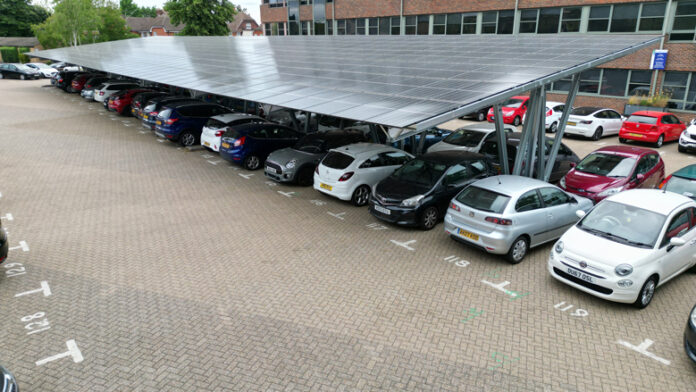
The answer to UK businesses’ energy supply and decarbonisation challenges could be found in their own car parks by installing solar carports according to new research from a renewable energy specialist.

Ongoing independent research commissioned by RenEnergy, a UK-based industry leader in renewable energy, has already found over half a million car parking spaces in the UK suitable for solar carports.

The investigation so far has uncovered the quantity of suitable parking spaces across England and Scotland in hotels, golf clubs, hospitals, airports, amusement parks, sports centres and “only scratches the surface” of the opportunity.

The organisation expects that hundreds of thousands more could be found as it continues its research across colleges, universities and sports stadiums. The project is set to uncover more across the entire UK and other commercial car parks such as train stations, service stations, supermarkets and retail parks.

Producing the same level of electricity in a year required to power the Houses of Parliament for 28 years, the ongoing research has found there is at least 1.3GW of solar that could be installed in the form of carports for businesses. Providing businesses across these sectors with energy security and a source of renewable electricity, this would also free up energy from the electricity grid equivalent to over 350,000 homes.

Avoiding complications with seeking permission from landowners or planning authorities often experienced with rooftop solar arrays, solar carports can see approval within eight weeks under permitted development with prior approval. After this, approval for the District Network Operator (DNO) to secure grid capacity and export is required, a process that providers such as RenEnergy can support businesses with.

By providing a renewable energy supply in a quick timeframe, businesses can satisfy their entire power generation needs with land they already use for car parking and sell enough energy back to the grid to pay for the investment in the process. Entering into a long-term power purchase agreement (PPA) with a provider such as RenEnergy, businesses can also have solar carports installed completely free of charge and pay only for the energy they use at a lower rate than grid electricity.

The research has been launched as high energy costs and unpredictability of energy supply continue to pose challenges to business owners across the UK. RenEnergy is highlighting the opportunity for businesses with suitable car parks to take control of their energy supply and costs through solar carports.

Damian Baker, Managing Director of RenEnergy, said: “Energy security and costs are ongoing concerns for businesses, and are likely to continue as the energy transition continues. To balance energy resilience and cost with reducing carbon emissions in line with targets, companies across the UK must look at all of the options available.

“There is untapped power waiting for many businesses in their car parks and our research has only scratched the surface of defining the solar power generation opportunity from commercial carparks. They could harness enough energy to cover their electricity needs and even sell energy back to the grid, paying for their investment in the process. Without needing to gain planning or landowner permission, harnessing the power of solar carports is truly an energy open goal for businesses in the UK.”

The installation of solar panels on car parks is already mandatory in a number of European countries, including Slovenia and France for those with more than 80 spaces. With so much energy potential from solar carports in the UK, rolling them out on British soil could be the answer to energy security concerns from government, businesses and the public.

Damian adds: “We are not taking advantage of the solar energy opportunity that is right in front of us in the UK.  If businesses are able to make use of an energy supply in their car park at no extra cost to them, we could see the equivalent energy for hundreds of thousands of homes not needing to come from the grid.”

For more information on the potential energy solar carports could provide your business, or to find out more about the research being conducted, click here.

New decarbonisation framework agreement helps public sector hit net-zero goals

Leading corporate services provider, NHS Shared Business Services (NHS SBS), has unveiled a £500m framework agreement designed to help public sector organisations – including the NHS – decarbonise their estates.

The new Decarbonisation of Estates framework agreement helps the NHS achieve its ambition of becoming the world’s first net zero national health service, reaching net zero by 2040 for the emissions the NHS controls directly.

Work covered under the agreement includes internal and external wall insulation, ground source and air source heat pumps, electric heating solutions, photovoltaic systems, ventilation systems and lighting works as well as traditional works such as replacement of windows and doors, and solutions to tackle damp and mould in domestic properties.

The framework agreement has been designed via extensive consultation with the public sector and Greener NHS leads. Importantly, it enables estates managers to create greater value by combining decarbonisation works with their backlog investment works to create cleaner, greener and more attractive estates.

Anjub Ali, Senior Category Manager at NHS SBS commented:

“With the announcement of over £1bn for public sector decarbonisation in 2024’s Budget, the Department for Energy Security and Net Zero confirmed funding for the next wave of the Public Sector Decarbonisation Scheme.

“This new framework agreement will support the delivery of the NHS’s ambition in ‘Delivering a Net Zero Health Service’ and is a response to the profound and growing threat to health posed by climate change. It is geared towards helping the NHS modernise and decarbonise aged assets and buildings throughout the public sector’s estates.”

NHS SBS’s framework agreement allows for both further competition and direct award across seven geographical regions.  Both public projects and domestic dwellings are in scope, and the framework agreement can be used by all NHS and wider public sector authorities, including local government and housing associations.

Suppliers awarded to the framework agreement include both well-known multinationals and small and medium-sized enterprises. All have been assessed on their ability to reduce the environmental impact of service delivery through the use of ground-breaking equipment, decreased energy and fuel consumption, and the monitoring of data of retrofit projects. 

For more information about the Decarbonisation of Estates framework agreement contact the NHS SBS team at: sbs.hello@nhs.net.

For more information about NHS SBS framework agreements click: Framework Agreements | NHS SBS 

EDF and Hypervolt to launch ‘virtual battery’ service using EVs to help balance the grid

EDF, the UK’s biggest generator of low carbon electricity, has announced a strategic partnership with Hypervolt, a leading EV charge-point manufacturer and software provider.

With EDF Wholesale Market Services’ PowerShift technology, the collaboration will explore leveraging the capability of Hypervolt’s UltraGrid software to enable a frequency response service from EVs, which will be a first for the industry.   Working with the National Electricity System Operator (NESO), this initiative will use Hypervolt EV chargers to support the grid at times where it is facing challenges maintaining the required frequency.

The offer aligns with proposals in NESO’s Clean Power 2030 Report that highlight the need for quicker responses to maintain a system frequency close to 50 Hz and increasing the volume of these services through frequency markets1

Using its award-winning capability, PowerShift, EDF will automatically adjust the energy usage of Hypervolt EV chargers to help balance the grid during periods of peak demand or excess renewable energy supply. By leveraging real-time grid conditions, EDF will help customers save on electricity costs, reduce their carbon footprint, and maximise the use of renewable energy sources.

Existing and future Hypervolt EV charger owners will also benefit from access to an innovative EDF tariff. The smart charging EV tariff automates smart charging for EVs and delivers EDF’s best value offer for frequent chargers.

Customers who sign up to the tariff always remain in control of their charging preferences, including the level of charge in the car and what time of day they need their EV to be charged. Charging will be managed automatically requiring no manual intervention and savings will be shown on the EDF app.

Hypervolt charger owners who are not on EDF supply can also opt in to benefit from flexibility savings through PowerShift, EDF’s virtual power plant. PowerShift unlocks the optimal flexibility value from both grid-scale and behind-the-meter assets, with the use of artificial intelligence, real-time data analytics, and sophisticated algorithms. EDF offers its multi-market flexibility trading capability to EV charge point manufacturers to capture value and reduce costs for all EV drivers.

Stuart Fenner, Wholesale Market Services Commercial Director at EDF, commented: “Our partnership with Hypervolt highlights EDF Wholesale Market Services’ commitment to integrating EV solutions into our award-winning PowerShift solution, leveraging our unique capability to create value in all available markets. We look forward to helping more customers optimise their energy usage and actively engaging in the transition towards a low carbon future.”

Flavian Alexandru, Founder and CEO of Hypervolt, added: “We are thrilled to partner with EDF to expand our innovative smart tariff offerings. Together, we aim to deliver unmatched affordability, quality, and user experience, driving forward the energy transition.”  

1 NESO Clean Power 2030 Report, p.43.  https://www.neso.energy/document/346651/download

It’s a new dawn, a new day, a new USA President – what impact on global energy?

Chris Goggin

Rinnai’s Chris Goggin looks at the potential impact of the new American President, Donald Trump, may have on international energy issues. This objective analysis on the global energy transition will cover carbon emissions, energy options and all climate issues relating to Net Zero. There is no conclusion but many questions.

The second presidency of Donald Trump could potentially impose a new direction of energy issues on America which could travel across the Atlantic towards Europe.

This article’s objective is to NOT adopt a bipartisan stance on political matters but instead aims to reflect the range of reportage carried by clean-energy focused multimedia, broadcast outlets and mainstream print as well as digital publications. Domestic and international energy distribution is a complex issue which could be further complicated by the proposed policies of the new President.

Since President Trump’s first term of presidency America has passed the Inflation Reduction Act (IRA) which is designed to reduce federal government budget deficit through investing in clean domestic energy production. The IRA ensures that tax credits are expanded for renewable projects, meaning that the potential for greater financial rewards is increased. A recent article in the Guardian newspaper has revealed that in a self-commissioned report the US (alongside India) has made the most progress in implementing climate policies since the 2016 Paris Agreement.

As a result, multiple renowned and established big businesses from across Europe, the UK and Asia have identified America as the ideal opportunity to earn large turnovers of revenue – and all have invested accordingly. Will America continue a NetZero path? Will America remain a member of the Paris Agreement?

Reverting to widespread domestic usage of fossil fuels is unlikely despite President-elect Trump selecting the CEO of oil and gas drilling technology company Liberty Energy – Christopher Wright – as the new DOE Secretary of Energy. An article published by The Guardian late last year states that solar power has been added to the American grid at 300% the rate of gas capacity throughout 2023.

The same article provides more detail that reveals the political cross-party complexity that the Inflation Reduction Act has created. President Trump is on record saying he aims to repeal IRA legislation. Doing so could jeopardize 300,000 new jobs and $150 billion in manufacturing investment – most which rests in Republican party states. 

Instead, President Trump prefers to target fossil fuel extraction and usage despite major groundwork being completed that provides America with fertile commercial conditions that encourage foreign investment.

If he cannot repeal the Inflation Reduction Act his administration is expected to reverse important Environmental Protection Agency regulations that limit emissions from power plants as well as light and heavy-duty vehicles. From the available information on the subject, he would prefer to both repeal the IRA and axe environmental regulations.

A Trump administration could also take a different route towards the path of green energy utilization. Project 2025, said to be a Republican policy platform, calls for the restructuring of federal agencies such as The Department of Energy, Department of Interior and Environmental Protection Agency. Reducing or nullifying the roles of these agencies could potentially impact funding for future clean energy projects.

A key funding program that could be cut by the Trump administration is Department of Energy Loans Programs Office which holds around $400 billion of finances. This department has provided numerous solar, nuclear and clean hydrogen projects with federal funds ensuring clean energy introduction into the American transmission grid. Project 2025 would also reportedly instruct the Interior Department to seek out further fossil fuels on American federal land.

Although US domestic renewable energy distribution could remain under Trump, America’s international commitments towards clean energy dispersal and agreed climate control measures could be scrapped. He will most likely remove America from the Paris agreement which aims to limit global warming by no more than 2 degrees Celsius from pre-industrial levels. 

Experts from the across the world believe that a Trump administration will attempt to slow the international energy transition rather than completely reversing all progress. Huge amounts of money and labour in Republican states are reliant on renewable projects and clean energy. To jeopardize jobs and investments will be politically counterproductive to an avowedly populist president.

A further 4 years of Trump politics will mean that more American fossil fuels will be in the domestic and international markets. However, there is too much clean energy infrastructure and policy in place and too many nations switching to cleaner fuels for a global reduction.  

Informing UK customers on all international energy matters is aimed at providing insight into possible energy market maneuverings and therefore a better understanding of global energy options. Rinnai hopes all information can assist the UK customer in better product and accompanying energy procurement. 

For more information on global and national energy policy sign up to the Rinnai newsletter today! https://www.rinnai-uk.co.uk/contact-us/newsletter-sign

Energy prices, clean energy availability and lack of capital revealed as top barriers to net zero, according to sustainability leaders

Image © Mitie Group plc.
  • New research from Mitie reveals that over four in five (84%) sustainability leaders feel confident businesses will be able to align with the UK’s net zero goals
  • In spite of this, price fluctuations and the reliability of renewable energy as well as securing capital for projects remain top concerns for achieving decarbonisation ambitions
  • Now in its third year, Mitie’s 2025 Net Zero Navigator report addresses these concerns with tips for navigating the path to net zero from Mitie’s energy experts and policy expert, Josh Buckland

Over four in five (84%) sustainability leaders are confident they can align with the UK Government’s ambitions to reduce carbon emissions by 68% by 2030, according to Mitie’s new ‘Net Zero Navigator’ report. Despite this confidence, the report reveals the key challenges and concerns decision makers face to stay on course for net zero.

The survey of over 100 senior sustainability leaders revealed that decision makers are concerned about how changes in the energy landscape will impact their businesses. The cost of energy was revealed to be a top concern with over half (57%) saying they worry about the cost of energy rising over the next five years, and just under two thirds (64%) concerned that prices remain unstable. Similarly, three fifths (60%) are worried supply chain disruptions will affect their organisation in the next five years.

When it comes to realising decarbonisation ambitions, over three quarters (78%) said they face difficulty securing capital to fund transformation projects such as ground source heat pumps or onsite battery storage. The availability and reliability of renewable energy sources was also cited as a top concern, with over a quarter (27%) saying that this is the biggest challenge in reducing their organisations’ reliance on fossil fuels.

Now in its third year, this year’s Net Zero Navigator, Mitie’s annual decarbonisation predictions report, helps organisations respond to the fast-evolving decarbonisation landscape. It includes insight from energy and environment policy expert, Josh Buckland, on the policy landscape for the year ahead. This includes likely outcomes at COP30 where nations will be required to present credible plans to meet the 1.5˚C degrees Paris Agreement target, and the shift to renewable energy meaning nuclear power will see a resurgence as grid infrastructure struggles to keep pace.

Buckland highlights the need for organisations to transform ambition into real impact by demonstrating the broader value of decarbonisation, such as driving technological innovation. By taking a technology-led approach, organisations will be able to balance immediate energy requirements with long-term sustainability goals.

With almost all (99%) of those surveyed saying they have already implemented ‘quick wins’ on their sustainability journeys and are now looking to tackle more difficult measures to help them accelerate towards net zero, Mitie’s energy experts also share their top tips to navigate the path to net zero:

  • Energy: Organisations that use smart data to understand their current and future energy use and work with suppliers to create a tailored energy plan will set themselves in good stead for the switch to cleaner, greener energy. Technology solutions, such as AI, can be applied to gain deeper insights into future energy strategy, factoring in typical generation from the grid as well as the weather and energy-generation patterns that might impact supply and demand.
  • Legislation: Proceeding with confidence and investing in energy infrastructure such as on-site battery storage and EV charging, will help organisations stay ahead in the midst of legislative change.
  • Estates and infrastructure: With extreme climate conditions expected to increase in frequency and severity, climate resilience for buildings should be a priority. Investing in climate resilient building upgrades as well as refining data and technology strategies to predict the resilience of supply chains will help protect organisations from climate change related extreme weather conditions.
  • Strategy: Positioning the proven benefits of ‘quick win’ solutions as part of a holistic strategy will help build the case for larger and more transformative decarbonisation projects. A move away from short-term thinking will achieve a longer-term impact on sustainability and help drive more significant investment.
  • Carbon reporting: Increasing ownership of carbon data beyond the boardroom and sustainability teams and making data more accessible and actionable will enable faster progress to net zero.

Mark Caskey, Managing Director of Projects, Mitie said:

“With a new government reigniting the drive to net zero and climate resilience becoming more urgent, we have to accelerate our progress to decarbonise.  Our report demonstrates many are still struggling to gain investment for sustainability projects – one way to address that is to integrate decarbonisation efforts into wider organisational goals. Rapid advancements in technology and AI hold the key to taking preventative action to create smarter buildings and manage our energy resources more sustainably.” 

The full Net Zero Navigator report can be found at: https://www.mitie.com/net-zero-navigator-2025/

New research confirms heat pumps are three to four times more efficient than boilers

Kensa, the UK’s leading ground source heat pump manufacturer and provider of networked heat pump solutions, welcomes new government-backed research confirming ground source heat pumps are the most efficient form of heating, and significantly more efficient than gas boilers.

The In-Situ Heat Pump Performance report, which examined heat pump performance shows:

  • Ground source heat pumps are on average 324% efficient
  • Air source heat pumps are on average 265% efficient

Today also saw the Energy System’s Catapult publish its Electrification of Heat Report, which showed that air-source heat pumps are, on average, 281% efficient. These efficiencies compare with an average 82.5% efficiency of gas boilers found by a previous government-backed in-situ study.

This new data highlights the superior efficiencies of heat pumps and demonstrates the major energy and carbon savings they offer over other heating technologies. Even with major disparities between electricity and gas prices, the efficiencies of heat pumps detailed in the reports also mean ground source heat pumps can provide notable energy bill savings when switching from gas and other traditional heating technologies.

The Electrification of Heat Report also highlights the high-performance levels of ground source heat pumps even at subzero temperatures in the depths of winter. This illustrates the important role ground source can play in managing grid capacity issues as heat pumps are installed in millions of homes across the UK.

Commenting on the findings Kensa CEO Tamsin Lishman said:

“This new research shows beyond doubt that heat pumps are the most efficient way of heating homes, three to four times more efficient than gas boilers.  As a manufacturer and installer of ground source heat pumps, it’s pleasing to see real-world data confirming the technology is the most efficient heating technology available, over 40% more efficient even than air source heat pumps.

“Importantly, the report shows ground source heat pumps perform well even when temperatures drop below zero, meaning reduced electricity demand and less pressure on the grid. This is a critical finding for how we achieve the mass roll-out of heat pumps, with millions of homes poised to switch to electrified heating.

“However, even with these efficiencies today’s energy prices still mean it’s only slightly cheaper to run a heat pump than a gas boiler in a typical British home. At a time when we need to be weening ourselves off fossil fuels, it doesn’t make sense that electricity is still four times the price of gas. It’s critical the government acts now to remove the levies artificially pushing up the price of electricity.

“Combine the continually improving efficiencies of heat pumps with lower power prices, and we’ll see the significant real-world savings consumers can make by switching to low-carbon heating. With this and ending the installation of gas boilers in new homes, the government can normalise heat pumps in UK homes and kick start the transition to clean affordable heat.”

SSE and Darlington Borough Council announce heat network partnership

Energy infrastructure expert, SSE Energy Solutions (SSE), has signed an agreement to collaborate with Darlington Borough Council (DBC) to support the development of a town-wide heat network.

While the project is in the early stages of development, SSE’s current plans include constructing an Energy Centre containing large air source heat pumps (ASHPs) which will be located in Darlington Town Centre. The collaboration could see the production of a network of connections formed between council buildings and other significant sites including, potentially, government, hospital, university and college buildings, as well as future mixed-use developments.

The Memorandum of Understanding (MoU) between the two parties sets out a joint vision for the development of a network. The agreement includes a shared ambition for SSE to apply to the Green Heat Network Fund (GHNF) in the next funding window.

DBC last year revised its target for reaching net zero across its estate, bringing it forward by a decade to 2040. The actions the council has taken so far have successfully reduced its carbon emissions by over 50% and it believes the agreement with SSE will accelerate low carbon investment in Darlington, as well as creating skilled jobs and driving local economic revival.

SSE has positioned itself at the heart of the clean energy transition with one of the largest investment programmes in the FTSE-100. Under the Net Zero Acceleration Programme Plus, the company is investing £20.5bn in green energy projects over the next five years.

According to recent government figures, heat networks are projected to meet 20% of the country’s heat demand by 2050 and are seen as a crucial component in the UK’s strategy to decarbonise heating, which currently accounts for 37% of CO2 emissions. It believes this could attract between £80-£100bn of investment into the UK.

Jody Pittaway, heat sector director at SSE Energy Solutions, said:

“The partnership we are announcing with Darlington Borough Council will support the Development process for the heat network by helping us engage with many of the potential low carbon heat offtakers within Darlington Town Centre. We have already had many promising conversations with building owners across Darlington and this agreement will help us take that engagement to the next level.

“DBC has set clear targets for decarbonisation and its economic growth agenda will only be boosted by our Social Value strategy which is designed to champion a fair and just energy transition.“

Cllr Chris McEwan, Darlington Borough Council’s cabinet member for economy, added:

“We have already made great progress towards net zero by 2040 but there is still work to be done. We are exploring the idea of a local heat network with SSE and this first step will help them bid for funding for the project.

“Local heat networks can offer many benefits to us and our central businesses and, as a council, we need to explore the options available to us. This collaboration with SSE is one such option.”

Building owners in Darlington that would like to get in touch about the potential to connect to a heat network are asked to contact Harrison.askew@sse.com

Key takeaways from ESOS Phase 3 to secure early Phase 4 compliance

Timothy Holman

As businesses tackle their ESOS Action Plan Reports, a new initiative introduced in Phase 3, Timothy Holman, Head of Consultancy at TEAM Energy, reflects on Phase 3 of the scheme, highlighting how organisations that start Phase 4 early will receive greater energy and cost saving benefits.

Promoting good energy management practice, the Energy Savings Opportunity Scheme (ESOS) helps UK organisations to save a substantial amount of money through reduced energy bills due to improved energy efficiency and management. By the end of ESOS Phase 2 the scheme had already led to an estimated annual energy efficiency saving in the region of 3.0TWh. The changes made to Phase 3 of the scheme are estimated to add a further £1.12billion in energy bill savings on top of the £1.6billion worth of savings from the existing scheme over the next 14 years.

This highlights two important things about the ESOS scheme. Firstly, organisations can save a significant amount of energy and money. Secondly, the Phase 3 story highlights that the ESOS requirements are always open to change. Nothing is set in stone, and with each legislative consultation – and now a change in Government – the process that organisations need to follow has the potential to become more demanding and complex.

Lessons from Phase 3 – take a proactive approach

During the four-year ESOS cycle organisations must conduct energy audits and compile extensive reports on them. Organisations must also then provide an energy saving action plan for the four-year compliance period and report on the progress of their plans.

Historically, the four-year period has given organisations within the scope of ESOS a natural opportunity to delay, which is perfectly understandable given the many competing pressures that such organisations face. The tendency to delay, however, can lead to negative consequences that are clear when you compare an organisation that audited earlier against one that did so much later.

Organisations that audited themselves earlier have benefitted from the energy savings they made over a longer period. They have had more years to accumulate the savings made from reducing their energy costs. For organisations that delay, achieving the maximum potential savings will be limited. As the Government’s data highlights, the total savings from ESOS are in the billions. Organisations that delay are missing out on their share of those substantial savings.

This presents a clear lesson for all organisations; be proactive with the “savings opportunities” sooner rather than later to reap the rewards for longer.

Because of the last-minute changes to Phase 3 requirements organisations that started late experienced more difficulties than those that began their compliance audits early. Organisations that audited early were able to make minor adjustments with few complications, while those starting late had to begin from scratch.

ESOS Lead Assessors are a requirement for all ESOS compliance submissions, so organisation’s that were further behind faced the issue of Lead Assessor and consultancy support. Because a large number of organisations needed support last minute, the demand for Lead Assessors outstripped the sector’s capacity. This can lead to delays and fines that can be avoided.

Working with an energy management consultancy can help organisations deal with any changes to the ESOS phase 4 requirements over the next three years. Tapping into expert knowledge can help mitigate these risks and ensure that organisations take the changing and complex UK regulatory landscape in their stride.

Let ESOS help to build an integrated programme of energy management

The challenges of ESOS can be transformed into an opportunity for substantial energy savings and operational benefits throughout an organisation.

The final key take away is that for the greatest benefits, organisations must not shelve ESOS as a job to be done every four years. Rather, they must treat it as a regular, ongoing process, and as one part of an integrated energy management programme. Now that ESOS action plans require organisations to collect and report more data more regularly, the chance to embrace it as a core energy management schedule will make ESOS action plans much easier with the right support.

TEAM Energy helps guide organisations through the complexities of ESOS, ensuring they meet the legal requirements and can maximise their energy savings and sustainability benefits. Its consultative approach helps organisations embed their ESOS compliance within a long-term strategy for energy management and energy efficiency, helping to boost their green credentials, and bolster the business case for any future energy savings improvements.