
UK plan for regional energy devolution

Chris Goggin

Chris Goggin provides an overview of plans to devolve regional energy decision making to local authorities. What this action could mean for wider national Net Zero objectives and what potential effects on local fuel options will be explored. This article will pose questions as to this – will the introduction of a new decentralised system be successful or not?

A full plan to devolve power to a local level has been published by the current UK government entitled: “English Devolution Whitepaper.” The document details how the current centralized UK government system can transition into a more fluid and localized form of governance that is more sensitive to regional requirements. 

Currently all major decision making relating to regional and local policy is set by centralized government agencies. Future devolved regional authorities will be more aware of local demands and will provide relevant solutions designed to interact with the local environment and economy. Town mayors could become pivotal figures in policy enforcement.

Devolution in the UK is not a new concept and at one point in recent history the UK employed a decentralised system of local governance. Upon Margert Thatcher becoming Prime Minister in 1979 the then Conservative government began decentralising local authorities and began transferring regional and local decision making towards Whitehall.     

An article published on the BBC website on the 14th of December 2024 describes how and why the current UK Deputy Prime Minister Angela Rayner is keen on introducing local mayors equipped with powers that can immediately stimulate economic growth. Within the interview Deputy Prime Minister Angela Rayner described the UK as the “most centralised country in Europe and pledged to end micromanaging by central government.”

The BBC article continues: “Under the proposals, the government also wants to merge areas where there are currently two tiers of local authority – smaller district and larger county councils – in a bid to streamline services.”

The “English Devolution Whitepaper” details new powers regional authorities will hold regarding localized energy matters:

  • Control of retrofit funding as part of the Integrated Settlements, providing a strengthened route to local delivery of the Warm Homes Plan.
  • Strategic Authorities will have a strategic role in the delivery of the Great British Energy Local Power Plans, delivering local sustainable energy generation.
  • They will also have a role in the wider energy system, delivering our transition to Net Zero, become the zoning co-ordinators for local heat networks, and with their plans taken into account in the National Energy System Operators’ Regional Energy Strategic Plans.
  • Finally, we will expand Strategic Authorities’ role in leading Local Nature Recovery Strategies.

Two UK areas that have been granted evolution are York and North Yorkshire who have combined to create the YNYCA (York and North Yorkshire Combined Authority) and have been overlooking local and regional matters since 2022. The YNYCA is committed to becoming a NetZero region by 2034 and carbon negative by 2040. 

To achieve this objective the YNYCA has launched several initiatives that will assist in reducing the region’s carbon load. In 2023 a NetZero fund consisting of £7 million was made available to carbon reducing projects across the region. The YNYCA have also launched the £10 million Carbon Negative Challenge Fund which is designed to accelerate the introduction of carbon reducing technology and systems. The scheme was set up in 2024 and will run to 2028. Devolution has enabled local funding to be directed towards localized issues.

A part of this funding focuses on decarbonising commercial buildings with a selection of energies and technologies including heat pumps and green hydrogen. This will ensure that localized gas consumption is reduced whilst still being able to utilise current infrastructure.

Within the idea of decentralizing decision making in English regions the issue of energy could present a variety of challenges towards national NetZero aims. UK energy decisions are currently made up by a national government that views energy distribution along national requirements – not regional.

For example, the rural east of England is made up of vast amounts of flat farmland which has access to regular sunlight. These conditions mean the area is ideal for solar power generation. Coastal areas with steep inclines will be better suited towards offshore and onshore wind manufacturing. Yet both landscapes are currently reliant on natural gas for energy customers who reside in these areas.

In a decentralized approach the region’s requirements will be considered. For example, if a natural gas based northwestern UK industrial city gains access to a successful hydrogen economy, hydrogen could become the easiest way to heat homes and businesses.

Although devolution can be regarded as a more informed and fluid form of governance potential friction between national NetZero goals and local energy demands could become apparent.

What happens if a certain area authority prefers to use cost effective but environmentally harmful natural gas instead of renewables? What happens if an economically split region adopts an expensive decarbonising solution? And what happens if new and stringent NetZero aims are introduced forcing national government to enforce devolved councils to adopt certain strategies not consistent with their own. 

Future legislation could be approved at a local and regional level across the UK soon, meaning that energy options could become far more relevant to the constituent. This means that local authorities will be pressured into delivering what is popular with constituents, not what is necessary for the region.

The UK would prefer a form of decentralised authority that is free from problems faced by the French model of regional power. Because power has been divided between a number of decentralised entities, French local authorities are part of an overly complex structure of governance with many financial routes making fiscal accounting difficult.

Devolving regions to govern local energy affairs is in theory a good idea that negates poor solution selections that do not meet local customer and infrastructural requirements. However, there is a possibility for future friction regarding national NetZero aims, local energy options and therefore costs that could arise from a UK decentralized energy approach.     

National NetZero objectives are currently enshrined in law and therefore have to be obeyed – however, an approach that is centred on regional autonomy cannot comply with previously agreed policy that is supposed to affect national energy options. The two ideas would appear to be incohesive.   

Constituents in the regions and cities could potentially demand energies that will have to be delivered even if those sources of power are negatively considered. Town mayors and locals alike will hold power in decision making regarding these issues – it is highly likely that cost will be the principal concern that dominates energy usage approval.        

Rinnai offers a selection of technologies capable of accepting a variety of energies that are to be included within the UK energy mix and are currently being used in domestic and commercial applications. Rinnai will continue to search for and present solutions to UK customers who require decarbonising technology.  

RINNAI OFFERS CLEAR PATHWAYS TO LOWER CARBON AND DECARBONISATION PLUS CUSTOMER COST REDUCTIONS FOR COMMERCIAL, DOMESTIC AND OFF-GRID HEATING & HOT WATER DELIVERY

www.rinnai-uk.co.uk/about us/H3

  • Rinnai’s range of decarbonising products – H1/H2/H3 – consists of hot water heating units in gas/BioLPG/DME, hydrogen ready units, electric instantaneous hot water heaters, electric storage cylinders and buffer vessels, a comprehensive range of heat pumps, solar, hydrogen-ready or natural gas in any configuration of hybrid formats for either residential or commercial applications. Rinnai’s H1/2/3 range of products and systems offer contractors, consultants and end users a range of efficient, robust and affordable low carbon/decarbonising appliances which create practical, economic and technically feasible solutions. 
  • Rinnai is a world leading manufacturer of hot water heaters and produces over two million units a year, operating on each of the five continents. The brand has gained an established reputation for producing products that offer high performance, cost efficiency and extended working lives. 
  • Rinnai products are UKCA certified, A-rated water efficiency, accessed through multiple fuel options and are available for purchase 24/7, 365 days a year. Any unit can be delivered to any UK site within 24 hours.
  • Rinnai offer carbon and cost comparison services that will calculate financial, and carbon savings made when investing in a Rinnai system. Rinnai also provide a system design service that will suggest an appropriate system for the property in question.
  • Rinnai offer comprehensive training courses and technical support in all aspects of the water heating industry including detailed CPD’s.
  • The Rinnai range covers all forms of fuels and appliances currently available – electric, gas, hydrogen, BioLPG, DME solar thermal, low GWP heat pumps and electric water heaters More information can be found on Rinnai’s website and its “Help Me Choose” webpage. 

RINNAI FULL PRODUCT AVAILABILITY 24/7 FOR NEXT DAY DELIVERY of ALL HOT WATER HEATING UNIT MODELS INCLUDING 48-58kW UNITS-

SAVINGS OF

20%                  REDUCTION of opex cost,

30%                  REDUCTION of initial cost

15%                 REDUCTION in carbon

75%                 REDUCTION of space

Visit www.rinnai-uk.co.uk  Or email engineer@rinaiuk.com  

For more information on the RINNAI product range visit www.rinnaiuk.com

Walsall Manor Hospital powers up green future with £12.5m decarbonisation project

A new heat pump system, LED lighting upgrades and insulation measures will be introduced at Walsall Manor Hospital as part of a £12.5 million “green” investment.

Vital Energi has partnered with Walsall Healthcare NHS Trust to deliver an innovative decarbonisation project that will reduce the Trust’s carbon footprint by 1,200 tonnes each year.

Thanks to funding from Phase 3B of the Public Sector Decarbonisation Scheme (PSDS), Vital Energi will implement a range of energy solutions across the hospital site, from heat pumps to LED lighting upgrades.

As well as reflecting the Trust’s dedication to environmental sustainability and enhancing the hospital’s energy efficiency, this project will support the NHS in achieving its goal of net zero by 2040.

Serving a population of around 270,000 across Walsall and surrounding areas, Walsall Manor will benefit from low-carbon heating, which will be supplied via a 1MW heat pump system.

Heat pumps take low-grade heat from the ground, water or air and boost it to higher temperatures to make it useable for heating.

Almost 4,000 light fittings will also be upgraded to LED, which will significantly reduce energy consumption. Pipework insulation will be upgraded to improve energy efficiency across the site, and replacement windows will ensure heat loss from the buildings is reduced.

The team from Vital Energi will also build a new plant room in a courtyard to house Air Handling Units (AHUs) for newly refurbished respiratory theatres.

Stuart Cornaby, Head of Estates for Walsall Healthcare, said: “The work being undertaken by Vital in partnership with the Trust is a positive step towards achieving the NHS Target of net Zero by 2040.

“This is an exciting project using the most up-to-date technology, moving away from gas-powered boilers.

“Over the coming years, the Trust and its partners will embrace the NHS greener plan to improve the facility and the environment.”

Steve Black, Account Director at Vital Energi, said: “This project represents a major step towards making Walsall Manor Hospital a more sustainable and energy-efficient facility, and we are proud to support the Trust in its mission to create a greener healthcare environment.

“Once complete, the project will support the Trust in its sustainability efforts, and contribute to the NHS’ overall net zero goal.”

Completion is scheduled for October 2025.

Kingspan Launches the Next Generation Solar Solution – PowerPanel

Kingspan Insulated Panels is excited to introduce PowerPanel, an integrated roofing and photovoltaic (PV) solution designed for pitched roofs.

PowerPanel is one of the first systems globally to earn the FM Approved mark to FM 4478, meeting rigorous performance tests for fire, hail, wind uplift, and snow loading.

This innovative system combines the thermal efficiency of Kingspan’s industry-leading QuadCore insulated panels with advanced solar technology, delivering U-values as low as 0.11 W/m²K and energy output up to 475Wp using lightweight dual-glass monocrystalline PV modules from LONGi, a world leader in solar manufacturing.

Manufactured in the UK using state-of-the-art robotics, PowerPanel ensures precision and reduces the risks of on-site installation, blending high performance with a sleek, slimline design to enhance building aesthetics.

Sandra Del Bove – Group Head of Innovation at Kingspan commented: ‘’The launch of PowerPanel marks a significant step toward making renewable energy more accessible to our customers worldwide. Our vision has always been to provide a fully tested and reliable system, ensuring confidence in every installation. This launch is only the first step in what promises to be an inspiring journey ahead.’’

For added assurance, PowerPanel includes a comprehensive Kingspan PowerPanel Assured Warranty, covering thermal and structural performance, external coatings, and photovoltaic modules.

Elevate your building’s performance and appearance with PowerPanel – an efficient, elegant and durable solution.

For full details please contact:

UK: +44 (0) 1352 716100  

IRE: +353 (0) 42 9698 500 

Web: www.kingspan.com/gb/en/campaigns/insulate-and-generate-with-powerpanel   LinkedIn: https://uk.linkedin.com/company/kingspan-insulated-panels

Rinnai Air Source Heat Pumps solution for heating & hot water to Surrey Sports Pavillion

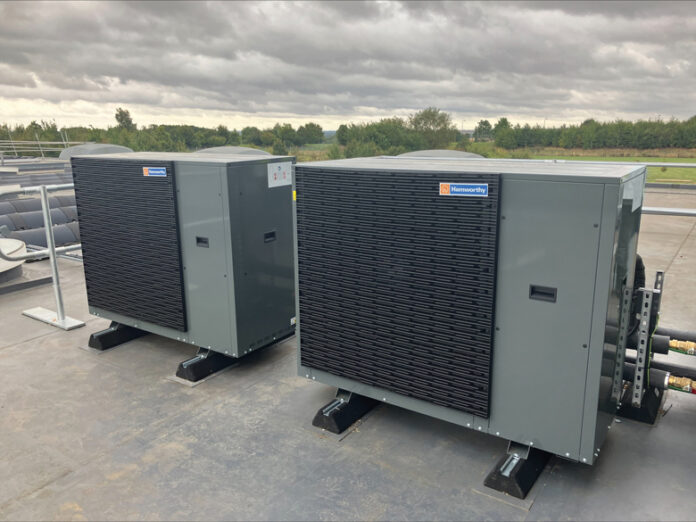
Rinnai has given a local community’s much-loved sports pavilion a replacement DHW system which upgrades from its old cylinder system and provides the same peak-time capacity with significantly reduced energy costs along with much lower emissions through utilising the Rinnai R290 heat pump system.

For bespoke design support services contact us today https://www.rinnai-uk.co.uk/contact-us/help-me-choose-product

Rinnai offered a choice of solutions all with capital, operational and carbon modelling as part of the offering, so that the decision makers could select the optimum solution for their needs. Based upon the data the site specifically requested an Air-Source Heat Pump replacement.

As a part of the bespoke design service offered by Rinnai three possible solutions were put forward, each with differing recovery times ranging from between two and four hours, with the 2000L in storage staying consistent with the old system’s capacity.

After full consultations with the site and the contractor, the system chosen was the 40kW R290 air source heat pump system. Despite the two other possible systems offering quicker recovery periods the client opted for one single heat pump unit. An additional factor governing the decision was the fact that the 40kW R290 system, incorporating 2 x1000 L cylinders, emitted less carbon and was more economical to run in the long term

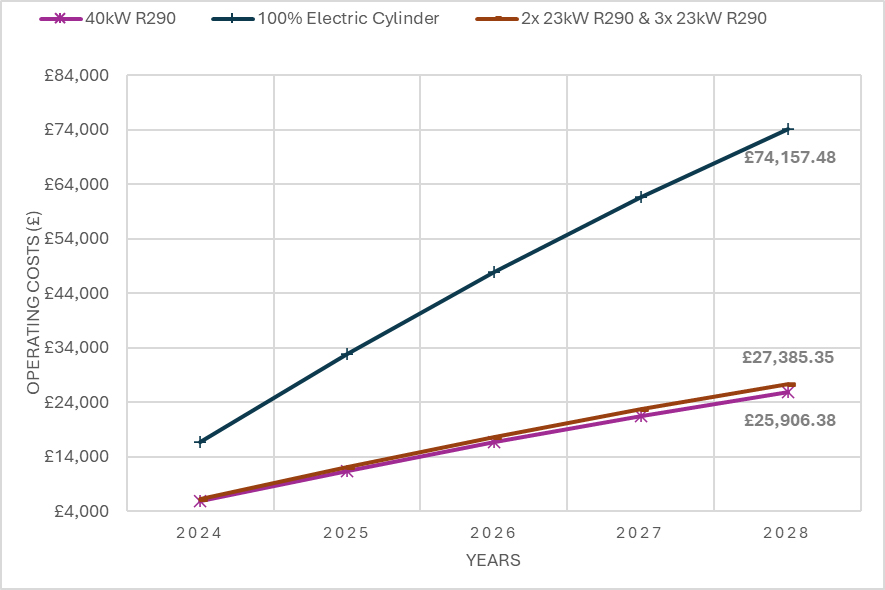
Cumulative Running Costs (OPEX) comparing a H1 and a H3 system for DHW This graph shows the cumulative running costs of each of the three possible systems across a 5-year period. As shown from the data the original system is significantly more expensive to run compared to the H3 systems. With a £46,772.13 or 170% increase compared to the 23kW R290 systems and a £48,251.10 or 186% increase compared to the 40kW R290 system by year 5.

The successful implementation of the Rinnai R290 air source heat pump system at the Surrey Sports Pavilion demonstrates the effectiveness of Rinnai’s bespoke design services and complete packaged solutions. By upgrading to a more efficient and environmentally friendly system, the pavilion now enjoys reduced carbon emissions, while maintaining the necessary capacity for peak-time demand. This project highlights Rinnai’s commitment to providing tailored solutions that meet the specific needs of all type of buildings to experience this service for your next project contact us today https://www.rinnai-uk.co.uk/contact-us/ask-us-question

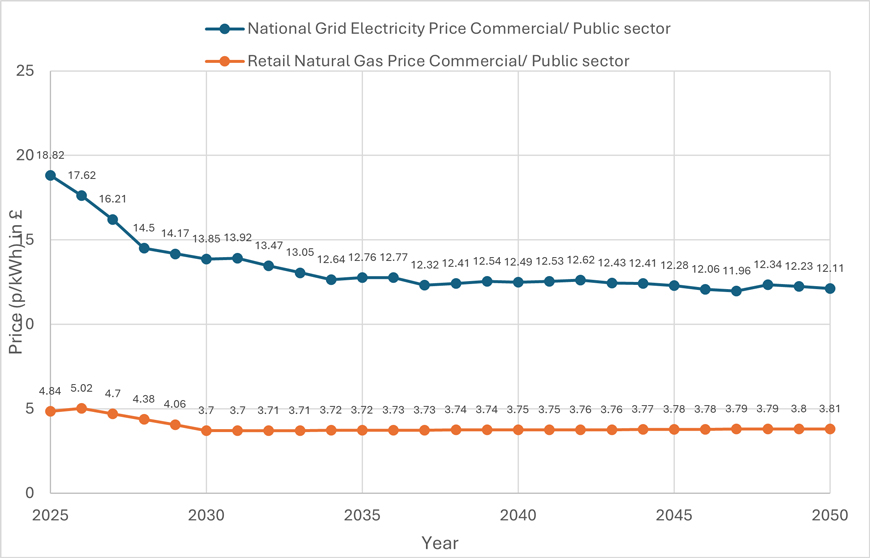
Energy Prices of National Gas and National Electricity Grid

UK energy strategists believe that clean and sustainable electrification is presently one of the best modes of reducing carbon emissions, maximise efficiencies and to also lower end-user customer costs.

Rinnai is determined to offer UK customers assorted options of carbon reducing technology that ensures an improved healthy lifestyle. Rinnai is also keen on informing all UK customers in major changes and developments concerning the international energy market that may affect purchase or power options in the near and far future.

For the latest blog and vlog information on products and policy visit www.rinnaiuk.com and subscribe to the Rinnai newsletter.

********************************************************

RINNAI OFFERS CLEAR PATHWAYS TO LOWER CARBON AND DECARBONISATION PLUS CUSTOMER COST REDUCTIONS FOR COMMERCIAL, DOMESTIC AND OFF-GRID HEATING & HOT WATER DELIVERY

www.rinnai-uk.co.uk/about us/H3

  • Rinnai’s range of decarbonising products – H1/H2/H3 – consists of hot water heating units in gas/BioLPG/DME, hydrogen ready units, electric instantaneous hot water heaters, electric storage cylinders and buffer vessels, a comprehensive range of heat pumps, solar, hydrogen-ready or natural gas in any configuration of hybrid formats for either residential or commercial applications. Rinnai’s H1/2/3 range of products and systems offer contractors, consultants and end users a range of efficient, robust and affordable low carbon/decarbonising appliances which create practical, economic and technically feasible solutions. 
  • Rinnai is a world leading manufacturer of hot water heaters and produces over two million units a year, operating on each of the five continents. The brand has gained an established reputation for producing products that offer high performance, cost efficiency and extended working lives. 
  • Rinnai products are UKCA certified, A-rated water efficiency, accessed through multiple fuel options and are available for purchase 24/7, 365 days a year. Any unit can be delivered to any UK site within 24 hours.
  • Rinnai offer carbon and cost comparison services that will calculate financial, and carbon savings made when investing in a Rinnai system. Rinnai also provide a system design service that will suggest an appropriate system for the property in question.
  • Rinnai offer comprehensive training courses and technical support in all aspects of the water heating industry including detailed CPD’s.
  • The Rinnai range covers all forms of fuels and appliances currently available – electric, gas, hydrogen, BioLPG, DME solar thermal, low GWP heat pumps and electric water heaters More information can be found on Rinnai’s website and its “Help Me Choose” webpage. 

RINNAI FULL PRODUCT AVAILABILITY 24/7 FOR NEXT DAY DELIVERY of ALL HOT WATER HEATING UNIT MODELS INCLUDING 48-58kW UNITS-

SAVINGS OF

20%                  REDUCTION of opex cost,

30%                  REDUCTION of initial cost

15%                 REDUCTION in carbon

75%                 REDUCTION of space

Visit www.rinnai-uk.co.uk  Or email engineer@rinaiuk.com  

For more information on the RINNAI product range visit www.rinnaiuk.com

AR Power and George Smith shine light on a sustainable future

L-R  Stephen Armstrong, Head of Commercial – AR Power and Steven Thompson, Financial Controller – George Smith

Two highly-respected and innovative North East businesses – AR Power and George Smith – have partnered to install a cutting-edge solar power solution at the George Smith manufacturing facility, reinforcing AR Power’s expertise in renewable energy and the luxury furniture maker’s dedication to delivering its sustainability strategy.

Established in 2011, AR Power has built a reputation for delivering high-quality solar energy solutions across the UK, helping businesses lower energy costs and meet sustainability targets. With an in-house team of design, installation, and maintenance engineers, AR Power ensures exceptional quality control by avoiding subcontracting installation work, and ensuring their own skilled people provide the highest level of dedicated and quality service. The company has worked with a range of organisations supporting them on their path to a more sustainable future. 

This exciting collaboration also reinforces George Smith’s focus on achieving a net zero future, impacting its business practices and operations, materials and waste / recycling and supply chain relationships. The company is renowned for crafting exceptional upholstered furniture for prestigious projects nationally and further afield, with an impressive showroom in London’s Kings Road. 

As part of its ongoing dedication to sustainability, the company has enlisted the expertise of commercial solar installers, AR Power, to install 392 solar panels at its Cramlington factory. This will be a 176.4 kWp system and is estimated to produce 167,355 kWh of energy per year. It will also help the luxury furniture manufacturer reduce their CO2e emissions by 37,713 kg annually.

The project will drive forward George Smith’s sustainability goals, focused on responsible sourcing and reducing resource consumption. Materials such as FSC-certified timber and byproducts of other industries including responsibly sourced feathers, horsehair, and coir – are integral to their designs, ensuring minimal environmental impact.

In addition, George Smith has implemented numerous energy-saving measures across its factory in Cramlington, including:

  • Transitioning hundreds of fluorescent tube lights to energy-efficient LED alternatives, reducing energy consumption significantly.
  • Upgrading wood machinery to modern, energy-efficient models, replacing outdated equipment dating back to the 1960s.
  • Installing a new air compressor with variable speed technology, ensuring it only operates at the necessary level, further reducing energy use and carbon.
  • Encouraging behavioural change among employees, including rigorous shutdown procedures for computers, lights, and machinery at the end of each working day.
  • Strengthening recycling initiatives for paper, cardboard, and plastics, continuously improving segregation and waste management practices.

Stephen Armstrong, Head of Commercial at AR Power, commented: “We are proud to partner with George Smith, a company that truly values sustainability. Our expertise in solar energy allows businesses to make impactful changes that benefit both the environment and their bottom line. By installing this solar panel system, George Smith is demonstrating its dedication to a greener future while ensuring long-term energy resilience.”

Jim Athey, UK Managing Director of George Smith, commented: “Sustainability is a core part of our vision today and for the future. We are constantly exploring ways to make our manufacturing processes more environmentally friendly, from the materials we source to the energy we use. Partnering with AR Power enables us to take a significant step forward in reducing our carbon footprint and embracing sustainable innovation. This project not only aligns with our commitment to sustainability but also sets a precedent for how traditional craftsmanship can integrate cutting-edge renewable technology.”

Sustainability in Emergency Lighting: The Role of TM65 and TM66 Explained

Ian Murphy

As sustainability continues to shape the construction and lighting industries, it is crucial for electrical contractors to understand key environmental assessment methodologies. Two important technical memorandums – TM65 and TM66, play a significant role in evaluating the environmental impact of lighting products. However, they serve distinct purposes.

What are the differences between TM65 and TM66, their relevance to emergency lighting, and how do they compare to Environmental Product Declarations (EPDs)?

TM65 is a method for calculating the embodied carbon of building services products, including luminaires, heating systems, and other mechanical and electrical components. It provides an estimate of a product’s carbon footprint when a full Environmental Product Declaration (EPD) is not available.

For emergency lighting manufacturers like Ventilux, TM65 is particularly relevant because their customers, including electrical contractors and consultants, often require embodied carbon calculations to assess the sustainability of projects. The TM65 framework considers the materials used in the product’s construction, the manufacturing processes and energy consumption, the transportation from production to the point of use, and the installation impacts on-site.

TM66 is different, it is a lighting-specific framework designed to promote a circular economy in the lighting industry. Unlike TM65, which quantifies embodied carbon, TM66 provides guidance and an assessment methodology to evaluate how well lighting products align with circular economy principles.

TM66 focuses on design for circularity, ensuring products are easy to disassemble and repurpose. It also emphasises remanufacturing potential to extend product life cycles and recycling efficiency by using sustainable materials. Additionally, TM66 promotes effective end-of-life management, aiming to reduce landfill waste. While TM66 does not provide direct data for embodied carbon calculations, it demonstrates a company’s commitment to sustainability and responsible product design. Overall, while TM65 is valuable for project specifications, TM66 highlights a company’s broader, long-term commitment to environmental responsibility.

An Environmental Product Declaration (EPD) is a comprehensive third-party-verified document that provides a full Life Cycle Assessment (LCA) of a product, covering its entire environmental impact from raw material extraction to disposal.

What many people don’t realise is that the third-party verification process that ensures accuracy, can differ with each different program operator who then oversees their registration and publication – often meaning different or conflicting calculations. While TM65 and TM66 provide valuable insights, they are not full LCAs like EPDs. However, when used together, TM65 and TM66 data can give a detailed picture of a product’s sustainability, making them a useful alternative when an EPD is not available.

Ventilux are committed to providing reliable TM65 data to assist their customers with embodied carbon calculations. Additionally, they support TM66 principles as part of their mission to drive sustainability within the emergency lighting sector.

Ian Murphy, R&D Manager at Ventilux Ltd, emphasises the company’s dedication to environmental responsibility: “At Ventilux, sustainability is embedded in everything we do, so much so we’ve made efforts to remove all non-essential plastic from our packaging. We also take proactive steps to reduce embodied carbon using TM65 and champion a circular economy with TM66. We believe that by embracing both, we are setting standards in the emergency lighting industry and helping our clients make more responsible choices.”

By understanding these frameworks clients and contractors can make more informed choices when selecting products, ensuring compliance with sustainability goals and regulatory requirements.

For more information on how Ventilux integrates TM65 and TM66 principles into their emergency lighting solutions, contact their team today > UK sales@ventilux.co.uk

Hamworthy launches its latestAir source heat pump CPD module     

Hamworthy Heating, technical experts in commercial heating and hot water products, is pleased to announce it has expanded its CIBSE-accredited Continuous Professional Development (CPD) portfolio with the launch of its latest module – ‘Considerations for air source heat pump selection, specification and system design’.

Designed for anyone involved in plant room design, ‘Considerations for air source heat pump selection, specification and system design’ is divided into four easy-to-digest segments and provides valuable information on selecting and sizing air source heat pumps (ASHP) for both new and existing commercial buildings.

Beginning with an introduction to the main driving forces behind air source heat pumps, the latest CPD from Hamworthy Heating discusses the various influencing factors to consider when specifying a heat pump.  Designed to offer guidance, participants can learn more about the process of sizing air source heat pumps according to their design, load and intended use.  Market drivers such as best practices and government incentives are also addressed.

Participants will gain an appreciation for the various considerations that need to be addressed when specifying and installing a heat pump, such as space and noise and positioning and mounting issues.  Additionally, for installers or specifiers considering options, the latest CPD also explores other possible heating and hot water solutions, in hybrid heat pump systems.

Delivered in person, or online for maximum convenience, the new, ‘Considerations for air source heat pump selection, specification and system design’ CPD seminar lasts approximately one hour.

More than just a manufacturer, Hamworthy is a company that is committed to providing high levels of service and aftercare to its customers.  To help customers get the best out of their products and stay up to date with the latest industry developments, Hamworthy Heating offers a wide range of CPD seminars and hands-on product training courses delivered by HVAC professional members of the Groupe Atlantic Expert Academy team.

For more information, please visit: www.hamworthy-heating.com 

The power of leadership and education in net zero transformation

Sam Arje

In the UK, achieving net zero emissions is not just a goal but a necessity and legal requirement. To drive transformative change within organisations, strong leadership and education are essential.

TEAM Energy’s Senior Energy Consultant, and approved EnCO Practitioner, Sam Arje, looks at the important role leadership and education has to play in supporting an organisation’s transition to net zero.

Setting the vision

Leaders need to clearly define and communicate the vision for achieving net zero emissions across the entire organisation. By championing this vision, they can inspire employees, stakeholders, and customers, fostering a collective commitment to sustainability. 78% of UK businesses have set net zero targets.

Establishing goals and climate science targets

Support the vision with a Carbon Reduction Strategy and Plan. Leaders should set ambitious yet achievable goals in their Carbon Reduction Strategy, aligning with the organisation’s net zero aspirations and grounded in the latest climate science, adhering to the Science Based Targets initiative (SBTi). Transparent communication and regular monitoring are crucial for ensuring progress and accountability. The Carbon Reduction Plan should outline the necessary initiatives and implementation steps to achieve carbon neutrality or net zero targets.

Building a culture of sustainability

Leaders are pivotal in cultivating a culture that prioritises sustainability and empowers employees to support carbon reduction initiatives. By integrating sustainability principles into the organisation’s values, policies, and practices, leaders foster an environment that promotes innovation, collaboration, and responsible decision-making at all levels. Notably, the net zero economy in the UK is 1.7 times more productive than the national average in terms of GVA per employee.

Promoting cross-functional collaboration

Leaders should encourage collaboration across various departments and teams to embed sustainability into every facet of the business. By dismantling silos and fostering interdisciplinary teamwork, leaders can leverage the collective knowledge and expertise within the organisation to drive meaningful change.

Lead by example

True leadership in sustainability begins with personal commitment. By embodying sustainable behaviours and integrating sustainability into their own decision-making processes, leaders can inspire others and build credibility.

Build a diverse and inclusive team

 A diverse and inclusive team brings a wealth of perspectives and experiences, fostering innovation and enhancing net zero problem-solving capabilities. Leaders should prioritise diversity and inclusivity, ensuring that sustainability initiatives also address social and environmental justice concerns.

Adopt transparency and accountability

Transparent reporting and accountability mechanisms are essential for tracking progress and establishing credibility. The increasing importance of greenhouse gas (GHG), energy, and sustainability reporting necessitates a shift to faster, more accurate data collection for precise, actionable insights that help organisations meet their carbon reduction targets.

Regulations change, sometimes faster than expected, those responsible for sustainability reporting must respond accurately despite the ‘shifting goalposts’. Near real-time data collection helps organisations keep pace with any potential regulatory or reporting changes that happen, ensuring accuracy and agility. Leaders should establish robust, auditable, measurement and reporting systems, engage with stakeholders, and be open about successes, challenges, and future plans.

Support for achieving net zero

Achieving net zero emissions requires investing in sustainability education, fostering collaboration, and strong leadership to inspire and equip the workforce for a sustainable future.

Invest in sustainability education and training

To really make a significant and positive difference to how organisations reduce energy consumption, carbon emissions, and associated costs, the key to success lies in shifting the entire organisation’s mindset towards sustainability. By inspiring the thinking of the people who know your business best, their workforce, to become more conscious of their workplace habits, you can make a scalable difference to your organisation’s carbon footprint, energy use and expenditure. Develop and deliver awareness training programmes and workshops – embedding sustainable thinking through education and training. The transition to a low-carbon economy is not just a technological shift but a significant reskilling challenge, equipping workforces with the necessary skills and knowledge is a key ingredient.

Foster collaboration and knowledge-sharing

Encourage leaders to participate in sustainability networks, industry associations, and partnerships. These platforms offer opportunities to learn from peers, share experiences, and collectively address sustainability challenges.

The road ahead

Leadership is a crucial catalyst for driving carbon reduction transformations in organisations. By setting a compelling vision, establishing goals, fostering a culture of sustainability, and encouraging collaboration, leaders can inspire their organisations to achieve Net zero emissions.

The next decade is critical for the UK’s net zero ambitions. Organisations must invest in comprehensive training programs to ensure their workforce is prepared for the green economy. By fostering a culture of continuous learning and adaptation, the UK can successfully navigate this transformative period and emerge as a leader in decarbonisation.

www.teamenergy.com

Navigating the Evolving Landscape of Renewable Energy Recruitment

Image by Isabela bela from Pixabay

Quinton Bouwer, Head of Renewables, First Point Group

The renewable energy sector is a rapidly evolving field, driven by increasing urgency to combat climate change and a global push towards sustainable energy solutions. As specialist recruiters in this industry, we’re witnessing firsthand the transformative shifts happening across the board, creating recruitment challenges for hiring managers and several incredible opportunities for skilled candidates.

Recruitment Roles In Demand

One of the most pressing issues we see impacting recruitment is the intensifying pressure on grid and infrastructure. Governments worldwide are scrambling to implement faster grid expansion strategies to keep pace with the rapid growth of renewable generation. The International Energy Agency (IEA) estimates that annual grid investment needs to double by 2030 to meet climate goals (IEA, Net Zero by 2050 Roadmap). This translates to a surge in demand for the following professionals with expertise in transmission line construction, substation development, and grid integration:

  • Engineers
  • Project managers
  • Technicians

The rise of hybrid renewable projects, combining solar, wind, and battery storage, further complicates the landscape, requiring professionals with a holistic understanding of these integrated systems. Furthermore, the growing focus on Distributed Energy Resources (DERs) and microgrids is creating new roles in areas like smart grid management and local energy trading, demanding a new breed of digitally savvy energy professionals. My recruitment advice for candidates should be to highlight any experience with smart grid technologies, energy storage solutions, and data analytics.

Wind Sector Faces Both Recruitment Challenges and Opportunities

The offshore wind sector, while demonstrating significant potential, continues to face challenges. Supply chain bottlenecks remain a concern, impacting project timelines and costs. However, government-backed initiatives aimed at boosting local manufacturing capacity are creating new opportunities for skilled workers in manufacturing, logistics, and supply chain management.

The exciting progress in floating wind technology, with projects moving from pilot to commercial scale, is opening up a whole new area, requiring specialised expertise in mooring systems, dynamic cables, and offshore operations. T

The Global Wind Energy Council (GWEC) predicts that floating offshore wind capacity will reach 16.5GW by 2030 (GWEC, Floating Offshore Wind Report). The industry is also grappling with the need for effective decommissioning and repowering strategies for older offshore assets, creating a demand for professionals with expertise in end-of-life management and circular economy principles.

The impact of AI on Renewable Energy

The increasing integration of AI and digitalisation is transforming the renewable energy sector. AI-powered asset management and O&M are becoming the industry standard, driving demand for data scientists, AI specialists, and engineers with expertise in predictive maintenance and machine learning. The adoption of blockchain and smart contracts in energy trading is creating new roles in areas like decentralised energy markets and carbon credit trading, requiring professionals with a blend of energy and technology expertise. AI-driven energy forecasting is also gaining traction, creating opportunities for analysts and modelers who can optimise grid balancing and market trading strategies. When speaking with candidates, I advise them to develop their digital skills and consider pursuing certifications in data science, AI, and blockchain. Organisations should invest in digital tools and platforms to attract and retain tech-savvy talent.

The renewable energy sector is a hotbed of innovation and growth, presenting a wealth of opportunities for skilled professionals. As specialist recruiters, we understand the nuances of this dynamic market and are committed to connecting the best talent with the most exciting opportunities. By staying abreast of the latest trends, from grid modernisation to AI integration, we can help both candidates and companies navigate this evolving landscape and contribute to a cleaner, more sustainable energy future.

Commercial property asset managers overlook critical risks in third-party solar PV deals, says Longevity Power

Credit: Via Outlets

With rising pressure to meet sustainability targets, renewable energy consultancy warns asset managers of the risks of third-party solar deals.

Commercial landlords and property managers under pressure to meet sustainability targets are increasingly turning to third party leases that are sold as attractive alternatives for landlords or tenants who don’t have the capital to invest in rooftop solar themselves. But according to Anthony Maguire, Managing Director at Longevity Power, these deals often aren’t as lucrative as they seem, with many landowners overlooking the potential associated risks.

Third party solar PV agreements involve the provision of a building roof for a solar PV system that is owned by a third party and leased to an asset manager over a set period (typically 20-30 years).

“Tenant demand, a pressing need to reduce emissions, and an increasing lack of grid capacity means that landlords are turning to third-party owned solar PV systems without necessarily knowing what they are signing up to,” said Maguire. “As a result, landlords and tenants become trapped in lengthy and expensive contracts that are even more costly and time-consuming to get out of.”

The recent European Renewables Market Overview Report further highlights the impact of market saturation and grid congestion as hinderances to greater renewable adoption and meeting established sustainability targets. Maguire points to the apparent convenience of the deals as a key reason that so many are turning to them.

“Property managers and landlords typically turn to these types of deals for two reasons,” he explained. “First, an unwillingness to part with the capital due to a sense that they are unlikely to make a good return on investment over the hold period of the asset: second, in some markets, the tax implications associated with a commercial landlord selling electricity preclude them from installing solar.”

“Despite having the best of intentions, asset managers find themselves in contracts that can last more than 20 years and include complex and unclear commercial terms.

“These contracts can often be hugely damaging long-term as they will likely stipulate that the landlord must pay for any loss of income in the event that the system needs to be switched off or disrupted for any period longer than a few days. If an entire rooftop has to be replaced, this means potentially compensating the third-party for loss of revenue for several months, which depending on the system size, could run into the hundreds of thousands.

“Withdrawing from a lengthy solar contract is also a famously tall order. Long leases mean landlords often face extremely high buy-out costs, and if an asset needs to be sold, they can lead to a host of added legal costs. Signing up to terms without fully understanding the consequences can cause major headaches long-term. This is why it’s vital that asset managers take the time to rigorously analyse the potential financial implications before signing on the dotted line.”

Maguire contends that third party deals aren’t inherently bad but are instead largely misunderstood and can leave some asset managers trapped on a long-term basis.

“Solar leases can be the right solution but it’s important to understand the characteristics of the system, the fund, the market and the tenant when determining whether it works for you. If you find yourself in a bad deal you need to review your terms now. Carefully look over the lease to understand your potential financial liability and understand the costs payable at contract-end. It’s crucial that landlords perform a proper tender and rigorously assess the proposed terms of the lease.

“Some contracts have a residual value of zero at the end of the contract whereas others must be bought at fair market value and others might include a renewal obligation. Understand who is liable for the removal of the panels and making good the roof at the end of the contract.”

“The alternative for anyone considering solar PV is the option of investing in a rooftop PV system directly. Owning the system means enjoying the full financial benefits and also having the flexibility to develop the system and surrounding areas over the coming years.

“The landlord also has a greater degree of certainty over the costs associated with future roof works and essential maintenance, and doesn’t have potentially large financial liabilities in the event of a vacancy or a roof replacement. In any case, it’s crucial that landlords have a clear understanding of the long-term implications of undertaking any kind of solar PV installation.