Senior leadership team: Chantelle Fuchs, Finance Director, Tom Garrigan, Technical Director, Lisa Ashworth, CEO and Kyrstyna Dawson, Commercial Director
The UK’s most progressive building services professional body announces a complete brand overhaul – including a new name that reflects its evolving focus.
The Building Services Research and Intelligence Association (BSRIA) announces its new brand identity, better reflecting its forward-looking commitment to sustainability, innovation and actionable guidance for the industry.
The revamped branding includes a modernised cuboid-shaped logo with a contemporary font and evolved icon. Retaining familiar colours, the design features distinctive ‘brackets’ symbolising BSRIA’s role as a knowledge hub, providing critical support to the built environment sector.
A brand built for impact
BSRIA’s refreshed identity aims to ensure its expertise and practical guidance are more widely understood and accessible by ensuring resources are easier to navigate. The rebrand aligns with the organisation’s mission to equip both industry professionals and consumers with the insights and tools needed to create better buildings.
Lisa Ashworth, CEO of BSRIA, comments: “As we look to the future, it is undeniable that the industry is evolving. Changes in occupant behaviour and a growing focus on sustainability are transforming how buildings are designed, constructed, and managed. Simultaneously, a new generation of talent has entered the industry, driving innovation and progress.
“Our rebrand isn’t just about aesthetics, it’s a bold step forward that reflects where we’re going as an organisation. The introduction of our new logo marks a renewed commitment to our mission: to equip stakeholders with the insights and tools needed to create better buildings here, now and in the future.”
Stitched into BSRIA’s fabric
As part of this vision, BSRIA has undertaken the retrofit of its headquarters, BSRIA House, in Bracknell. Phase 1 is complete, showcasing the potential of sustainable building upgrades. With a high-efficiency, low-global-warming-potential HVAC system, BSRIA expects a 28% reduction in Scope 1 and 2 emissions by 2025 compared to 2022. The building also serves as a ‘Living Laboratory,’ providing real-time insights to optimise building performance.
Ashworth concludes, “This retrofit isn’t just a milestone for BSRIA, it’s a demonstration of what’s achievable for the sector. This new, modernised identity runs through the entire business, reaffirming our unwavering commitment to providing the expertise, tools, and solutions our customers need to create better buildings and a more sustainable future.”
To learn more about the new look and BSRIA’s ongoing initiatives, visit www.bsria.com/uk.
NHS Property Services is proud to announce the launch of its new Green Plan, a comprehensive three-year strategy aimed at reducing the environmental impact of NHS facilities and progressing towards a net zero carbon future by 2040. This initiative aligns with the broader NHS goals of creating smarter, greener, and more efficient healthcare facilities that enable excellent and sustainable patient care.
Achievements of the Previous Green Plan
Since the launch of the last Green Plan in 2022, NHSPS has made significant strides in sustainability, including:
A 48% reduction in carbon emissions since the 2017/18 baseline.
£47.8 million saved on energy and utilities since 2022/23.
Completion of 960 sustainability-related projects, including LED lighting upgrades, BMS optimization, and Solar PV installations.
Flood risk assessments at 16 high-risk climate adaptation pilot sites.
Reduction of customer carbon emissions through the NHSE clinical waste strategy.
Focus Areas of the New Green Plan
The new Green Plan focuses on four key areas: Energy, Utilities and Data, Environment, and Waste. Each area has specific goals, steps, and measures to ensure progress.
Energy: The goal is to achieve Net Zero Carbon by 2040. To measure progress, the key performance indicator (KPI) is to complete 90 decarbonisation projects over the next three years. We all have a role to play in achieving these goals and empowering our customers to make changes. The strategy to achieve this involves implementing a comprehensive Net Zero Carbon Strategy. This strategy focuses on reducing emissions at the top 100 emitting sites, supporting zero emissions transport, and enhancing energy efficiency. This commitment is demonstrated through initiatives such as piloting a toolkit with GPs to save energy in their practices.
Utilities and Data: The goal is to help NHSPS colleagues and customers use data to reduce utilities costs, carbon emissions, and environmental impact. To measure progress, the key performance indicator (KPI) is to double the amount of data accessible to customers. The strategy to achieve this involves improving carbon reporting, enhancing data sharing, and providing analysis to help stakeholders reduce their environmental impact.
Environment: The goal is to continuously improve our environmental impact and meet compliance obligations. To measure progress, the key performance indicator (KPI) is to complete audits at 132 higher-risk sites. The strategy to achieve this involves embedding processes to improve climate resilience, boost biodiversity, and develop sustainable travel and buying strategies.
Waste: The goal is to reach the NHS England waste segregation target of 20% incineration, 20% infectious waste, and 60% offensive waste. To measure progress, the key performance indicator (KPI) is to achieve a 50% reduction in carbon emissions from waste management by 2026. The strategy to achieve this involves aligning services with the NHS clinical waste strategy, implementing correct waste streams, and increasing waste segregation to reduce costs and lower carbon emissions.
Cameron Hawkins, Head of Energy and Environment, said: “We are really proud of what the previous Green Plan delivered, from the 48% reduction in carbon emissions to the £47.8 million we saved on energy. We are now even more ambitious to contribute towards a net zero NHS with a smarter, greener and more efficient estate.”
For more information and support, visit our Green Plan webpage at www.property.nhs.uk/greenplan or contact our Customer Service Centre.
The future of decarbonised home heating is upon us and is already being rolled out across the UK with some of the country’s largest housebuilders – with the latest housing development benefiting from the solution ‘going live’ in recent weeks.
The Community Heat Hub (CHH), one of GTC’s Future Homes Standard-compliant heat network solutions, is now delivering low-carbon heat at The Gateway in Bexhill, Sussex, a vibrant housing development being delivered by Vistry Group, the UK’s leading provider of affordable mixed-tenure homes.
GTC has been the chosen utility partner for housebuilders and developers across the UK for almost 30 years, delivering pioneering multi-utility infrastructure solutions to all types of new-build developments.
The Community Heat Hub is one of GTC’s low carbon heat network solutions that answers the Future Homes Standard by reducing carbon emissions by 75-80% from day one, combing the two FHS notional specifications of heat pumps and heat networks in one future-proofed, net zero solution.
Vistry contracted GTC to deliver heat via its innovative Community Heat Hub to The Gateway in Bexhill, alongside electric, fibre, water, and wastewater. Once fully built the scheme will provide 801 high-quality mixed-tenure new homes, a primary school, community centre and sports pavilion connected to the low carbon solution.
GTC commissioned The Gateway Community Heat Hub in late February and first homeowners moved in on February 24th. This is the UK’s second Community Heat Hub to be commissioned since its launch, with more contracted across the country being delivered in the coming months.
The Community Heat Hub at The Gateway is estimated to save around 850 tonnes of carbon dioxide emissions annually in comparison to individual gas boilers in homes.
John Marsh, Chief Operating Officer at GTC said: “Home decarbonisation is top of the agenda right now and The Gateway at Bexhill is a brilliant example of how low carbon heat can be delivered into new homes. The forthcoming end of gas means decarbonisation is no longer optional. Working with housebuilders, like Vistry, who want to showcase compliance and sustainability excellence is always a pleasure, and to be able to offer a solution that meets forthcoming Standards is credit to the skills and expertise of the GTC team.”
Brendan Evans, Managing Director at Vistry Kent said: “Vistry is committed to delivering sustainable long-term communities that provide the mix of high-quality new homes that residents need. Collaborating with like-minded organisations like GTC is essential to help us deliver innovative solutions that meet important decarbonisation standards while helping to fulfil the UK’s chronic need for new housing.”
Designing and installing new Electric Vehicle chargepoint hubs can be a complex project, and UK Power Networks is making the process easier.
The UK’s biggest electricity distribution network operator has published a new guide, to set out exactly what land consents need to be in place before installers apply to connect their site to electricity grid.
Every year the firm receives up to 100 applications from customers wanting to connect an EV charging hub site, and some require 3MVA of power – equivalent to powering more than 2,000 homes. The new online guide sets out the hierarchy of consents required and also aims to streamline to connection process. Four common scenarios are profiled, to help readers relate the information to their own situation.
Neil Madgwick, head of connections service delivery said: “Having the correct access and licensing arrangements can dramatically speed up the connections process, enabling sites to be up and running in weeks rather than months.”
UK Power Networks provides a unique wrap-around service to manage the final connection to the local electricity grid, working closely with the operator and their independent connections provider from site design to energisation. Neil added: “This helps ensure that they can take advantage of our innovative products so they stay in control and don’t need complex leases and wayleaves.
“We receive a lot of enquiries from individuals to large corporations keen to explore low carbon technologies, and are building up a library of helpful guidance as this is new territory for many.”
Read the guide here: www.ukpowernetworks.co.uk/guide-pages/electric-vehicles-faqs
For more details, or if you have a question for the Connections team call 0203 324 1460 (free, including from a mobile), or see https://ukpowernetworks.my.site.com
The T-4 GB Capacity Market auction has cleared at £60,000 per MW per year. This is the 3rd consecutive year that the auction has cleared above £60,000 per MW per year signalling the ongoing importance and value of the T-4 auction. Enel X has secured 520MW (derated) of Demand Side Response (DSR) capacity as the company continues to invest in essential grid flexibility services to help defend Great Britain’s energy security.
Wayne Davies, Head of Flexibility UK & Ireland at Enel X commented on the outcome of the auction: “Many commercial and industrial scale energy users are not aware that their energy assets can serve a dual purpose: powering their operations while supporting national grid stability. Through participation in the Capacity Market, with very little effort they can support the balance of electricity supply and demand at critical times. Why is this important? It helps protect their own business continuity by reinforcing grid reliability, reduces reliance on fossil fuel generation, which is good for all of us, and provides participating businesses with a regular, bankable source of income. It’s a triple win.”
Davies added: “The continuing trend of high clearing prices in the T-4 Capacity Market auction represents a really compelling commercial opportunity for businesses with flexible electricity capacity. In our experience, most businesses tend to have more flexibility than they may realise that can be put to good use. It benefits the grid, benefits businesses and benefits the economy.”
What do these auction results mean for businesses participating in the Capacity Market?
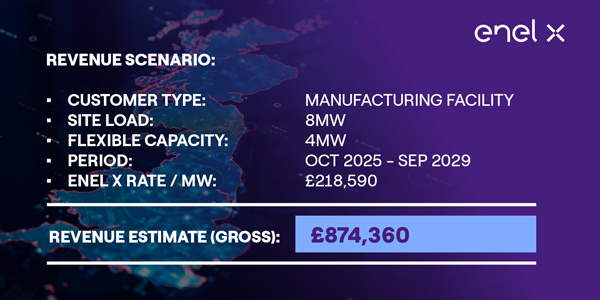
The scenario below illustrates how much a typical Capacity Market participant could earn with Enel X over the next four years:
*Revenue estimate based on Capacity Market participation with Enel X from October 1st 2025 to 30th of September 2029 subject to eligibility, terms and conditions. Auction results will remain provisional until confirmed by Secretary of State (21st of March 2025) following the Auction Monitor’s report.
Davies concludes:
“Flexibility is an essential component of renewable-energy-powered electricity grids. It smooths out the peaks and troughs that may otherwise challenge grid stability.
By incentivising businesses to adjust their energy usage when the grid needs it most, energy flexibility programmes like the Capacity Market are key to the transition to a low-carbon future, grid reliability and cost-effectiveness for all electricity consumers.”
What is the Capacity Market?
The Capacity Market mechanism exists to defend Great Britain’s electrical energy security by helping to balance supply with demand, especially during times of grid stress. Great Britain’s National Energy System Operator (NESO) views it as crucial for delivering a secure, sustainable, and affordable electricity system.
Energy generation assets, such as CHPs and back-up generators, or storage assets such as battery energy storage systems (BESS), are ideal candidates for the Capacity Market. It is also possible to participate by temporarily curtailing the electrical consumption of equipment such as compressors, HVAC (Heating, Ventilation, and Air Conditioning) and refrigeration units.
Reducing stress on the electricity grid helps to prevent interruptions to the electricity supply to homes and businesses nationwide. By managing their electricity flexibly, participating businesses receive significant financial payments for supporting grid stability. Flexible capacity can come from a single site or can be aggregated across multiple locations. There is no upper limit if sufficient positions are available. Payment is made to businesses registered to participate and is not subject to grid events occurring.
Participating in GB’s Capacity Market gives commercial and industrial businesses a significant advantage over non-participants by:
Offsetting volatile energy prices and maintaining a competitive cost base.
Achieving greater energy security and protecting business continuity.
Accelerating their Net Zero ambitions and delivering on ESG commitments.
Enel X has been providing demand side response (DSR) services to Great Britain’s electricity system since 2009. The core offering in the UK and Ireland is built around maximising the commercial and environmental rewards available from energy flexibility programme participation. By optimising how and when energy is consumed, Enel X enables commercial and industrial scale energy users to extract value from the energy markets by leveraging their flexible energy assets in ways that support a greener, more stable and resilient electricity grid.
Ross McLory (left) Head of Business Development for Industrial and Commercial at SSE Energy Solutions and Donald MacBrayne, Business Development Manager at Scottish Water Horizons - Photograph, Iain Ferguson, The Write Image
SSE Energy Solutions and Scottish Water Horizons have announced a new strategic partnership to develop low-carbon district heat networks across Scotland, accelerating the country’s journey toward net zero.
Under the agreement, the organisations will collaborate to identify, develop and deliver innovative heating solutions that harness the untapped potential of wastewater by capturing thermal energy that would otherwise be wasted, creating a sustainable heat source for local communities and businesses while helping to address one of Scotland’s biggest decarbonisation challenges.
A first project has been identified for development in Inverness, where a Scottish Water pumping station will provide a sustainable heat source for a network serving several buildings, including local SSE and Scottish Water Offices and facilities, and other private and public sector buildings in the area.
Beyond reducing carbon emissions, the partnership aims to create opportunities for local supply chains and skills development in the growing heat networks sector, supporting Scotland’s just transition to a low-carbon economy.
Decarbonising heat, which currently accounts for 37% of the UK’s CO2 emissions, is a crucial component in meeting the country’s ambitious net zero targets. Heat networks are projected to meet up to 20% of the UK’s heat demand by 2050, according to recent government figures.
Ross McClory, Head of Business Development for Industrial and Commercial at SSE Energy Solutions, said:
“This partnership with Scottish Water Horizons represents a significant step forward in Scotland’s heat decarbonisation journey. By combining our expertise in sustainable energy solutions with Scottish Water Horizons’ experience in recovering heat from wastewater, we’re creating powerful opportunities to deliver low-carbon heating across Scotland.
“Our joint project in Inverness is just the beginning of what we expect to be a productive collaboration that will help communities and businesses across Scotland transition to cleaner, more sustainable heating solutions while supporting the country’s net zero ambitions.”
Donald MacBrayne, Business Development Manager at Scottish Water Horizons, said:
“Scottish Water Horizons is committed to unlocking the hidden value in our infrastructure to help decarbonise Scotland’s heat supply. Having already delivered and facilitated the UK’s first five heat from wastewater schemes, we have seen first-hand how effective this technology can be in delivering low carbon energy.
“The Inverness project is another step forward in using innovative approaches to support businesses and communities in reducing their carbon footprint. By partnering with SSE Energy Solutions, we can extend the reach of this technology and help drive Scotland’s transition to sustainable heat.”
The partnership aligns with the Scottish Government’s Heat Networks Delivery Plan, which identifies heat networks as a strategic priority for meeting Scotland’s climate targets. The Heat Networks (Scotland) Act 2021 sets ambitious targets for heat networks to deliver 2.6TWh of thermal energy by 2027 and 6TWh by 2030. Building on their initial focus in Inverness, SSE Energy Solutions and Scottish Water Horizons expect to announce further projects across Scotland as heat network zoning is implemented by local authorities throughout 2025 and beyond.
Gemserv, a Talan Company, is delighted to announce that it will continue to deliver the Government’s Heat Network Efficiency Scheme (HNES) for a further four years, following a successful tender process.
Gemserv will continue as the HNES Delivery Partner and will be supported by Ramboll and Gleeds Consultancy. The multi-million-pound contract will run until 2029 and ensures Gemserv will continue to play a key role in delivering the Government’s Heat Network Transformation Programme.
The new contract means that Gemserv will continue to manage the overall scheme delivery, pre-application engagement and support, application management, monitoring and reporting processes, and the delivery of the scheme’s communications and events.
HNES is at the beating heart of the transition to net zero. It is designed to breathe a new lease of life into older, inefficient heat network infrastructure. Funding is provided to help make heat networks more efficient, less carbon intensive and for reducing customer detriment to improve consumer confidence in the technology. The support is also vital to help existing heat networks prepare for heat network regulation, zoning, and technical standards.
So far, through Gemserv’s delivery of the scheme, 233 heat networks have received a share of £34.83 million, benefiting over 43,000 residents and reducing carbon emissions by over 100,000 tonnes of CO2 per annum.
David Hiller, Programme Director, said:
“Our success in winning this tender is a testament to our expertise in the heat network sector. The win also extends our central role in delivering the Government’s Heat Network Transformation Programme.
“Alongside our existing roles in the Green Heat Network Fund (GHNF) and the Heat Network Technical Assurance Scheme (HNTAS), this new HNES contract cements Gemserv as an industry leader in delivering a thriving UK heat network market.
“We are looking forward to working with our delivery partners at Ramboll and Gleeds to deliver efficiency improvements and energy savings to heat networks across England and Wales.”
Miatta Fahnbulleh, Minister for Energy Consumers, said:
“The energy shocks of recent years have demonstrated the need to ensure heat networks deliver energy to connected customers as cheaply and reliably as possible.
“The Heat Network Efficiency Scheme plays an important role in this, ensuring old and inefficient heating systems are upgraded to provide heating and hot water, and helping businesses and homes lower their energy bills.
“This contract will allow Gemserv to provide support to transform underperforming heat networks, so they deliver the service customers deserve.”
Those interested in applying for the scheme can express their interest by emailing HNES@gemserv.com.
The Heat Network Efficiency Scheme Guidance is available on the gov.uk website.
More information about HNES including upcoming events can be found on Gemserv’s website, the delivery partner for the HNES Scheme.
Gemserv has been appointed as the Delivery Partner for HNES supported by Ramboll who will be providing technical assessment, Gleeds providing cost consultancy and Lux Nova providing legal support.
Most weeks, I observe and analyse negotiations. As a Consultant at Scotwork, a world-leading negotiation consultancy, it’s my job to work with our clients to develop the negotiation skills of their negotiators and navigate complex negotiations.
Any time a negotiation concludes or deadlocks, the first part of the process I analyse is what preparation was done beforehand and was it effective in providing the foundations to a successful outcome – because effective preparation is the foundation of any negotiation and makes it vastly more likely that the outcome will be a successful one.
Sadly, however, all too often the preparation before a negotiation is no more than a bit of number crunching and a strategy consisting of ‘let the other side speak first and we’ll go from there’. Preparation is vital in any negotiation and is the most important step in the negotiation process, including Power Purchase Agreement (PPA) negotiations between businesses and renewable energy generators. It covers a wide agenda of what negotiators must consider in advance. And the more complex the negotiation, the greater the need for effective preparation.
Negotiating PPAs can seem a complex process, with negotiators required to navigate multiple challenges including terminology, regulatory requirements and changes, fluctuating market prices, shifting demand requirements, and many more. This article therefore explores three things those negotiating PPAs can do to be better prepared: doing your research, setting objectives and having a strategy. Effective preparation won’t guarantee success, but it will help mitigate these challenges, enabling you to enter negotiations with confidence.
Do Your Research
The world of PPAs can seem complex and confusing. Do your research and market analysis to understand what you know and what you don’t know before the negotiation begins. Doing so will confirm the information you already have, what information you can gather before the negotiation, what assumptions you are making and what information you need to get from the other side at some point. Information will of course differ whether you are negotiating the buyer or supplier side of the agreement, covering the entire potential structure of the contract, including the expected energy requirement and terms and conditions.
Be Clear on Objectives and Priorities
Before entering negotiations, be clear on the objective you are trying to achieve, what you expect the negotiable variables to be, and what your priorities are. Having a well-defined objective and set of variables allows you to articulate your needs clearly, stay focused during discussions and trade value during the process, avoiding haggling over the most difficult variables, which is usually price.
Determine your Strategy
You know the objective and you know what you know and what you don’t. The strategy is how you are going to achieve your objective and fill in the gaps in your knowledge. Consider the following: How will you manage the negotiation process? How will you structure the other side’s expectations? What is your power in the negotiation and how will you leverage it? What questions will you ask and at what point in the negotiation? Are you going to make the first proposal in the negotiation or invite the other side too? How will you identify and deal with negotiation tactics the other side use? How will you deal with the inevitable obstacles during the process?
Conclusion
While it won’t guarantee you’ll always get everything what you want from your PPA negotiations, effective preparation is the foundation of any negotiation and being prepared is more likely to lead to a successful outcome. Doing the research, being clear on the objective and having a strategy beforehand positions you for favourable outcomes. As the UK continues to transition towards a sustainable energy future, the PPA market will continue to grow and the importance of preparing effectively for these negotiations will only become greater. Invest the time and effort to prepare and you will be better equipped to navigate the complexities of the energy market and forge agreements that meet your strategic goals.
This article appeared in the March 2025 issue of Energy Manager magazine. Subscribe here.
Extensive pipework is crucial for the operation of any energy plant, including biogas and hydrogen production.
Mechanical pipe joining specialist Victaulic offers a safe and sustainable alternative for pipework in biogas energy plant infrastructure development, explains Paul Herman, vice president for the UK energy market at Victaulic.
Global energy demand is increasing rapidly, with the World Energy Outlook predicting that 50% more energy will be needed worldwide by 2050. More energy plants are required, and with that will come a greater need for essential pipework. As a global provider ofmechanical pipe joining solutions for the most complex piping applications, Victaulic plays a pivotal role in developing safe and sustainable energy plant infrastructure.
Every energy plant possesses extensive pipework essential to its operation. This pipework consists of critical systems for cooling water, instrument air, and other important service lines needed to run the plant. Whatever the facility – be it biogas or hydrogen production, carbon capture or waste to energy – it needs reliable systems for it to run. The need for high-speed, high-quality piping is critical in an industry that is growing rapidly. While welding in pipework is seen by many as an industry staple, grooved pipe joining provides a robust solution to welding and flanged alternatives and helps to reduce the pipe joining and maintenance challenges that come with them, such as accommodating misalignments, system accessibility, and constructability.
An energised market
Energy production from biogas continues to increase in Europe. The European biogas plant market was valued at approximately €1.56 billion ($1.67 billion) in 2020 and is expected to reach €3.24 billion ($3.47 billion) by 2028. This holds significant potential. As demand for renewable energy grows, there will be increased opportunities for constructing biogas plants. Construction expertise is required to design facilities that efficiently convert organic waste into energy and ensure their long-term operational viability.
One of the main challenges is ensuring that constructed facilities meet the rigorous standards required for biogas production. This includes managing the complexities of integrating biogas systems with existing infrastructure and ensuring consistent quality control throughout the construction process. The growth will drive innovation in construction techniques and materials, which should be seen as an opportunity for more sustainable building practices.
A proven pipeline build strategy
Victaulic solutions have become synonymous with faster and easier installation that can be implemented across diverse industry applications and can significantly improve efficiency and reduce the total installed cost in the construction of energy plants’ utility lines. Grooved pipe joining also does not require open flames in its installation process, enhancing site safety and eliminating hazardous emissions. Though welding or flanging can still be utilised in specific circumstances, such as in very high-pressure, extreme high-temperature pipelines, grooved piping can become a game-changing alternative for over 40% of pipe installations in new energy plant construction projects.
Constructability of piping systems is significantly increased when using Victaulic Installation-Ready™ Technology. This provides a single-unit coupling design, enabling the installer to install couplings by simply inserting them onto the grooved end of a pipe and tightening the nuts. Because the coupling housings, nuts, bolts, and gaskets do not need to be disassembled, the installation process is expedited and reduces the number of loose parts that could potentially be dropped or misplaced. It can be installed in less than half the time of standard grooved couplings, six times faster than flanged joints and 10 times faster than welded joints.
Grooved joints also provide full restraint, eliminating the need for thrust blocks, which can involve extensive digging and concrete, or restraint systems which require complex welding and time-consuming disassembly.
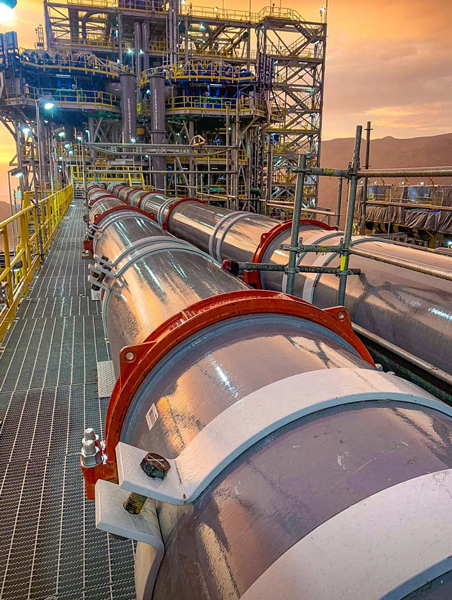
Victaulic provides a safe and sustainable pipework solution for biogas energy plant infrastructure.
Sustainable solutions at every stage
Time efficiencies directly impact energy consumption. Victaulic has embedded sustainability as a mindset. In energy plant construction, as elsewhere, sustainability challenges necessitate innovative approaches, as traditional methods often consume significant energy and may not deliver long-term value.
Victaulic offers a versatile and sustainable solution. A grooved system takes less time to install and, unlike welding, produces zero emissions during installation, with products made from up to 98% recycled content using the cleanest technology.
Grooved systems are fully reconfigurable and reusable, allowing pipes, fittings, and couplings to be disassembled, cleaned, repurposed, or entirely recycled at the end of their lifecycle. This reduces waste and eliminates the need for new raw materials. Victaulic couplings also feature a pressure-responsive gasket that is designed for multiple reuses.
These advantages align with, and extend beyond, net-zero mandates. The Victaulic coupling system requires only two bolts for connections up to 24 inches and four bolts for those up to 60 inches, significantly reducing the number of bolts compared to flanged connections. It results in less waste throughout the process and facilitates easy maintenance and modifications, as the system is easy to access or to dismantle.
If this sounds simple, then that’s because it is. Simple but extremely effective. Victaulic is an easy-to-learn system, as opposed to welding, which requires skilled construction professionals. It currently takes four years to train to become a welder, with a significant 20-year industry training gap due to the insufficient influx of newly trained professionals entering the field. There is currently a skilled labour shortage throughout the UK and Europe. A report by the Learning and Work Institute has predicted that the UK skills shortage will cost the country £120 billion by 2030, with a shortfall of 2.5 million highly skilled workers and an oversupply of 8.1 million people with traditionally intermediate or low skills. This is a labour problem that Victaulic can help solve. The simple coupling, with only two bolts and nuts, saves on time and labour during installation. Victaulic offers world-class customised training tailored to individual business needs, helping to upskill the workforce, and ensures quality control and first-rate service with all applications.
Collaboration is crucial. Construction and engineering teams must work closely to design and build energy plants that are not only efficient but also scalable and adaptable. Early engagement in the concept or FEED (Front-End Engineering Design) stage ensures that both teams understand project goals and constraints. Furthermore, the industry must stay informed about advancements in technologies, more efficient processes, and innovations in solutions. Keeping up with these advancements can improve plant efficiency and output.
It is essential to maintain a dialogue with key partners and continue to advocate how the Victaulic sustainable and efficient approach can offer a reduction in energy consumption and waste. In this way, Victaulic can continue to support both environmental goals and long-term operational efficiency for biogas plant projects.
In January 2027, the UK’s copper-based ADSL network will be powered-down permanently. Moving forwards, the nation’s landlines and internet connections will all run on full-fibre-optic broadband, which is much faster and more secure than copper, as well as being less prone to interference.
For anyone still relying on ADSL, time is running out to upgrade equipment and connections to avoid system failures and data losses. This is particularly important for heat network billing and management systems as the copper switch-off coincides with a strengthening of regulations designed to ensure greater protection, fairness and charging transparency for heat network consumers. Heat suppliers and heat network operators could face penalties if residents are incorrectly billed, not to mention a host of messy administrative issues.
Any building that is more than 10 years old could be one of the approximately 30% of UK properties still using a legacy copper-based connection. You can check this online at openreach.com/fibre-broadband. If so, you can request a fibre connection from your internet services provider (ISP); it should take around 10 days to two weeks, including installation of an optical network termination (ONT) device, if not already present.
Modern developments and those already served by full-fibre broadband (as indicated on their contracts and bills) won’t be impacted by the demise of ADSL. However, that doesn’t necessarily mean they’ll have the consistent and reliable connections they need for essential services across their site, particularly if they’re relying on wireless solutions.
Complete security and reliability
The only way to ensure robust, uninterrupted, real-time data communication for efficient metering & billing operations is to install a fixed internet connection (FIC) between your energy metering system and your heat network service supplier’s billing and payment infrastructure.
This should be a permanent, hardwired link, ideally in the form of a high-speed FTTP (full fibre to the premises) cable with a fibre-based router connecting to the building’s ONT. Other approaches are possible too, including using existing on-site internet solutions, such as Hyperoptic or local area network (LAN). However, they’re less reliable and cost effective than FTTP.
The FIC should also be a dedicated connection, meaning it’s not shared with other building services such as CCTV, which can consume a lot of bandwidth. For maximum security, connectivity and stability, the solution should also include a static IP address which won’t change each time a device connects to the network, ensuring continuous access to data loggers and pre-pay equipment. And the whole thing should be backed up by a failover 4G multinet roaming SIM for total 24/7/365 resilience.
Internal upgrades
In older properties, it’s possible that some rewiring of legacy copper connections will be needed within and around the site too. Although any internal ADSL network can theoretically still function until 2030, it will be transmitting data at a much slower speed than the fibre link to and from the building.
Therefore, although it can be difficult and costly to replace, because it’s likely to involve removing and refitting fire-stopping materials, it’s a good idea to do it as soon as possible. Situating equipment such as data-collection devices as close as possible to the ONT will help to minimise disruption, but the more work that’s likely to be involved, the more important it is not to leave it to the last minute.
Performance monitoring
It’s not only metering & billing systems that need a failsafe internet connection. Accurate, timely and detailed data from meters and sensors across a heat network is the bedrock of managing energy efficiency.
If there are periods when consumption and performance data is not transmitted, real-time monitoring software won’t work properly, meaning faults and inefficiencies may go undetected for long periods, with costly consequences.
Managing your FIC
It might make sense to hand over the management of your FIC account to your metering & billing provider. They can ensure it’s paid correctly, automatically reacting to any pricing changes without you needing to notify them, with the costs recovered via residents’ energy services tariff. You’re also likely to get things fixed a lot faster if a fault occurs.
It’s worth noting, too, if you’re commissioning a new FTTP connection, your metering and billing provider may be able to do this for you at a lower cost via an ISP broker, meaning the total outlay is the same as commissioning and managing the service yourself.
However you go about it, the process of fitting compliant FICs will be far smoother, quicker and more efficient when done in a considered way. It therefore pays to review your connectivity equipment sooner rather than later to see what upgrades, if any, are needed in the next two years.
This article appeared in the March 2025 issue of Energy Manager magazine. Subscribe here.