New Silent-Aire series of Coolant Distribution Units provides reliable and efficient liquid cooling to high-density racks.
Johnson Controls (NYSE: JCI), the global leader in smart, safe, healthy and sustainable buildings, has expanded its data center thermal management offerings with the launch of its Silent-Aire Coolant Distribution Unit (CDU) platform. This latest addition to Johnson Controls’ end-to-end thermal management portfolio enables data centers to seamlessly transition to liquid cooling as rack densities rise. The Silent-Aire CDUs offer a wide range of scalable cooling capacities from 500kW to over 10MW in flexible designs that are uniquely tailored to suit the needs of any data center deployment.
“The launch of this expanded series of CDU technology marks a pivotal step in our commitment to advance data center cooling, from chip to chiller,” said Austin Domenici, vice president and general manager, Data Center Solutions at Johnson Controls. “By collaborating with leading ecosystem players in the hyperscale, colocation and semiconductor industry, we’ve engineered an innovative and scalable platform that meets the demands of next-generation AI training and inference hardware, delivering consistent performance and reinforcing our role as a strategic partner to data center professionals scaling for the digital economy.”
With the rapid growth of AI and increasing demand for computing power, denser chips are generating more heat, making cooling innovation a critical priority. Silent-Aire CDUs allow for precision cooling of this equipment, enabling data center owners and operators to deploy the latest in semiconductor technology. Positioned either within the rack row adjacent to heat-generating equipment or in the whitespace perimeter, Silent-Aire CDUs are designed for flexibility to support a wide range of liquid-cooling configurations and hybrid designs to deliver precise, efficient cooling of high-performance environments ranging from edge-based inference to large AI factories.
This launch is built on Johnson Controls’ broad portfolio of existing Silent-Aire, York and M&M Carnot thermal management products that serve data centers worldwide. By adopting Johnson Controls’ comprehensive thermal management solutions, owners and operators can significantly improve total facility efficiency. Since 2020, large data centers have typically devoted more than 30% of their energy to cooling and other non-IT functions. However, Johnson Controls’ solutions can reduce non-IT energy consumption by more than 50% in most North American data center hubs. For a gigawatt-scale AI factory, this reduction translates to enough energy savings to power over 200,000 households annually.
Johnson Controls manufactures the Silent-Aire CDUs at facilities across North America, Europe and Asia Pacific. With more than 1.8 million square feet of production floorspace, this global footprint helps to increase capacity needed to meet the accelerated pace of data center development. A robust network of over 40,000 field and service technicians backs Johnson Controls’ building technology to ensure reliable service, maintenance and parts delivery worldwide.
In 2025, Johnson Controls was named a top thermal management provider for data centers by ABI Research, recognizing its excellence in innovation, implementation and customer-centric approach.
Millom Rugby Union Football Club situated in the scenic Cumbrian countryside, is a multi-use facility that includes rugby pitches and a popular caravan and camping ground. The club required a reliable, energy-efficient hot water solution to replace its traditional stored hot water supply.
The system was required to meet a high and variable demand from matchday players, onsite staff, and campsite visitors who demand comfort and safety. The variable nature of demand created multiple peaks in supply throughout the day.
The site is off-grid and reliant on LPG, and initial plans to connect to mains gas were abandoned due to the prohibitive cost and limitations of the existing infrastructure – therefore Rinnai LPG to BioLPG hot water system were seen as both an economically and ecological route to lower costs and carbon.
After consultation with Rinnai engineering experts the Club installed four N Series 1600 continuous flow water heaters all supplying instant temperature accurate hot water on demand for all players and caravan site visitors.
Originally a stored water system was proposed but Rinnai’s engineering team provided a full CAPEX, OPEX, and lifecycle cost analysis as standard. This demonstrated that an LPG and BIOLPG ready continuous flow system would outperform a traditional stored hot water system in terms of:
Energy efficiency
Operational cost savings
Carbon footprint reduction
System longevity and reliability (up to 12 years warranty)
All Rinnai appliances are manufactured under strict guidelines of ISO 9001 quality management and ISO 14001 environmental management. The commercial continuous flow water heaters are designed to provide almost limitless volumes of cost-effective and temperature controlled hot water.
Each Rinnai N Series gas fired water heaters offer a more compact and enhanced combustion design that allows for convenient installation, superior operational performance, and easy accessibility when servicing is required. All additional components are designed and manufactured by Rinnai ensuring proven quality and reliability.
The Rinnai N Series is the first ever continuous flow water heater manufactured with stainless steel heat exchangers to be available in the UK – this provides an extended working life at optimum performance to each of the four models in the range.
Features include:
Flue up to 48+ metres for concentric for flexible mounting
Turbo Fan and longevity
Built-in controller as standard on both internal and external models for easy set up
Cascade Cable assembly allows up to twenty-four water heaters to be connected and function as one total and complete system. Any number of N-series Rinnai water heaters can be manifolded together enabling the largest capacities on the market.
Frost Protection – minus 15°C on the internal versions and minus 20 °C on the external versions for flexible installation
Temperature setting up to 85 degrees for legionella protection or high temperature projects
Maintenance Monitor for engineers for easy system updates, diagnostics or set up.
All Rinnai products in this range are low-NOx. The N Series uses Rinnai’s patented advanced burner technology with a 13-1 turn down ratio – the largest on the market meaning the water heater is optimising gas usage at all times which equates to energy and cost savings. All Rinnai units are extremely quiet in operation. Integral controls on the units enable the water heater to achieve high efficiencies due to advanced burner control and high modulation ranges.
And one small point for history buffs:- across town is the Millom Rugby LEAGUE Football Club – it is the oldest amateur rugby league club in the world, having been founded in 1873.
Rinnai’s H3 range of products include domestic and commercial heat pumps that offer immediate property decarbonisation. Rinnai is determined to provide UK customers with cost effective low carbon solutions towards domestic and commercial hot water and building heating provision.
RINNAI OFFERS CLEAR PATHWAYS TO LOWER CARBON AND DECARBONISATION PLUS CUSTOMER COST REDUCTIONS FOR COMMERCIAL, DOMESTIC AND OFF-GRID HEATING & HOT WATER DELIVERY
Rinnai’s range of decarbonising products – H1/H2/H3 – consists of hot water heating units in gas/BioLPG/DME, hydrogen ready units, electric instantaneous hot water heaters, electric storage cylinders and buffer vessels, a comprehensive range of heat pumps, solar, hydrogen-ready or natural gas in any configuration of hybrid formats for either residential or commercial applications. Rinnai’s H1/2/3 range of products and systems offer contractors, consultants and end users a range of efficient, robust and affordable low carbon/decarbonising appliances which create practical, economic and technically feasible solutions.
Rinnai is a world leading manufacturer of hot water heaters and produces over two million units a year, operating on each of the five continents. The brand has gained an established reputation for producing products that offer high performance, cost efficiency and extended working lives.
Rinnai products are UKCA certified, A-rated water efficiency, accessed through multiple fuel options and are available for purchase 24/7, 365 days a year. Any unit can be delivered to any UK site within 24 hours.
Rinnai offer carbon and cost comparison services that will calculate financial and carbon savings made when investing in a Rinnai system. Rinnai also provide a system design service that will suggest an appropriate system for the property in question.
Rinnai offer comprehensive training courses and technical support in all aspects of the water heating industry including detailed CPD’s.
The Rinnai range covers all forms of fuels and appliances currently available – electric, gas, hydrogen, BioLPG, DME solar thermal, low GWP heat pumps and electric water heaters More information can be found on Rinnai’s website and its “Help Me Choose” webpage.
RINNAI FULL PRODUCT AVAILABILITY 24/7 FOR NEXT DAY DELIVERY of ALL HOT WATER HEATING UNIT MODELS INCLUDING 48-58kW UNITS-
How to become an industry expert in renewable energy:
Expert Learning Pathways help participants become experts in their chosen energy field. Energy Expert Certificates are a 3 course learning pathway, created to help the growth of the renewable energy sector in the UK, Europe and worldwide.
The courses are taught by respected university professors, industry experts and renowned lecturers with years of expertise.
Successful participants gain the internationally recognised Galileo Master Certificate, and the Expert Certificate for the chosen Pathway, from the Renewable Energy Institute.
With 9 prebuilt expert certificates plus the ability to create your own bespoke combination of courses, a Consultant Expert Certificate will be the perfect fit for your career progression.
All courses are CPD accredited and can be used as evidence of your continued professional development.
On completion of your studies, you will receive 1 year of complimentary REI membership. Our experienced support team will be more than happy to answer any questions you might have.
Baxi has launched the Amptec S, a state-of-the-art electric system boiler to provide an energy-efficient alternative heating and hot water solution to gas.
As a leader in sustainable heating solutions, Baxi’s expansion of its established portfolio of electric boilers signals its ongoing commitment to enable social housing providers to offer an alternative heating solution with the removal of gas without compromising on comfort.
Manufactured in the UK, the Amptec S is available in six models ranging from 4kW to 18kW, offering a versatile solution for social housing properties.
With a temperature range adjustable from 30°C to 80°C, modulating ratio up to 9:1 and cycling of its heating elements, the boiler intelligently matches output to demand. This all results in reduced energy use and running costs.
To ensure seamless integration with a wide range of controls, Baxi has made the Amptec S compatible with universal communication protocol, OpenTherm. The unit includes a circulation pump, an expansion vessel, this allows for reduced installation times and space saving as all pipework is inside the boiler. The Human Machine Interface (HMI) feature improves user experience and assists with maintenance and fault finding.
Its lightweight, compact design fits neatly into a cupboard 290mm deep, significantly reducing the time and space needed for installation.
Created with future adaptations in mind, in addition to its core features, the Amptec S can be easily paired with Solar PV via PV batteries. This offers an attractive option for those seeking sustainable cost-savings on energy bills, such as social housing providers and landlords.
The Amptec S also comes with a 2-year warranty for added peace of mind.
Rob Pearse, Residential Business Director at Baxi said: “Keeping manufacturing in the UK means we can easily adapt to what our UK customers and users really need. The country’s drive towards the decarbonisation of social housing is a significant challenge and the launch of our Amptec S offers a valuable option to the social landlords faced with playing their part. It is vital that social housing providers have the solutions that meet their requirements and the needs of their tenants, who will generally have a variety of different needs. The Amptec S has the look and feel of a domestic boiler, providing operation familiarity to the end user.”
For further details on the Amptec S electric system boiler, please visit Baxi.co.uk.
With 85% of the buildings that will still be in use by 2050 already built, decarbonising the UK’s public and commercial estate represents one of the most pressing and complex challenges facing facilities managers today. Our building stock is among the oldest in Europe, and the regulatory landscape continues to evolve at pace. This means there is no universal solution. The only effective approach is one rooted in accurate assessment, where decisions are informed by robust evidence, not assumptions.
By starting with a detailed understanding of how each building performs, how it is used, and how occupants experience it, facilities managers can ensure that retrofit measures deliver maximum benefit. This approach makes it possible to achieve decarbonisation that is evidence-based, cost-effective and resilient, while also meeting compliance requirements and safeguarding long-term performance.
Investigation before intervention
Successful decarbonisation begins with investigation, not intervention. This means fully evaluating existing conditions before committing resources or planning works. A thorough performance assessment may draw on a range of non-invasive techniques, from thermal imaging and airtightness testing to acoustic analysis and post-occupancy evaluation. When these findings are considered together, they provide a holistic view of building performance, revealing inefficiencies, inconsistencies or vulnerabilities that are not immediately visible.
The value of this process is twofold. It allows targeted investment, avoiding unnecessary works or disruptive upgrades, and it ensures that improvements are tailored to the actual usage patterns of a building, rather than being based on broad generalisations. This approach also gives occupants a voice in shaping the outcome. Direct input from users – whether through surveys, interviews or informal conversations – can uncover comfort issues, behavioural patterns and operational constraints that purely technical assessments may overlook. Engaging those who use the building every day encourages a shared sense of responsibility in achieving, and maintaining, operational sustainability goals.
We saw the benefits of this approach first-hand during the recent retrofit of BSRIA House, our own headquarters. Rather than implementing a list of generic upgrades, we began with rapid, cost‑effective fabric assessments that established a clear performance baseline. This enabled us to identify and prioritise the interventions that would deliver the greatest value. The results were significant: building airtightness improved by 35 per cent, Scope 1 and 2 emissions reduced by 28 per cent, and occupant satisfaction rose by 14 per cent, all while the building remained fully operational.
Achieving compliance
Today’s facilities managers are being asked to balance the demands of day-to-day operations, occupant comfort and long-term asset performance with an increasingly stringent set of legislative requirements. The Building Safety Act, the Future Homes and Buildings Standards, changes to Energy Performance Certificates and associated reporting obligations are reshaping the compliance landscape.
While it is easy to see these developments as additional burdens, they present an opportunity do better. Adopting a measurement-led approach to decarbonisation naturally supports compliance by providing detailed performance outcomes and documentation that reduce risk and liability in the long term.
Central to this is a fabric‑first mindset. However advanced an energy system may be, it will only deliver its full potential if the building envelope itself is efficient. Improving insulation, tackling thermal bridges and eliminating air leakage will reduce demand at source, ensuring that any energy generated is used as effectively as possible. These improvements not only ensure a building is more energy efficient, but they also pave the way for the successful integration of low‑carbon technologies, whether now or in the future.
Long-term performance
Independent, third‑party verification forms the bedrock of a credible decarbonisation strategy. Objective testing ensures that the initial performance of a building is thoroughly understood and provides a benchmark against which improvements can be measured.
Construction professionals who rely on independent measurement, rather than self‑certification, report markedly higher confidence in their results. In fact, our research shows that almost half of the architects and engineers surveyed expressed greater trust in their outcomes when physical measurements had been taken by an impartial party. This underlines the fact that robust data is important for accountability and transparency in both the initial phase of a retrofit project and for continuous improvement.
This data only becomes more valuable over time: retrofit should not be viewed as a one‑off event. Ongoing performance management is essential if gains are to be protected. Advances in cloud-based in‑use monitoring now allow facilities teams to track performance in real time, identifying inefficiencies before they become costly issues, helping to ensure that buildings will continue to operate as intended. This capability also provides continual verification of retrofit outcomes, proving that savings and improvements are maintained in practice, not just on paper.
A driver for positive change
The idea that pursuing Net Zero requires compromise on comfort, quality or operational efficiency is a misconception. When retrofits are based on diagnostics, not assumptions, they can enhance multiple aspects of a building at the same time by improving efficiency, resilience, user wellbeing and long-term value. For facilities managers, particularly in the public sector, this turns compliance from a procedural obligation into an opportunity to create better environments for users, and the planet.
Decarbonisation will not be easy, but when approached with accurate measurement, occupant engagement and a commitment to continuous improvement, it becomes a powerful driver for positive change. However, the time to act is now.
This article appeared in the September 2025 issue of Energy Manager magazine. Subscribe here.
New facility in city’s emerging “renewable hub” has created 15 jobs and will provide enough green gas to heat more than 9,000 homes
Acorn Bioenergy, which is expected to become the UK’s leading producer of biomethane and green CO₂, has launched Winchester’s first renewable anaerobic digestion (AD) facility at Three Maids Hill.
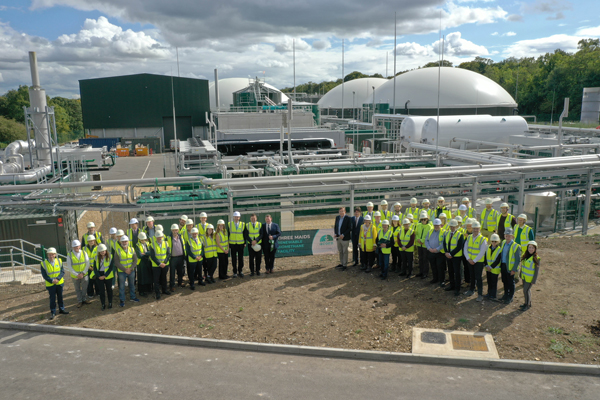
Now fully operational and supplying renewable gas to the national grid, the plant was officially opened at a ribbon-cutting ceremony attended by the Department for Energy Security and Net Zero (DESNZ), Winchester City Council Leader Councillor Martin Tod, local stakeholders, politicians and partner farmers.
The new facility, located alongside a solar farm and InstaVolt’s EV superhub near the A34, reinforces Winchester’s position as an emerging “renewable energy hub”. The plant has already created 15 jobs and is expected to support up to 50 positions within the wider engineering, rural and infrastructure supply chain.
Designed to process 83,600 tonnes of agricultural residues, local agri-waste and break crops annually, the site will produce more than 120 GWh of biomethane per year, enough to meet the entire heat demand of more than 9,000 homes.
By turning farming waste such as slurries, manures and rotational crops into green energy, the facility will save approximately 30,000 tonnes of CO₂ annually, the equivalent of planting 1.2 million trees or removing 15,000 cars from the road.
The site also generates nutrient-rich bio-fertiliser – known as digestate – that is returned to local farms to improve soil health and reduce reliance on imported and carbon-intensive alternatives, as well as high-purity green CO₂ for sustainable industrial uses.
The project is already delivering tangible benefits to local farmers, providing guaranteed fixed-pricing agreements that shield them from volatile commodity markets while lowering fertiliser costs through the use of digestate, as well as providing farmers with a local outlet for break crops grown as part of sustainable crop rotations.
Minister for Industry, Sarah Jones, said: “Acorn’s development will deliver secure, clean energy for thousands of homes and provide jobs for the local community in Hampshire.
“Biomethane can play an important role in reducing our reliance on imported fossil fuels, boosting our energy security and helping us accelerate to net zero.”
Alister Veitch, Head of Business Development at Acorn Bioenergy, added: “A real flagship hub for Acorn Bioenergy, we were delighted to launch the Three Maids facility, to demonstrate how renewable biogas generation can power homes, strengthen food security and support the UK’s net zero ambitions. Alongside our dozen sites in development, it is a major step towards our ambition to supply 25% of the UK’s biomethane.”
Commenting on the initiative, Nick Rowsell of West Stoke Farm, who supplies break crops to the facility, said: “Having farmed at Three Maids Hill previously, we always found the land had limited agricultural value. However, it has strong potential with this new renewable biogas generation facility which we are now providing feedstock for. Both energy security and food security are massively important to the UK, and partnering with Acorn Bioenergy helps us deliver both.”
By producing constant renewable gas, the Winchester plant complements intermittent sources such as wind and solar, strengthening the UK’s energy system and contributing to the Government’s ambition to quadruple biomethane production by 2030–2035.
Acorn Bioenergy is already constructing two further plants in the United Kingdom, alongside a dedicated gas injection hub. The company was acquired in 2022 by Qualitas Energy, a leading global investment and management platform with a dual focus on both funding and developing renewable energy, energy transition, and sustainable infrastructure.
Spencer Thompson, CEO at Eclipse Power, discusses the need for further competition in the transmission network, and how successfully innovating the grid depends on recognising the problem-solving role of independent network innovators.
The UK’s electricity transmission network has a problem. Begun in the 1920s, expanded in the 50s, and designed for an era of coal-fired power, today’s grid is attempting to serve the electricity demands of the 21st century with fundamentals that date back to the coal age.
But coal power has gone, renewables are thriving, and the electrification of heat and transport continues apace. As the nation strives to meet its net zero obligations, the transmission network is fast having to adapt to the variability of wind and solar, large demand customers, new centres of power generation, and new consumer needs.
Is it any wonder cracks are beginning to show? The transmission system needs modernising and rethinking to be fit for purpose now, let alone in a near-future where our power is renewable, and our heat and transport needs are met chiefly by electricity. Yet the transmission network in Great Britain is almost entirely owned by three companies, each a natural monopoly.
A grid history
It pays to understand a little of the history of power transmission in Britain. In its infancy, mains electricity was generated relatively locally and distributed only to nearby users – often municipal streetlights. As generation and use became more distributed, localised grids arose, yet there was no coordinated national system. This changed with the 1926 Electricity (Supply) Act, and in 1938 the first nationwide grid.
The fledgling grid ran at 132 kilovolts (kV), but in 1950 it was upgraded with 275kV interconnectors, offering lower losses and allowing for thinner cables for a given amount of power. By 1965, the need to transmit more electricity over longer distances was addressed with new 400kV links.
This very much became the model for British power transmission through the seventies and beyond, as major coal, gas and nuclear plants provided almost all of the nation’s electricity demands. However, the expansion of renewable energy presents two major challenges.
First, major wind and solar projects aren’t bound by the same fuel needs as coal or gas-fired stations, so big projects, requiring big connections, may be situated far from existing grid infrastructure – and major power users. Second, the output from wind and solar is inherently variable, meaning the power transmission system needs flexibility to ensure balance, consistency, and reliable operation.
New demands, new power
All of this is without reckoning on the additional challenge of changing use and growing demand. The government has set an ambitious target for almost wholly renewable power under the Clean Power 2030 Action Plan, describing this as ‘key to a growing economy, our national security, and improving our standards of living’. Achieving it is vital if renewable electricity is to displace fossil fuels for transport, and for water, space and industrial process heating – all necessary for the UK to meet its net zero commitments.
At the same time, the UK is a front-runner in data centres. It’s the world’s third-largest market for AI (after the US and China), and the leader in Europe. The country has the potential to consolidate its position and benefit from billions of pounds of investment in new data centres, unlocked by the AI Growth Zones envisaged by the government. Yet AI is famously energy-hungry, and delays in connecting new projects could threaten this highly valuable sector.
As the UK leans on clean electricity to decarbonise transport and heat, its commercial and domestic users will need more power, sometimes distributed to new places – such as large-scale EV charging points on the motorway network. These new demands are a far cry from those the grid was built to serve, and it needs rapid change to meet them.
Regulation and oversight – a necessary evil?
And yet, when did large-scale national infrastructure ever move quickly? The British power transmission grid is owned today by three companies: National Grid Electricity Transmission, ScottishPower Transmission, and Scottish Hydro Electric Transmission Limited (SHETL). National Energy System Operator (NESO), the grid operator for the whole of Britain, manages the electricity market – to it falls the challenge of balancing changing supply and demand.
The transmission system is effectively a monopoly, run to strict rules and heavily regulated by Ofgem. The industry is slow-moving and risk-averse – it’s undergone relatively modest infrastructure development since the majority of transmission assets were installed 45-60 years ago.
Despite the urgent need for multiple major upgrades, under the current system transmission projects have limited appeal to investors. They move slowly, face bureaucratic hurdles, and carry the risk of regulatory penalties that can take a huge bite out of the returns.
In this environment, it’s difficult to innovate, and challenging to deliver new capabilities to the grid. Currently it is virtually impossible to build out transmission assets for large single-use customers without a significant change in regulation. We urgently need an updated Electricity Act, and a coordinated approach from industry bodies.
The present setup isn’t what we need to decarbonise the power grid, or to capitalise on investment opportunities in the AI sector and elsewhere. With a lack of flexibility, and a limited track record in delivering major infrastructure upgrades, the incumbents of the transmission industry risk becoming the bottleneck in the UK’s plans. They need support and different non-monopoly solutions to deliver these huge infrastructure upgrades.
Adapt and innovate
If the UK’s power transmission network is to complete its renewables switch, while adapting to fast-changing use patterns, it needs a huge shake up. New grid capacity needs to come online in a matter of years, not decades. Investors in major power-using or generating projects need the reassurance they’ll get connections within a viable timeframe – or they’ll put their money in other countries where they can.
For some years Ofgem has been examining the potential of competition to drive the necessary changes. Indeed, NESO is now pushing ahead with the implementation of competition for selected projects that are:
Clearly defined (their design and construction can be separated from the system)
Large, and high-value
Not integrated with the rest of the grid in a way that means only existing incumbents can deliver them
Key to this is the concept of ‘early competition’, which it’s hoped will drive innovation, and result in fresh ideas and improved technologies. The other objectives for competition include lower costs for consumers, and projects that are more attractive to investors, helping speed up their funding and delivery. It’s certainly progress, but as the first project is tentatively put out to tender, it’s slow going.
Competition time
Yet our experience in the connections space – the so-called ‘last mile’ distribution between the transmission grid and its consumers and suppliers – shows us that competition is exactly what’s needed. In 2000, competition in distribution was opened up so that the established distribution network operators (DNOs) now faced competition from independent distribution network operators (IDNOs) like Eclipse, and independent connection providers (ICPs).
This competition has allowed dynamic market entrants who aren’t bound by geography in the same way as DNOs. Independents can plan, provide and adopt new connections to the grid across the British power network. And while still regulated by Ofgem, we enjoy greater flexibility to design innovative solutions that can reduce cost or delays, or even contribute to the overall viability of new projects.
This has had a measurable benefit for businesses and investors seeking to connect critical infrastructure such as EV charging points, battery electric storage systems, housing and commercial developments and data centres. It’s also positively impacted the service levels of monopoly DNOs, as well as improving cost-effectiveness and service levels for customers.
We need an equivalent change – now – in the transmission network. While steps towards early competition are welcome, they’re too little, too slow, to deliver the changes we need in the time we have. New independent transmission owner-operators should be created, and allowed to build the grid supply points that major power customers demand, delivering projects in two to three years – not the 10 to 15 they might otherwise take.
By leveraging the same innovation and flexibility that independent operators have brought to the distribution market, the UK can get its transmission infrastructure on track. But the status quo doesn’t encourage the incumbent grid operators to drive change, and the regulator is under-resourced and lacks the capacity or remit to do so. Without change, the sector can’t deliver the progress we need, the government’s commitments won’t be met, and the UK will miss out on massive wealth-creation opportunities.
Rinnai is launching a new division – Rinnai Applied – which will be dedicated to the design, supply and service of larger HVAC units and systems that will meet the specific heating, ventilation, air conditioning and hot water demands of commercial and industrial premises.
Applied Products, or sometimes known as Applied Solutions, consist of wide ranges of advanced air conditioning, ventilation, and heating systems designed for commercial and larger building projects. These systems offer tailored and bespoke solutions for complex HVAC needs, focusing on energy efficiency and integration into specific building designs to meet sustainability goals and comfort requirements.
Applied Products in the HVAC sector are projected to expand in global growth rate by almost 7% in the coming few years, according to a leading market intelligence & research agency. The value of the 2024 global HVAC marketplace stands at approximately $280 Billion, and it is projected to rise significantly to $390 Billion by the end of this decade.
Rinnai Managing Director – Tony Gittings, believes in the need for the entire HVAC industry supply chain to work in unison so that optimum products and systems are delivered to the HVAC commercial & industrial building sector:
Tony Gittings
“For the building services consultants, designers, larger M&E contractors, and end users it could mean that they will adapt to this changing market by asking more from others in the supply chain. I have spent my career – almost 45 years now – in product manufacturing and I have never seen a greater need for flexibility and versatility from the manufacturers and suppliers.
“Also, I want to give special mention to specialist HVAC Sales Engineers – these are highly skilled and experienced analytical people who help customers understand Applied Products and how they can be efficiently and optimally utilised. These practitioners also select products and prepare proposals for clients which include quantifiable data to support HVAC systems offered.
“The HVAC manufacturer will need to be a true partner to all those in the design, installation, and commissioning sector. We will need to offer design; full evaluation of each site in terms of practical, economic, and technical considerations; full quantitative data on CAPEX, OPEX services and life cycle costings.”
The industry growth is motivated by the global energy transition and international demand for energy efficient methods of providing acceptable HVAC products and systems. All new HVAC systems and accompanying condiments must be low carbon, best exemplified by refrigerants – hence the proliferation of R290 low GWP refrigerant.
The market is being propelled by all governments instigating immediate initiatives to encourage individuals, bodies, institutions, industries, and all developments to use energy-efficient HVAC systems in all their work areas and homes. The resurgence in HVAC applied products is best highlighted from the 1980/90s era when there was a marked move from centralised to decentralised plant installations. Now centralised systems are considered an ideal solution for heating, ventilation, and air conditioning.
Adds Tony Gittings, “A change in approach to HVAC products is making the industry take on the challenge of an inevitable reset. Gas-fired appliances such as commercial and residential boilers will be on the descent with an ever-decreasing market share.
“Electricity is well placed as the dominant future globe fuel but hydrogen, synthetic fuels, LNG (Liquified Natural Gas), and BioLPG are all being actively developed for the mass markets. Electricity will be generated from a variety of sources, all of which will be from renewable and sustainable sources such as solar thermal or heat pump appliances.
He concludes by adding, “At Rinnai we offer all these services within our mantra of ‘Creating a Healthier Way of Living’”.
For more information on the RINNAI product range visitwww.rinnaiuk.com
This article appeared in the October 2025 issue of Energy Manager magazine. Subscribe here.
Victoria Clarke: Senior Energy and Carbon Analyst, Salix Finance
As the UK accelerates towards net zero goals, the built environment, responsible for approximately 25% of the UK’s total carbon footprint, is undergoing a transformation.
Traditional buildings are evolving into intelligent systems that are no longer passive energy consumers and instead are becoming data driven systems that are capable of real time optimisation. At the core of this transition is smart energy management which can deliver substantial savings, improve performance and lower emissions, all essential to a decarbonised built environment.
For decades, buildings have consumed energy without actively managing or optimising its use. Heating, cooling and lighting all ran on fixed schedules or manual controls, often regardless of actual occupancy or demand. This led to widespread inefficiencies, such as an empty office building being fully lit.
Today, several powerful forces are driving the rapid rise of smart buildings.
Through my work at Salix, I am able to see a range of innovative solutions using the very latest smart technology in our buildings.
As organisations commit to net zero targets, improving building efficiency has become a fast and high impact lever for reducing emissions. Additionally, fluctuating energy prices and rising peak demand make efficient energy use an economic necessity for building owners and operators. Traditional energy management models are no longer sustainable, and the pressure to enhance performance, cut costs and future proof assets continues to mount. Meanwhile, advances in AI and sensor technologies have made smart technologies more affordable and scalable which has accelerated adoption. These innovations enable data driven decisions, allowing AI and machine learning algorithms to accurately forecast energy demand, detect faults early as well as optimise consumption.
A smart building integrates automation systems, sensors, meters and AI driven analytics to monitor and manage energy use across a system, such as lighting, HVAC and ventilation and renewables and storge assets on site. They are typically controlled by a Building Management System (BMS) or Building Energy Management System (BEMS) which gather and analyse thousands of real-time data points. In effect, the building becomes capable of “thinking”, observing its environment, learning from patterns and making autonomous decisions. Such thinking can enable a building to adapt to occupant behaviour, environmental conditions and energy pricing automatically. These systems don’t just gather information; they act on it. For example, being able to adjust lighting based on natural sunlight, or even shifting energy usage to off-peak hours to save on cost. This automation has eliminated the need for manual intervention, which drives not only energy savings, but also system resilience and occupant comfort.
While the advantages are clear, challenges do persist. One of the primary concerns is interoperability, as these systems often involve a complex mix of sensors, hardware and software platforms, which must communicate seamlessly. Many legacy systems were never designed for integration, making it difficult to connect older infrastructure with newer technologies. Cybersecurity is another critical issue, as greater connectivity can increase the risk of digital threats if systems are not properly secured. There is also the matter of cost. Smart technologies often require high initial investment, along with the need for ongoing maintenance and skilled personnel to operate and interpret advanced automation and analytics tools effectively.
Still, these barriers seem to be shrinking as technological advancements and supportive policy frameworks reshape the landscape. Modular, scalable solutions now allow owners to retrofit older buildings incrementally, meaning they can upgrade one component at a time, rather than requiring a full overhaul. Cloud based platforms have reduced the need for expensive onsite hardware, making deployment more accessible and flexible.
Additionally, in the UK, regulatory drivers and government incentives are helping to accelerate adoption. Initiatives like the Public Sector Decarbonisation Scheme which we deliver at Salix, has offered funding for upgrades to low-carbon and smart energy systems. Meanwhile, as the industry increasingly adopts open standards and interoperable technologies, integrating systems such as lighting, HVAC, energy management and security is becoming more streamlined, improving operational efficiency and making buildings more adaptable for the future.
The impact of smart buildings extends far beyond individual properties. By enabling more dynamic and responsive energy use, automation allows buildings to actively support wider grid management strategies, such as demand response, peak load reduction and integration with on-site renewable energy sources. For example, during times of high demand, a smart building could automatically reduce non-essential loads or temporarily shift to battery storage or on-site solar. In effect, the building functions not just as an energy user, but as an energy asset which contributes to grid stability. The shift aligns towards the move to more decentralised, low carbon energy systems. As the line between energy producers and consumer continues to blur, smart buildings are uniquely positioned to support a cleaner and more resilient energy future.
The rise of intelligent, automated energy management therefore represents a fundamental transformation in the way we design, operate and interact with the built environment. What was once considered a futuristic idea is now a practical, scalable solution addressing some of the most pressing challenges of our time: climate change; volatile energy markets; and the need for infrastructure that can withstand environmental and economic disruptions.
Smart buildings go beyond merely conserving energy. By combining real-time data, automation and AI, they can “think” to optimise performance. In doing so, they fundamentally redefine how energy is sourced, distributed and consumed. In the race towards net zero, smart buildings are not just part of the solution-they are helping to lead the way.
The solar sector in the UK has witnessed remarkable progress over the past decade – costs have plummeted, adoption has surged, and technology has advanced. But as we look ahead, it’s clear that simply generating clean energy isn’t enough. The next frontier is flexibility.
Recent policy announcements, particularly the Future Homes Standard, reinforce this direction and place a strong emphasis on low-carbon heating and onsite renewable energy – including solar PV. But the key evolution isn’t just in how homes produce energy; it’s in how they use and trade it.
With solar adoption continuing to grow, the challenge lies in managing when and where energy is used. A sunny afternoon may generate surplus electricity, but excess energy often goes to waste or is undervalued. Flexibility unlocks the true value of solar by aligning supply with demand more intelligently.
The UK’s smart meter rollout, combined with advances in battery storage and grid digitalisation, is enabling households and businesses to become active energy participants – shifting consumption, storing excess generation, or trading it in real-time markets. The result? A more resilient, efficient, and lower-cost energy system.
This is where independent aggregators such as Levelise come in. Levelise allows domestic customers to trade flexibility services in energy markets. It remains the only operator trading solely with home assets at scale. Their proven trading success has translated directly into financial results for households, having paid over £2 million to its domestic customers with batteries to date, with 94% exceeding their projected flexibility payments since 2019. On average, each customer has earned over £154 per year simply by allowing Levelise to optimise their battery. This continues to prove that residential flexibility isn’t just technically possible – it’s commercially powerful.
Achieving the government’s net zero goals will also require a power system that is not only clean but also smart and capable of adapting to fluctuations in supply and demand. One example of this adaptability is directly curtailing solar generation – intentionally reducing output to balance the grid or prevent oversupply without requiring any co-located battery. Independent aggregators – such as Levelise – enable this by coordinating distributed energy resources and making real-time decisions to maximise value for asset owners while supporting grid stability.
The benefits stretch far and wide, including:
Supporting the local grid
Local grid operators (DSOs) need help managing supply and demand – especially in areas with congestion or limited capacity. By reducing solar output on request, independent aggregators can unlock payments through DSO flexibility tenders, helping homes support their communities while being rewarded for it.
Beating the tariff trap
Some smart export tariffs, like Octopus Agile Outgoing, drop to zero when energy prices go negative. That means no payment for exported solar, no matter how green it is. But with flexibility trading, that same exported energy can be pulled into the market and earn money – even when the standard tariff pays nothing.
This shift from tariff-based earnings to market-based trading is the future. It’s more responsive, more profitable, and more sustainable.
Smarter solar and storage
For homes with solar and battery storage, curtailment plays an even bigger role. It can help avoid overcharging, free up space for high-value grid services like Dynamic Containment, and ensure systems are ready to respond when prices peak.
A major industry update – Modification P444 – is currently in the pipeline. Once approved, it will make sure households are fairly compensated when their solar is curtailed as part of a flexibility service. This would remove the final barrier to wide-scale adoption and make flexibility trading even more attractive.
The bottom line is flexibility trading helps solar homes do more with less – less export, but more value. It supports the grid, boosts household earnings, and helps the UK build a smarter, greener energy system.
This article appeared in the September 2025 issue of Energy Manager magazine. Subscribe here.