Europe’s decarbonising energy leader, Veolia, is extending low carbon heat supply to a further 1,618 residential properties across six apartment blocks in Bermondsey, using energy supplied from the 35MWe South East London Combined Heat and Power (SELCHP) facility.
Working with property real estate company Greystar’s Bermondsey Project development, the 25 year contract will help lower carbon emissions through a new district heating network. The aim is to save an estimated 1,524 tonnes of CO2 emissions a year compared to natural gas derived heat supplies.
The new district heating scheme marks another important step in decarbonising domestic heat as almost a third of the final energy consumed in the UK is used as heat in the domestic, commercial and public sectors. District heating networks that harness the heat from the waste-fed electricity generation process represent an efficient, affordable and decarbonising alternative to provide households with cleaner energy.
Due to start operating in May 2026, this infrastructure project aims to provide the heat with around a 60% renewable content due to the biogenic component of the waste treated at SELCHP. As this system represents a low carbon solution compared to alternative supplies, it will also help to advance London’s ongoing commitment to combat climate change by lowering the carbon footprint.
Veolia will design, construct, and commission the network, and be responsible for operation, maintenance, and lifecycle replacement. The system will be supplied with hot water from SELCHP, fed into the systems at 75oC, to distribute heat in the connected buildings and meet the thermal demands at each location. To ensure system resilience, the network will include an additional facility housing a back-up boiler installation.
John Abraham, Chief Operating Officer, Industrial, Water & Energy UK , Ireland & Nordics said: “This latest heat network will further advance the progress to reach the important net zero goals that protect the environment and lower climate change. It is fully in line with GreenUp, Veolia’s strategic program to accelerate the company’s ecological transformation. Locally sourced energy, derived from previously untapped resources such as waste, is becoming a true driver of regional growth. Veolia’s engineering solutions can make a real and lasting difference, help break the reliance on fossil fuels, deliver the essential energy to support communities, and address the issues of energy price volatility. By combining its expertise in waste management and local energy solutions, Veolia maximises synergies to harness the full potential of local resources for the benefit of both residents and the planet.
“This will make a significant difference to the people it serves, delivers increased energy security and resilience, and will help advance sustainability in London.”
Philip Hirst, Director, Sustainability, Greystar, said:“Trends such as urbanization, energy transition and digitization require a forward-thinking approach to infrastructure. The connection to decarbonised South East London Combined Heat and Power (SELCHP) heat network aligns with Greystar’s net zero and infrastructure ambitions, whilst also providing value to our Bermondsey residents with locally generated, low carbon heat.”
Cllr John Batteson, Cabinet Member for Climate Emergency, Jobs & Business at Southwark Council said: “In Southwark we’re committed to tackling the climate emergency and reducing carbon emissions from buildings is a key theme in our climate strategy as we work towards becoming a carbon neutral borough.
“This ambitious project will provide thousands of residents with cleaner energy sourced locally in south-east London, making positive use of waste generated in Southwark and the wider area while reducing the borough’s carbon footprint in the process.”
Veolia’s specialist network team delivers optimised, commercially viable, and technically robust solutions gained through the experience of designing and installing thousands of kilometers of networks across many prestigious and technically demanding projects. In the UK Veolia currently manages the energy plant and networks across more than 50 sites and operates over 120 community heating schemes . These distribute low carbon or renewable heat from combined heat and power plants, waste wood biomass and Energy Recovery Facilities. Globally the company currently operates around 600 district heating networks covering 7000km of heat mains.
HermeticaBlack – specialists in the development and management of energy and infrastructure assets – advised on the commercial structure and the delivery of the connection. Jones Day provided legal advice.
Affordable housing, brand new infrastructure, and nature on the doorstep. Labour’s ambition to build 1.5 million homes by 2029 and begin construction on three new towns before the next election offers a practical response to the current housing crisis. But there’s a significant roadblock in the way: the grid.
With every new home comes the fundamental need for a reliable energy connection. But the system they’ll depend on is already bursting at the seams. Ageing, weather-worn and overstretched, Britain’s grid is being tested by soaring demand and the growing impacts of climate change. It won’t neatly absorb new towns.
The government has acknowledged the scale of the challenge. Their pre-election proposal to “rewire Britain” outlined plans to modernise energy infrastructure. But while policy ideas are debated, housing projects are already moving forward, and the grid can’t afford to lag behind. For every new town we plan to create, we must simultaneously reinforce and future-proof the infrastructure required to serve it. And to do that effectively, visibility is everything.
Diagnosing in the dark
We know where the pressure points lie. Britain’s energy demand and consumption has surged ahead of its infrastructure. We’re expecting the grid to handle things at a scale it was never designed to do, while extreme weather continues to expose its physical vulnerabilities.
While we understand these strains, we have historically lacked a clear picture of where, when and how the grid is most at risk. Utilities have been navigating increased energy demand, dwindling capacity and grid ‘weak spots’ with limited insight – effectively diagnosing in the dark.
Creating a mirror image
What’s needed are tools that allow utilities to see and simulate the grid in its full complexity. A virtual physics twin could be the answer.
Physics twins are digitally-powered 3D simulations which map areas of the grid and its surrounding environment, and model how they behave and respond to the world around them. They hold up a mirror to the grid, informed by comprehensive, high-fidelity data. This visibility allows for smarter decisions: stress-testing assets, planning interventions, and responding to threats before they escalate – all in a safe, virtual environment.
Town ‘twins’ for smarter development
For planners and architects designing the next generation of towns, this technology could be transformational. With a comprehensive map of the surrounding energy infrastructure and an understanding of its constraints from day one, they can design energy-resilient developments and avoid costly delays to connection.
If 10,000 new homes are planned in an area, we know we’ll need capacity for 10,000 new grid connections. Using a physics twin, we can model this need in real-time. Based on data collected from across the existing network, we can simulate what will happen if we try to run a higher volume of energy through the grid. This will flag where there may be capacity constraints, as well as areas where there could be space for more energy to be transmitted.
Beyond capacity, these models also help us plan for environmental risks. As climate change worsens, extreme weather must be a central consideration in all future planning. By simulating events like flooding or wildfires, the model reveals which parts of the grid are likely to be affected, the damage which may be caused to different assets, and the likelihood of power outages. This foresight can facilitate preventative action. We can bolster weak points in the grid and tighten up response plans (like diverting power to local hospitals) when outages do occur.
We’ve seen this in action at Neara. In our work with a major UK utility to re-simulate Storm Arwen (which left 1 million people without power) we found that thousands of high-risk poles and vulnerable spans would fail if a similar storm hit again. Insights like these can transform how repairs are prioritised, making the network far more resilient. Applying this approach to new housing developments means identifying risks early and reinforcing infrastructure to protect communities from future outages.
These twins can also help to tackle one of the biggest hidden risks: vegetation. Trees and plants near power lines can be a serious threat. They can fall onto lines during storms, sag dangerously close in extreme heat, and even spark fires. With physics twins, planners get a bird’s-eye view of how much clearance is needed between vegetation and live power lines, balancing safety requirements with preserving green spaces.
As plans for new towns gather pace, we have a choice to make. We can continue building first and fixing infrastructure later, or we can bake energy resilience in from the beginning. We have to develop and reinforce the grid in tandem with new housing developments, not just as cities are planned and built, but also as they grow and spill out. By embracing tools like physics twins, we can ensure that every new town is designed with the future in mind.
Rinnai UK is introducing Rinnai Applied at the Elemental Show, ExCel London November 19 & 20th 2025. Rinnai Applied is dedicated to the design, supply and integration of larger HVAC units and systems that meet the specific heating, cooling, and hot water demands of the bigger commercial and industrial premises.
The Rinnai Applied stand will be dedicated to displaying the benefits of design for system congruity and modelling of overall performance from a capital expenditure, operational expenditure, and carbon emissions perspective. Rinnai Applied will be staffed by an expert team to simplify, validate, and educate on real life performance of renewable systems on major projects and sites.
Rinnai Applied will be featuring the company’s innovative approach to offering the consultant, the HVAC design engineer, and major end-users a complete specification process from systems choice and design, products selection, system commissioning and full and comprehensive after sales services – all designed to make consultant and specifier lives simpler.
Applied Products in the HVAC sector are projected to expand in global growth rate by almost 7% in the coming few years, according to a leading market intelligence & research agency. The value of the 2024 global HVAC marketplace stands at approximately $280 Billion, and it is projected to rise significantly to $390 Billion by the end of this decade.
Rinnai Managing Director – Tony Gittings, believes in the need for the entire HVAC industry supply chain to work in unison so that optimum products and systems are delivered to the HVAC commercial & industrial building sector:
“The HVAC manufacturers, such as Rinnai Applied, will need to be a true partner to all those in the design, installation, and commissioning sector. We will need to offer design; full evaluation of each site in terms of practical, economic, and technical considerations; full quantitative data on CAPEX, OPEX services and life cycle costings.
“We have a large range of educational CPDs from SPF in heat pump assessment, Heat Pump design, Integrating solar thermal and Heat Pumps and many more sign up for a free CPD today as places are filling up fast https://www.rinnai-uk.co.uk/training/cibse-cpd-training-enrolment.”
He concludes by adding, “At Rinnai Applied we offer all these services within our mantra of ‘Creating a Healthier Way of Living’”.
Hamworthy Heating, a trusted British manufacturer and supplier of commercial heating and hot water products, has supplied its Modumax mk3 modular condensing boilers and Powerstock calorifiers to Corpus Christi College, University of Cambridge. Installed within a Grade I Listed building; the new system delivers an efficient heating and hot water solution tailored to the unique challenges of the site.
The project involved replacing an ageing plant room in the basement of the college, where access was severely restricted and space limited. These constraints ruled out traditional large-scale plant equipment and required a compact system that could be transported through narrow doorways without structural alterations.
The chosen system features four Modumax mk3 floor-standing condensing boilers (196 / 392V) delivering 1,532 kW total across eight modules. These are integrated with two Hamworthy Heating Powerstock PS500 indirect calorifiers to provide domestic hot water for the college.
Hamworthy Heating’s Modumax mk3 range is specifically designed with retrofit projects in mind. The modular format allows boilers to be dismantled and manoeuvred into confined spaces before being reassembled in position, providing the flexibility needed for heritage environments where plantroom layout and access present unique challenges. By combining the modular boilers with Powerstock calorifiers, the system delivers both efficient heating and a reliable domestic hot water supply for the college.
To ensure precision, the project team used Hamworthy’s 3D digital design tools to plan the plant room layout in detail. This approach enabled much of the pipework to be prefabricated offsite, which streamlined the installation, and ensured that new equipment could be delivered in stages and installed in a single operation.
“The 3D models allowed us to coordinate the plant room before we even stepped on site. It saved time and helped everything run efficiently. Careful delivery planning also meant the installation could be completed in one single day,” explains Geoff Bunton of Bunton M&E Services.
The completed upgrade now provides Corpus Christi College with a robust, futureproof heating and hot water system that improves efficiency, reduces emissions, and meets the demands of its academic community, all while preserving the integrity of its historic setting.
To further assist those responsible for specifying and installing energy storage system (ESS) solutions, Ecobat Battery, the UK’s largest battery distributor, continues to grow its product offering and make understanding the depth of its portfolio more transparent and easy to digest.
Addressing the overall offering, Ecobat Battery’s policy is to provide flexible and scalable solutions, from several alternative suppliers, to allow its customers to tailor the system to their specific requirements. With this approach, the deciding factors that naturally have to be considered before a decision is made, such as the overall cost or the country of manufacture, etc, can be catered for, which further endorses the company’s multi-brand strategy.
Presenting the brands and the various products that these manufacturers offer is equally important, which is where Ecobat Battery’s new ESS catalogue comes into play. The 16 page publication, which is available online, to download or via flipbook, begins with an introduction indicating the variety of customers the company caters for, before setting out what it has to offer, why customers should work with it and the brands that it supplies, plus the ESS sectors that it serves.
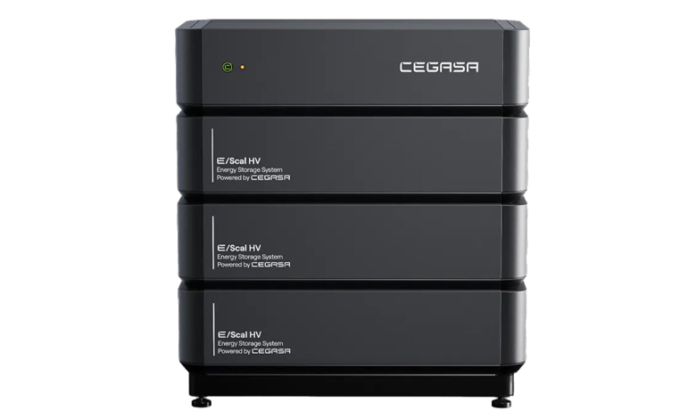
Examining the brands in detail, and beginning with Pylontech and the various options that this well respected manufacturer has to offer, it then turns the spotlight on to prominent European manufacturer Fronius, alongside Cegasa, another European option incorporating high and low voltage compact, but scalable systems. Victron Energy is a well known player in the market and its flexible inverter/charger systems and parallel and three-phase support systems are all clearly described, along with renowned Canadian manufacturer Rolls Battery, with its ESS offering.
Naturally, an ESS system is rarely complete without a solar element, which is where the catalogue concludes, with several options highlighting a variety of modular systems from brands including LONGI Solar, trinasolar, eurener energia solar, JinKO Solar and AIKO.
Ecobat Battery’s ESS offering, which caters for both on and off grid systems is, in common with its products supplied across multiple sectors, supported by a superb level of service, technical advice and backup, and a reputation that comes with a business that has been proactive in the battery market for more than 70 years.
In this article, Tom Davies, Sales Manager for Energy Control at fortop Automation & Energy Control (fortop UK), explores how improving power quality and energy management is essential for industrial facilities to achieve Net Zero goals and comply with schemes such as the Energy Savings Opportunity Scheme (ESOS).
Technical Managers in Industry Face Major Challenges
Heavy industry and manufacturing sectors are under increasing pressure to reduce carbon emissions and energy costs. With the transition away from gas and the rapid adoption of advanced electronic machinery, electrical pollution is becoming a significant issue. The reliable operation of industrial equipment is increasingly at risk due to poor power quality.
Electrical Energy Supply in Industrial Facilities
Factories and industrial plants have seen a significant rise in the use of electronic devices and automation systems. Robotics, CNC machines, VSDs and VFDs, and advanced process controls are now indispensable. While these technologies boost productivity and efficiency, they also introduce new challenges for energy management and power quality.
Energy-saving solutions such as solar panels, LED lighting, and frequency-controlled drives are widely implemented. However, these devices, along with industrial equipment, can introduce pollution into the power grid, affecting voltage and current quality. Modern machinery is often sensitive to the very disturbances it helps create, leading to:
Increased risk of system failures from voltage sags and current peaks
Emergency power systems failing due to capacitive loads, harmonic pollution, and unbalanced loads
Higher maintenance costs and more frequent malfunctions due to increased network pollution from mechanical installations, automation equipment, LED lighting, and solar panels
Greater load on the neutral conductor due to unbalanced phases and network pollution
Increased transformer burden resulting from network pollution and asymmetric loading, compounded by harmonic distortion and phase imbalance on the load, leads to further derating of the transformer
Ever more stringent legal requirements regarding electrical energy quality and responsibilities
These trends make electrical energy systems harder to manage. Emergency power operations may fail, and voltage sags can cause production line stoppages or even temporary plant shutdowns. The costs of poor power quality are often hidden within maintenance budgets, making them difficult to track.
Voltage and Current Quality in Power Monitoring Systems
Most energy monitoring systems in industrial facilities are linked to SCADA/Factory Automation Systems and focus primarily on energy consumption. However, the health of voltage and current is often overlooked. Electrical disturbances and power quality issues frequently go unrecorded, making it difficult to diagnose failures, a situation that is no longer acceptable for modern industry, especially with ESOS and Net Zero targets in focus.
Leveraging its experience in critical applications to ensure voltage and current availability under all conditions fortop UK applies a unique chain of competencies: measuring, monitoring, and improving.
The Four Management Aspects of Electricity
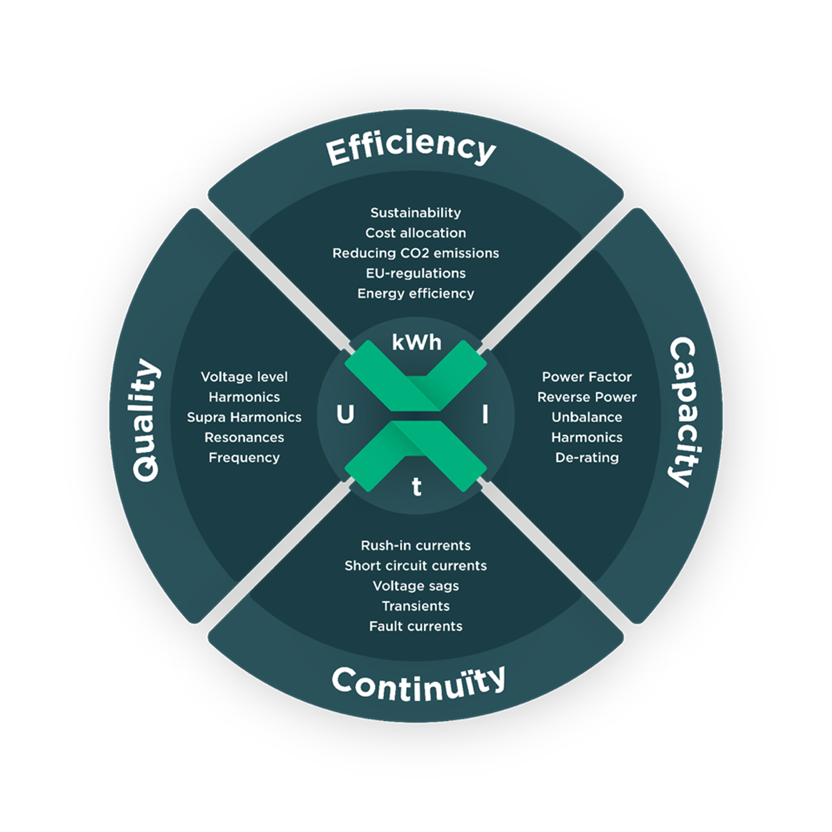
Power optimisation is a continuous improvement process involving measurement, monitoring, and optimisation to prevent failures, reduce energy and maintenance costs, and minimise the impact of malfunctions. This process focuses on four key aspects of electricity:
1. Energy Efficiency (Consumption) Mandatory energy audits and increasingly stringent regulations – such as ESOS – make continuous insight into energy flows essential. By visualising energy consumption, awareness and engagement in energy-saving measures increase, and their impact can be continually assessed. This approach enables accurate allocation of energy costs to different departments or production lines. Monitoring power consumption across installations helps identify energy losses, standby consumption, and metering connection errors immediately.
2. Load (Current) Facility managers need a clear understanding of available capacity within the electrical system without requiring costly expansion. When switching to backup generator operation, it is crucial to know how much power is available for connected equipment. Harmonic pollution, low power factor (cos-phi), and unbalanced loads place additional stress on transformers and generators. The dynamic behaviour of loads makes prediction challenging, necessitating insight into daily, weekly, and yearly load profiles.
3. Quality (Voltage Quality) A healthy voltage supply lowers maintenance costs, prevents failures, and conserves electrical energy. It also provides clarity and responsibility allocation, which is essential in liability cases following equipment failures. Voltage quality standards play a crucial role in determining whether industrial equipment can be connected and whether warranties apply.
4. Continuity (Sags, Swells, and Residual Currents) Voltage sags and current peaks can cause failures in parts of the electrical installation. Timely alerts shorten downtime by enabling faster troubleshooting. By recording dips and peaks with a resolution of 50 microseconds, the root cause can be identified, and appropriate measures can be taken to mitigate negative impacts.
Integrating Power Quality into Power Monitoring Systems
When integrating energy measurement systems for energy efficiency, it is essential to incorporate voltage and current quality into the monitoring concept.
Three Steps to Lower Consumption, Reduced Maintenance Costs, and Fewer Failures
Power optimisation is a continuous improvement process involving measurement, analysis, and optimisation, aiming to reduce energy consumption, lower maintenance costs, and minimise failure risks.
Step 1: Continuous Measurement with Power Analysers
To support continuous improvement, 24/7 measurement is essential to enable trend analysis, verification of energy savings, and real-time alerts for incidents.
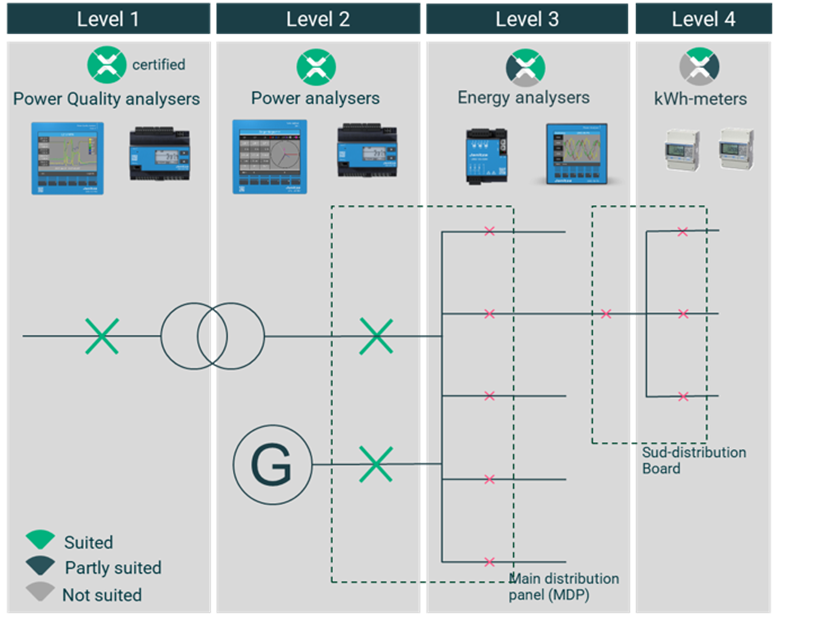
Fortop uses a standardised blueprint for an “installation-wide” measurement system, assigning the most suitable measuring instrument at each level of the electrical installation, including Janitza measurement instruments with a resolution of 50 μs for precise voltage and current sampling.
Measurement levels:
Level 1: Medium voltage incoming fields – Power Quality Analysers
Level 2: Low voltage side of power transformers – Power Analysers
Level 3: Main distribution board outgoing feeders – Energy Analysers
Level 4: Sub-distribution boards and end users – DIN-rail consumption meters or multi-channel meters
Step 2: Continuous Monitoring with gridXpert
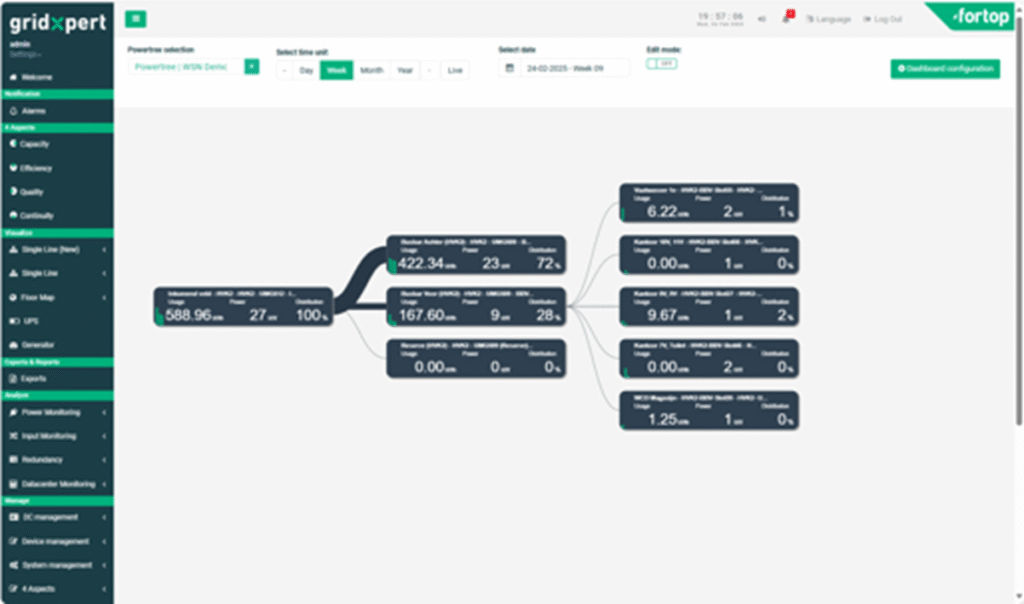
To consolidate all measurement data into a single system and translate it into actionable insights, fortop UK has developed the gridXpert Industrial Edition. This system provides real-time and historical measurement data at a millisecond level. It integrates data from meters, switches, generators, and UPS systems into real-time alerts, visualisations, and reports.
Key features:
Alarm Manager: Immediate alerts for overloading, voltage failures, and power quality deviations via SMS, email, BMS, or a dedicated smartphone app
Power Tree Function: Maps real-time and historical phase loads for the entire electrical system, identifying energy waste and optimising capacity
A simple SCADA/Factory Automation System controls building functions but lacks deep energy analytics. Power monitoring adds precision, cost control, and reliability, making it a smarter choice for industrial energy management strategies. This leads to enhanced energy efficiency, cost savings, improved resilience and reliability, compliance with schemes like ESOS, and better, more informed decision making and future planning.
Many facilities already equipped with SCADA choose to expand capabilities by integrating with a new Power Monitoring System (PMS). Issues arise only when facilities attempt to rely solely on a BMS to avoid using a PMS.
Step 3: Improving Power Quality
Once a power quality issue has been identified and thoroughly analysed, the implementation of appropriate power quality solutions becomes essential to mitigate its impact and prevent recurrence. By applying targeted corrective measures, power quality solutions not only restore compliance with standards but also improve system efficiency, extend equipment lifespan, and reduce operational disruptions..
Extra Power Capacity and Fewer Failures with gridXtend Modular Hybrid Filters (FPH)
The FPH Modular Hybrid Filters provide a comprehensive solution for power factor issues. These hybrid filters contain both active and passive components, allowing them to mitigate various power quality problems, including harmonics, supra-harmonics, resonances, and unbalanced phases.
Key benefits:
Up to 30% more transformer capacity and 50% more generator capacity by filtering reactive power and harmonics.
Up to 4% energy savings and CO2 reduction by reducing cable and transformer heating and improving overall energy efficiency.
Lower maintenance costs and protected equipment warranties by minimising voltage pollution.
Voltage Dips Prevention with Stabilisation Systems
Voltage stabilisation systems operate parallel to the load, mitigating short-term voltage dips without requiring full UPS systems. This prevents equipment failures and unwanted current peaks.
Experience Fortop
The team of technical specialists at fortop UK can guide factories and industrial facilities through all aspects of power management, from selecting the right meters to commissioning and maintaining software and active compensation systems, all under one roof.
For further information about fortop’s experience with industrial facilities, visit www.fortop.co.uk.
Advanced Corrosion Protection and Efficiency Enhancement for Critical Energy Infrastructure in the UK & Ireland
Deep Water Blue, a leading provider of innovative water treatment solutions, has announced the availability and proven benefits of ODACON® film-forming chemistry for Waste-to-Energy (WtE) facilities, gas-fired power stations, and biomass plants across the UK and Ireland. This technology, licensed by Reicon, offers exceptional corrosion protection and operational efficiency improvements for high-pressure steam systems operating under the demanding conditions typical of modern power generation facilities.
Where power stations have moved away from using legacy oxygen scavengers like hydrazine, the shift has left steam systems more exposed to oxygen-related corrosion. This is especially prevalent as modern plants frequently shut down, restart, and adjust output to manage grid demand. These flexible operations are now common, but create new vulnerabilities in turbine, condenser, and steam cycle components.
As Deep Water Blue’s water treatment consultant George Nixon explains, ODACON® offers a modern solution for these evolving industry needs: “ODACON replaces outdated, hazardous chemicals with an advanced film-forming treatment that, in one simple step, covers the entire water-steam system from the boiler right through to turbines and condensers, helping power stations protect their assets even while demand is fluctuating.”.
By adding a molecular coating to system surfaces, ODACON® shields against both oxygen corrosion and flow-assisted corrosion, key threats during frequent load changes and stop-start cycles. As George highlights: “This means power stations can count on enhanced corrosion protection to maintain reliable operation and extend the life of their equipment.”.
Recent projects underlining the proven value of ODACON® include the 800 MW combined cycle gas turbine (CCGT) power plant in at Statkraft Germany, where it delivered a 50% reduction in re-commissioning time and a 70% reduction in iron concentration in intermediate pressure sections during restart. The treatment also eliminated the need for nitrogen blanketing and complex drying procedures, significantly simplifying operational requirements while providing robust corrosion protection.
In a Swedish biomass facility operating at 144 t/h steam capacity, ODACON® led to the complete elimination of Flow Accelerated Corrosion (FAC) in critical components. It also transformed red haematite oxides into a protective grey magnetite layer, reduced turbine deposits and scale formation from boiler carry-over, and enhanced drying capabilities during shutdown periods.
Efficiency gains are another major advantage, with ODACON® gently cleaning legacy deposits and encouraging the transformation of red haematite into a protective magnetite layer on heat transfer surfaces.
ODACON has a very low dosage requirement, is easy to integrate into existing power plant control systems and fits smoothly into today’s operational blueprint. For power facilities seeking straightforward, reliable corrosion protection that improves efficiency and cuts downtime, ODACON® answers the challenge. Its proven record across fossil, combined cycle, and biomass plants is supported by guidance from leading industry groups, including IAPWS TGD 8-16 (2019).
Lighting is playing an ever-increasingly important role in the circular economy. Luminaires are no longer seen as part of the disposable society, thanks to a recognition that they can be upgraded and refurbished to extend their lifetime. Responsible manufacturers are integrating this approach into the design of luminaires from the outset, providing greater convenience to sustainability. David Goddard, Head of UK Projects from LEDVANCE explores this principle.
For many years the lighting industry faced the challenge of reducing electronic waste. The barrier to achieving this was the limited lifespan that traditional light sources, and even early generation LEDs, offered. To address this, responsible manufacturers have adopted manufacturing practices that enable luminaires to be part of the circular economy.
At its heart, the circular economy is a model of production and consumption that involves reusing, repairing, refurbishing existing products for as long as possible. The lifecycle of products is subsequently extended and is a move away from the linear economic model society had become reliant on. The unsustainable linear model is one which involves large quantities of cheap, and therefore rapidly disposable, products. These are never recycled or upgraded and ultimately end up being sent to landfill on an all too frequent basis.
One example of the circular economy in practice is LEDVANCE’s EVERLOOP approach. This principle enables the replacement of individual light sources and drivers in a convenient way, rather than having to replace luminaires in their entirety. The purpose behind EVERLOOP is that it is integrated into the LED from the offset, allowing for the straightforward upgrade with new drivers and new LED light sources at any time. This means the luminaires have an almost unlimited lifespan.
The ease of replacement is key to the success of this sustainability practice. Having the ability to change the driver and light source embedded into the luminaire offers a convenient choice for many across the industry. This includes installers, planners, and facilities managers, among others wanting to secure sustainable efficiency of industrial and office applications, as well as public buildings.
The EVERLOOP approach is one way that LEDVANCE is contributing to the EU’s plan to reduce electronic waste. As well as meeting legislative requirements and targets, it also represents how lighting manufacturers are demonstrating efforts and measures that go above and beyond to address sustainability matters.
There are many reasons why focusing on the reduction of electronic waste is crucial. Firstly, the re-use of existing products slows down the use of natural resources and raw materials. This means a reduction in landscape and habitat disruption as materials do not need to be mined.
A circular economy further protects the natural environment by lowering the amount of waste that is sent to landfill, or disposed of through burning. Figures from the World Resources Institute show that each year, 300 million tonnes of plastic waste is produced globally. This is in addition to 54 million tonnes of electronic waste. Designing products that can be used for much longer will reduce waste levels, and therefore pressure on the environment.
Adding to this, creating more efficient and sustainable products from the beginning of its lifecycle helps to lower energy and resource consumption. This is because, according to research published by the European Parliament, it is estimated that more than 80% of a product’s environmental impact is determined during the design phase.
To put this into context, data shows that around 45% of global greenhouse gas comes from product use and manufacturing. By implementing circular economy strategies that reduce this need to keep producing more and more, will significantly lower greenhouse gas emissions. This has the ability to reduce and potentially reverse some of the negative implications of climate change.
The circular economy also secures benefits that go beyond the individual products themselves. A reduction in the number of new products also lowers the associated packaging that needs to be disposed of. By upgrading the products that are in situ, there is less packaging for the replacement products – only what is needed to transport and store them safely. This in turn lowers the amount of waste, that in too many cases is still non-recyclable, that will be sent to landfill.
The role of lighting in the circular economy is clear to see, especially when there is an easy solution to challenging the outdated and detrimental linear model. The move to refurbishing and upgrading luminaires is becoming increasingly commonplace, and LEDVANCE is proud to be part of this movement. https://www.ledvance.co.uk/
Student accommodation providers face a triple challenge. They need to deliver comfortable, modern living environments, stay ahead of tightening regulatory requirements, and cut costs in the face of rising energy bills. At the same time, they are under growing pressure to support universities’ ambitious net zero strategies.
Many operators are already investing in retrofits, electrification, and smarter building management. But compliance deadlines and budget constraints mean not every solution is realistic to implement at speed. What if there were a way to reduce emissions and costs immediately, without new capital expenditure, and while future-proofing estates for the long term?
That’s where Voltalis comes in.
Flexibility that goes further than compliance
Voltalis provides intelligent demand-side flexibility. In practice, this means helping buildings use less electricity during peak times, when power is most expensive and carbon-intensive, without affecting comfort or student experience.
By installing smart control modules at no upfront cost, Voltalis enables short, automatic adjustments to heating, cooling and hot water systems. These adjustments are invisible to occupants but deliver up to 15% reductions in electricity use, verified carbon savings, and compliance with grid-balancing and decarbonisation requirements.
For estate managers, that means:
Immediate financial returns: Average 15% reduction in electric heating and cooling costs with no capital investment
Verified Scope 2 emission reductions that contribute directly to net zero reporting
Zero operational disruption to student comfort or accommodation management
Automatic compliance with grid-balancing requirements and future regulatory frameworks
Revenue opportunities through participation in grid flexibility markets
Real results: University of Wales Trinity Saint David
In autumn 2024, Voltalis partnered with the University of Wales Trinity Saint David to install its technology across over 100 student accommodation rooms. The 15-minute installations required no rewiring or building modifications, making them ideal for heritage properties.
Within six months, the results exceeded expectations:
13% reduction in electricity consumption across two accommodation blocks
Over 5,000 grid support events delivered automatically
Significant Scope 2 emission reductions contributing to decarbonisation targets
Zero student complaints despite consistent system operation
Seamless integration even in buildings dating back over 200 years
As Daniel Priddy, Head of Sustainability, explains: “Since installing the Voltalis solution, we’ve achieved a 13% reduction in electricity use across our student accommodation – all without any changes in comfort or behaviour. That’s rare, especially in a heritage university with complex infrastructure. What’s even more impressive is that despite the system running consistently, there were no complaints from users.”
The strategic advantage: from cost centre to grid asset
Traditional energy management treats buildings as consumers. Voltalis transforms them into active grid participants, creating value from flexibility while reducing costs.
As the UK grid becomes increasingly renewable-dependent, the ability to shift demand intelligently becomes a strategic asset. Student accommodation, with its predictable usage patterns and distributed footprint, is perfectly positioned to capitalise on this transition.
For PBSA providers managing multiple sites, this represents a step-change in how accommodation can contribute to both institutional sustainability goals and operational efficiency. It’s not just about using less energy, it’s about using energy smarter.
Beyond compliance, towards resilience
The role of student housing in the energy transition is often overlooked. Yet PBSA buildings are both high-consumption and highly replicable across the UK estate. With solutions like Voltalis, operators can move beyond box-ticking compliance to become active contributors to grid stability, carbon reduction, and cost resilience.
Flexibility is not just about balancing the grid. It’s about future proofing your estate against rising costs, regulatory scrutiny, and the volatility of a changing energy system. Early adopters don’t just achieve compliance, they position themselves as leaders in the sector’s transition to smarter, more sustainable operations.
Scaling success across the sector
With over 1.5 million devices already managing flexibility across Europe and UK, Voltalis is expanding its university partnerships following the UWTSD success. Similar deployments are underway with other institutions, demonstrating the scalability and replicability of demand-side flexibility in student accommodation.
New research from TEAM Energy, a leading multidisciplinary energy consultancy, shows that while many UK organisations are committed to the UK’s net-zero journey, most are not on track to meet the deadlines, with several structural challenges undermining their ability to decarbonise and jeopardising the UK’s net zero agenda.
The survey report, ‘Carbon Countdown: Progress Towards Net Zero,’ shows that almost half of organisations have made a formal commitment to achieve net zero emissions (49%), yet a large majority are currently not on track to hit them. Only 2% say they are extremely confident their organisation will meet their net zero deadline. By far the biggest challenge facing UK organisations is financial constraints (76%), leading many organisations to call for greater levels of support in the form of accessible financial aid (72%). Organisations also say they are lacking the technology, training and guidance (63%), and policy clarity (44%) to make meaningful progress towards their net-zero targets. Over a third of organisations say technological limitations (39%) are a major challenge, while 33% of organisations are lacking the expertise they need.
Graham Paul, Service Delivery Director at TEAM Energy, said: “We consistently see organisations that want to deliver net zero hamstrung by a lack of expertise, tools and funding. And many of those who do have the resources are missing the independent validation needed to decarbonise. Without addressing these challenges, organisations could lose the momentum behind net-zero projects, undermining their potential for progress and success.”
Most organisations (55%) haven’t had their net zero planning independently validated, risking the effectiveness of the plans – and putting their brand reputations at risk in case of failing to meet them. On top of this, just under half of organisations surveyed (48%) rate their organisation’s progress as ‘fair’, and 27% of respondents report they are ‘not so’ or ‘not at all’ confident their organisations will meet their stated deadlines.
Graham Paul said: “Given the size of the transformation required, I’m impressed with the achievements so far of many UK organisations, especially considering net zero has only been a UK target for six years. But now is the time for organisations to work closely with the right partners and take a structured approach to net zero planning: reducing emissions, auditing energy use, setting Science Based Target initiative (SBTi) aligned targets, investing in their workforce, and embedding sustainability in top-level leadership decisions. Without this, they risk putting time and effort into ineffective and unproven strategies. I’m confident that with the right support, this approach can deliver results.”
The report captures insights from organisations from all sectors and of all sizes, building a comprehensive picture of where UK businesses stand and the support required to accelerate their transition. Alongside the insights, it has concrete recommendations and practical steps that organisations can take today – download a copy here.
This article appeared in the October 2025 issue of Energy Manager magazine. Subscribe here.