



George Richards, Director, JRP Solutions asks: Do you have a white elephant hiding out in your organisation? Or maybe even a whole herd of white elephants?
I have discovered that, sometimes with the best intentions and some very good projected results, energy efficiency projects or equipment are commissioned and installed and then either never turned on OR turned on and then not operated in the way in which they were intended.
Up and down the land, I have seen expensive technologies sitting idle and not fulfilling their potential once commissioned and installed. I asked around our consultants if they had had any similar experiences. Sadly the answer was a very loud yes!
Here are just a few examples from our consultants where they have seen examples of these ‘white elephants’:
“We rarely see a BMS that is operating optimally – we recently carried out a BMS optimisation exercise for a red-brick university where substantial energy and costs savings were made by rectifying some problems including
- Thermal wheel heat recovery systems not working
- Faulty or inaccurate temperature sensors
- Lack of dew-point temperature sensor resulting in dehumidification when not required
- Heating and cooling systems fighting each other because of poor tuning of control loops
- Heating and cooling control valves passing when in closed position.”
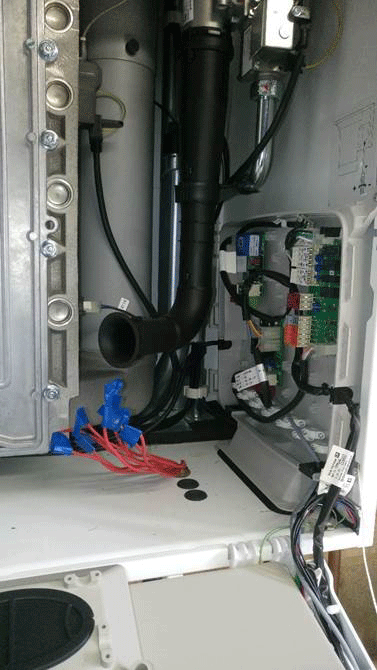
“This picture is of a boiler plant in a school that was never connected to the BMS outstation when installed. So the BMS said all the heating was off, but I could see gas consumption going through the AMR meter so after some lengthy investigations the Operations Manager found this. This had been going on for about 3-4 years at a cost of about £10k per year which represented about 35% of the school’s energy bill each year.”
“One that springs to mind is a water company that had a medium sized hydro turbine installed at a reservoir, only for it to be mothballed and left in a state of disrepair shortly after and never really getting it going again because it was ‘too difficult’.”
“To save costs, one global organisation had heat recovery systems installed cheaply in a configuration that is impossible to operate. The same client had a heat recovery exchanger replaced with straight pipe without client being aware.”
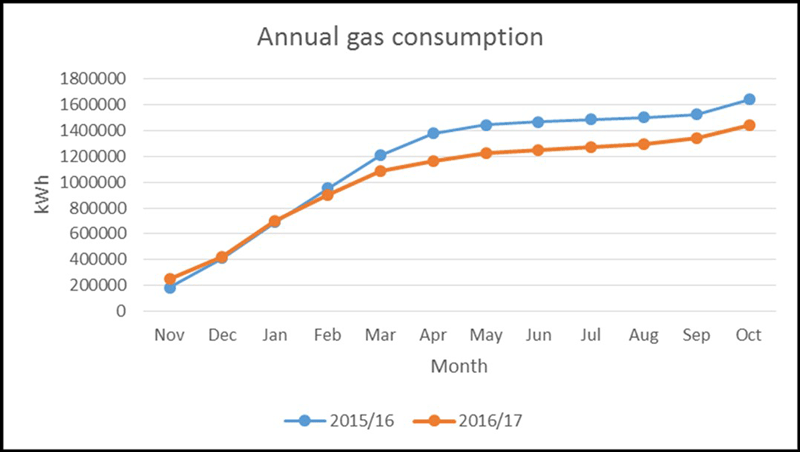
“Installing a retrofit economiser is a great way to save energy – they basically take the heat from within a boiler chimney, and put it into the water going into the boiler (the feed water, which is normally at general tap temperature) to minimise the amount of energy required to heat the water up in the actual boiler to the desired temperature. The downside is they get dirty very easily and pretty much every retrofit economiser project I have ever seen is either not working efficiently or not at all as a result of fouling and either lack of knowledge or willingness to keep it clean! We even saw one in a brewery where they couldn’t prove any benefits as they forgot to install any metering.”
“One global manufacturing client had a major lighting project installation which was predicted to make significant savings. When we checked the data, we could see that the savings achieved were greatly below forecast following the initial installation because the contractor hadn’t adjusted the controls.”
“In some schools where I worked, new biomass boilers were installed by the local authority to emphasise the council’s green commitment and credentials, as well as being part of a plan toward reducing emissions. Alongside the Biomass boilers back up gas-fired boilers were installed. The schools were worried about running out of pellets or the biomass boilers breaking down and not knowing how they worked so they never used them and used the backup gas-fired boilers instead. I have also seen solar thermal installations not connected and rainwater harvesting projects abandoned because they needed regular maintenance which had not been costed or scheduled so were turned off. In another school a solar thermal project was installed as part of a bigger project to build a new sports Hall. No one on the design team had any relevant experience. It was supplied by the manufacturer but fitted on site by the build team. It was incorrectly installed and never worked.”
All this equipment represents a substantial investment and an incredible waste of money, resources and potential energy and emissions savings. So, when most organisations are watching the pennies and striving to reduce greenhouse gas emissions, how can this happen?
These are some of the reasons that we have seen:
- Transfer or lack of responsibility: Often cutting edge equipment has been included by building designers in order to gain a high BREEAM rating for a new build, but once the building has been constructed, there is no proper handover so it falls to a building manager who doesn’t understand the technology and doesn’t know how to use and maintain it, so it’s never used. Additionally, the technology is provided by a third party such as landlord but occupants prefer not to use.
- Personnel change: I have seen efficient buildings become inefficient because the only person who understood the Building Management System and made it look easy has left and the powers that be have assumed that because the building is efficient, a much less qualified person can be left to manage it.
- Lack of training and skills fade: Often after initial equipment training, operators fall into bad habits and efficiency is lost. Sufficient initial training and regular refresher training is essential to maintain efficiency.
- Limited documentation: The benefits of training can be lost if there is limited documentation. This may be limited to a folder of operation and maintenance manuals for each component of a system, but lacking an overall documentation on how the whole system should operate efficiently.
- Poor data analysis: Installation of good metering and monitoring equipment is an essential first step to consistent and comprehensive energy management to ensure maximum efficiency. Having installed the equipment however, sometimes there is insufficient ability to analyse and interpret what the data means and opportunities to make savings are lost.
- Excessive ‘Value Engineering’: I have seen key elements of a project omitted or simplified to save costs, including omission of meters or sensors not deemed essential for efficient operation and simplifying an installation to such an extent that a system will be incapable of efficient operation. This can happen particularly on these last parts of a project if other elements have been over-spent. In such cases commissioning may have been deemed to be successful if, for example the required space or process temperatures have been achieved, but at the expense of excessive heating/cooling conflict and energy waste upstream in the delivery system.
- Culture: If the culture of the organisation is not aligned with energy and carbon saving objectives, it is unlikely that individuals will be motivated to either be aware of or address the technological challenges.
- Mistake: Rarely is the purchase of new equipment a complete mistake, but it does happen. A thorough business case and options appraisal by a qualified person will ensure this doesn’t happen.
Here are some sensible and often quite simple steps that will ensure your equipment is being used efficiently and effectively to maximise cost and carbon savings:

- Carry out an equipment health check and/or energy audit
- Appoint an appropriate organisation to carry out system/equipment optimisation
- Implement appropriate training
- Consider implementing a behaviour change programme
- Engage professionals to ascertain viability of bringing the asset into service
- Locate operating instructions and retrain/up skill staff or use external trainers if needed
- Set correct operating parameters or confirm existing ones still match the operational needs of the building
- Determine and set aside a maintenance/service budget for the future
- Install permanent or temporary metering of consumption/generation of technology and analyse to gain insight to inform business case or monthly/annual reports on kWh/carbon reduction or efficiency.
We should all be focussed on doing everything we possibly can to work towards a Net Zero economy. We cannot afford to miss opportunities to save energy and reduce greenhouse gas emissions. In some cases there may be some costs involved in appointing specialists to help you maximise your investment and make the energy savings predicted but the cost of not doing anything will be far greater.*
If you have any questions or would like to discuss any of the above, please call JRP Solutions on 0800 6127 567 or email George.richards@jrpsolutions.com.
