


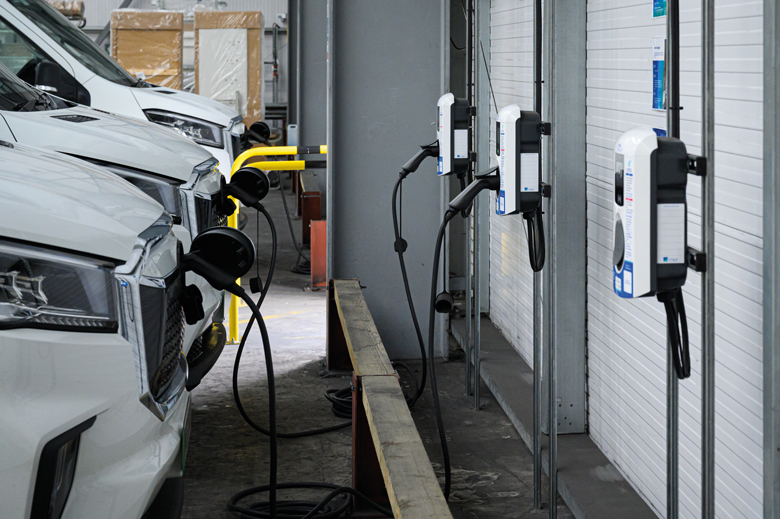

With continuing growth in fleet electrification, Natasha Fry, head of sales at Mer Fleet Services, talks about why businesses must put charging infrastructure at the top of their EV fleet plans, and the risks to those that don’t.
Transitioning a fleet to electric vehicles (EV) is a board-level concern: it requires significant investment and has far-reaching operational implications. And, like many capital projects, the decisions made in the early stages have a habit of compounding – for better or worse – as the project heads towards completion.
For EV fleets, one of the most consequential early decision points is how to design and specify charging infrastructure. It’s a decision that is frequently delegated too far down the organisation, approached as a procurement exercise and decided by cost and delivery times, rather than a strategic decision that defines the project.
The choice between AC (alternating current) and DC (direct current) charging sits at the heart of this. Get it right and your infrastructure becomes a competitive asset that can reduce operational costs, increase driver retention and grow the fleet in the future. Get it wrong and you’re looking at wasted investment and operational disruption, and probably some expensive retrofitting that erodes confidence in your electrification programme.
A technical decision with long-term business consequences
The technical difference between AC and DC charging comes down to where the power conversion happens. The electricity grid delivers AC power, but EV batteries store DC power. With AC charging, the conversion happens inside the vehicle itself, using the car’s onboard charger, which is limited in size and weight, and therefore power capacity, or speed of charge. DC charging bypasses the vehicle’s onboard charger entirely. The conversion from AC to DC happens not in the car, but in the charging unit itself, which can therefore be much larger and more powerful, shortening charge times dramatically.
It might seem like a simple decision – after all, who wouldn’t want faster charging? But DC charging infrastructure requires a higher capital outlay than AC, often by a significant multiple. At scale, across a large depot or many sites, that can run into hundreds of thousands of pounds. DC chargers are also more complex, more expensive to maintain and fix, and place significantly greater demand on your incoming electrical supply. For many sites, this triggers long and expensive grid reinforcement works, causing project timelines to stretch well beyond initial expectations.
So if vehicles don’t need rapid charging to meet their operational duties, installing DC chargers can result in a significant investment tied up in infrastructure that delivers no tangible business benefit.
But the reverse error also has a cost: relying on the cheaper, easier-to-install AC infrastructure in an operational environment that needs at least some rapid charging, results in vehicle downtime and service disruption. It will ultimately require retrofit investment to fix, something that almost always costs more than paying for the right specification up front.
Operational resilience as a strategic priority
It’s clear that the companies which most successfully transition to EV fleets are those who reframe the AC versus DC question, turning it from a technical decision to a strategic direction. They’re asking the question: which infrastructure model best protects our ability to operate continuously, at scale, and with the flexibility our business demands?
In practice, there is no single right answer: it varies significantly by business model and other factors, including geography and available investment. A logistics operation with depot-based vehicles and predictable overnight dwell times has fundamentally different infrastructure requirements to a field service business with unpredictable schedules, or a passenger transport operator running vehicles across multiple shifts. A business operating in an urban environment faces different challenges to one in a rural setting.
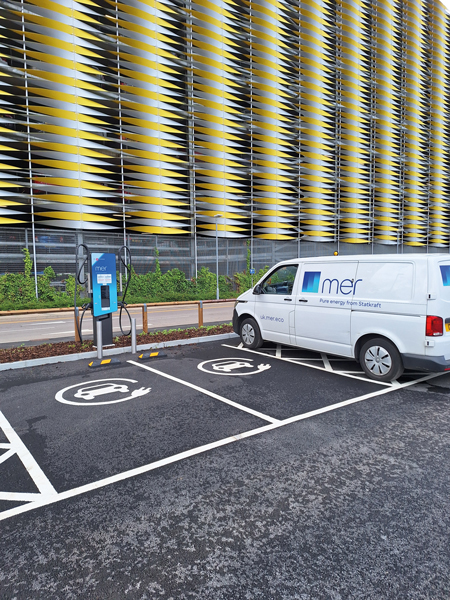
Each business has a charging profile that needs correctly matching to the right technology to become an operational strength. Incorrectly matched, it becomes a liability.
Approaching charging infrastructure strategically also builds in three advantages that compound over time.
- Scalability. Infrastructure designed with growth in mind, using the right technology mix from the outset, makes it easy to accommodate additional vehicles without expensive site or technology reconfiguration. This is particularly valuable for businesses with ambitious fleet transition timelines or those anticipating significant growth in their EV fleet.
- Cost efficiency. Correctly specified infrastructure, matched to actual operational patterns rather than theoretical scenarios, avoids both over-investment in unnecessary capability and under-investment that creates operational bottlenecks. Over a fleet’s lifetime, this can translate into a significant financial sum.
- Organisational confidence. One of the less-discussed challenges of fleet electrification is internal buy-in. Drivers, operations managers, and finance teams are all watching the transition closely. Infrastructure that works reliably, charges vehicles as expected and doesn’t affect operations, builds internal confidence in what can often be a multi-year transition programme.
Changing charging projects for better outcomes
The AC versus DC charging decision is ultimately inseparable from a deeper set of operational questions: how vehicles are deployed, how sites are configured, how the fleet will evolve and how energy costs are structured. These are questions that charge point operators are best placed to answer.
Specialist fleet charging expertise brings a different kind of value to an organisation. It’s not simply about knowing which charger to install – it’s about understanding the operational context in which that infrastructure must perform. That means proven experience modelling real duty cycles, anticipating growth scenarios, integrating with fleet management systems and designing infrastructure that remains fit for purpose as your fleet, your vehicles and your business evolve.
For organisations at the early stages of fleet electrification, this expertise is most valuable precisely when it feels least urgent: before commitments are made, before hardware is ordered and before the cost of changing course becomes prohibitive.
AC versus DC charging is, on the surface, a technical question. But for any organisation making a serious commitment to fleet electrification, it’s really a question about capital allocation, operational resilience and long-term strategic fit. And it’s the organisations making this distinction and making the right decisions that are delivering on the full promise of fleet electrification.
https://uk.mer.eco/ev-fleet-charging/
This article appeared in the April 2026 issue of Energy Manager magazine. Subscribe here.
