


The UK’s efforts to meet ambitious government net zero carbon emissions targets by 2050 continue to gather pace, with BEIS figures showing the country broke renewable energy generation records in 2019. However, as we transition to greener power sources, it is vital energy storage infrastructure in order to negate potential disruption, says Chris Rason, Managing Director for Northern Europe at Aggreko UK.
It cannot be denied that industry, and the country as a whole, are trending toward more sustainable energy sources. BEIS figures published earlier this year showed that renewables constituted a record 37.1 per cent of UK electricity generated last year, and this figure will likely rise in 2020 due to pandemic-induced lockdowns. News like this, combined with recent Government announcements that all UK homes will be powered by wind within a decade, show definitively that green power is a growing concern.
However, UK industry’s enthusiasm for green energy sources has not been mirrored in the uptake of battery storage technology. To an extent, this reluctance can be explained, as battery storage on the industrial scale has traditionally been seen as expensive. Yet the ongoing decarbonisation of the National Grid has injected fresh urgency into this issue, with companies potentially needing to consider battery technology if they are to avoid concerns that may arise from growing dependence on renewable energy.
Fluctuations
First and foremost among these concerns is the possibility of power fluctuations. The National Grid’s October announcement that unusually low wind speeds were affecting the country’s energy supply demonstrates an issue that, if not accounted for, may grow in prominence as we transition to greener energy sources. Companies reliant on the grid for power could be placed at risk of unplanned downtime, which, in turn, could affect their bottom line.
With COVID putting budgets under pressure like never before, this disruption could have a huge impact. However, if organisations cannot afford to invest in energy storage technology to alleviate this risk, they could find themselves locked in a situation they cannot resolve, and could get worse.
Offsetting risk
Consequently, it is clear that energy storage technology needs to be implemented on a wider scale if industry is to build resilience while hitting net zero targets. This resilience issue was highlighted in research from Aggreko carried out last year, when 82 per cent of key energy decision makers surveyed pinpointed power continuity as a major or significant concern to their business.
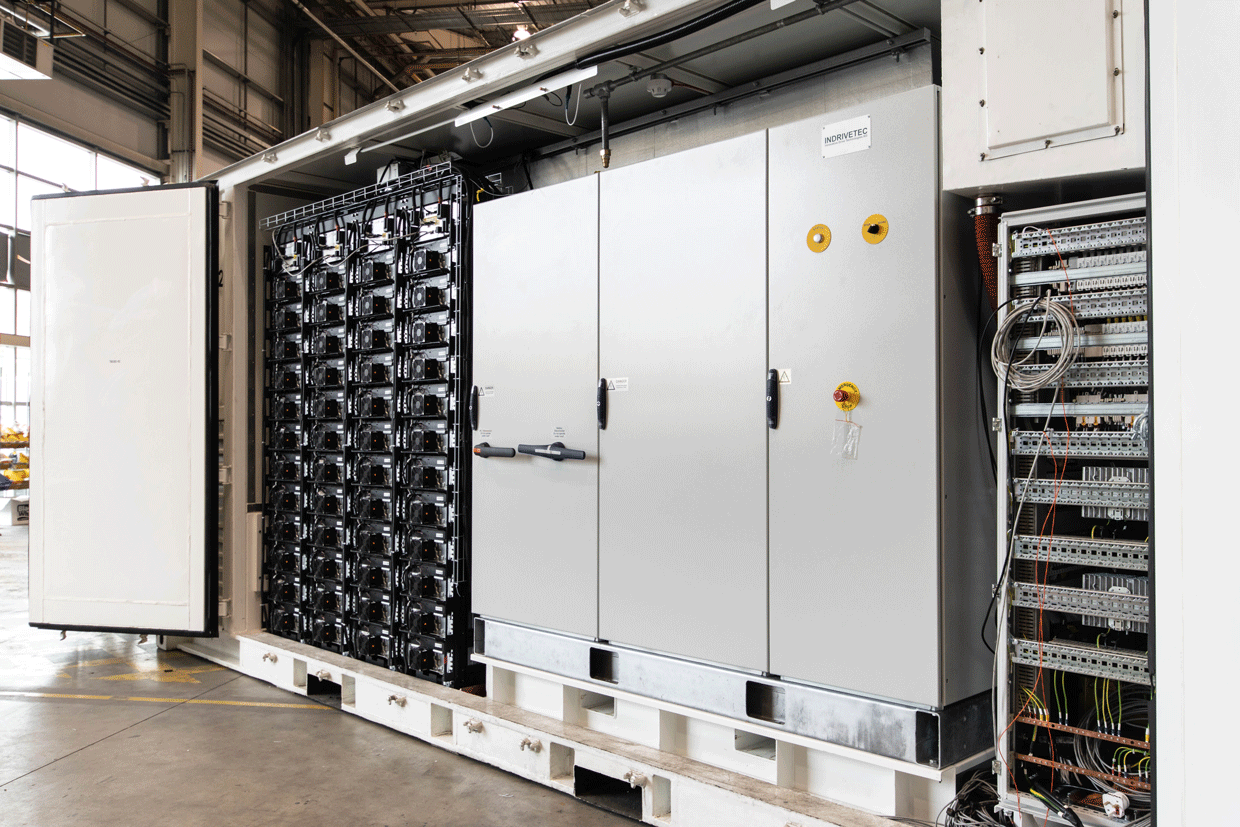
Added to a site’s wider energy mix, battery technology can provide an effective and green way of offsetting these concerns and potential risks associated with power fluctuation. By allowing energy levels to be ‘smoothed’ and deployed at times where energy supply might be declining but on-site demand is increasing, it can serve as a bulwark against potential disruption.
This smoothing effect also extends to ensuring consistent performance on equipment more sensitive to larger load step changes, like gas generators. Because batteries can ensure frequency and voltage remain within agreed specifications, such fluctuation-based disruption can be minimised.
UPS and spinning reserve
As well as stabilising energy provision, this energy storage technology can serve as an uninterrupted power supply (UPS) for site managers looking to implement decentralised energy schemes. By providing back-up power if utility or grid power is disrupted, batteries can help the site enter a graceful shutdown of site equipment without impairing critical processes, or keep everything online long enough at required loads until power is reinstated.
Additionally, the technology can act as a spinning reserve for sites looking to increase overall efficiency and overall savings, allowing fewer generators to run at a higher load with less fuel consumption. This is especially effective in the data centre sector, which has traditionally been extremely energy intensive and reliant on a stable and consistent power supply. Adding two 1MW battery systems to an 18MW data centre with a gradual load ramp, for instance, could lead to approximately £900,000 in fuel gas and carbon emissions savings over a two-year period.
Affordability
Even with these benefits in mind, there remains an elephant in the room – affordability. The pandemic has led to many site managers having to do more with less, and with the UK’s energy storage infrastructure not yet able to provide appropriate levels of power resilience, new approaches must be considered. However, advances in the rental market now makes strategic equipment hire an appealing option, as new battery solutions are becoming available for on-site and grid support applications.
These options can allow organisations struggling with capex constraints to avoid the high up-front costs required for a permanent installation. By instead factoring this expense as an ongoing opex cost, companies can make savings while also building the funding required to potentially invest in a permanent solution as the technology matures.
Indeed, a further benefit of treating energy storage as an ongoing, hired service in the short-to-medium-term is that it safeguards organisations against the swift progression this particular field is currently experiencing. Because rental battery solutions can be replaced as even more efficient models are developed, businesses do not run the risk of being stranded with permanent solutions that may become outmoded or comparatively less high-performing over time.
In summary, the UK’s growing use of renewable energy sources is to be welcomed, but further energy storage solutions must be implemented if this trend is to continue at the same rapid rate. By looking at options such as strategic equipment hire, companies can continue to decarbonise while alleviating risks such as power disruption without being hamstrung by the prohibitive costs associated with permanent installations.
For more information about Net Zero and sustainable energy technologies such as battery storage, download Aggreko’s latest report, ‘Bridging the Gap to Net Zero: Solutions towards the net zero challenge,’ visit: www.aggreko.com/netzero.
