

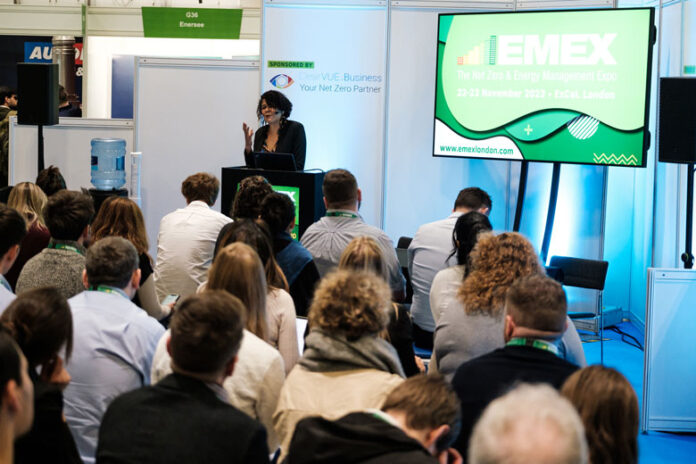
EMEX, the Energy Management and Net Zero exhibition, returns to Londonโ€™s ExCeL on 20 & 21 November 2024.

Coming into this year, the EMEX team felt it was important to take a step back and really understand what visitors see the event standing for. It became clear that there are three pillars that EMEX proudly stands by: solutions, innovation and implementation, and it is these attributes that set it apart from other events in the energy management space. Throughout every aspect of the show, EMEX gives its visitors real answers to their challenges, whether itโ€™s via practical case studies on the conference programme, getting hands-on with the latest technology demonstrated by exhibitors, or making new connections and understanding how they have overcome similar issues within their businesses.

With this in mind, EMEX is committed to offering visitors solutions-focused content and this year sees even more brand new free-to-attend features appearing at the show. BSI Group are offering free, 30-minute CPD-accredited training sessions throughout both days of the show: Introduction to Energy Management ISO 50001, Introduction to Environmental Management ISO 14001 and Introduction to Net Zero. BSI Group is the national standards body of the UK and getting free access to their accredited training is an opportunity not to be missed. These training courses are an excellent way to improve your knowledge if you are new to this field or if you want to build further on what you already know.

Also new for 2024 are free workshops led by top industry experts. These fully interactive sessions are designed to demonstrate practical strategies for achieving key goals in energy management and carbon reduction. This is an unmissable opportunity to gain valuable insights and hands-on experience with companies such as Carbonology. Further details of the different focus areas of the workshops can be found on the EMEX website and places can be reserved when show registration opens in August.

This year, EMEX is delighted to welcome IEMA (Institute of Environmental Management and Assessment), a global body for environment and sustainability professionals, as hosts of exclusive peer mentoring sessions. Aimed at energy managers who may be new to their field or those who simply feel they would benefit from speaking with a more experienced associate, this is a valuable opportunity to network, gain professional advice and learn from senior IEMA members, all highly skilled in the energy transition field.

Once again, the conference programme hosted across four different theatres is jam-packed with some of the foremost thought-leaders in the space, as well as a huge range of practical case studies from those who are hands-on in the implementation of creating an energy efficient future. Led by Lord Rupert Redesdale, a key voice within government on the issue of sustainability, over 130 expert speakers will be presenting a range of panel discussions, technical and innovation showcase sessions, learnings and advice to visitors on how to move forward with their own net zero agenda. The four conference areas cover: Energy and Carbon Management Strategy, Sustainability and Net Zero, Built Environment and Transport and Energy Future and Flexible Networks, meaning there really is something for everyone. Check out the event website for further details of all the sessions as they are released.

Returning for 2024 are the highly popular Public Sector Roundtable Networking Meetings. Exclusively for those working in the public sector, these discussion groups are a unique opportunity to shape the future of net zero within small, impactful groups.

Many of the 100+ exhibiting companies at EMEX are showcasing new and innovative energy efficient solutions. This is a real opportunity to be amongst the first to see how rapidly developing technology is helping to reach sustainability goals. Whether youโ€™re just starting out or looking for the right product for the next step of your journey, the busy show floor is the place to be.

Of course, many visitors come to EMEX each year to grow their professional networks. Whether itโ€™s informal chats over a coffee, or a pre-arranged meeting in one of the expoโ€™s many break-out areas, having the largest gathering of energy managers in one place means you can make the right connections for the next twelve months over just two days!

EMEX welcomes over 4,000 visitors from the smallest companies to the largest multi-nationals, from limited budgets to those who have millions to invest in sustainability solutions and from across the wide spectrum of both the private and public sectors โ€“ there really is something for everyone who walks through the doors. Typically attracting the majority of visitors from within energy management or environment and sustainability roles, whether youโ€™re coming to source products and equipment, conduct meetings with industry peers or acquire knowledge and best practice learnings from the educational agenda, EMEX is the place for you.

Donโ€™t forget that registration is completely FREE and gives you access to all of these features and more. Register your interest in attending now ahead of visitor registration opening in August: https://www.emexlondon.com/register-interest.


This article appeared in the July/August 2024 issue of Energy Manager magazine. Subscribe here.

Navigating the Evolving Energy Landscape

Chris Maclean

Chris Maclean, CEO, True, powered by Open Energy Market

In todayโ€™s energy market, UK businesses face multiple operational, commercial, and sustainability-driven challenges and opportunities. Recent developments, such as Europeโ€™s abundant gas supplies leading to lower wholesale prices, have sparked talks of resolving the energy crisis. But underlying economic issues suggest a more complex reality, reinforcing the urgency behind why businesses must adopt more strategic approaches to energy procurement.

Assessing the Energy Market

Thomas Marzec-Manser, Head of Gas Analytics, Independent Commodity Intelligence Services (ICIS), recently warned against jumping to conclusions about the end of the energy crisis. Economic challenges persist, and while energy markets might seem stable, there are hidden vulnerabilities.

The ongoing cost of living crisis has led to reduced consumer spending, impacting industries like hospitality. Additionally, the manufacturing and production sectors, both essential for economic growth, have faced operational challenges amidst supply chain disruptions and rising input costs. This subdued demand, coupled with lingering concerns over geopolitical tensions and supply chain bottlenecks โ€“ particularly in regions crucial for energy production and transportation โ€“ underscores the volatility of the energy market.

Itโ€™s a timely reminder for businesses to take a forward-thinking approach to energy management. By closely monitoring market trends, identifying emerging risks, and implementing robust risk mitigation strategies, organisations can better navigate the evolving energy landscape.

Embracing Smart Energy Management

Effective energy procurement is vital for financial stability and operational resilience. By anticipating market trends and seizing opportunities to make the energy market work in their favour, businesses can optimise energy costs while ensuring a reliable supply. This proactive approach enables businesses to mitigate the impact of price fluctuations, minimise exposure to market volatility, and maintain budget predictability. 

Promoting Sustainability Through Renewable Energy Strategies

In addition to driving financial savings and enhancing operational resilience, strategic energy procurement plays a crucial role in advancing sustainability goals for businesses. By adopting proactive strategies that prioritise renewable energy sources, organisations can significantly reduce their carbon footprint.

One key way that strategic energy procurement promotes sustainability is through leveraging power purchase agreements (PPAs). PPAs are contractual agreements between energy buyers and sellers.

In a physical PPA, the buyer purchases electricity directly from a renewable energy generator and receives delivery of energy to its facilities. In a financial PPA, the buyer does not take physical delivery of the electricity but instead enters into a financial agreement with a renewable energy generator to purchase renewable energy certificates (RECs) or guarantees of origin (GOs) associated with the renewable energy production. The buyer receives financial benefits in the form of renewable energy credits, which can be used to offset their grid-based energy consumption or demonstrate their commitment to renewable energy procurement.

PPAs offer several key benefits for energy buyers including price stability, cost savings, bolstered environmental credentials, and risk mitigation. Put simply, PPAs offer a flexible and customisable mechanism for businesses to access renewable energy, achieve their sustainability objectives, realise financial benefits and minimise operational risks.

The Open Performance Fund (OPF): A Longer-Term Play

Trading energy in the market is an option for businesses with high energy consumption, but itโ€™s complex and risky. For medium to large enterprises looking for a simpler and more reliable solution, the Open Performance Fund (OPF) is a great choice. 

The OPF is a long-term buying strategy designed to secure sustainable cost savings and reduce trading risks over time.

One of its key features is its consistent outperformance in energy cost savings compared to the broader market. In fact, the OPF consistently surpasses the 12-month rolling market average across both gas and power markets.

Besides cost savings, the specialists behind the OPF also help to simplify energy procurement by handling market monitoring, decision-making, and execution, allowing businesses to focus on their core operations with peace of mind.

Strategic Energy Procurement and Sustainability in Practice

One organisation that has successfully navigated the complexities of the energy market is Shepherd Neame, Britainโ€™s oldest brewer. Over the past four years, Shepherd Neame has partnered with True to optimise its energy procurement strategies and drive significant cost savings.

Through strategic energy procurement and participation in the OPF, Shepherd Neame has achieved remarkable savings of 49.9 percent against the average price of energy. This translates to millions of pounds in savings over four years, enabling Shepherd Neame to reinvest in its operations and sustainability initiatives.

In doing so, Shepherd Neame is driving operational efficiencies while reducing its carbon footprint. The breweryโ€™s holistic approach to sustainability can serve as a blueprint for businesses looking to balance commercial growth with environmental responsibility.

Staying One Step Ahead

As the energy landscape evolves, businesses must be proactive in their energy procurement strategies. By staying ahead of market uncertainties and embracing sustainability, they can achieve financial resilience and environmental stewardship simultaneously.

For more information about True, powered by Open Energy Market, visit https://www.truezero.tech/


This article appeared in the July/August 2024 issue of Energy Manager magazine. Subscribe here.

Distributed energy can be a big win for the next government

John Behan

With the political parties pussyfooting around net zero claims ahead of the general election, a more robust approach to accelerating the roll-out of solar is critical to driving confidence around achieving decarbonisation goals without burdening the taxpayer.

We are witnessing a โ€˜solar revolutionโ€™ in the UK, according to energy think tank Ember.[1] Rooftop deployment is seemingly booming, with more than 190,000 installations carried out in 2023 alone.[2] The Microgeneration Certification Scheme (MCS) suggests that 2024 will likely see the sectorโ€™s 13th year of continued incremental growth, while forecasts from SolarPower Europe predict a staggering 22% increase in annual demand. However, affirmative policy action is needed to capitalise on this momentum and realise the full impact that solar can deliver for the UKโ€™s energy transition.

Putting renewable generation at (or near) the point of consumption is by far one of the cheapest and most efficient forms of energy available. Today, technological progress and maturing funding models are making on-site solar increasingly simple for businesses, offering the potential to significantly reduce carbon without resorting to subsidies.

Two elements are essential to achieving this. Firstly, learn from other European markets when it comes to accelerating the adoption of collective self-consumption, which could prove a game-changer when it comes to tackling local grid constraints and unlocking stranded projects. Secondly, we need to see clarity and proactivity when it comes to government support for smaller business customers, which would enable access to cleaner, greener, cheaper on-site energy.

John Behan, CEO of AMPYR Distributed Energy (ADE) said: โ€œWe are talking to businesses every day who can see the advantages of solar to drive down energy costs, increase supply security and deliver measurable decarbonisation progress. However, there is significant pent-up demand for solar deployment, so a key Government focus should be on policies that put solar front and centre of the smart grid transition and the future energy systems we need to meet net zero.

โ€œWhile energy security, decarbonisation and sustainability are referenced in each of the main partiesโ€™ manifestoes, the lack of direction on policies to accelerate solar needs to be addressed urgently.

โ€œWhile improving grid connectivity is already high on the agenda, there also needs to be more joined up thinking and stronger communications to unleash the potential of on-site renewable generation for businesses in the UK. Distributed energy aligns with the need for investment in the UKโ€™s property infrastructure, including energy efficiency, carbon reporting, and enabling decentralised energy solutions with clear market reform.

โ€œCountries in Europe, such as Spain, are empowering communities with clear legal frameworks for community self-consumption schemes, where residents in flats, for example, can confidently sign up to shared rooftop solar schemes that can not only reduce reliance on the grid and lower energy bills, but also create opportunities for selling back to the grid when surplus is generated. Models such as these, which are now tried and tested, can inform the transformation of our own systems to take full advantage of the potential of renewable energy.

โ€œCommercial properties across Europe are also engaged in collective self-consumption. Rather than simply harnessing self-generated green energy and exporting surplus, this sees sites encouraged to trade with neighbouring buildings that donโ€™t have access to renewable energy generation capabilities.โ€

With many solar arrays specified to deliver a material portion of on-site energy consumption, accelerating pathways to increase this percentage will maximise the value of distributed energy across the UK. From an economic perspective, local communities and businesses can share the benefits of low-cost renewable power. From an environmental perspective, it reduces pressure on centralised energy supply, instead creating flexible community microgrids.

But what about those often forgotten about by policymakers? Miles Thomas, CCO at ADE, added: โ€œFor smaller, or poorer credit business customers, we need to find work arounds to unlock cleaner, greener, cheaper on-site energy supply. This is key to enabling solar, at scale, for everyone and accelerating progress towards the UKโ€™s net zero energy landscape of tomorrow.

โ€œIn my opinion, we could approach this in a similar way to the real estate sector; using government-backed leases in selected areas to support commercial development and catalyse regeneration areas where leases are short, or covenants arenโ€™t of sufficient quality to support investment and development. Government support to achieve this, however, is critical โ€“ this isnโ€™t direct subsidy, itโ€™s support, keeping capital costs low and energy prices at levels which provide real benefit to those businesses that need it most.โ€

As one of the key enablers to a low carbon energy future, the outlook for solar is clearly positive. However, if we really are to rely on home grown energy, we need to see far greater government ambition. Alongside clarity regarding the planning system, this includes revolutionising the way networks deal with solar and storage, upskilling the UK workforce and ensuring that the market framework is fit for purpose.

Behan concluded: โ€œThe UK needs to push the day-to-day of distributed energy firmly up the agenda. Mandating the inclusion of solar panels on all new commercial buildings is a sensible step forward, but most of the buildings that will exist in 2030 are already built, so bold policies that can support retrofitting on all buildings and, more importantly, for all commercial and industrial consumers, should be central to any new governmentโ€™s charge towards net zero. Bold action has been taken in France where solar canopies are now required in all large car parks, we could take a similar approach in the UK.

โ€œMore accountability around carbon reporting, as well as a step-change when it comes to mandatory energy efficiency measures beholden to commercial properties, all have a vital role to play. Net zero requires a massive investment in property infrastructure, a more joined-up approach really is just common sense.

โ€œUltimately, energy security is no short-term game and we must continue to identify new and innovative solutions to accelerate progress towards net zero. Once the dust settles, Iโ€™d like to see a step-change in enthusiasm, ambition and commitment when it comes to renewable energy. Assuaging the concerns of the industry is a good start, but progress, clarity and decision-making must be proactive, rather than a last resort.โ€

For more information about AMPYR Distributed Energy, visit www.ampyrde.com.


This article appeared in the July/August 2024 issue of Energy Manager magazine. Subscribe here.

Hamworthy Heating expands low carbon range with new Tyneham CO2 natural refrigerant commercial heat pumps

Now available from Hamworthy Heating, technical experts of commercial heating and hot water products, is the arrival of its new CO2 and CO2Q range of Tyneham monobloc heat pumps with natural refrigerant, to help future proof investments.

Designed to achieve high temperatures of up to 70ยฐC with ultra-low global warming potential (GWP) of just one thanks to the use of R744 (CO2) refrigerant, the latest CO2 and CO2Q Tyneham heat pumps are the perfect fit for both new build projects needing an efficient and low carbon solution.

Featuring a co-efficient of performance (CoP) rating of up to 3.4, the latest range of heat pumps from Hamworthy Heating also include an invertor-controlled compressor to match the heat demand of the building accurately and efficiently. 

Suitable for larger heating and domestic hot water (DHW) commercial applications, the latest range of Tyneham heat pumps with CO2 refrigerant is available in six models with outputs from 65kW to 130kW in normal and low noise options (Q). Units can be cascaded to achieve even higher outputs in larger applications. 

Suitable for installations where space is of a premium, the new Tyneham CO2 commercial heat pump range can be installed flush against a wall or back-to-back with another unit with minimal installation clearances needed. For a low-carbon hybrid heating solution, the new heat pumps can also be seamlessly combined with Hamworthy Heating boilers, such as the Wessex Modumax MK3.

Jason Allen, Commercial Product Manager โ€“ Hamworthy Heating comments, โ€œWith decades of experience of heating buildings in the UK, we understand the importance of finding low-carbon solutions. As heat pumps with natural refrigerant play an important role, weโ€™ve taken the next step forward by further expanding our Tyneham commercial heat pump range with natural refrigerant. These heat pumps will ensure our customers continue to have the best and most advanced heating and hot water solutions on their journey to Net Zeroโ€.

For more information on the latest range of Tyneham CO2 and CO2Q heat pumps with natural refrigerant or to arrange a site survey,ย visit:ย https://hamworthy-heating.com/Products/Commercial-air-source-heat-pumps/Tyneham-CO2-CO2Q-air-source-heat-pump


This article appeared in the July/August 2024 issue of Energy Manager magazine. Subscribe here.

Prefect Controls appoints new Managing Director

Will Mills & Nicole Howard

Prefect Controls, the specialist heating control systems company has appointed Will Mills as Managing Director.

The retirement of Glen and Sue Golding, founders of Prefect Controls, has seen a succession plan roll out over the last two years.

Will joined the company in 2018 and quickly became conversant in all things Prefect. He spent the first 5 years travelling the length and breadth of the UK managing projects from Aberdeen to Exeter. Prefectโ€™s diverse client base of accommodation providers includes Unite Students, Host, Curlew Capital and Study Inn as well as universities, including UWE, Durham, Cambridge, Greenwich, Oxford Brookes and Bangor.

Appointed Commercial Director in Summer 2023, Will has focussed on developing the project management team and taking on greater responsibilities for the day to day running of the company.

Glen Golding commented, โ€œSoon after Will joined the business, I recognised a leadership quality he had, that I was confident could be developed to take Prefect forward when the time came for me to step back from frontline duties.โ€

Glen and Sue will keep an eye on the business as Chair and Vice-Chair respectively but are looking forward to spending time doing the things that they enjoy away from Prefect that retirement will afford them.

In 1997 when Prefect was founded, the target market was commercial providers of rooms – student accommodation, hotels etc, where the excessive use of heating energy by guests, who were not subject to the direct cost, was a real problem. Initially, Prefectโ€™s locally programmed intelligent thermostats ensured energy wasnโ€™t being wasted. The progression of the internet has seen this concept develop into a complete centrally controlled system, that monitors environmental conditions and manages temperature control for room and water heating. It also collects invaluable data that helps energy managers to maximise their buildingโ€™s efficiency.

โ€œA lot has changed in terms of technology and indeed provision of student accommodation in the time since I opened Prefect,โ€ Glen continues, โ€œbut the need for efficiency and decarbonisation has only become more important. Prefect is in a prime position to benefit all multi-occupancy accommodation by cutting out waste and providing data that is used to optimise performanceโ€.

Nicole Howard, formerly Office Manager, has also stepped up to the plate as she takes over from Sue, becoming Prefectโ€™s Financial Controller, she commented, โ€œSue and I have worked very closely to ensure the transition has been seamless. Itโ€™s very much business as usualโ€.

Will Mills concludes, โ€œI am extremely proud of the company Glen and Sue have built. They have overseen the development of a solid, well respected, and financially secure business. One that has grown organically and responded to market demands while staying true to its โ€˜family businessโ€™ roots. I look forward to working closely with the remarkable team we have assembled to take Prefect to the next level and beyond. Our recent growth has been phenomenal, but there is still massive potential. I am excited to be driving this business forward.โ€

Water Efficiency Lessons From Kimberly-Clark

Image by Arek Socha from Pixabay

Becoming more water efficient and operating more sustainably is becoming increasingly important for businesses of all sizes and across all sectors and industries, as the combined pressures of climate change, population growth, urbanisation, pollution, water mismanagement and extreme weather events take their toll on freshwater resources around the world.

It can be useful to look at what some of the biggest global corporations are doing to reduce their water footprint if youโ€™re keen to start improving your blue credentials – and, to this end, fast-moving consumer goods conglomerate Kimberly-Clark has just published its latest annual sustainability report, revealing that it has successfully hit its 2030 water efficiency targets an impressive seven years ahead of schedule.

The organisation had planned to reduce water consumption at its sites located in water-stressed areas such as China, Indonesia, Brazil, Colombia and El Salvador by half come 2030, but it achieved a 52.8 per cent reduction in 2023 against a 2015 baseline.

These water targets were only set for those locations facing water stress and scarcity issues because Kimberly-Clarkโ€™s water consumption is apparently โ€œnot as substantial as typical consumer packaged goods companies given its product mix. Therefore, we focus our efforts on where we have the biggest impactโ€.

The corporation updated its water risk assessments and consumption habits to work out which areas to prioritise, with water leak detection and repair heading the list, as well as rainwater harvesting and the installation of water recycling equipment for cooling tower water.

The company hasnโ€™t just stopped at its own water consumption and inefficiencies, however, and it has also been working alongside other stakeholders to enhance water security in basins where its factories are in operation, such as the Barbosa Mill in Colombia.

Here, work was recently undertaken to pinpoint opportunities for ecological restoration and conservation, collaborating closely with local authorities and non-government organisations to implement the appropriate changes. This model is also now likely to be replicated at other sites as a bastion of water stewardship for the company.

Kimberly-Clarkโ€™s overall water footprint strategy involves reducing water consumption and optimising wastewater treatment before itโ€™s returned to the natural environment, using techniques through water resilience, water efficiency and water stewardship approaches.


These techniques include managing public perception, environmental hazards and regulatory compliance, implementing lean water management tools to increase productivity and decrease its water footprint, and direct engagement with the communities where the company operates on local water resource management.

The Lean Water Programme

Kimberly-Clark has worked to expand its Lean Water Programme to sites in the Asia-Pacific region, with the aim being to mitigate water risks in relation to ageing infrastructure and both water quality and quantity, as well as increasing staff awareness of water operations to reduce waste and compliance costs, while increasing productivity and efficiency across the board.

By creating a workplace culture that focuses on water quality and conservation, ownership and responsibility is afforded to site employees to prioritise water management to a similar degree as they would safety, delivery, quality and cost.

Continuous improvement in water management systems will be driven at its manufacturing facilities through investment in dashboards, metering and real-time visual management tools so that water usage can be made more efficient.

Water withdrawals, consumption and discharge for each operational site will be tracked, as well as water use efficiency at those sites that have high water use for manufacturing.

Overall progress

Water aside, other highlights included in this latest sustainability report include building on the companyโ€™s 100% Natural Forest Free commitment, protecting biodiversity and working to mitigate climate change. The hope is that the corporation will be more than halfway to achieving this goal by 2030.

Last year, Kimberly-Clark also prioritised utilisation of alternative energy sources like solar power and wind, launching a new virtual purchase power agreement and an onshore wind farm in Scotland, as well as initiating various renewable power purchase agreements.

And itโ€™s also working to strengthen its product offerings through more sustainable solutions, such as reusable menstrual and incontinence items and its first-ever Kotex paper pouch.

Furthermore, fibre procurement from sources with sustainable forest management certification continues to be prioritised, with other alternative fibre solutions now under investigation.

Plastics is also a top priority for the company, with reductions of 16.4 per cent seen towards its goal of a 50 per cent drop by 2030 against a 2019 baseline.

Chairman and CEO Mike Hsu said: โ€œSustainability is woven into the fabric of our 152-year-old companyโ€™s innovation strategy and purpose, serving as a guiding principle across every facet of our operations. I am proud of our teamโ€™s commitment to our purpose of Better Care for a Better World, focusing on where we believe we can make the biggest impact.โ€

Newly appointed chief sustainability officer Lisa Morden made further comments, saying: โ€œWe are proud of our progress and in 2023 we continued to address challenges associated with single-use plastics, carbon emissions and water use in our operations and value chain, while working to decrease forest reliance and increasing our use of renewable energy.

โ€œWe recognise that there are still challenges and opportunities ahead and we remain dedicated to supporting a more sustainable future for all.โ€

What can businesses do?

Hopefully, all of Kimberly-Clarkโ€™s efforts are excellent food for thought, showcasing what can be achieved where water is concerned.

If youโ€™re not sure where to begin, however, get in touch with the Switch Water Supplier team to see how we can help.

We can organise an audit of your entire site so you can gain a deeper understanding of how you use water and where, so you can identify the most appropriate water-saving solutions and adjust these over time to account for the changing needs of your business.


This article appeared in the July/August 2024 issue of Energy Manager magazine. Subscribe here.

Clean air on construction sites can be a thing of the future

Toby Gill

Toby Gill, CEO, IPG Energy

While carbon reduction targets have been widely established, there is currently no UK-wide legislative requirement that sets the equivalent targets for pollutant emissions. This is despite the fact that air pollution has been identified as the single largest environmental health risk in Europe, and exposure to even low levels is linked to increased risk of strokes, cancers and premature death.

The construction industry is one sector which has a problem with this, with sites featuring among the highest contributors to poor air quality in London. This is due to the large quantities of PM10, or dust, produced by demolition activities, and additional pollutants NOx, CO and PM2.5 found at lower quantities in the exhaust fumes of non-road mobile machinery (NRMM), such as diesel generators.

To combat the latter, the Construction Leadership Council, author of the Zero Diesel Sites Route Map, has proposed that 78% of diesel plant should be eliminated from UK construction sites by 2035.

So what is being done about it?

Some authorities and organisations have set minimum emission standards for NRMM. In London, Air Quality Neutral (AQN) and Air Quality Positive (AQP) guidance is setting air pollution standards for new developments, while the Ultra Low Emission Zone (ULEZ) will require all Non-Road Mobile Machinery (NRMM) to be zero emission by 2040.

Although these targets may seem daunting, the work that has already been done to identify viable solutions for achieving zero carbon construction will make achieving pollution-free sites even easier.

The move towards the electrification of tools and plant machinery, as well as emerging solutions offering a clean, net-zero alternative to the diesel generator for on-site power generation, show that reducing pollutant emissions in the same breath as targeting zero carbon is a real possibility.

One such alternative offering a clean, net-zero alternative to the diesel generator includes renewable generators which employ flameless and/or catalytic combustion technologies. Not only do these technologies, found in fuel cells and fuel-agnostic gensets, produce power without emitting pollutants, they also have the additional benefit of reducing carbon emissions due to their compatibility with net-zero and zero-carbon fuels.

It’s time to clear the air

Both solutions enable construction companies to decarbonise their operations and improve the health of their site teams without prioritising one over the other. They are indicative of progress being made within the sector to unlock the transition to cleaner jobsites, and with the help of more ambitious government tenders and national legislation, we can accelerate this transition further still.

The awarding of large tenders presents an opportunity to transform the priority that is placed on pollutant emissions reductions in this process, and see mitigation action for them playing a more prominent role alongside carbon emissions. Driving positive change from the top down in this way will help to bring about change throughout the whole construction value chain. Itโ€™s time for construction to set the standard for all industries where fuel-based power is needed and prioritise solutions that solve both the carbon and pollutant problem in the same breath.


This article appeared in the July/August 2024 issue of Energy Manager magazine. Subscribe here.

Acrospire Work with Marwood Lighting Solutions to Make the Prittle Brook Greenway Safer with Solar-Powered pathway Lights

Today, solar-powered lighting solutions are providing a cost-effective route for local authorities to enhance safety and accessibility along previously unlit paths.

Originally designated the Prittle Brook Greenway after its refurbishment during 2010-2012, this 5.7km route serves as a vital traffic-free connection for cyclists and pedestrians in Southend-on-Sea. Linking urban areas to Woodlands Park in Hadleigh, it offers access to Priory Park, local schools, the hospital, and residential zones. Despite its significance, safety concerns hindered nighttime usage, with 50% of residents avoiding the path after dark due to worries about anti-social behaviour. Responding to community feedback, the Southend-on-Sea City Council allocated ยฃ225,000 to install lighting along the greenway.

The project was entrusted to the family-run independent business Marwood Lighting Solutions. To enhance safety along the rural Prittle Brook Greenway, the company sought an energy-efficient, off-grid lighting solution with integrated smart controls.

Marwood Lighting Engineers visited Southend on Sea to survey the 3.5Km of Prittle Brook Greenway between Eastwood Road and Victoria Avenue. This was to ensure that the Defender Solar powered lanterns could illuminate the pathway to BS5489-1:2020 and to review any specific site constraints that would need to be considered for the design proposal.

Marwoodโ€™s lighting design team produced plots to determine the optimum spacing between the lanterns and to satisfy Southend on Sea City Council that light spill would be carefully controlled. 6m Raise and lower columns were selected to ensure the scheme could be easily maintained in the future as the site does not allow for vehicle access.

120 Defender solar-powered lanterns were installed in the positions indicated by the lighting design by Southendโ€™s nominated contractor in a phased programme which Marwood Lighting Solutions supported, stocking the materials and delivering in batches to suit the project roll out over several months. The solution provides a safer environment for pedestrians and cyclists, particularly during evening hours.

Cllr Meg Davidson, former cabinet member for environment, commented, “The Prittle Brook Greenway is a beloved path for walkers and cyclists in our city, but it’s clear some folks avoid it after dark due to safety concerns.

“The new lights are solar-powered, so they do not need electricity and are smart too. They turn on when someone uses the path and dim down when they’re not needed, being solar powered it saves energy and money.”

David Player, Sales Director at Marwood Lighting Solutions commented, “The solar-powered Defender luminaires we selected for the Prittle Brook project are known to be performing well on many UK projects already, making them the perfect fit for this project as there was no power supply to the area which was in need of lighting. Marwood partner with the very best lighting brands globally, and our extensive collaborations enable us to deliver optimal outcomes for our clients.

The installation has significantly enhanced safety and accessibility for residents of Southend-on-Sea. By combining energy-efficient technology with smart controls, the project demonstrates a commitment to both sustainability and community welfare”.

For more information on Acrospire’s solar-powered range, please visitย  https://acrospire.co/ranges/solar/


This article appeared in the July/August 2024 issue of Energy Manager magazine. Subscribe here.

A Sustainable Retrofit

EPR Architects’ new London headquarters, All Saints in Austral Street, underwent a remarkable transformation into a net-zero carbon in operation studio. Zumtobel’s lighting solutions were pivotal in this retrofit project, aligning with the practiceโ€™s sustainability, flexibility, and innovation values.

EPR Architects’ new London headquarters, All Saints, is a testament to sustainable retrofitting, aiming for net-zero carbon operations, epitomising the practice’s values. Following decades of unsympathetic alterations, EPR has restored a once fine but crumbling Victorian building to its former glory.

The collaborative effort between EPR Architects, Zumtobel, and other stakeholders, including Hilson Moran (MEP Consultant), Sheridan (M & E Contractor), and McCue (Main contractor), realised their vision for the retrofit project, without overstretching the tight budget.

Preserving Heritage, Embracing Sustainability

The retrofit project aimed to restore the Victorian building’s original charm while incorporating sustainable practices. Zumtobel’s lighting solutions played a central role in achieving this balance, emphasising energy efficiency and aesthetic enhancement.

Luminaires and Design Integration

Zumtobel’s diverse range of energy efficient LED luminaires, including SLOTLIGHT Infinity D/ID, VIVO, PANOS infinity, LINARIA, ONDARIA, LINETIK, SUPERSYSTEM in various sizes and shapes, ARTSIGN and), RESCLITE PRO emergency luminaires, LITECOM lighting controls and eBox, AMPHIBIA and Sister brand Thorn Lighting’s Aquaforce Pro, were strategically installed to complement the building’s design and layout. 

Dominic Norman, Architect at EPR Architects, expressed his satisfaction with the project, emphasising Zumtobel’s contribution to its success. “The rectangular formed linear SLOTLIGHTS in the studio spaces complement the exposed services aesthetic and provide uplighting to highlight the existing flitch beams and exposed joists,” he remarked. “Tracked spotlights lift the rusticated, textural qualities of the exposed masonry, drawing attention to the heritage of the Victorian building and furthering the feeling of a creative work environment.”

Challenges and Solutions

The project encountered challenges such as lead times and budget constraints. However, Zumtobel’s proactive approach, including regular design reviews and transparent communication, facilitated effective problem-solving. Collaborative efforts with the contractors ensured smooth installation despite logistical hurdles.

Client Satisfaction and Recognition

The successful integration of Zumtobel’s lighting solutions garnered praise from EPR Architects and other project stakeholders. It was shortlisted for the Environmental Prize in the New London Awards 2023, and as a net zero carbon in operation project, it achieved an excellent BREEAM RFO 2014 rating. Furthermore, it embodies many WELL building standards, representing a beacon of sustainable retrofitting and design excellence.

Dominic adds, “The successful integration of Zumtobel’s lighting solutions has not only enhanced the functionality of our spaces, but also elevated the overall aesthetic appeal of the All Saints project. Incorporating scene control settings proves particularly useful and ensures we have the right light levels for all occasions in meeting rooms and the central hub space to fit the various functions – daily use, presentations, or as an event space. Zumtobel’s dedication to service excellence and attention to detail truly made a difference.”

For further information on any of the products please visit: https://z.lighting/en/zumtobel/


This article appeared in theย July/August 2024ย issueย of Energy Manager magazine. Subscribeย here.

Discover the Technology Powering the Energy Transition – Energy Technology Live Launched

To coincide with the exciting growth of the flexible energy sector, Event Partners are delighted to announce the launch of their newย Energy Technology Liveย brand, which features both the existingย The Distributed Energy Showย and our exciting new event The Energy Storage Show. Energy Technology Liveย featuringย The Distributed Energy Showย andย The Energy Storage Showย will provide a unique opportunity to discover the technology powering the energy transition, at the largest exhibition space in the UK, the NEC on 12th & 13th March 2025.

Building upon the success of The Distributed Energy Show and introducing the all-new The Energy Storage Show, Energy Technology Live will deliver unparalleled insights into the latest developments in renewable energy integration, smart grids, energy storage, demand-side management, decentralisation, electrification, policy and regulation as well as investment and innovation.

The free to attend event in March 2025 will welcome over 5000 visitors, 200 exhibitors and 150 speakers. With a commitment to innovation, collaboration and sustainability, Energy Technology Live will serve as the unrivalled platform for industry professionals, thought-leaders, and innovators to explore the latest advancements, trends, and challenges shaping the global energy landscape.

The Energy Storage Show will feature battery and energy storage systems for large-scale applications ranging from utility scale systems through to onsite and domestic technologies. Along with the full systems, the show will feature the components, services and technology to develop, install, operate and maintain them.

The Distributed Energy Show is established as the UKโ€™s leading event for flexible, decentralised energy systems. It is an opportunity for energy users from commercial and industrial sectors, local authorities, property developers and land owners to meet with the energy supply chain and find technologies and services to implement a flexible energy strategy.

Steve Bryan, Managing Director of Energy Technology Live says, โ€œEnergy Technology Live featuring The Distributed Energy Show and The Energy Storage Show will bring together industry stakeholders from around the world for two days of insightful discussions, networking, and innovation. Whether you are a seasoned energy professional, an emerging start-up, or a policymaker driving change, Energy Technology Live offers a unique opportunity to engage with the latest trends, technologies, and strategies shaping the future of the energy market.โ€

For more information and to find out how your organisation can get involved get in touch.

Energy Technology live is brought to you by Event Partners.

https://energytechlive.com/