Inside Great British Energy: Britainโ€™s New State-Owned Power Player

Fancy cheaper energy bills, cleaner water, and less guilt about that vacation flight youโ€™ve got planned?

With its approach to energy production poised to transform, the UK seems to have its eyes locked on achieving its ambitious 2030 net zero grid target.

At the heart of this mission is none other than Great British Energy: a new nationalised energy entity headquartered in Scotland, for which the legislative blueprint has just been revealed by the Labour government.

Focusing on technologies such as offshore wind, this publicly owned company aims to speed up investment in renewable, clean energy – a transition which also aims to gradually reduce costs for consumers.

Legislative Blueprint and Goals

Recently confirmed in Kingโ€™s Speech, The Great British Energy Bill is designed to ensure energy independence and support the production of sustainable aviation fuel.

The bill also includes measures to improve water quality and strengthen the authority of the water regulator, reflecting a holistic approach to environmental sustainability.

The new energy company will not operate as a traditional energy supplier, but will serve as an investment vehicle, driving the development of renewable energy sources.

This initiative is part of Labourโ€™s broader green prosperity plan, which includes a ยฃ5 billion annual investment to support renewable energy projects and create thousands of green jobs.

Imagine your next job interview including the question, โ€œSo, how many wind turbines have you managed?โ€

Political and Economic Implications

The plan has faced criticism from figures such as Jeremy Hunt, the Shadow Chancellor, who argues that nationalisation efforts could lead to increased union influence, more strikes, and higher costs for taxpayers.

powerHunt has also warned that publicly-owned utilities might necessitate taxpayer bailouts, reflecting concerns about fiscal responsibility.

Despite these criticisms, Chancellor Rachel Reeves has defended the measures, outlining the need for growth and reform in the planning system in her arguments.

Labour claims that GB Energy will cut energy bills by ยฃ300 a year per household by 2030, as well as:

  • create hundreds of thousands of jobs;
  • help decarbonise UK power, and;
  • make the UK energy independent, thereby enhancing energy security.

Funding and Scale

The government has pledged an initial ยฃ8.3 billion capital investment in GB Energy, a figure that some experts argue needs to be significantly higher to achieve meaningful impact.

According to the Trade Union Congress (TUC), scaling up the company will require ยฃ61 – ยฃ82 billion of investment between 2025 and 2035. Mathew Lawrence, director of the think tank Common Wealth, stresses that achieving these goals will require substantial scale.

Operational Strategy

GB Energyโ€™s operational strategy involves partnerships with the private sector to drive investment in emerging technologies, such as floating offshore wind and tidal power.

This approach aims to de-risk new technologies and attract private investment, leveraging public funds to stimulate innovation.

The company will also support local energy projects through the Local Power Plan, which involves developing renewable energy projects in partnership with local authorities and communities.

This initiative is expected to generate up to 8GW of energy and provide significant local benefits, including job creation and community investment (think of it as the local bake sale, but instead of cupcakes, you get clean energy).

Challenges and Opportunities

At the time of writing, the energy sector’s response to GB Energy has been mixed. While some industry leaders are supportive, provided the new company does not receive special treatment in state auctions, others have stressed the need to focus on eliminating barriers that private companies face.

For instance, the development of new technologies and infrastructure should complement, not compete with, private sector efforts (sort of like playing nice in the sandbox, but with billion-dollar toys).

One of the key challenges for GB Energy will be managing the transition to renewable energy without significantly increasing energy bills. Although renewable energy sources have lower running costs once established, the price of initial investment and infrastructure development costs will be substantial.

The goal is to reach a point where the long-term savings from reduced gas consumption offset these initial costs.

Great British Energy: The Future of UKโ€™s Energy Independence?

The success of GB Energy will depend on its ability to attract substantial investment, manage operational challenges, and deliver tangible benefits to consumers and the broader economy.

As the UK sets out on this hopeful endeavour, one question remains: how will GB Energy reshape the future of the nation, and can it deliver on its promise to create a sustainable, affordable, and secure energy system for all?

https://ngpltd.co.uk/


This article appeared in the October 2024 issue of Energy Manager magazine. Subscribe here.

ยฃ2.7 million awarded in Round 6 to optimise heat networks in England and Wales

In the sixth round of funding awarded under the Governmentโ€™s Heat Network Efficiency Scheme (HNES), another ยฃ2.7 million has been awarded to 33 heat networks across England and Wales.

So far, HNES has helped to improve heating and hot water supply for over 41,000 residents connected to 192 heat networks, and funding in Round 6 adds to that progress, as another 1,945 residents are set to benefit from improved and optimised heating and cooling provision. The 33 successful heat networks will receive either direct capital funding for improvement works, or funding to support optimisation studies which will help heat network owners identify the causes of low efficiency levels and areas for improvement.

Some notable projects benefitting from support in this round include capital support to the Reservoir and Watersreach heat network to implement improvements identified as a result of their HNES revenue grant funding in Round 1. Universities in Nottingham and Worcester will also receive support to undertake studies to identify issues with their unreliable heat networks, which are currently operating at low efficiency levels and causing occasional service interruptions.

Minister for Energy Consumers, Miatta Fahnbulleh MP, commented:

Heat Network customers should be able to expect a good quality service โ€“ delivering regular, reliable heating and hot water.

Todayโ€™s ยฃ2.7million funding boost will transform 33 old and inefficient heat networks across the country, adding to our support of more than 41,000 residents, ensuring they get what most of us take for granted.

This is part of our wider efforts through the Heat Network Efficiency Scheme โ€“ with more projects set to benefit in the near future.

Louise Singleton, Principal Consultant at Gemserv, said:

It is great to see HNES continuing to provide vital funding to old, inefficient heat networks across England and Wales.

It is particularly encouraging to see applicants being proactive once receiving the output of their HNES funded optimisation studies. Projects are now being awarded capital funding to implement recommendations from these studies that will go on to improve outcomes for residents and occupants. We look forward to working with heat networks throughout England and Wales who plan to apply for HNES in future rounds after being inspired by demonstrated successes from our funded projects

Capital Grant Funding

Capital grant funding will go directly towards covering the cost of operational works to improve the efficiency of existing heat networks. In this round, ยฃ2.2 million will directly improve the efficiencies of heat networks serving 334 residents.

Housing Associations and Social Housing Providers

Notting Hill Genesis

Notting Hill Genesis will receive over ยฃ1.8 million for two heat networks in Westminster and Hackney serving 179 residents. The Ernest Harriss House and Reservoir and Watersreach networks will receive funding to remedy high heat losses, poor insulation and low efficiency levels.

A2Dominion Housing Group Limited

A2Dominion Housing Group has been awarded almost ยฃ154,000 to improve a heat network serving Baker House in Ealing. The heat network, serving a building in the Capital, will utilise funding to fix the lack of data being received from the Building Management System, upgrade insulation in the energy centre and to create hydraulic separation in each dwelling by installing hydraulic interface units.

Private Sector

Listello Buildings Management Company Limited
Listello Buildings Management Company Limited has been awarded over ยฃ71,000 for the Greenaway Apartments/Newberry Mews/Bloore House heat network. The two buildings, housing 75 apartments, will utilise HNES funding to improve pipework, insulation and metering systems that are resulting in poor efficiency levels and high energy bills.

Revenue Grant Funding

In addition to capital grant funding, projects in Round 6 have also been awarded almost ยฃ564,000 of revenue grant funding to undertake optimisation studies to review the performance of their heat networks and identify areas for improvement. Optimisation studies in this round will identify improvements to networks affecting 1,611 residents.

Housing Associations and Social Housing Providers

Bolton at Home Limited, for the Presto Gardens and Blake Gardens heat networks in Bolton, serving 88 residents.

ClwydAlyn Housing Ltd, for the Llys Abad and Llys Eleanor heat networks in Conwy and Flintshire, serving 70 residents.

Home Group, for the Clock Tower heat network in Watford, serving 56 residents.

Metropolitan Thames Valley Housing, for the Hitches Lane, Barrington Road & St James Crescent and St Paulโ€™s House heat networks in Hart, Lambeth and Haringey, serving 263 residents.

Great Places Housing Group, for the John Atkinson heat network in Manchester, serving 33 residents.

Orbit Group, for the Creganford Court & Perry Street, Tithe Lodge, and Saxon House heat networks in Norfolk, Bexley and Stratford-on Avon, serving 159 residents.

Private Sector

UPP (Hull) Limited, for the Taylor Court heat network in Kingston upon Hull, serving 288 residents.

St Jamesโ€™ Court Management Company, for the St James Court heat network in Wiltshire, serving 15 residents.

ThamesWey Energy Ltd, for the Victoria Way heat network in Woking, serving 234 connected heat customers from a tri-generation CHP led Energy Centre

Roffey Homes Ltd c/o Chanctonbury Estates Ltd, for the Wentworth Court heat network in Worthing, serving 20 apartments.

Health and Education Sector

University of Nottingham, for their University Park campus heat network.

The University of Worcester, for the Edward Elgar District Heat Network.

University of Exeter, for the Geoffery Pope Building heat network.

Croydon Health Services NHS Trust, serving the Croydon University Hospital heat network.

Hywel Dda University Health Board, for the Bronglais Hospital heat network.

Other

The Centre for Alternative Technology Charity Limited, for the WISE building and site heating network in Powys.

Stockwood Community Benefit Society Ltd, for the Stockwood CBS Ltd heat network in Wychavon.


Those interested in applying for the scheme can express their interest by emailing HNES@gemserv.com.

The Heat Network Efficiency Scheme Guidance is available on the gov.uk website here.

GB NRG sign groundbreaking renewable energy partnership with Somerset County Cricket Club

In an inspiring move towards sustainability, GB NRG, a leading commercial solar and energy storage installer based in Somerset, has signed an exciting new partnership with Somerset County Cricket Club which will help the Club reduce both its carbon footprint and operational costs.

The collaboration has seen GB NRG provide and install a solar PV panel system onto the roof of the Clubs Andrew Caddick Pavilion. 

Founded in 2010 GB NRG are a leading commercial solar and energy storage installer based in Somerset and this new alliance, which comes at a time when the importance of sustainable energy solutions is increasingly recognised, will enable the Club to become much more energy and cost efficient and sets a pioneering example for sports clubs nationwide.

The Pavilion building plays an important role at the Club, providing a central hub for the players and support staff.  The solar PV system, the layout of which has been designed to spell out the clubโ€™s initials โ€˜SCCCโ€™, will cover a substantial portion of the club’s energy needs, especially during peak summer months when daylight hours are extended, and cricket matches are in full swing. The savings on energy bills will be significant, enabling the Club to allocate resources more effectively.

Regarding the partnership, SCCC CEO, Jamie Cox said: โ€œWe are delighted to be working in partnership with GB NRG. By providing the Club with this solar panel system, they will enable us to reduce our carbon footprint and to help raise awareness about the benefits of solar energy.

โ€œAt a time when we have made a commitment to sustainability, this new partnership will provide the Club with both environmental and economic benefits via the use of renewable energy.โ€

GB NRG CEO, Jon Antoniou, also expressed his enthusiasm for the project saying: “We understand the importance of supporting the local community and are thrilled to support Somerset County Cricket Club through the provision of this system.  Our goal is to make renewable energy accessible and beneficial for all sectors notwithstanding sports. This project aligns perfectly with our mission to create sustainable and cost-effective energy solutions and โ€˜Power the Switchโ€™to a brighter future.”

Since its inception in 2010, GB NRG has been at the forefront of numerous industrial and commercial solar installations across the UK, helping businesses and communities transition to clean energy.   Their reputation is built on a foundation of quality, innovation, and community involvement and their commitment to sustainability extends beyond business objectives, reflecting a broader vision for a cleaner, more sustainable future.

The partnership represents a win-win scenario highlighting the synergy between sports and sustainability and exemplifies how traditional institutions can embrace modern technology to achieve environmental and economic benefits.  It is hoped that it will serve as an inspiration for other organisations to follow suit.

As the world increasingly moves towards renewable energy, projects like this underscore the importance of community-centric approaches to environmental stewardship.

National Grid scoops award win for impactful partnership with Birmingham charity

Aurie Styla, Charity Times Awards host, Surwat Sohail (CEO, Roshni Birmingham), Shaila Pervez (Manager, Roshni Birmingham), Ellie Patey (Community Engagement Manager, National Grid), Andrei Yusfin (CEO, Localgiving)

National Grid Electricity Distributionโ€™s long-standing work with Localgiving and charities in the West Midlands has been recognised at the Charity Times Awards, with the organisations taking home a trophy alongside Roshni Birmingham, a charity based on Soho Road in Handsworth.

The Charity Times Awards celebrates best practice in the UK charity and not-for-profit sector. The Corporate Community Local Involvement award was given for the collaboration in supporting Roshni through last yearโ€™s winter with a grant from National Gridโ€™s Community Matters Fund. Since its launch in 2021, the Community Matters Fund has awarded ยฃ10.8 million to grassroots organisations across the Midlands, the South West and South Wales.  

Roshni, one of the recipients of the fund, supports black and minoritised communities affected by domestic abuse, including forced marriage and honour-based abuse. Set up in 1979, the organisation is a leading source of support for survivors through their journey to safety, confidence, and independence to live free from violence, abuse, and fear.

Last winter, Roshni received a ยฃ10,000 grant from National Grid, and with this funding was able to purchase new duvets and fleeces for every resident on arrival, and refurbish thirteen rooms with new soft furnishings and thick curtains that retain heat, making the space brighter and more welcoming for those who need support.

By alleviating the financial pressure of equipping new accommodation, the grant was able to provide warmth and comfort to those seeking refuge last winter.

Speaking after the ceremony, Surwat Sohail, CEO and Shaila Pervez, Manager of Roshni Birmingham said:

โ€œWe are thrilled to have won this prestigious award. This recognition is a testament to our dedication, hard work, and unwavering commitment to making a positive impact in our community. Please join us in celebrating this incredible achievement and together, we can continue to make a difference.

โ€œWe extend our sincere thanks to Localgiving and National Grid for nominating us. Your support and belief in our mission inspire us to work even harder. This recognition motivates us to continue making a positive impact in our community.โ€   

Ellie Patey, Community Engagement Manager at National Grid Electricity Distribution, said:

โ€œWe are over the moon to have won a Charity Times Award, particularly given the very high calibre of projects in our category. It was a privilege to be among such wonderful causes and organisations.

โ€œThe team at Roshni Birmingham provide people in their community with a beacon of hope in the most difficult of times, and we are incredibly proud of the support weโ€™ve been able to provide Roshni and hundreds of other brilliant grassroots charities through our Community Matters Fund.โ€

The grant was promoted and managed by Localgiving who, since 2012, has connected grassroots organisations with donations, grants, resources and support, helping thousands of UK community groups thrive. With a focus on bringing digital solutions to even the smallest of groups, Localgiving have recently rolled out a new AI tool to further support fundraising and supercharge grant applications.

Andrei Yusfin, CEO of Localgiving, added:

โ€œAt our heart is supporting groups rooted in communities, and Roshni Birmingham does truly amazing work in aiding people and families in some of the most challenging circumstances possible.

โ€œBig impacts canโ€™t happen without real partnerships, and thatโ€™s what we have built with National Grid through the Community Matters Fund. We are incredibly proud of our work together. It was an inspirational night and a real privilege to see our work spotlighted. Weโ€™re excited to keep supporting more amazing groups like Roshni in the coming years.โ€

To find out more about the support National Grid offer to customers and grassroots organisations all year round, visit https://www.nationalgrid.co.uk/customers-and-community.

Security and risk management in power generation

As the energy industry becomes more digital and interconnected, challenges in cybersecurity, human error prevention, and maintenance management grow. Here, Alexander Punzenberger, President of automation supplier COPA-DATA CEE/ME, explains how implementing a secure software platform provides advanced tools to enhance security and risk management in power generation facilities.

Threats to power generation are constantly evolving. As the energy industry is essential in powering economies and providing critical services, it is a target for cyber criminals. Cyberattacks targeting critical infrastructure, such as ransomware, Distributed Denial of Service (DDoS) attacks, and insider threats, have grown both in frequency and sophistication. These attacks can disrupt operations, compromise sensitive data, and in extreme cases, even cause physical damage to infrastructure. For power generation companies, the stakes are high โ€” operational downtime or breaches can lead to widespread power outages, ultimately leading to financial impacts, reputational damage, and even danger to public safety.

To mitigate these risks, companies must adopt best practices such as network segmentation, firewalls, Intrusion Detection Systems (IDS), and data encryption. Regular security updates are also essential to patch vulnerabilities and ensure systems remain resilient to emerging threats and able to react in real-time.

The zenon software platform from automation expert COPA-DATA addresses cybersecurity challenges in power generation head-on, offering built-in security features aligned with the IEC 62443 standard for Industrial Control Systems (ICS) security. These features include encrypted communication, secure password management, and protection against unauthorized access. zenon also allows real-time system updates, meaning security patches can be applied without any downtime, a crucial feature for facilities that cannot afford interruptions to operations. The platform also undergoes continuous security testing and adapts to meet new challenges, ensuring that power generation systems remain secure even in the face of evolving threats.

Reducing human errors in power generation

Despite significant advances in technology in recent years, human error remains a major risk in power generation facilities. Errors in operation, poor password management, and insufficient training can all lead to security breaches or operational failures. The impact of these errors can be devastating, with consequences ranging from minor disruptions to major system failures that could compromise safety and security.

Preventing human error begins with a strong security culture within an energy organization. This includes clear processes and protocols, regular training sessions for staff, and continuous monitoring of operations. A well-informed and trained workforce is the first line of defense against operational mishaps and security lapses.

zenon can also play a pivotal role in minimizing human errors. The platform features user-friendly interfaces that simplify complex processes, making it easier for operators to avoid mistakes. Additionally, zenonโ€™s integrated alarm and messaging system quickly alerts operators to deviations from normal operation, enabling swift corrective action. The platform also supports role-based access control, ensuring that only authorized personnel can access critical systems, reducing the risk of errors or security breaches due to improper access. By providing clear process visualization and real-time data monitoring, zenon allows operators to make informed decisions, further reducing the likelihood of human error.

Enhancing maintenance and emergency management

Regular maintenance is also crucial for ensuring the long-term safety and reliability of power generation facilities. Failure to perform timely maintenance can lead to equipment failures, unplanned downtime, and safety hazards. In addition to routine upkeep, companies must be prepared to respond to emergencies and crises that could arise from system failures, cyberattacks, or natural disasters.

Effective maintenance and emergency management require comprehensive planning, data-driven decision-making, and real-time monitoring of power generation systems. Predictive maintenance, which uses data analytics to forecast potential equipment failures, can significantly reduce downtime and improve operational safety.

zenon provides powerful tools for maintenance and emergency management. The platform supports predictive maintenance through integrated data collection and analysis, enabling operators to anticipate issues before they escalate into major problems. Custom dashboards provide real-time insights into equipment performance, helping teams make quick, informed decisions. In emergency situations, such as security breaches, zenonโ€™s centralized architecture allows for coordinated crisis response across multiple locations, ensuring a rapid and efficient resolution to critical incidents.

As energy companies confront growing risks from cyber threats, human errors, and maintenance challenges, a holistic approach to security and risk management is essential. COPA-DATAโ€™s zenon software offers a complete solution, with advanced cybersecurity features, user-friendly interfaces, and powerful maintenance tools designed to enhance the reliability and security of power generation facilities.

With zenon, companies can ensure their systems remain secure, minimize operational risks, and maintain continuity even in the face of evolving challenges.

To explore how zenon can support your power generation operations, visit the COPA-DATA website for more information or to request a demo.

Tackling the Scope 3 challenge and what it means for hydrogen users

Nadim Chaudhry

Comprising the largest share of an organisationโ€™s emissions, Scope 3 is also the most difficult to tackle. Nadim Chaudhry, Founder of World Hydrogen Leaders, takes an honest look at hydrogenโ€™s full lifecycle carbon footprint and its impact on this crucial and complex emissions scope.

Global demand for hydrogen has increased by 28% over the last decade. It is rightly recognised as a versatile fuel source that can reduce emissions across large parts of our economies. In particular, hydrogen has shown significant promise in hard to abate industries, such as steel and cement manufacturing, chemical processing, and long-distance transportation, as well as long term storage for utilities and energy networks.

Yet there remain misconceptions around how much hydrogen can reduce an organisationโ€™s emissions and the Scope (1, 2, or 3) that the emissions fall into. Because hydrogen emits zero emissions at its point of use, it is sometimes referred to as a โ€˜zero emissionโ€™ or โ€˜cleanโ€™ fuel source and companies attribute this to a direct reduction of their total emissions.

However, most hydrogen is best seen as a lower emission fuel source that will become significantly less carbon intense in the future. Hydrogen users need also to be aware of the CO2 emissions emitted from both upstream and downstream activities used in the production of hydrogen that sit inside their Scope 3 emissions; specifically, Scope 3, Category 3: fuel- and energy-related activities not included in Scope 1 or Scope 2.

The scarcity of low-emission hydrogen and the complexity of its sources

Hydrogen can be created in several ways, and the technologies used to produce it largely determines its carbon intensity. Being aware of the production method for purchased hydrogen is therefore crucial to accurately report on and reduce an organisationโ€™s Scope 3 emissions. Currently the vast majority of hydrogen demand is met mainly through unabated fossil fuel technologies. Low-emission hydrogen represents less than 1% of total hydrogen production, according to the IEA. The two main methods for producing โ€˜high emissionโ€™ or โ€˜carbon intenseโ€™ hydrogen are steam methane reforming (SMR) without carbon capture, and coal gasification. Organisations which use these forms of hydrogen are largely displacing their emissions from Scope 1 to Scope 3 rather than reducing them.

Hydrogen produced by electrolysis is considered the least carbon intense form of hydrogen, particularly when the electrolysis process is powered by renewable energy. But even then, different energy sources such as wind, solar, or tidal vary the carbon intensity of the hydrogen produced depending on the full lifecycle emissions of the energy source. Based on  National Renewable Energy Laboratory (NREL) data, the World Economic Forum has shown that the carbon footprint of low-emission hydrogen can vary significantly. Ocean and hydropower produced hydrogen has a fraction of the carbon-intensity of photovoltaic or geothermally produced hydrogen, for example.

On top of this, the intermittency and location of renewable energy means up to 30% of planned electrolysis projects will be connected to national electricity grids to draw power. This introduces the need for hydrogen generators to evidence the source of their renewable energy through mechanisms like power purchase agreements (PPA). This adds another layer of complexity for hydrogen buyers aiming to accurately calculate their Scope 3, Category 3 emissions.

The need for a greater quantity of accurate data from all stakeholders within the value chain is further emphasised by the ongoing debate surrounding the โ€˜additionalityโ€™ of electrolysis produced hydrogen. The large increase in potential demand on the grid from electrolysers may impact the generation mix because it may have to be met by fossil fuel generation. Any increase in demand must be met by an increase in supply.  Even if their owners have renewable power contracts in place, new electrolysers will still create an overall increase in electricity demand which will be met by gas or coal fired power plants. Any fossil fuel savings are therefore displaced, and the real-world, net carbon intensity of such hydrogen would therefore remain high.

Transportation, certification, and โ€˜well-to-gateโ€™ measures

The transportation of hydrogen adds significantly to its full lifecycle emissions, and therefore the carbon intensity of the end product. Again, this must be accounted for in hydrogen buyersโ€™ Scope 3, Category 3 emissions. Over 40% of announced hydrogen capacity is intended for export, and estimates suggest that by 2030 one-third of total hydrogen production may be exported.

Transporting hydrogen generates more emissions than those from freight fuel (a fuel source which could be replaced by hydrogen or hydrogen derivatives in the future). Due to hydrogenโ€™s low density, transporting it requires one or more of three processes: compression, liquification, or conversation into a derivative such as ammonia or methanol. Ammonia is preferred for long-distance shipping, involving converting and  cracking at either ends of its journey. Estimates suggest this could add between 1 – 4.5 kgCOโ‚‚e/kgHโ‚‚ to the carbon intensity of hydrogen.

Hydrogen buyers must be aware of these additional costs when sourcing low-carbon hydrogen, while exporters and other stakeholders need to be conscious of the impact this can have on the potential sales in other markets. For example, the transportation of hydrogen can make a material difference to whether or not the end product qualifies as low carbon, and whether  an exporter may face financial sanctions stemming from border adjustment mechanisms, such as the EUโ€™s Carbon Border Adjustment Mechanism (CBAM).

The transportation of hydrogen between markets also highlights the need for universal and consistent certification schemes for  labelling and assessing the carbon intensity of hydrogen. Currently, there are many certification schemes are inconsistent, and hydrogen buyers must be aware of the differences prior to purchasing hydrogen and calculating their Scope 3 emissions. For example, it is only the EUโ€™s carbon intensity threshold calculations that account for the conversion and transportation of low-emission hydrogen. Meanwhile, the US, the UK, Japan, India and others certify hydrogen as low-emission based only on โ€˜well-to-gateโ€™ emissions, i.e., those emissions that โ€˜stop at the factory gateโ€™. In effect, this means many hydrogen users will require more granular downstream data to calculate their Scope 3 emissions. Relying on national certification labels will almost certainly be a misleading guide to an organisationโ€™s final Scope 3 calculations.

What next?

Scope 3 emissions are simultaneously crucial and complex. By their nature, they are difficult to identify, measure, and address, requiring many stakeholders to work in tandem. Yet they also take up the largest share of any organisationโ€™s total value chain emissions; the UN Global Compact estimates that scope 3 emissions account for 70% of an organisationโ€™s overall emissions.

As weโ€™ve seen, hydrogen buyers face the difficulty of needing full lifecycle data on their hydrogen to calculate their Scope 3 emissions. It is required for reporting schemes such as the Science Based Target Initiatives (SBTi), and inaccurate Scope 3 reporting creates an information gap for investors that can introduce financial and reputational risks.

Coordinated action and collaboration is therefore required from all stakeholders in the hydrogen value chain. World Hydrogen Leaders helps to facilitate progress toward better Scope 3 hydrogen reporting by bringing parties together to share data, research, and potential ways forward.

World Hydrogen Leaders are hosting the worldโ€™s largest hydrogen event in Copenhagen, Denmark from September 30th to October 4th, 2024. For more information please visit World Hydrogen Week.

Rinnai Sets New Record with Largest Heat Pump Units Delivery to Date

Rinnai has started deliveries to site of its biggest ever intake of orders for its range of commercial heat pumps. The order is said to be worth several hundreds of thousands of pounds and was placed by HVAC contractors working closely with building services consultants and designers.

The heat pumps are being employed on a range of commercial sites across the North of UK and the Strathclyde region of Scotland.

Says Rinnaiโ€™s Chris Goggin/Tony Gittings, โ€œWe are very encouraged that our strategy of offering our customers the full range of heating & hot water appliances in all available fuels such as gas, electricity and LPG/eDME and other synthetic gases. We have deliberately followed a product policy of creating Practical, Economic and Technical criteria as the basis for product choice specific to any given commercial or high-end residential site such as accommodation or apartment blocks.

โ€œWe support this with FREE system design, technical support, commissioning and supply to site in one single consignment. We offer heat pumps in all the standard sizes and in larger ones for bigger sites with heavier loads. We also offer Hybrid and solar thermal systems plus standard hot water heating units as auxiliary back up.โ€

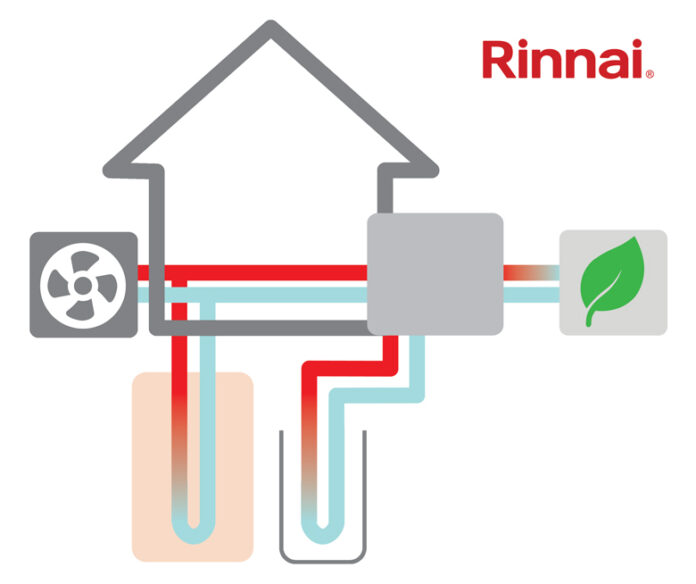
Rinnaiโ€™s range of Monobloc air source heat pumps are available in an assortment of variants, from 4 to 110kW. Rinnai Monobloc air source Low-GWP heat pumptechnology allows up to seven units to be cascaded together, making the Rinnai heat pump range an ideal choice for any heating or hot water demand. The innovative ability of the system to switch between heating, hot water, and cooling mode ensures that the Rinnai range has flexibility and durability as standard.

The units omit minimum acoustics via an installed ultra-low sound capability making Rinnai heat pumps suitable for any area with prohibitive sound legislation. Rinnaiโ€™s range operates within compliance of all stringent sound standards ensuring low-sound functionality.

All Rinnai heat pumps use R32 refrigerant, renowned for reducing electricity consumption by up to 10% and for holding a lower global warming potential (GWP). R32 has a GWP one-third lower than other refrigerants. Rinnaiโ€™s HPI heat pump range is ratified with an ERP rating of A +++ and includes an ability to switch between settings of heating, hot water and cooling.

Rinnaiโ€™s H3 LowGWP 55kW Heat Pump/Hybrid Hot Water Tanks with cascaded continuous flow hot water heating units were recently specified at a new development in the heart of the Farringdon district of London. The site is for a luxury hotel plus prestigious office complex and affordable homes.

Rinnaiโ€™s HPI heat pumps, hybrid formations, electrical formats and hydrogen gas mix powered water heaters are part of the H3 range of products. All new models are designed to reduce decarbonisation, energy efficiency and reduce customer costs by offering practical, affordable and technological solutions to UK customers.

RINNAI OFFERS CLEAR PATHWAYS TO LOWER CARBON AND DECARBONISATION PLUS CUSTOMER COST REDUCTIONS FOR COMMERCIAL, DOMESTIC AND OFF-GRID HEATING & HOT WATER DELIVERY  

https://www.rinnai-uk.co.uk


This article appeared in the Nov/Dec 2024 issue of Energy Manager magazine. Subscribe here.

Overcoming intermittency in renewables for long-term, low-cost energy

The impact of intermittency in renewable electricity generation should not be a showstopper for businesses looking to generate renewable power for their own use. In this article, Bruce Woodman Managing Director of Pure Energy Professionals (PEP) asks if renewables are really as intermittent as they are made out, and sheds light on the subject to alleviate investment anxiety in businesses looking to take control of their long-term energy costs.

The intermittent nature of variable renewable energy sources is a fact. The sun doesnโ€™t always shine, and the wind doesnโ€™t always blow. While this is sometimes used as an argument against renewables, or to express concern about potential supply disruption, intermittency does not need to have the impact that people might think.

At grid-level, addressing the challenges of integrating higher proportions of variable renewable energy has driven the development of several technological solutions to maintain a balanced grid. Last year low-carbon sources accounted for 56% of the countryโ€™s total electricity consumed, made up of renewables (43%) and nuclear (13%). Carbon Brief published that the share of electricity generated in GB from burning coal and gas fell to a record low of 2.4% for an hour at lunchtime on Monday 15 April. In 2024, we have already seen a record 75 half-hour periods when fossil fuels have met less than 5% of demand, compared to 16 in 2023 and five in 2022.

It is important that existing grid connections for businesses generating their own renewable power remain unchanged. For business-scale, user-owned renewable power generation, adding renewable energy plant โ€˜behind the meterโ€™ will supply on-site demand first and feed into the grid when there is surplus. When there is a shortfall in wind or solar supply, the site continues to be supplied from the grid. Getting the balance of installed renewable energy right can allow a high proportion of grid electricity to be replaced with completely clean renewable electricity. Adding battery storage will increase that proportion still further. With modern direct boilers, renewable electricity can also directly displace gas for space heating or process heat.

The rise and rise of user-owned power generation

The appetite for user-owned or in-house power generation among businesses is growing. This is essentially a way of generating energy from renewable sources โ€“ usually wind and solar โ€“ on or near to the facility that will use it. That might be an out-of-town office for an insurance company, a business park, or a factory or processing plant โ€“ anywhere that needs a certain baseload of power.

Ideally the renewable asset, such as a solar installation and/or wind turbine, is in relatively close proximity to the business premises, either on-site or within 2 to 10 km, so that a dedicated cable brings the power directly to the buildings using it. If there is no suitable location nearby, power can be generated some distance away and transported, or โ€˜sleevedโ€™ to the facility through transmission and distribution networks to supply yourself under a self-consumption Power Purchase Agreement.

There are considerable financial, technical and commercial benefits for businesses who opt to use renewable sources to generate energy for their own use. Bringing energy production and management in-house offers energy security; protecting a business from short-term price volatility and long-term price rises. It may be self-evident, but as there are no fuel costs for wind and solar power, the ability to control and accurately forecast energy costs over a period of 20+ years can significantly boost a businessโ€™s long-term profits and shareholder value.

Developing renewable assets accelerates corporate net zero ambitions. It enables a business to have ownership and control of the full energy lifecycle, from generation to storage and usage and associated emissions reductions.

These are compelling reasons why organisations are moving towards more user-owned or in-house energy production. It would be wrong to say that they are going โ€˜off-grid,โ€™ however. A grid connection is still important for a couple of reasons. First, to provide back-up in case there is a major shortfall in the availability of supply from in-house resources and, secondly, through offtake contracts to export excessive supply of non-dispatchable power โ€“ on a particularly windy day, for example.

Intermittent does not mean unpredictable

There is a difference between intermittent and unpredictable. While wind and solar are intermittent, their short-term output and annual average over the next 25 or more years can be very accurately predicted. Of course, there are variations year to year, but they are not huge.

Understanding how the weather behaves at a certain location is a key part in almost all decisions about renewable energy. There are many data sources that can be used first to help determine potential power generation from a particular site and, secondly, to predict or forecast the amount of energy that could be provided over both the long-term (seasons, years and decades) and the short-term (daily and even hourly).

By looking at past weather behaviour, it is possible to model likely future weather patterns. The introduction of long term global reanalysis data-sets like NASAโ€™s Modern-Era Retrospective analysis for Research and Applications (MERRA) provides a whole world picture of climate performance going back over 20 years. That data can be used to predict future weather conditions and trends for the 20- or 30-year life of a renewable energy project at a high resolution.

Smoothing intermittency with a right-sized renewables mix

If a site can host a mix of renewable energy production, intermittency can be smoothed, and its impact reduced. Solar and wind are complementary. Solar PV production is strong in the summer while there is less produced from wind. With the opposite happening in winter months.

By over-sizing its renewable production capability, a business can decrease still further its dependency on grid electricity and gas. A business consuming, say, a 1 MW baseload power and heat at a factory or large out of town office would build a renewable energy production facility of more megawatts than it consumes. For as much of the year as possible, it would be supplying its own demand and returning the rest to the grid under a Power Purchase Agreement (PPA), or supplying another of the companyโ€™s premises under a PPA.

Using storage technologies can further smooth intermittency through Battery Electric Storage Systems (BESS) and other technologies such as heat batteries and hydrogen, which can be stored and used for heat, transport fuels and even electricity production if necessary.

Ownership provides control

As we have experienced over the past few years, power prices are driven by international events and global markets. This leads to huge volatility in pricing. Predicting and budgeting for electricity, heat and transport costs into the future is a major concern for companies. Anything that can increase the predictability of costs helps the business budget its investment in future growth, production improvements and in renewable energy.

Wind and solar projects use natural energy, so there are no fuel costs. The recurring annual costs for land rental, insurance, operations and maintenance are all contracted up front and so are predictable. The capital cost of the renewable energy project can be forward-fixed over many years with a structured loan.

Because the costs are contracted, over the course of any financial year they are highly predictable. If output drops in a poor year, the cost of each unit of electricity generated will increase by a small amount. Similarly in a good year, the cost drops, again by a small amount.

Predictable, low-cost and low-carbon

The impact of intermittency is often exaggerated and should not be used to hold back investment in in-house renewable energy. The intermittent nature of wind and solar is easy to overcome by over-sizing renewable generation and using storage, while always maintaining grid connection for back-up and exports.

Power from wind and solar is the lowest cost, lowest emission generating energy option available to businesses. It provides the most predictable cost over the near, medium and long term as all of its costs can be contracted and controlled, to alleviate investment anxiety for businesses that want to reduce their carbon footprint significantly. The output from renewables can be used for power, heat and transport.

Owning the means of energy production gives companies control over their energy supply, security and costs: boosting profits, providing essential energy security, and having a genuine plan to deliver on net zero goals.


This article appeared in the September 2024 issue of Energy Manager magazine. Subscribe here.

Harnessing AI technology for sustainable change: why businesses need to work together to deploy modern technologies to drive sustainability

Photo by Igor Omilaev on Unsplash

Rohan Kelkar, EVP Global Power Products, Schneider Electric

Artificial Intelligence (AIโ€™s) energy demands are escalating at a significant rate, with a recent WEF report finding that computational power is doubling every 100 days. This rate of growth puts increasing pressure on organizations to find new ways to make AI sustainable. Research shows that leveraging AI for environmental applications could contribute over $5 trillion to the global economy in 2030.  However, to realize that potential, AI needs to be more than just intelligent. It needs to become fully optimized to increase efficiency across all environmental applications and add business value through saving time and improving accuracy.

In recent years weโ€™ve seen the development of AI continue to accelerate, and the AI capabilities we have available to us today have been built and deployed in ways designed to generate valuable data. The emphasis here is to contribute to enabling improved decision-making, which in turn boosts productivity and optimizes efficiency across industries. When coordinated effectively, AI can substantially contribute to accelerating reliable and low-cost energy transition by helping us learn and understand the exact usage of energy in every infrastructure so that we can measure and act accordingly to save energy. 

The advantages of digitalization in driving sustainability

Digitalization is improving performance efficiency while playing a crucial role in the energy transition. The opportunity to drive sustainability lies in applying various digital technologies that exist today, including solutions enabled with a full digital twin, across the entire lifecycle, from the design phase to maintenance within a unified digital environment. This gives AI stable and reliable data sets, enabling real-time processing to efficiently manage the design, build, operation, and maintenance of the physical system. Resources and data that were traditionally managed individually are now integrated and managed with the dual goal of achieving sustainability alongside improving efficiency.

We have reached a stage where green policy is ramping up, digital energy solutions are becoming more easily available, and there is increasing proof that sustainability isnโ€™t solely an environmental concern, but also an economic and business opportunity. Investments in decarbonization technologies are growing and green financing is to grow by 21% per year by 2033, showing the direction where investments are flowing across the next decade. Itโ€™s up to us to support that transition and do so in a way that benefits our industry and business ecosystem.

Collaboration is key for sustainable AI development

Businesses cannot develop sustainability strategies alone, there needs to be more industry collaboration and co-innovation. One of the most effective ways to do this is through finding the right partnerships. Collaboration between organizations, suppliers, and customers, is crucial in helping each party build resilience and reduce their overall environmental impact. This means adopting the role of sustainability consultants to partners and suppliers that are on their own journey to decarbonize. 

An effective example of this is Schneider Electricโ€™s partnership with leading chip maker NVIDIA to optimize data center infrastructure and build AI capabilities. This partnership saw the development of the worldโ€™s first publicly available AI data center reference designs. These designs opened up new doors for AI deployment and operation within data center ecosystems.

Addressing the evolving demands of AI workloads, the reference designs offer a robust framework for implementing NVIDIAโ€™s accelerated computing platform within data centers, whilst optimizing performance, scalability, and overall sustainability. Partners, engineers, and data center leaders can then utilize these reference designs for existing data center rooms that must support new deployments of high-density AI servers and new data center builds that are fully optimized for a liquid-cooled AI cluster.

Continuing the deployment journey

Business growth across industries relies on taking advantage of available technologies, and successful AI deployment offers untapped potential to achieve this. As we have discussed, leveraging the right partnerships to address the challenges posed today makes it possible to simplify and accelerate both your businesses and your partnerโ€™s sustainability journeys.

When deployed effectively, AI makes it possible to accelerate the energy transition by helping us better understand the role of energy in infrastructure so that we can monitor energy consumption in real time and make data-driven decisions on where energy can be saved by improved efficiency. In order to benefit from this untapped potential, though, businesses need to work together to integrate AI into their sustainability strategies. Doing so effectively will not only provide business value in advancing efficiency but will also provide wider sustainability benefits in our collective journey to reaching net zero.


This article appeared in the September 2024 issue of Energy Manager magazine. Subscribe here.

All-Energy and Dcarbonise 2025 set for success with new team members at the helm

Call for speakers for show floor theatres launched

All-Energy, the UKโ€™s largest renewable and low carbon energy exhibition and conference, and the co-located Dcarbonise, being held by RX at Glasgowโ€™s Scottish Events Campus (SEC) on 14 and 15 May 2025, is already on track to be the biggest edition ever. With projected growth of 16%, the exhibition is filling up fast.

A new Event Manager, Anam Khan is in post to head the organisation of All-Energy, and the co-located Dcarbonise, along with other new members of the team.

The 2024 edition of All-Energy and Dcarbonise attracted total attendance of 11,736 from home and overseas; some 270 exhibitors and saw 13,458 badges scanned at entrances to conference halls and rooms and show floor theatres.

Call for Speakers now open

The Call for Speakers for the eventโ€™s popular show floor theatres in which the spotlight turns on cutting-edge technology, innovative solutions, software, AI, โ€˜lessons learnedโ€™ and case histories has launched. The invitation to contribute knowledge and insight is atย www.all-energy.co.uk/CfP with a deadline of 10 January 2025.

The invitation to submit abstracts is open for six theatres in which discussions, presentations and networking opportunities will be held:

  • โ€˜FutureGridโ€™ with the โ€˜Great Grid Upgradeโ€™ firmly in mind.
  • โ€˜Offshore and Onshore Windโ€™ โ€“ the first time an onshore wind theatre has appeared at the heart of the busy and buzzing exhibition, which already features GE Vernova, Statkraft and Red Rock Renewables. On the exhibitor list.
  • โ€˜Hydrogen and Energy Storageโ€™.
  • โ€˜Marine Renewables and FLOW (floating offshore wind)โ€™.
  • The โ€˜Dcarbonise Theatreโ€™ focussing on the decarbonisation of Heat and the Built Environment, and on Transport.
  • Future Talent, dedicated to inspiring the next generation of energy professionals and those joining the sectors from other industries .
  • The Insight Energy Theatre designed as the home for innovative renewable energy solutions, AI and sustainable practices that are driving energy transition. It will also feature โ€˜Community and Local Energy โ€˜ which has long played a key role at All-Energy.

There is no Call for Speakers for the main conference, with its two plenary and 11 parallel sessions, that involves invited politicians and key industry, government and academic stakeholders. Within the All-Energy programme every source of renewable energy, the grid and networks, hydrogen and energy storage, investment, purchase power agreements (PPAs) and much more will be covered. The Dcarbonise programme will focus on the decarbonisation of heat and the built environment, transport, cities/places, industry, the supply chain – and more.

Discussions are currently under way with many of those key stakeholders identifying themes for panel discussions and presentations that will be highly relevant in May 2025; Glasgowโ€™s 850th birthday will also play a part. The conference programme will be launched in January 2025.

As Anam Khan explains: โ€œThe arrival of a new UK government with its far-reaching plans for energy decarbonisation, and the Scottish Governmentโ€™s recently published Energy Strategy and Green Industrial Strategy ensures there will be a fresh feel within the discussions and presentations that will feature in the 50+ panel discussions and presentations over the two days.โ€

New team at the helm

Anam Khan, All-Energy and Dcarboniseโ€™s new Event Manager has extensive experience in launching events across new markets, particularly asset management and ESG, and has successfully lead teams and developed strategies to drive business growth.

She commented: โ€œThis is a particularly exciting time to join All-Energy and Dcarbonise, especially as the event experiences significant growth. I am eager to contribute to and be a part of this dynamic journey as it progresses and evolves.โ€

Anam is joined by another new face to All-Energy and Dcarbonise. Mariana Barrios, who has been Conference Manager at RXโ€™s The London Book Fair for the past two years. She has joined All-Energy and Dcarbonise in a similar role and will be working closely with Judith Patten MBE, who continues as Conference Project Director. Together they will be working to build upon the highly successful content programmes over many years at All-Energy and Dcarbonise, reflecting the evolving nature of the energy industry.

Not only does All-Energy and Dcarbonise have a new Event Manager and a new Conference Manager, RXโ€™s new Portfolio Director Energy and Marine, Gareth Rapley is also in place. He has taken over from Jonathan Heastie as Energy & Marine Portfolio Director responsible for SPE Offshore Europe (OE) and Oceanology International as well as All-Energy. Jonathan is now overseeing RXโ€™s recently acquired portfolio of worldwide hydrogen events.

Gareth brings more than 15 years of events leadership and energy experience having previously worked for RX on SPE Offshore Europe for nine years, latterly as Exhibition Director before spending three years in the Middle East with dmg events and Informa Markets. Most recently, he returned to London as Director of The London Book Fair.

He commented: โ€œI am delighted to have rejoined the energy industry. All-Energy and Dcarbonise, SPE Offshore Europe, and Oceanology International combine to represent many facets of the energy and marine industries. These are valuable national assets that need to be secured and developed to continue to deliver for the UK and our events provide very successful platforms to further these aims.โ€

Further details on all aspects of All-Energy and Dcarbonise, from the ever-growing exhibitor list and information on exhibiting and sponsorship to the Call for Speakers and route for contributing thoughts on conference themes is at www.all-energy.co.uk