
Smarter water heating control yields 30%+ savings

Operators of multi-occupancy accommodation, such as student residences, hostels, and shared housing, face ongoing challenges in managing hot water systems effectively.

They face unique usage patterns, fluctuating occupancy levels, and a high demand for both comfort and operational efficiency. At the centre of these challenges lies the hot water cylinder: a seemingly simple piece of equipment that, when poorly managed, can lead to excessive energy consumption, inflated utility bills, system failures, and compliance risks.

Understanding the common issues with traditional hot water systems in these settings, and the benefits that tighter control and monitoring can offer, is key to future-proofing operations and improving sustainability.

Lack of control and visibility

Most traditional hot water cylinders in multi-occupancy buildings use basic thermostatic controls or fixed-time schedules. Often heating water continuously, without real-time understanding of demand or occupancy.

This lack of visibility translates to guesswork. There is little or no data indicating when water is being used, consumption, or efficiently operating cylinders. Without control, buildings often maintain hot water availability around the clock, even during periods of low or no occupancy, such as holiday breaks or weekends.

This “always-on” approach results in wasted energy and unnecessary wear on equipment.

Ageing components

In many student accommodations, water heating systems include older immersion elements and poorly insulated cylinders. These degrade over time, becoming inefficient – consuming more energy to maintain the same output.

Old systems are also prone to temperature drift. The set temperature is not maintained accurately, leading to inconsistent hot water delivery, a common complaint among residents. Additionally, older systems lack modern safety features like automated thermal disinfection, which helps prevent bacteria growth such as Legionella.

Energy and water consumption

Heating water is one of the largest energy costs in multi-occupancy buildings. With outdated or uncontrolled systems, cylinders are heated far more frequently than necessary.

Water waste is another concern, either through leaks, dripping taps or an intermittent faulty toilet cistern.

The benefits of tighter temperature and volume control

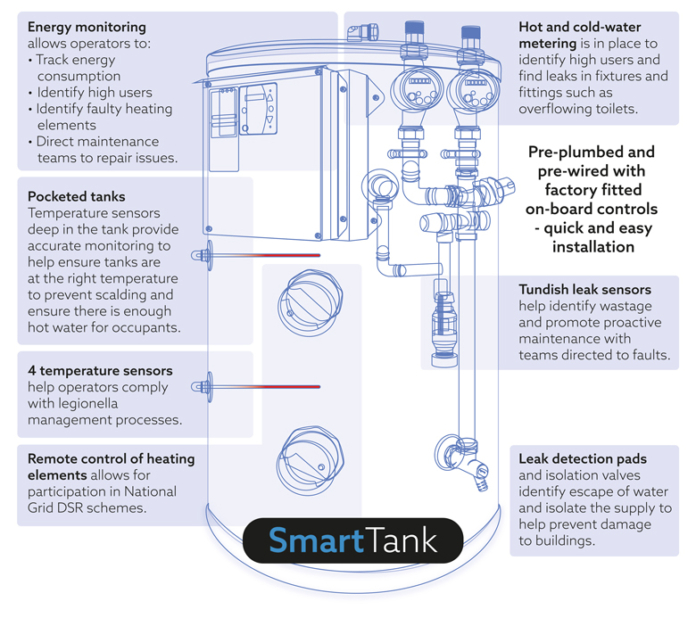
Implementing SmartTank as part of the Irus ecosystem offers a solution. Cylinders that enable real-time temperature management and water measurement can transform hot water systems from a passive utility into a proactive asset.

Utilities efficiency – SmartTank enables much tighter control of heating, based on more accurate temperature measurement. Rather than heating all day, cylinders can be preheated before peak times and held at safe standby temperatures during low-demand periods.

SmartTank data reveals 31% energy saving, per bed over a year.

Leak detection is another feature. At one site SmartTank detected a year-long leak, wasting 14,000 litres of water per day!

PipeSense is a system addition, monitoring outlet temperatures, and detecting faulty toilet cisterns.

Maintenance and reliability – Monitoring temperature consistency and heating performance helps detect degrading elements before they fail. Preventative maintenance can be scheduled more effectively, reducing downtime and emergency repairs.

Improved sustainability and reporting โ€“ Accurate water measurement gives operators clear insights to hot water consumption. Meaningful reporting from the Irus Portal enables targeted conservation efforts, helps meet sustainability targets, and supports transparent utility reporting.

Resident satisfaction – By ensuring reliable hot water supply and reducing downtime, residentsโ€™ comfort improves. Additionally, SmartTank prevents overheating or underheating, addressing common complaints around inconsistent temperatures.

The challenges posed by traditional hot water cylinders in multi-occupancy accommodation are real, but they are also solvable. With tighter temperature control and accurate water measurement, operators are dramatically improving utility efficiency, reducing waste, extending equipment life, and enhancing the living experience for residents. In an increasingly data-driven and sustainability-focused world, upgrading hot water systems is not just smartโ€”itโ€™s SmartTank.

www.prefectcontrols.com


This article appeared in the June 2025 issue of Energy Manager magazine. Subscribe here.

New Whitepaper Sets the Standard for Corporate Carbon Accounting

Tunley Environmental has announced the publication of a new whitepaper authored by Associate Carbon Scientist Emily Alexander, titled โ€œWhat is Carbon Accounting and Why Does it Affect Business?โ€

This whitepaper, specifically designed for organisations and busy teams, offers a scientifically grounded yet easily comprehensible overview of the carbon accounting process. Carbon reporting is now a legal requirement for some businesses, particularly in light of expanding international frameworks like the Corporate Sustainability Reporting Directive (CSRD) and the UKโ€™s Streamlined Energy and Carbon Reporting (SECR), highlighting the need for corporations to have the internal capability to measure and manage emissions.

Commenting on the release of the paper, Emily said, โ€œThis whitepaper is designed to help organisations understand carbon accounting and realise that they can build this capability internally, with the right training and support.โ€

Emily outlines the practical advantages of in-house expertise in carbon accounting, including stronger data accuracy, year-on-year consistency and improved stakeholder confidence. While third-party verification still plays an important role in audit and assurance, Tunley Environmentalโ€™s latest whitepaper encourages organisations to build lasting internal capability to manage their emissions and meet long-term climate goals.

The paper also introduces a structured pathway to train key personnel in carbon reporting, a collaborative course designed and delivered in partnership with learning provider Astutis. The course covers everything from identifying emissions sources and applying GHG Protocol standards, to calculating an organisationโ€™s carbon footprint and developing a roadmap to Net Zero. Training is available online or in person and is tailored to both individual learners and corporate teams.

To download the whitepaper, visit this https://www.tunley-environmental.com/en/white-papers/what-is-carbon-accounting-and-why-does-it-affect-business.

Images sourced from Envato Elements and used under Tunley Environmentalโ€™s license.


This article appeared in the June 2025 issue of Energy Manager magazine. Subscribe here.

Protecting performance: Rinnai puts Limescale defence front and centre at Installer Show 2025

Rinnai to champion critical role of scale protection in hot water systemsโ€”plus new tech, extended warranties and 15 chances to win one of 15 free boilers

Rinnai will use Installer Show 2025 to spotlight the often-overlooked threat of limescale in hot water systemsโ€”and why scale protection is essential for long-term system performance, efficiency, and cost control. With hard water affecting over 60% of UK sites, Rinnai is urging installers to prioritise scale defence as a standard part of every domestic hot water (DHW) installation.

Visitors to the Rinnai stand will be able to explore the science behind scale formation and see how solutions like Aquabionโ€”an advanced galvanic and electrolytic systemโ€”transform calcite into non-adhering aragonite, preventing build-up and protecting system integrity.

But this isnโ€™t just about showcasing a product. Itโ€™s about starting a conversation. Rinnaiโ€™s technical team will be on hand to discuss real-world installation scenarios, share best practices, and help installers understand how scale protection can reduce callouts, extend appliance life, and improve customer satisfaction. Come to the Rinnai stand and get involved and join the conversation on scale protection and system longevity.

What else is on the Rinnai stand at the Installer SHOW?

  • New electric storage and instant water heaters
  • Smart-grid-ready R290 heat pumps
  • N Series Sensei continuous flow water heaters with up to 12-year warranties
  • Rinnai Applied: a new division offering heat pumps up to 600kW, chillers, and AHUs for large-scale commercial projects

And for a bit of relaxation โ€“ Come and Play to win darts, โ€œPlay Your Cards Right,โ€ and hundreds of prizesโ€”including 15 free domestic boilers.

Register now for a free goodie bag: https://www.rinnai-uk.co.uk/contact-us/ask-us-question at the Installer show.

National Grid Electricity Distribution leads the way to a new energy era with cutting-edge innovation project

Funded by Ofgemโ€™s Network Innovation Allowance, the HV Pilot project will use smart meter data, helicopter survey insights, and machine learning to map how high voltage (HV) networks connect to low voltage (LV) systems.  

This data-driven approach will help identify where reinforcement might be needed to accommodate growing demands for electricity, particularly in rural areas where single-phase HV sections and transformers can lead to network imbalances and inefficiencies.  

David Penfold, innovation and deployment engineer at National Grid Electricity Distribution, said: โ€œUnderstanding exactly how our HV network is connected at a phase level is essential for a smarter, more flexible grid.  

โ€œThis project empowers us to make data-driven decisions, leading to optimised rural infrastructure. Itโ€™s about precision, innovation, and preparing for a future powered by clean, reliable electricity.โ€  

Gav Berry, secondary modelling engineer in the National Grid DSO modelling and analysis team, said: โ€œAccurate phasing data can improve National Grid Electricity Distribution power system models, and provide network designers with the information required to design a balanced and efficient electricity network.  

โ€œWeโ€™re looking forward to working with CGI and Loughborough University to see how we could make this innovative method work.โ€ 

The HV Pilot, with partners CGI and Loughborough University, aims to deliver a low-cost, scalable solution to improve phase balancing without the need for additional visual surveys. If successful, the project could save up to ยฃ2.9 million through targeted interventions and improved network management. It could also reduce voltage issues for rural customers, improve efficiency and increase the number of connections opportunities.  

More information here: National Grid – HV Pilot (High Voltage Phase Identification) 


This article appeared in the June 2025 issue of Energy Manager magazine. Subscribe here.

Gloss or game-changer? AI in non-domestic decarbonisation

Craig Mellis, Senior Advisor – Decarbonisation of Complex Sites, and Samuel Young, Practice Manager โ€“ AI, at Energy Systems Catapult

Comment by Craig Mellis, Senior Advisor โ€“ Decarbonisation of Complex Sites, and Samuel Young, Practice Manager โ€“ AI, Energy Systems Catapult

What do we mean by โ€˜Artificial Intelligenceโ€™ (AI)? It seems like every software solution nowadays boasts that it uses AI, but, as with other buzzwords like โ€˜sustainabilityโ€™ or โ€˜digital twinโ€™, what people mean by it and how people interpret it varies hugely.

This can be a problem when it comes to procuring and using AI tools. If what users think of AI as being differs from how it actually works, then real world decisions can be made based on flawed assumptions and misplaced confidence.

In the course of our work with non-domestic energy data and supporting Net Zero innovators, we have spent time working with AI experts to understand how the market is evolving, what AI products are available and how they deliver. The question we want to address is:

How can you tell whether a particular AI solution is appropriate for your situation?

Generative vs predictive AI

Generative AI (like ChatGPT and other โ€˜large language modelsโ€™) essentially works by answering the question โ€œwhat are the most likely words to come next?โ€. It is focused on words and what is most commonly written, rather than underlying data and facts, so the answers it gives are usually plausible but not always grounded in fact. When you hear software โ€œuses AIโ€ and the software involves documents or a chatbot, this is probably what it means.

Predictive AI analyses more structured data, often in a spreadsheet or database, and looks for patterns in that data. When you give it new data, it compares that data to the patterns it found in previous data and suggests things that might also be true of this new data. You may sometimes see this referred to as machine learning (ML). This is a bit more grounded in data and facts, but it is still only extracting patterns from past data, so if the data is incomplete or the future is quite different from the past, then it wonโ€™t necessarily give the right answers.

Applying AI to heat decarbonisation plans

Letโ€™s look at an example to illustrate this. Consider the case where we want to develop heat decarbonisation plans for sites or buildings based on previous heat decarbonisation plans for similar sites or buildings.

A generative AI approach would feed the existing pdf-based heat decarbonisation plans into a ChatGPT-type tool which might then generate pre-populated decarbonisation plans for new sites. However, because the approach is โ€œwhat text is most likelyโ€, these new plans will tend to be based on the most common applications and recommendations, with a thin veneer of site customisation, rather than reliably understanding the needs of each site and customising plans accordingly.

A predictive AI approach would take a wide range of structured information about a site (e.g. location, building areas, energy usage) and use similar information from other sites to find correlations and make recommendations. It is more likely to recommend approaches that have been pursued at similar sites and remove options that are clearly unsuitable for a site from examination of the data.

Of course, neither can compete with the nuance and detail available from a site-based walk around and audit (โ€œPhew!โ€ I hear some of you engineers say) but the second is likely to provide a better suggestion of the options which could be then investigated whereas the first may well provide spurious results that are less useful.

It is also important to recognise that neither approach is ever going to be more accurate than its input data. An AI can only go on the information it has been provided with, and if that information is insufficient or incorrect it will make incorrect recommendations โ€“ usually without alerting the user to the fact key information is missing/wrong! This is where engineers and people who really know the site really shine โ€“ they can much more reliably spot when something isnโ€™t accurate or realistic for a site.

In some cases, hybrid approaches combining different types of AI may be more effective. For example, generative AI may be able to extract structured data from text for a predictive AI approach to use (e.g. โ€œDoes this decarbonisation plan involve solar PV?โ€) or turn the output of a predictive AI model into more user-friendly text.

When developing building decarbonisation plans:

  • Generative AI is less likely to provide reliable insight about specific sites
  • Predictive AI with access to structured data about lots of buildings may be able to group buildings to help identify and prioritise investigation and action
  • Expert knowledge will still be required to tailor a plan to each site

Does AI actually help us?

Well-chosen AI tools can be a powerful force in helping us pick up the pace in getting our wide and varied non-domestic estate to Net Zero. However, reliance on AI tools that are inappropriate for the task also has the potential to undermine good decision making and slow us down.

To ensure we use AI appropriately it is important to:

  1. Understand what a specific instance of AI is, and is not, capable of (you may sometimes need support from people with greater AI knowledge for this).
  2. Evaluate whether the data provided to AI contains enough of the important information for the AI to make reasonable recommendations.
  3. Define a small number of detailed examples that you can use to test how reliable an AIโ€™s outputs are.
  4. Ensure human expert knowledge is applied after or alongside AI recommendations, rather than following them blindly.

For more information, visit the website: https://es.catapult.org.uk/what-we-do/net-zero-sites/insite/


This article appeared in the June 2025 issue of Energy Manager magazine. Subscribe here.

Chauvin Arnoux launches the CA 6652 Test Adapter

Chauvin Arnoux is excited to announce the launch of the CA 6652, an advanced test adapter designed for Type 2 AC electric vehicle charging stations (EVSE). This versatile adapter enables rapid and comprehensive diagnostics of charging stations for both battery electric vehicles (BEVs) and plug-in hybrid electric vehicles (PHEVs).

Designed for effortless deployment, the CA 6652 is ideal for professionals seeking speed, safety, and accuracy in the evolving EV charging infrastructure. Its compact design and comprehensive features make it an essential adapter for installers, inspectors, and maintenance teams/technicians.

Engineered for safe and simplified operation, the CA 6652 is suitable for both indoor and outdoor use, making it the ideal adapter for on-site inspections, maintenance, and certification testing.

The CA 6652 is capable of providing a quick diagnosis of EVSE charging station operation and has in-built safety features in the event of a fault. When paired with a multifunction installation tester, it supports complete electrical safety testing in compliance with industry standards.

Technicians can simulate the vehicle charging status (CP/Control Pilot) and cable configurations (PP) to cover all conditions defined by the regulatory standards. The fault simulation buttons on the device can further enhance safety, allowing engineers to replicate potential anomalies between the electric vehicle and the charging system, such as cases where the DC voltage to the control signal (CP) is not blocked.

For in-depth analysis, the CA 6652 allows direct access to the CP signal at its terminals and when used alongside the HANDSCOPE II or SCOPIX IV BUS oscilloscopes, engineers can diagnose communication issues between the vehicle and charging station with precision.

About Chauvin Arnoux

With over a century of expertise in the test and measurement industry, Chauvin Arnoux continues to lead innovation with instruments tailored to meet the demands of modern electrical systems. The CA 6652 shows our commitment to delivering reliable and efficient solutions.

For more information or to request a quote, please contact: 01924 460494 or Visit – cauk.tv


This article appeared in the June 2025 issue of Energy Manager magazine. Subscribe here.

Dispelling Myths: Steamโ€™s Role in a Net-Zero Future

When it comes to decarbonisation, steam often gets a bad reputation.

Thereโ€™s a growing misconception that to achieve net-zero, industries must move away from steam entirely โ€“ a process sometimes dubbed โ€œdesteaming.โ€ But hereโ€™s the truth: steam isnโ€™t the problem; Itโ€™s the fossil fuels that have traditionally been used to generate steam that are. In fact, with the right updates and technologies, steam systems can play a central role in a low-carbon future.

At Spirax Sarco, we believe itโ€™s time to set the record straight.


โŒ Myth: Steam is Outdated and Incompatible with Net-Zero

Steam has been the backbone of industrial heating for over a century. Itโ€™s trusted, efficient, easy to control and distribute and incredibly versatile โ€“ which is exactly why itโ€™s still widely used across sectors like food & beverage, healthcare, pharmaceuticals, and manufacturing.

Whatโ€™s often misunderstood is that steam systems themselves arenโ€™t inherently inefficient. Itโ€™s how theyโ€™re managed, maintained, and powered that makes the difference.


โœ… Fact: Steam Can Be Decarbonised โ€“ Without Being Replaced

Modern steam systems are nothing like those of decades past. Today, businesses can make huge strides towards net-zero while continuing to use steam, by adopting smarter, cleaner practices such as:

  • Electrifying steam generation using renewable electricity
  • Installing energy-efficient components like precision control valves, insulation, and flash steam recovery systems
  • Digitally monitoring steam traps to prevent losses and keep systems running at peak performance
  • Recovering waste heat to reduce overall energy demand

These solutions donโ€™t require a complete overhaul. They work with the existing infrastructure you already have โ€“ and they deliver measurable savings in both emissions and operating costs.


Why โ€œDesteamingโ€ Isnโ€™t Always the Answer

Removing steam entirely often comes with unintended consequences: large capital expenditure, longer payback periods, costly and intrusive building, pipework and process modification and the introduction of alternative systems that may still rely on fossil fuels at some stage of the process.

For many businesses, it’s far more practical โ€“ and sustainable โ€“ to optimise whatโ€™s already in place.

At Spirax Sarco, weโ€™re helping customers decarbonise without compromising performance, safety, or reliability. Whether it’s a dairy looking to cut emissions or a hospital needing guaranteed sterilisation, steam remains one of the most effective ways to deliver heat โ€“ especially when it’s used wisely.


The Bottom Line

Ditching steam isnโ€™t a prerequisite for going green.

With the right upgrades, maintenance, and control, steam systems can absolutely support your decarbonisation strategy โ€“ and in many cases, outperform newer alternatives in both efficiency and environmental impact. The FIRST step is to reduce demand for steam by following best practice with steam generation & distribution and then seek to understand the process.

Letโ€™s stop writing steam off โ€“ and start working with it to build a cleaner, more sustainable future.


Need help understanding how your steam system fits into your net-zero plans?
Talk to our experts or book a site assessment today.

www.spiraxsarco.com


This article appeared in the June 2025 issue of Energy Manager magazine. Subscribe here.

Power prescription: why open protocol platforms pave the way to resilient healthcare

Nigel Thomas, ABB’s National Specification and Projects Sales Manager

With modern hospitals consuming up to 2.5 times more energy per square foot than typical commercial buildings, they are often hampered by power supply challenges. Nigel Thomas, ABB’s National Specification and Projects Sales Manager, takes a closer look at this urgent yet underreported crisis and offers modern solutions to safeguard uninterrupted electrical power.ย 

Healthcare facilities in the UK and across the globe are under severe pressure. Ageing infrastructure, extreme weather events caused by climate change, and cyber-attacks leading to power blackouts arethreatening their ability to provide continuous, quality healthcare. In addition to these risks, the transition to greener energy makes electricity supplies more unpredictable, even as hospitals require more power to run advanced medical technologies.

To overcome these hurdles, hospitals must operate in a more agile and efficient manner without compromising patient care. Connecting equipment, devices, and technologies from various providers through an open protocol platform is essential for building the resilience needed to address these challenges confidently.

The primary challenges

Hospitals are like small cities in their energy demands. With a multitude of equipment โ€” ranging from life-saving devices to basic operational tools โ€” these demands are immense. Heating, ventilation, and air conditioning (HVAC) systems alone account for around half of all energy usage in hospitals. To deliver reliable patient care, they must have a stable, uninterrupted electricity supply.

However, as healthcare becomes increasingly digital, hospitals’ carbon footprints have grown to concerning levels. So much so that, if global healthcare were a country, it would be the fifth-largest greenhouse gas emitter on Earth. Therefore, hospitals face the challenge of embracing innovative yet energy-intensive technologies while also maintaining sustainability. They must also strike a delicate balance between improving conditions for patients and staff while becoming more energy-efficient to reduce emissions.

Stakeholders, primarily patients and healthcare providers, bear the brunt of energy reliability issues. Patients, for instance, depend on stable energy to power life-support machines; any interruption, even for a minute, can be detrimental to their well-being. The economic ramifications are also alarming. A hospital power outage can cost upwards of $7,900 per minute, reflecting not only financial loss but also potential degradation of patient trust and hospital reputation.

Cybersecurity is another concern. As hospitals implement digital systems, the risk of cyberattacks, particularly ransomware, increases. These attacks can have severe implications if energy management systems are compromised. Thus, deploying secure energy management software becomes imperative. By utilising encrypted communication and constant monitoring, these systems can effectively ward off potential threats.

Hospitals must continually innovate to meet evolving patient needs. Yet, building or redeveloping hospitals has grown significantly more costly, mainly due to shortages of specialist skills and increasing labour expenses. This situation presents a challenging task for healthcare providers, who must carefully balance competing priorities: keeping pace with technological advances while managing and controlling escalating costs.

Open protocol platforms and other solutions

To tackle these challenges, hospitals must embrace innovative and sustainable energy solutions. A promising approach lies in the adoption of open protocol solutions, which facilitate interoperability among various pieces of equipment. These systems enable hospitals to select the best-suited technology, minimising the risk associated with vendor lock-in, which can hinder upgrades and adaptability. Open protocols also improve seamless data transfer, enabling more informed decision-making โ€” crucial for efficient energy management and robust power monitoring.

Energy management systems must evolve to integrate smart technologies seamlessly, such as an intelligent power network, which acts as the hospital’s central nervous system. This interconnected approach enables facilities to anticipate and address issues promptly, thereby reducing the risk of power outages. Hospitals must also maintain strong connectivity across their electrical systems while integrating new technologies, such as human-centric lighting, in-room sensors, and voice control activation, all while simultaneously reducing energy consumption.

Another critical solution is the integration of Uninterruptible Power Supply (UPS) systems. High-efficiency UPS units ensure long-term system availability, significantly reducing carbon emissions while safeguarding against sudden power outages.

Why healthcare providers need a connectivity partner

Working with a connectivity partner in the initial stages of development allows hospitals to build a digital ecosystem that optimises for today and lays the groundwork for the future. Having access to cutting-edge, flexible, and scalable systems is crucial for building the infrastructure necessary to maintain mission-critical uptime.

The path to better energy reliability in hospitals hinges on embracing open, secure, and flexible solutions that are future-proofed against both technological and environmental changes. By addressing inefficiencies and adopting comprehensive energy strategies, hospitals can boost their service delivery, meeting immediate and future healthcare demands with confidence.


This article appeared in the June 2025 issue of Energy Manager magazine. Subscribe here.

When is the Right Time to Invest in Solar?

Faced with rising energy prices, sustainability targets, and ageing infrastructure, many businesses are no longer asking if they should transition to solar power – but when. Should investment happen now, or is it wiser to wait for better incentives, technological advancements, or infrastructure upgrades?

Ciaran Cotter, Head of Technical at Solivus, explores when to invest in solar and what key factors should guide that decision.

The future energy task is a complex one, especially for industry. On the one hand, there is the issue of maintaining business as usual and supporting new growth, while seeking to reduce operational costs and offset rising energy cost pressures.

At the same time, there is a pressing need to lessen environmental impact. As the UKโ€™s net zero trajectory comes closer into sight, we continue to see new industry standards and carbon reduction expectations for businesses to get to grips with. Additionally, stakeholders – including customers, employees, and suppliers – are increasingly aligning themselves with businesses that demonstrate clear environmental responsibility.The result is increased onus on the environmental measures which can drive efficiencies and optimise energy consumption levels while helping to futureproof.

Against this backdrop, solar power presents a clear opportunity: it enables significant carbon reductions while minimising disruption and controlling energy costs. But despite its appeal, it can sometimes be difficult for businesses to ascertain when to make the switch.

A Strategic Response to Rising Costs

In our experience the most common catalyst for solar adoption is rising energy costs. Businesses increasingly need to think tactically about grid usage and cost control. Whether triggered by increased energy demand, tariff changes, or grid constraints, strategic energy management has become a critical concern.

Take, for instance, an automaker that expands its operations with EV charging infrastructure. While a positive step toward electric mobility, it also introduces significant peak energy loads – driving up electricity bills and straining the grid. In another scenario, a company might face new utility contract terms that include higher demand charges – fees tied to peak usage rather than total consumption. These can inflate operating costs for energy-intensive operations.

In both cases, solar power- particularly when paired with battery storage- offers a way to self-generate energy, reduce grid reliance, and shield the business from volatile energy prices. It becomes a commercially sound decision, not just an environmental one.

Environmental Leadership and Business Continuity

Thereโ€™s also a proactive dimension to this shift. Many businesses are now looking beyond immediate cost savings and taking decisive steps to reduce their carbon footprint as part of a broader decarbonisation strategy. For these organisations, the move to on-site renewables and smart energy systems is as much about environmental leadership as it is about operational efficiency.

Another compelling case for commercial solar can be found in business climates where an interruptible power supply is paramount. As aged grids become increasingly unreliable, deviations and other disturbances to electrical supply are more common. For a busy factory or manufacturer, the result of even a few minutes downtime can be huge in terms of the loss to productivity and revenue impact. Solar, combined with energy storage, provides a buffer – ensuring continuity of critical systems and reducing dependence on the national grid.

Choosing the Right Solar Solution

Once the case for solar is made, the next step is specifying the right solution. Structural capacity is often the first concern. As many as 40% of commercial buildings in the UK can’t support the weight of traditional solar panels. Fortunately, advancements in lightweight, ultra-thin film technology now make solar viable for buildings previously deemed unsuitable.

Scalability is another key factor. As the world moves towards future decarbonisation, it is becoming increasingly difficult for commercial and industrial users to predict what loads they may require a year from now, never mind in five yearsโ€™ time when new electric fleets or new production technologies might have been added to the mix. In this vein, the ability to grow, support commercial objectives and scale up as needs increase is essential.

Digitalisation also plays a pivotal role. From system monitoring and energy optimisation to leveraging data analytics and AI, smart energy systems are transforming how businesses manage consumption and emissions. Energy storage supports this digital shift, enabling informed control of usage based on real-time insights. In this way, any solar solution should complement existing infrastructure while aligning with broader smart building ambitions.

A Strategic Imperative

The energy transition is accelerating, driven by renewable adoption and changing consumption models. While this brings complexity, it also creates a strategic opening for businesses to redefine how they generate and use power.

In this way, solar should be viewed as far more than a cost-saving measure; itโ€™s a strategic asset. Early adopters often gain reputational advantages, better resilience against price volatility, and stronger alignment with customer and investor expectations.

The truth is, the most significant benefits from solar come with long-term use. Each year of delay represents lost savings and missed emissions reductions. So, when is the right time to invest? In short: now.

For more information please visit www.solivus.com


This article appeared in the June 2025 issue of Energy Manager magazine. Subscribe here.

Net zero explained, dispelling myths for a green future

Photo by JOHN TOWNER on Unsplash

In recent years, the term “net zero” has become a buzzword in discussions about climate change and sustainability. However, there are several myths and misconceptions surrounding this concept. TEAM Energy has asked some of its Energy Consultants to debunk the most common myths and shed light on the reality of achieving net zero.

Myth 1: Net zero means zero emissions by Timothy Holman, Head of Consultancy

One of the biggest misconceptions is that net zero means eliminating all emissions. In the UK, net zero has a clear legal definition under the Climate Change Act 2008 (2050 Target Amendment) Order 2019. It means cutting greenhouse gas emissions by at least 100% compared to 1990 levels by 2050.

In reality, net zero refers to balancing the amount of greenhouse gases emitted with the amount removed from the atmosphere. This involves drastically reducing emissions at the source and addressing only residual emissions, those that are unavoidable, with offsetting measures. Residual emissions are expected to account for no more than 10% of total emissions.

Working towards net zero is all about creating a balance while striving for a more sustainable future.

Myth 2: Net zero is only about carbon by Sophie Legg, Data Analyst

While carbon dioxide is the primary greenhouse gas contributing to global warming, net zero encompasses a range of greenhouse gases, including methane (CHโ‚„), nitrous oxide (Nโ‚‚O), and fluorinated gases, such as hydrofluorocarbons (HFCs) and perfluorocarbons (PFCs). These gases vary in their sources and warming potential but collectively impact climate stability. Achieving net zero requires addressing emissions from sectors such as agricultureโ€”where methane emissions stem from livestock; industryโ€”producing nitrous oxide and fluorinated gases through manufacturing processes; transportationโ€”primarily emitting carbon dioxide from fossil fuel combustion; and energy production from fossil fuels (coal, oil, and natural gas). Effective strategies to mitigate these emissions involve reducing reliance on fossil fuels, enhancing efficiency in industrial and agricultural practices, transitioning to renewable energy sources, and investing in carbon capture technologies to offset any residual emissions.

All sectors play a significant role in the UK’s greenhouse gas emissions profile, and targeted strategies are essential to mitigate their impact.

Myth 3: Net zero is too expensive by Sam Arje, Senior Energy Consultant

Many believe that achieving net zero is prohibitively expensive. However, the costs of inactionโ€”rising global temperatures, extreme weather events, and disrupted supply chainsโ€”are far greater. Investing in sustainable practices and technologies is not only essential for addressing these risks but can also result in long-term savings and economic opportunities. For businesses, aligning with climate mitigation plans such as adopting renewable energy, improving efficiency, and integrating low-carbon technologies can enhance resilience and competitiveness.

Additionally, there are incentives, grants, and funding available to support the transition to net zero. Organisations are further encouraged to be guided by frameworks like the Task Force on Climate-related Financial Disclosures (TCFD), which requires organisations to report on their climate-related risks and strategies. By aligning with TCFD requirements, organisations can demonstrate accountability, attract investment, and better position themselves for future regulatory changes. Proactively transitioning to net zero is not just a moral imperativeโ€”it is a smart and forward-thinking business strategy.

Myth 4: Net zero is only for big corporations by Tom McLeish, Energy Consultant

Net zero is not an ambition reserved for large corporations; smaller businesses play a crucial role in contributing to this global goal. Simple actions, such as embracing energy efficient measures, and prioritising sustainable goods and services, collectively drive meaningful change. These efforts also create ripple effects throughout the supply chain โ€“ which can account for up to 90% of an organisationโ€™s total carbon emissions. Therefore, suppliers and smaller businesses can play a vital role in a large corporationsโ€™ carbon reduction and the success of its net zero goals. By implementing carbon reduction plans, small businesses prove their commitment and secure their future within the supply chain. Achieving net zero requires collective commitment from all sectors, where even seemingly small contributions add up to create substantial environmental impact.

Myth 5: Net zero is a distant goal by Georgina Wisby, Energy Consultant

Some people think that net zero is a goal for the distant future. As of 2024, 147 out of 198 countries worldwide have established some form of net zero target. The UKโ€™s target is to achieve net zero by 2050 or even earlier, in some cases 2030. Depending on where you are as an organisation, 25 years is not as far away as you think. Reducing carbon emissions is undoubtedly a complex and challenging undertaking that will reveal bumps in the road, but it is an essential step in addressing the climate crisis. Gaining a clear understanding of the different types of emissions, harnessing near real-time data, engaging stakeholders, and fostering collaboration across the supply chain, can take time. But organisations can take meaningful strides toward their sustainability goals once the first steps are made. By adopting sustainable practices now and utilising effective tools to drive change, we can collectively accelerate the journey toward achieving net zero and create a more resilient, sustainable future.

Final thoughts

Achieving net zero is a complex but necessary goal to combat climate change. By understanding and debunking these myths, we can better appreciate the efforts required and the benefits of reaching net zero. It is a collective responsibility that involves governments, businesses, and individuals working together to create a sustainable future.

www.teamenergy.com


This article appeared in theย June 2025ย issue of Energy Manager magazine. Subscribeย here.