
Carbon Neutral and Net Zero: Why the Difference Matters

As climate pledges increase, many organisations are committing to cutting emissions. However, terms like carbon neutral and net zero are often used as if they mean the same thing โ€” and they donโ€™t.

Both approaches aim to reduce environmental impact, but they take different routes to get there. Understanding the distinction is key for businesses that want to avoid greenwashing and build credible sustainability strategies.

This guide explains what each term means, how they differ, and what to consider when setting your companyโ€™s climate targets.

What Does Carbon Neutral Mean?

Being carbon neutral means balancing the amount of carbon dioxide (COโ‚‚) emitted with an equivalent amount that is removed or offset. A company, product, or event can call itself carbon neutral if the emissions it generates are matched by investments in activities that counteract those emissions โ€” not by eliminating them altogether.

Most organisations start by calculating their emissions and then purchasing offsets such as renewable energy credits or tree planting projects. While this compensates for emissions, it doesnโ€™t necessarily drive reductions at the source.

Carbon neutral claims typically cover Scope 1 and Scope 2 emissions (direct emissions and purchased energy). Some companies include parts of Scope 3, but this is less common.

For many businesses, carbon neutrality is an entry point into climate action. Still, the concept has faced criticism when companies rely heavily on offsets without making meaningful internal reductions.

What Does Net Zero Mean?

Net zero goes beyond carbon neutrality. It requires cutting greenhouse gas emissions across the entire value chain and only using offsets for residual emissions that cannot be eliminated.

To reach net zero, reductions must cover Scopes 1, 2, and 3 โ€” everything from on-site fuel use and purchased electricity to supply chain activities, product use, and business travel. Because Scope 3 often makes up the largest share, net zero requires systemic changes, not just surface-level adjustments.

Offsets are still part of the equation but play a limited role. Current net zero standards require that they be high-quality, permanent removals such as carbon capture or verified nature-based solutions.

The Science Based Targets initiative (SBTi) states that companies must cut 90โ€“95% of emissions before relying on offsets for the rest. Net zero, therefore, represents a long-term, science-driven commitment to measurable reductions.

Carbon Neutral vs Net Zero: Choosing the Right Path

Although often used interchangeably, carbon neutral and net zero represent different levels of ambition. Carbon neutrality focuses on balancing emissions, usually through offsets. Itโ€™s suitable for organisations looking for quick wins, but it doesnโ€™t always require significant internal changes.

Net zero, on the other hand, is the recognised benchmark for credible climate leadership. It demands deep reductions across operations and supply chains, with only minimal use of verified offsets. More companies are aligning with net zero targets to meet rising expectations from regulators, investors, and customers.

What About Climate Positive?

Some organisations are aiming beyond net zero by becoming climate positive (or carbon negative). This means removing more carbon from the atmosphere than is emitted.

To achieve this, businesses must first minimise their own footprint, then invest in projects that actively remove additional carbon โ€” such as reforestation, soil carbon storage, or direct air capture technologies.

While still relatively rare, climate positive strategies are gaining attention from companies that want to lead the way and demonstrate impact that goes beyond compliance.

Taking the First Step

Whether your organisation chooses carbon neutrality, net zero, or climate positive, the most important thing is to begin.

The UKโ€™s Net Zero Strategy sets a target of cutting emissions by 2050. Businesses that align with this roadmap not only support climate goals but also strengthen their resilience against future regulation.

The first step is understanding your footprint. Measuring Scope 1, 2, and 3 emissions gives you the data needed to act. From there, set measurable targets, implement a reduction plan, and track progress.

You donโ€™t need to tackle everything at once, but you do need reliable data and the right tools. Solutions like ClearVUE.Business help organisations monitor emissions, identify energy waste, and build credible strategies for long-term climate action.

https://clearvue.business/


This article appeared in the September 2025 issue of Energy Manager magazine. Subscribe here.

Energy Bills Set to Rise in October โ€“ Save Big with This Tip

This winter, millions of households in the UK will see their gas and electricity bills rise by around 2% after Ofgem announced the latest energy price cap from October 2025. Even a small increase in charges can add extra strain to monthly budgets.

While we canโ€™t control the price rises, we can control how much energy we waste. The key to lowering bills is recognising where energy slips through the cracks and stopping it.

In this article, Julian Grant, General Manager at Chauvin Arnoux UK, shares how the right power and energy logging solution can help professionals spot hidden energy waste, cut down on costs, and make sure every unit of energy counts.

Keeping track of energy use pays off

Monitoring how power and energy are used in a premises can uncover problems that often go unnoticed. These issues can drive up energy bills, reduce environmental performance, and even lead to more frequent equipment breakdowns and costly repairs.

Whether youโ€™re fixing a fault or simply looking to make your power systems run more efficiently, a power and energy logger like the PEL113 can be a game-changer. As even short-term monitoring provides clear insights, supports routine maintenance and helps prevent unexpected breakdowns.

How can the Chauvin Arnoux PEL113 help save more ยฃยฃยฃ?

The PEL113 is a modern, three-phase power and energy logger designed to make tracking electricity use simple and effective. Lightweight and easy to handle, it can be powered by batteries or mains and works automatically without the need for constant supervision.

The PEL113 is quick and simple to use. You can install it on a distribution panel and remove it just as easily โ€“ all without shutting down the mains.

Once itโ€™s up and running, it records thousands of readings to give you a clear view of how energy is being used. You can set your preferences and decide how it collects data too โ€“ be it detailed snapshots for close monitoring or long-term averages for a bigger picture.

With its on-screen display and remote access capabilities, the PEL113 helps you quickly identify energy waste, reduce costs, and ensure your systems run smoothly.

Track energy with a PEL

Power and energy loggers (PELs) collect a wide range of electrical data, including current, voltage, power, and energy. They can also measure important factors like phase angle cos ฯ†, tan ฮฆ, power factor, total harmonic distortion (THD), and harmonics.

The most advanced loggers use separate sensors for each type of measurement. These smart devices automatically recognise the sensors, set the correct ratios, and adjust measurement settings, making it easier than ever to get accurate, detailed insights.

Monitor multiple channels at once

Multi-channel data loggers can record information from several inputs at the same time. For example, a six or eight-channel logger might track three or four voltage inputs and three or four current inputs simultaneously โ€“ making it ideal for monitoring three- phase power systems.

These loggers donโ€™t just collect data, they can also perform calculations, such as measuring power and energy usage.

Measure to manage energy costs

Many energy managers rely on monthly utility bills to understand overall energy use and demand. While this can highlight trends or potential issues, it rarely shows where, when, or why energy spikes occur. Combining PELs with general energy review practices fills that gap โ€“ providing precise, time-stamped data on energy use. This allows technicians and facility managers to proactively identify waste and make targeted improvements.

Access the electrical data remotely

Using the free PEL Transfer Software, you can access energy data remotely from your office or anywhere with an internet or wireless connection. This lets you monitor multiple points within a facility or even across several locations โ€“ all without the cost and time involved to collect the data manually.

Turn data into actionable energy decisions

One of the hardest parts of optimising energy usage is convincing facility/building managers to invest on new equipment or changes without proof that it will make a difference. Power and energy logging solutions from Chauvin Arnoux solve this problem by showing clear, easy-to-understand data on where energy is being used and wasted. This makes it much easier to justify upgrades or when itโ€™s time to invest in new energy- efficient equipment.

Moreover, by comparing energy use before and after changes, you can clearly see the savings and show how effective your energy-saving strategies really are, especially as electricity costs rise.

To make the PEL single-phase or three-phase logger part of your contractorโ€™s kit, visit: https://cauk.tv/pel-series/


This article appeared in the September 2025 issue of Energy Manager magazine. Subscribe here.

Babcock Wanson Group releases new Sustainable Solutions brochure

The Babcock Wanson Group, of which industrial process heating equipment and solutions specialist Babcock Wanson UK is a founding company, has released a new brochure covering its many and varied sustainable solutions.

As a major international supplier of boiler rooms and associated equipment, operating in more than 13 countries, Babcock Wanson Group has become a major player when it comes to energy transition, offering increasingly carbon-free heat production solutions for industry. Its ambition is to enable customers to reduce their fossil fuel consumption and achieve their targets for reducing their environmental footprint.

The energy transition solutions deployed by the Groupโ€™s brands are built around four major pillars, which are explained within the new brochure: decarbonisation, energy performance, reduction of polluting emissions, and recovery & re-use. 

Decarbonisation is being addressed by Babcock Wanson Group through the development of alternative solutions to the use of fossil fuels in steam and hot water production.  This includes a range of electric boilers which have been introduced over recent year; hybrid solutions that allow customers to use the best available energy source at any given time; and combustion solutions based on renewable energy such as hydrogen, biogas and oxycombustion.  These are detailed within the new sustainable solutions brochure.

For existing boilers, Babcock Wanson Group is addressing energy performance by optimising several aspects: ensuring seamless matching of burners with the heated vessel; adapting water treatment to the quality of the water available; and remote monitoring of heating systems.  Combined, these actions reduce the consumption of fossil fuels, reducing NOx and CO2 emissions in the process.

This latter aspect forms part of the Groupโ€™s commitment to reducing polluting emissions.  This is taken one step further through the provision of equipment specifically designed to capture and eliminate air pollutants generated by industrial installations.  Its thermal oxidation solutions, including regenerative, recuperative and deodorising options outlined in the brochure, are highly effective at treating VOCs and odours.

The last pillar in Babcock Wanson Groupโ€™s energy transition plan, recovery and re-use looks at best practice in managing natural resources.  The Groupโ€™s solution to water management issues is to provide solutions for recovering and reintegrating part of the water discharged, thereby reducing water consumption.  Solvent recovery and waste heat recovery are also covered within the brochure, outlining the recovery options and the savings that can be made.

โ€œWe are proud to play a leading European role in providing clean solutions for industrial steam and heat productionโ€ states Cyril Fournierโ€Montgieux, Chairman of the Babcock Wanson Group.  โ€œThis exciting challenge is an extraordinary source of motivation for all the teams in our Group, enabling us to make a vital contribution to improving our world.

โ€œDrawing on their history and complementary added values across different backgrounds and industries, our brands enable the Group to offer unique expertise to its customers and markets across the entire value chain. Structured in this way, we can accompany our customers on the road to decarbonisation.โ€

For a copy of the new Babcock Wanson Group Sustainable Solutions brochure, go to www.babcock-wanson-group.com/our-solutions


This article appeared in the September 2025 issue of Energy Manager magazine. Subscribe here.

Smart Lighting: An intelligent way to cut energy use

When it comes to energy management in the lighting arena, nothing rivals smart lighting. Highly functional, adaptable and precise, it offers incomparable levels of control and efficiency. In this article we speak with Chris Anderson, Technical Manager at Ansell Lighting who delves deeper into the technology; highlighting its many benefits and explaining how it can be used to achieve optimum energy performance in almost any environment.

Smart lighting has been around for many years, but it is only during the last decade that its use has become more widespread. Advances in technology, rising energy costs and growing consciousness of sustainability issues have all played their part in accelerating its popularity, helping it to become the go-to solution for those seeking an effective lighting system which delivers reduced energy use.

As one of the largest contributors to energy use in buildings โ€“ lighting is commonly reported to account for up to 40% of total energy consumption in commercial buildings โ€“ lighting is one of the biggest causes of co2 emissions and high operational costs for organisations. These factors make it a prime area of focus for cutbacks and smart lighting is proving to be the most effective method to achieve this.

In a smart lighting system, each light fitting installed is connected to each other using wireless protocols such as Wi-Fi, Bluetooth and Zigbee.

Forming an intelligent network, this connectivity provides users with the ability to control each fitting installed from a central point, offering an unparalleled level of precision over all lighting settings. From the timings of operation to the colour, brightness, intensity and combinations of lamps in use at any time, smart lighting enables the output of every individual light fitting within a building to be controlled and automated to the most minute detail, meaning that energy use is optimised to this exact level too. It removes the guesswork from energy management, providing tangible, measurable results.

For example, schedules can be pre-programmed so that lighting only operates at specific times of day or in specific areas of buildings that are in use. This targeted approach means lighting is only in use where it is genuinely needed. It also eliminates reliance on human intervention, thereby reducing the risk of lights being accidentally left on and wasting energy.

Smart lighting can also respond to real-time conditions which again helps to moderate energy use. Paired with motion sensors that detect when a space is occupied, lighting can become instantly responsive, activating when someone enters the area and switching off again when it is empty. Similarly, daylight harvesting fittings can be used to automatically dim artificial lighting output when it is not needed. They measure the amount of natural light in a space and adjust output accordingly to maintain optimal illumination levels without unnecessary energy use. This approach not only saves energy but also creates a more comfortable environment by maintaining consistent light levels throughout the day.

It sounds simple but the impact an effective smart lighting system can have on energy use is considerable. Previous installations we have provided have proven that they have the capability of reducing lighting energy consumption by up to two-thirds, which is an impressive saving in terms of both energy use and expenditure.

Smart lighting technology is continually developing and we are already seeing new features arise that are designed to enhance its functionality even further. One of the most promising recent innovations are light monitoring dashboards. A central control and reporting interface, dashboards compile and store real-time data from each device within the smart lighting network to give users a clear, real-time view of their lighting systemโ€™s performance, energy consumption and occupancy trends.

They make it easy to identify areas where energy is being wasted, whether that may be through unnecessary operation in certain zones or inefficient settings. They can also flag failing or underperforming components before they cause bigger problems, allowing maintenance to be carried out more quickly and efficiently.

Smart lighting systems and complementary technologies such as light monitoring dashboards are leading the way in energy management in the built environment. Whilst advancements are undoubtedly set to continue, they are a great futureproof investment for organisations looking to optimise energy performance and minimise environmental impact. In an era where sustainability is imperative, smart lighting is proving to be an essential tool for building managers to use to meet energy efficiency, cost and carbon reduction targets.


This article appeared in the September 2025 issue of Energy Manager magazine. Subscribe here.

Smarter energy, smoother operations: how demand flexibility is powering change in hospitality

Across the UK, public sector and commercial estate managers face the same challenge: how to reduce energy consumption and emissions without compromising operational comfort or blowing through already stretched budgets.

This dilemma is particularly acute in high-consumption sectors like hospitality, healthcare, and education, where buildings must remain consistently functional and welcoming, regardless of energy market volatility. At the same time, these same sectors are under increasing pressure to deliver on ambitious carbon-reduction targets.

And while plenty of solutions exist, from deep retrofits to heat network transitions, these are often capital and/or resource-intensive, and not every organisation has the time or funds to pursue them.

Thatโ€™s where Voltalis comes in. We offer a solution thatโ€™s simple, completely free to deploy and operate, and designed to start delivering value immediately – without lifting a finger.

Smarter energy use, without the disruption

Voltalis provides intelligent, demand-side flexibility. In short: we help buildings use less electricity when it matters most, during peak times, without impacting comfort, control or user experience.

We do this by installing smart thermostats, at no cost, to electric heating, cooling or hot water systems. When the grid is under pressure or wholesale prices spike, our platform can briefly reduce power consumption in a way thatโ€™s imperceptible to occupants. Those small changes, aggregated dynamically across thousands of sites, create a meaningful reduction in electricity demand, provide a valuable balancing service for the grid and produce on average 15% energy savings and significant carbon emission reductions to asset owners

This isnโ€™t just demand reduction, itโ€™s smarter demand.

Unlike traditional efficiency measures that require behavioural change from users, equipment upgrades or investment, Voltalis is designed to be hands-off and maintenance-free. Once installed, the technology works automatically in the background, optimising usage in real time and adapting to local conditions.

That means estate teams donโ€™t need to train staff, change BMS protocols, or adjust comfort settings. Thereโ€™s no need to compromise on experience to achieve sustainability. The system operates completely within pre-set comfort boundaries, ensuring rooms stay warm, cool, or ventilated as they should – just using energy more intelligently.

Proven in practice: The University of Wales Trinity Saint David

One of our most successful UK pilots took place at the University of Wales Trinity Saint David.

In autumn 2024, over 100 student accommodation rooms were equipped with Voltalis Demand Response technology. Each device took just 15 minutes to install – no rewiring, no capital cost, and no disruption to students or staff.

Six months later, the results were clear:

  • 13% reduction in electricity consumption across two student accommodation blocks
  • Significant Scope 2 emission reductions, contributing to the universityโ€™s decarbonisation strategy
  • Over 5,000 grid support events delivered in under six months
  • Zero complaints from occupants

Even in heritage buildings dating back over 200 years, the technology worked seamlessly, optimising performance without impacting comfort.

โ€œSince installing the Voltalis solution, weโ€™ve achieved a 13% reduction in electricity use across our student accommodation โ€“ all without any changes in comfort or behaviour. Thatโ€™s rare, especially in a heritage university with complex infrastructure. Whatโ€™s even more impressive is that despite the system running consistently, there were no complaints from users. Everything worked quietly and seamlessly in the background.โ€  โ€” Daniel Priddy, Head of Sustainability

And this is just the beginning. Voltalis have since started deploying their technology across more universities and are discussions with several other universities and large estate operators across the UK to replicate and scale these results.

A solution for estates under pressure

Voltalis is already managing over 1.5 million devices across 250,000 homes and businesses across the European Union and the UK.

Typical benefits include:

  • Up to 15% savings on electric heating and cooling usage
  • Verified reductions in Scope 2 emissions
  • No upfront cost or ongoing maintenance
  • Seamless operation with no behavioural change or change in supplier

For large estates managing multiple buildings such as schools, care homes, council offices, or hotel chains, the impact multiplies quickly. Flexibility becomes not just a savings opportunity, but a strategic asset.

A smarter system needs smarter demand

As the UK grid moves towards more renewable energy, the challenge isnโ€™t just about producing clean power – itโ€™s about using it more intelligently. Wind and solar are intermittent by nature. That means the grid needs help during peak demand or supply dips, and flexibility becomes a frontline solution.

By shedding load intelligently, Voltalis helps avoid the need for fossil-fuel peaking plants, reduces the risk of blackouts, and increases energy security by supporting a more resilient national energy system.

For the public sector, itโ€™s also a way to deliver leadership on net zero, showing how innovation, not just investment, can drive progress.

Come see for yourself

Weโ€™ll be showcasing our solution at the Hospitality Tech Expo 2025, taking place on 30th September and 1st October at ExCeL London. Come and visit us at stand HT328 to see how Voltalis can support your energy strategy, simplify operations, and protect your bottom line.

Because when buildings can think, and flex, you donโ€™t just save energy, you build the future.

All together better.

To learn more, visit voltalis.co.uk.


This article appeared in the September 2025 issue of Energy Manager magazine. Subscribe here.

Decentralised Energy Key to Supporting Electrification, Says Aggreko

Following the announcement that The Netherlands is now rationing electricity due to the strain of electrification, energy solutions specialist Aggreko is warning that this may be a sign of what is to come in the UK, and is highlighting the key role that decentralised energy will have to play in supporting this transition.

More than 11,900 businesses, new homes, and public buildings are currently awaiting a connection to the Dutch grid, which is struggling to cope with growing demand due to its ageing cabling infrastructure. Despite investments in new substations and infrastructure, network operators say that some connections will not be available until the mid-2030s.

As a result of these issues, local leaders have raised concerns that their regions could lose investment if the connection concerns continue.

According to Craig Fleming, Utilities Sector Lead for UK & Ireland at Aggreko, The Netherlands may serve as an early warning as to what may follow in other countries. He said: โ€œThe Netherlands is a prime example of the strain that electrification can place on the grid, and what the possible consequences are for business owners and end users. Europe is home to some of the oldest electricity infrastructure in the world, so this transition is not something to be taken lightly.

โ€œFor this reason, decentralised energy will be a key asset for both network operators and industry during this transitional period. When deployed on a large scale, decentralised energy can help reduce grid intermittency, while for businesses, it can help support resilience and capacity, or bridge the gap while waiting for a grid connection to be established.โ€

While not yet facing electricity rationing, the UK is also facing challenges with its ageing grid infrastructure as the pace of electrification ramps up.

In the UK, many of the components in use today were installed during the post-war era, with electricity transformers being, on average, 63 years old.

To help support the integration of renewables, large-scale, gas packages can be used to deploy power where the grid requires stabilisation, providing responsive, reliable energy to combat fluctuations. These systems are ideal for balancing energy supply and demand, particularly during peak periods when additional capacity is critical. To ensure smooth synchronisation, Aggreko has achieved grid code certification for its gas-fuelled electrical generation equipment in several EU countries.   

For industry, decentralised solutions such as low-emission Stage V generators, gas and battery energy storage systems (BESS) can provide supplementary or bridging power to businesses whilst wating for a grid connection, provide added resilience or let them harness current on-site generation bolstering them against grid shortfalls.

Investment in low-carbon, decentralised technologies such as these is a core pillar of Aggrekoโ€™s sustainability framework, Energising Changeโ„ข, which aims to ensure that greener solutions are available to businesses throughout the energy transition.

He concluded: โ€œIt is critical that electrification is supported in order to maximise the share of renewables and minimise impact to industry. The journey to a more sustainable future will have bumps in the road, but there are solutions to ease the route while simultaneously enabling green ambitions to be achieved.โ€

Find out more about Aggrekoโ€™s bridging solutions.

Carbon offsets land companies in court as climate-washing cases rise; Energy experts urge to implement ‘real sustainability measures on site’

Emissions are being cut abroad, but pollution stays at home

According to the recent LSEโ€™s report โ€˜Global Trends in Climate Change Litigation: 2025 snapshotโ€™, at least 226 new climate-washing cases were filed in 2024. Experts in energy management stress that companies need to prove that they cut emissions on their own sites instead of offsetting them elsewhere in the world.

Corporate Accountabilityโ€™s report, released this summer,ย warned of rising risks for companies that depend solely on carbon offsets to support their sustainability claims, including the risk of court challenges over misleading claims, and growing financial and reputational damage tied to climate-related litigation.

In the report, analysts examined 43 of the largest offset projects in the voluntary carbon market, and most were โ€˜unlikely to deliver the climate benefits promised.โ€™ Last year alone, researchers claimed that 47.7 million credits were ‘problematic,’ meaning that they wonโ€™t deliver real emission cuts, and were taken out of circulation.

Each carbon credit equals one ton of COโ‚‚ reduced or removed, becoming an offset once purchased and retired.

According to Exergio, an energy optimization company that develops AI-based tools for commercial buildings, it represents a growing climate-washing rate, where companies โ€˜pretend that their assets are green, yet continue to pollute local communities.โ€™

โ€œBuying questionable credits for projects halfway around the world doesnโ€™t make your building in London, Paris, or Vilnius any cleaner,โ€ said Donatas Karฤiauskas, CEO of Exergio. โ€œOffsets donโ€™t lower your local emissions or improve air quality. And they wonโ€™t protect you from legal scrutiny. Real reductions need to happen where your pollution happens.โ€

A similar image is portrayed in a recent report by the London School of Economics and Political Sciences. It shows that the disparity between climate claims and actual results causes many companies to land in court, with over 226 new climate-washing cases filed in 2024. The report also shows a positive trend โ€“ claimants indeed win a high share of those climate-washing cases.

In 2024, 20% of cases targeted companies or their executives, with defendants ranging from financial institutions to consumer brands. It is a change in the past trend, where oil companies once dominated such litigation.

Additionally, 80% were strategic cases that tried to change government policy or company practices. Many sought to force stronger climate rules or hold companies accountable for misleading environmental claims.

โ€œFor asset owners, the message is clear โ€“ cut emissions on-site or be ready to justify every tonne you claim to reduce,โ€ added Karฤiauskas. โ€œA little isnโ€™t enough anymore in sustainability, and if businesses claim that their assets are green, theyโ€™ll have to be ready to provide concrete steps, such as installing efficient heating and cooling systems or redesigning production processes.โ€

This focus on tangible, local impact is especially relevant for the buildings sector, one that is responsible for the highest percentage of emissions, Karฤiauskas notes.

He adds that offsets have never addressed the constant problems in commercial properties, such as outdated HVAC systems, wasted energy from static controls, or the comfort and health of occupants.

โ€œIf you decide to offset your carbon credits, these issues remain untouched, no matter how many credits you buy. Court decisions and raising awareness on climate-washing showcase that major companies wonโ€™t be able to run away from the issue or hide it elsewhere,โ€ Karฤiauskas concluded. โ€œWith the help of AI, we can already cut a buildingโ€™s energy use, and its emissions, by 20% to 30% in months, without expensive retrofits. Thatโ€™s the kind of result you can verify and defend, and it represents the impact on-site.โ€

Ground source heat pump scheme to slash heating bills in Manchester

Renewable heating upgrades to cut energy costs for 19 Wythenshawe Community Housing Group homes.

Residents at Lullington Close in Wythenshawe, Manchester, are set to benefit from lower bills and warmer homes this winter following the installation of a new networked heat pump system by leading British heat pump manufacturer and installer, Kensa.

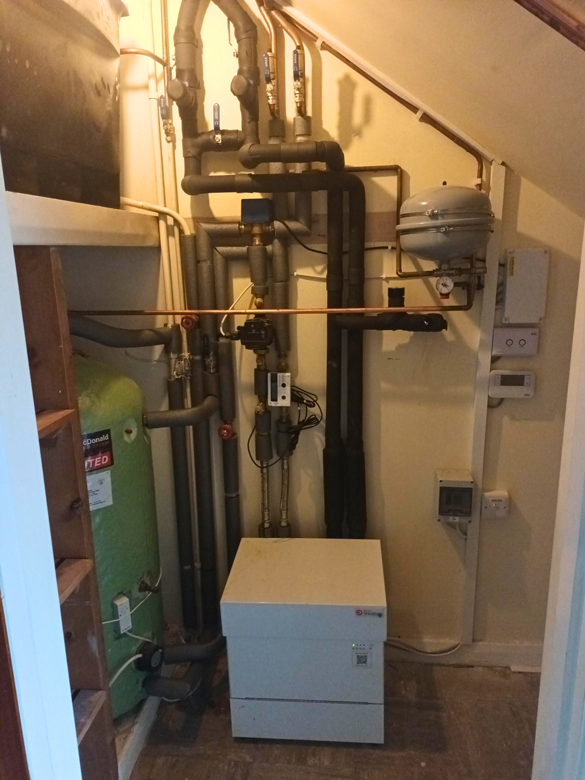
The project, delivered for Wythenshawe Community Housing Group, has seen outdated electric night storage heaters in 19 one-bedroom social flats replaced with Kensa’s highly efficient Shoebox ground source heat pumps. The compact units, installed inside each home, will provide residents with reliable, low-cost renewable heating and hot water.

It’s the first time Kensa has worked with the Manchester-based housing provider. The heating retrofit project forms part of the social landlord’s efforts to futureproof its homes and support its residents, installing low-carbon heating and making energy-efficiency improvements across its estate.

Seven boreholes were drilled around the flats to harness the renewable underground heat energy used by the heat pumps. A shared network of pipes connects these to the heat pumps, which are neatly tucked away inside a cupboard in each flat.

The heat pumps are expected to last between 20 and 25 years, while the underground pipe network will collect heat energy for over 100 years. With all the infrastructure hidden underground and the heat pumps located inside the home, the scheme has been delivered with no more visual impact or disruption than installing gas.

Replacing electric storage heaters, which are often costly to run, with modern ground source heat pumps will improve comfort and significantly reduce heating bills. The new system will be around 300% energy efficient, delivering over three units of heat for every unit of electricity used, making it three times as efficient as the previous system.

In other projects where Kensa has replaced electric night storage heaters with networked heat pumps, residents have seen energy bills fall by as much as 50%, sometimes more. With nearly one in four UK homes that use electric heaters living in fuel poverty, the project is expected to deliver meaningful savings and improve residents’ quality of life.

The installation also comes as Greater Manchester Combined Authority allocates its Warm Homes Social Housing Fund to deliver energy efficiency and clean heat upgrades across its portfolio. Lullington Close offers a replicable model that delivers long-term improvements for residents across the city-region.

Stuart Gadsden, Commercial Director at Kensa, said:

“We’re proud to be working with Wythenshawe Community Housing Group, helping deliver warmer, more efficient homes and lower energy bills for its residents. Replacing outdated and expensive night storage heaters with ground source heat pumps ensures affordable, reliable heating and hot water all year round, without residents worrying about high costs.

“Each flat at Lullington Close is getting its own British-made Kensa Shoebox heat pump, providing all its heating and hot water needs. These homes join thousands of others across the UK already benefitting from our networked heat pump system, showing how we can cut carbon, tackle fuel poverty, and strengthen the UK’s energy security at scale, without leaving anyone behind.”

Victoria Marsh, Project Manager at Wythenshawe Community Housing Group, said:

“Kensa have been excellent in their engagement with residents at Lullington Close and in working collaboratively to deliver this scheme. We’re looking forward to reviewing the long-term savings from the new system and continuing our efforts to reduce Wythenshawe’s carbon footprint.”

Veolia and Royal United Hospitals Bath NHS Foundation Trust to deliver major carbon and energy savings, in partnership with the Carbon and Energy Fund and Salix

Leading resource management company, Veolia, is helping the Royal United Hospitals (RUH) Bath NHS Foundation Trust to decarbonise its Combe Park estate following the start of a major upgrade that will deliver a carbon reduction of approximately 25 percent from 2030 onwards. The project has received ยฃ21.6 million grant funding from the Public Sector Decarbonisation Scheme (PSDS), which is administered by Salix on behalf of the Governmentโ€™s Department for Energy Security and Net Zero (DESNZ). The Carbon and Energy Fund (CEF) led on the development of their PSDS Salix application and procurement of the project.

The project for the district general hospital will deliver wide ranging energy and infrastructure improvements to save around 45,000 tonnes of carbon over the life of the contract. Delivered through Veoliaโ€™s strategic GreenUp plan, the upgrades have been designed using the holistic whole building approach that accounts for how facilities and the energy delivery systems interact with each other.

Planning applications for upgrades covering the desteaming of the majority of the heating distribution network and replacing aging infrastructure, along with the removal of the existing boiler plant and installation of a new low-carbon heating system, including 2.2MW of air and water source cascade heat pumps, was approved in February 2025. These installations have the capacity to significantly reduce carbon emissions and will be further supplemented with low-grade and high-grade heat from the existing combined heat and power plant, and continue the steam supply to the autoclaves used for sterilisation.

On site generation of renewable electricity will come from a new 300kWp solar array which will reduce the carbon impact of electricity, with potential future inclusion of battery energy storage. A new building management system will provide the essential control of all the systems and enable greater oversight and control of energy expenditure.

Other supporting works include building fabric improvements, new LED lighting, insulation, high voltage electrical infrastructure, and upgrading the on-site energy systems to extend the lifespan of existing equipment.

Commenting on this new hospital decarbonisation project, John Abraham, Chief Operating Officer – Veolia UK & Ireland – Industrial, Water & Energy said:Our work with the Royal United Hospitals Bath over the past 13 years has provided us with a unique understanding of the site. By using this experience, and our wider carbon reducing energy projects across more than a hundred NHS sites, we will be able to deliver major carbon reductions that exceed the governmentโ€™s targets, making it future proof for years to come.

โ€œThis key decarbonisation project for healthcare is another example of our strategic GreenUp plan in action as we help the NHS advance towards their net zero goal. We look forward to continuing our long standing partnership with RUH and helping them achieve their environmental targets.โ€

Toni Lynch, Chief Nursing Officer at the RUH said: โ€œThe RUH is committed to supporting the NHSโ€™s ambition to become the worldโ€™s first Net Zero health service, for the benefit of our patients, staff, and wider community. This carbon-saving project marks a crucial milestone on that journey, and weโ€™re proud to be working in partnership with the CEF, Salix and Veolia to make it a reality.โ€

Director of Public Sector Decarbonisation at Salix Ian Rodger said: โ€œThe NHS has set itself bold net zero targets and Royal United Hospitals Bath NHS Trust is working hard towards achieving these. โ€œThis project will go a long way towards helping the Trust meet their net zero targets and deliver significant energy cost savings. It is a great example of how decarbonisation projects can deliver cost effective and sustainable buildings, as well as enhancing patient care.โ€

Will Fairclough, Project Manager, CEF: โ€œThe Carbon and Energy Fund (CEF) were extremely pleased to be asked by the Trust to lead on the development of their PSDS Salix application and subsequent procurement of their energy efficiency and energy generation project. Working closely with the Trust and CEF framework contractors, the Trust has chosen a solution that has created an innovative carbon reduction project.โ€

The RUH provides acute treatment and care for a catchment population of around 500,000 people in Bath, and the surrounding areas. The Trust provides a range of acute services including medicine and surgery, services for women and children, accident and emergency services, and diagnostic and clinical support services, as well as specialist services such as rheumatology, chronic pain and chronic fatigue syndrome/ME, via the Royal National Hospital for Rheumatic Diseases, which has been a part of the Trust since 2015.

Veolia has been working with the RUH since 2011, and currently provides energy and facilities management to over 100 hospitals in the UK. These support the healthcare for around 8.1 million inpatients each year, and reduce CO2 emissions in the healthcare sector by 120,000 tonnes.

For more information visit www.veolia.co.uk

UK Power Networks ignites the future of clean heat

HeatScape will map where heat networks exist today, predict where theyโ€™re likely to grow, and estimate how much electricity theyโ€™ll need under different scenarios

Heating our homes while cooling our carbon footprint has taken a big step forward thanks to an innovation from UK Power Networks.

Decarbonising heat is one of the biggest opportunities in helping the achieve the UKโ€™s journey to Net Zero. Currently, heat networks make up just 3% of the countryโ€™s heating demand, but this is set to rise sharply to 20% by 2050*. Moving from fossil fuels to electrified heat networks (which deliver heating and hot water from a central energy source) will not only play a key role in cutting carbon emissions but will also put new demands on electricity infrastructure.

To better understand and plan for this change, UK Power Networks has joined forces with Arup, Environmental Resources Management and Bring Energy (who own and operate the East London Energy Distribution Heat Network) to launch HeatScape.

This innovative project will map where heat networks exist today, predict where theyโ€™re likely to grow, and estimate how much electricity theyโ€™ll need under different scenarios.

Building on the earlier Flex Heat Networks initiative, HeatScape combines datasets, advanced modelling, and real-world insights to give a detailed picture of how electrified heat networks will interact with the grid. By integrating this information into UK Power Networksโ€™ Strategic Forecasting System, the project will enable more informed decisions on how to prepare and adapt the electricity network for the future.

The project will also explore more flexible management of heat networks, for example, by using thermal storage to reduce peak electricity demand.

HeatScape will work with Bring Energyโ€™s customers to explore their interest in energy flexibility, as well as support the adoption of low-carbon technologies, helping to accelerate the transition to cleaner energy systems. This project, alongside Heatropolis, demonstrates UK Power Networks’ innovation in the field of heat decarbonisation.

Luca Grella, head of innovation at UK Power Networks, said: โ€œDecarbonising heat is one of the biggest opportunities we have to create a cleaner, more efficient energy future. With HeatScape, weโ€™re taking a proactive approach, working with our partners to understand where heat networks will grow and how theyโ€™ll interact with the grid. By combining data, modelling and customer insights, we can plan smarter, reduce costs and make sure the transition to low-carbon heating benefits everyone.โ€ Stephen Hutchins, concession director at Bring Energy, said: “As operators of East London Energy, one of the UKโ€™s largest heat networks, Bring Energy see first-hand the importance of forward-looking, data-driven planning in the shift to low-carbon heat. HeatScape will give us a clearer picture of how and where heat networks are likely to grow, and what that means for our electricity infrastructure. Weโ€™re excited to be partnering with an industry leader in innovation like UK Power Networks to explore new ways to make heat networks more flexible, including smarter use of thermal storage. We believe this collaborative project will help accelerate the transition to cleaner, more efficient energy systems for communities across the UK.”

https://www.ukpowernetworks.co.uk/