



The government has lifted all mandatory COVID-19 restrictions and we’re all yearning for a return to some sort of normality. Does this mean the time is right for business owners and building managers to abandon COVID-19 precautions? Unfortunately no, says Julian Grant of Chauvin Arnoux.
There’s a sense of freedom in the air and people are going about their everyday lives with much less concern for COVID-19 than they would have had only a few short months ago. But COVID-19 hasn’t gone away. In fact, at the time of writing, infection rates across most of the UK are higher than they have ever been. Thankfully, hospitalisation and death rates remain far below those seen at earlier stages of the pandemic. Nevertheless, huge numbers of people are confined to their homes while they recover, leading to widespread disruption in business and education.
This is, therefore, no time to relax. Not only do business owners and building managers have a statutory duty of care toward their workers and others who use their facilities, it also makes very good business sense to put in place measures that will help mitigate the spread of COVID-19. After all a sick worker sitting at home is not generating any income and, likewise, a sick student is missing out on important and costly education.
But what can be done? Measures which require active participation of those involved, such as wearing face masks or social distancing, can no longer be enforced so it would seem that options are limited. There is, however, one measure that all business owners and building managers should be adopting – the provision of effective ventilation in their premises. Good ventilation dramatically reduces infection rates as virus particles are quickly dispersed. Good ventilation also has another hugely significant benefit: it’s entirely passive; it doesn’t rely on the building occupants doing anything at all.
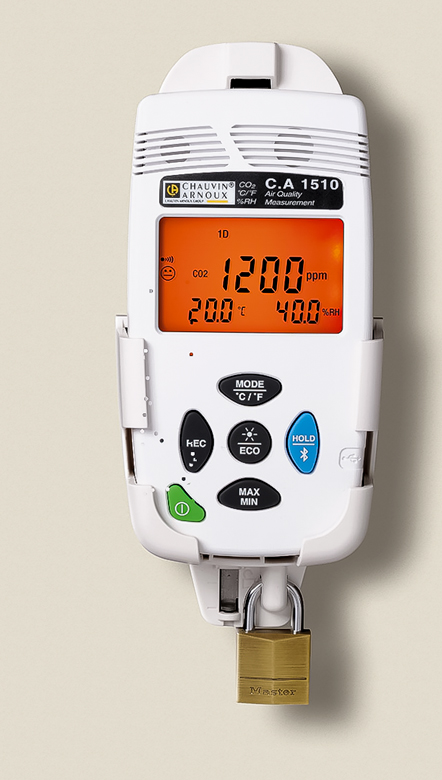
It is all very well, however, talking about providing ‘good ventilation’, but what is good ventilation and how can it be measured? Fortunately, no lesser body than the Health and Safety Executive (HSE) has suggested a simple answer: use a carbon dioxide (CO2) monitor. More detailed guidance on the use of CO2 monitors can be found here: https://www.hse.gov.uk/coronavirus/equipment-and-machinery/air-conditioning-and-ventilation/identifying-poorly-ventilated-areas.htm,
The use of CO2 monitors was actually advised long before the COVID-19 pandemic because high levels of CO2 can lead to discomfort and inattention, but it has become much more important in the COVID-19 era. This is not because CO2 levels are a direct measure of possible exposure to COVID-19, but because checking levels can help to identify poorly ventilated areas so that appropriate adjustments can be made. Nevertheless, it’s important to remember that CO2 measurements are a broad guide to the effectiveness of ventilation rather than a tool for establishing ‘safe’ thresholds.
The HSE recommends portable monitors that use NDIR (non-dispersive infrared) technology and show the level of CO2 in parts per million (ppm). A wide measuring range is useful, as CO2 concentrations can vary widely, from around 400 ppm in locations that are open to the outside air to 1,000 ppm or more in poorly ventilated spaces. (As a guide, values below about 800 ppm are generally considered acceptable for indoor locations). To ensure that the monitor provides dependable results, it should be easy to check its calibration.
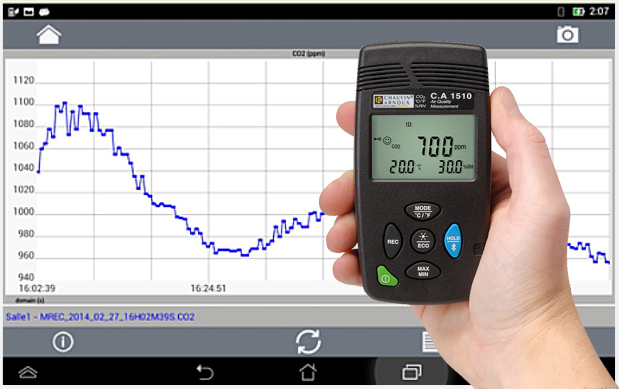
Instantaneous (snapshot) readings are useful to confirm current conditions, but to establish whether or not ventilation arrangements are adequate in the longer term, it is necessary to take readings over a day or an even longer period. This can be done manually by noting readings at prescribed intervals, but a much more convenient solution is to use a CO2 monitor with logging facilities which will take the readings automatically and store them.
The CA 1510 monitor from Chauvin Arnoux is cost effective and easy to use, and it can store up to one million readings for later downloading via Bluetooth or a wired USB connection. It is a good solution for initial surveying of locations using the MAX/MIN function to inform the COVID-19 risk assessment, and subsequently as a fixed monitor for long-term checking and control. Accessories for this versatile instrument include a calibration kit and mounting brackets to facilitate semi-permanent or permanent installation where this is needed.
While investing in a CO2 monitor may appear to be a somewhat unnecessary extravagance given that we all live in hope that the COVID-19 pandemic will eventually subside, in reality this is not the case. First of all, the instrument has only to prevent a few COVID-19 cases to quickly repay its modest cost – and it’s worth remembering that good ventilation will help to reduce the spread of other diseases like the common cold and winter flu. Second, even if COVID-19 does go away, the monitor will help to ensure efficient ventilation, which is always beneficial as a good working environment makes people feel comfortable and increases their productivity.
Helping workers, students and members of the public to stay healthy is always a worthwhile endeavour, and never more so than in these COVID-19 blighted times. As we have seen, a CO2 monitor like the CA 1510 from Chauvin Arnoux can make an invaluable contribution and, as such, it’s a worthwhile investment that will repay its modest cost many times over, not only in the COVID-19 era but also for many years to come.
