


| Advantages of Solar Energy | Disadvantages of Solar Energy |
|---|---|
| Renewable Energy Source | High installation cost |
| Easy to install | Only works during the day |
| Low maintenance | Take Up A Lot of Room |
| Low Carbon Footprint | Seasonal |
| Reliable | |
| Lower Electricity Bills |
Advantage – Solar is totally renewable
This is the biggest plus to solar power. The sun has been heating up the earth for a good 4.8 billion years and it is set to carry on for another 5 billion years. We could fill the earth in solar panels and it wouldn’t diminish the suns power by even 0.5 of a watt.
Every inch of the world that is exposed to the sun is receiving energy that can be converted into electricity. A recent study looked at the amount of sunlight the Sahara Desert receives and, for a way of highlighting the power available, worked out that we could generate enough energy to power the entire world by just covering 1.2% of the desert in solar panels.
In term of effect on nature and the environment, solar comes way down the list in comparison to other renewables, so its appeal looks even more universal than it ever has.
Disadvantage – High installation cost
It has to be said that shelling out 7 – 20 thousand pounds on a solar energy system is quite the outlay. Installing items on your roof, where 90% of domestic panels are situated, is always going to be something we leave to the professional. That means scaffolding, safety and planning.
However, it is cheaper now as it has ever been for the equipment, with prices dropping by over 80% in the last decade. Technology is moving so fast that you’re getting more for your money too. Panels are more efficient, inverters quicker and batteries more reliable.
Advantage – Easy to install
That may seem like we are contradicting the previous disadvantage, but cost and ease are 2 different things.
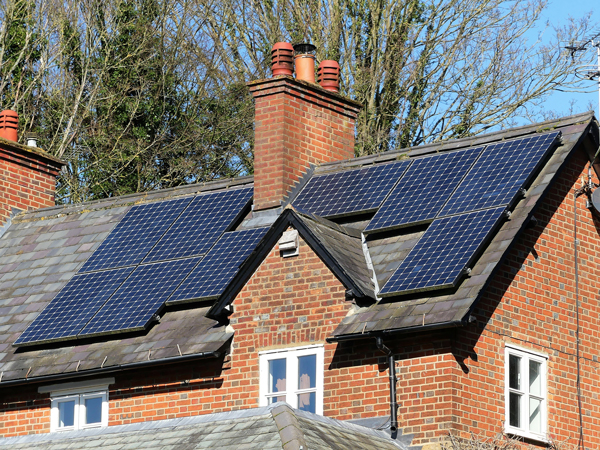
Solar panels don’t need any planning permission, they are light, require minimum work once they are installed and do not make any noise. Domestic windmills need planning permission if you want them on your home or another building, and you can only have one in the garden – solar panels are not subject to any of those rules.
They do have to installed correctly though as there are building regulations you need to comply to: They cannot over-hang the roof, mustn’t touch any other roof furniture and must be very secure.
So long as your installer has the relevant accreditations, this should be no problem.
Disadvantage – Only works during the day
There is simply no getting around this one! Although the moon is reflecting sunlight back to earth, that’s how we can see it, the spectrum of that light is nowhere near the same as it is during the day. Daylight has the full spectrum, from Ultraviolet to Infrared, so the panels can get everything they need to make electricity.
Even the best, domestically available panels are only converting at 24%. This means that 24% of the daylight that hits the panels is converted into electricity. So, when you consider that the moon only reflects 13.6% of the sun’s light there isn’t going to be any noticeable charge during the night.

Advantage – Minimal maintenance
Solar has the least amount of maintenance of any renewable energy source, especially in domestic installations.
Solar panels themselves have absolutely no moving parts. They consist of crystals of silicon connected to copper wires all mounted in a steel, glass-covered box. While that may be an oversimplification, it does capture the basics. The silicon is hit by the sunlight, this creates electricity, and that electricity is carried along the wires to the inverter.
That fact that most panels come with a 25-year guarantee shows that they are not subject to wear-and-tear. Some panels have a lifespan of over 50 years.
Inverters and batteries last around 10 years each with little or no maintenance too.
Disadvantage – Take Up a Lot of Room
The more space you can cover with a PV panel, the more of the sun’s energy you are harvesting. You would want to cover as much of the roof/garden/shed as you can.
An average panel is just over 1 metre square, and you will need at least 10 for an average domestic installation. 10 metres square is a lot of space to give up for something that cannot be moved. That said, they are best installed high up to avoid any shading, so the chances are you won’t be losing any useable space.
Batteries and inverters can take up a bit of room too depending on the size of your installation and how much energy you want to store.
Advantage – Low Carbon Footprint
We can hear the people at the back drawing breath to point out that making solar appliances creates a huge carbon footprint. But, this ignores that fact that all forms of electricity generation need equipment and all that equipment needs making also.
The parts of a solar panel are mostly recyclable – silicon, steel, copper and glass – and the more popular solar power becomes, the more recycling sites we will start to see.
During the lifespan of an average solar energy system it will create 14-73 grams of CO2e per kWh – compare that to the average carbon footprint of burning oil to create electricity, which is 742g per kWh, and you can clearly see the advantage.
Disadvantage – Seasonal Power Generation
Long days and short nights is good, long nights and short days, not so much.
The average amount of daylight we get here in the UK is around 12 – 14 hours. That is, of course, split over the entire 12 months and the amount of sun hitting your panels from dawn ‘til dusk, is going to vary on the time of year.
You are simply not going to be generating as much power in winter as you do in summer and, ironically, we use a lot more power in winter than we do in summer. If you don’t have some kind of storage system you won’t be able to use all the power you generate at any time of year, but you are going to struggle to use any solar generated power at all in the winter.
Basically, make sure you have energy storage.
Advantage – Reliable.
Believe it or not, Solar power is the most reliable form of renewable energy available right now. As mentioned before, panels and appliances are relatively maintenance free, so that means they are also very reliable.
The sun is exceptionally reliable too, it comes up in the morning and goes down in the evening, but it is always there. Panels don’t work on sunlight; they work on daylight – the stronger the better. So, as long as the sun comes up, you can be sure the panels are producing electricity.
Advantage – Lower Electricity Bills
Generally, this is the biggest advantage to installing solar panels domestically and usually the main reason for people having a system fitted. In fact, it’s the reason many businesses, and even the government, are turning to solar for their energy needs.
Electricity is currently 34p per unit, or kWh, in the UK and an average home uses 2800 kwh a year. If you have no battery and can only use the energy you produce between sun rise and sun set, you’d still be using about 1500 kWh of your own electricity – saving over £500 a year in bills.
Add in some storage and clever appliance us and you could almost double that.
