



By Mareike Schmidt, Head of Innovation, Prospering from the Energy Revolution challenge programme, Innovate UK
About the author
Mareike Schmidt is Head of Innovation for Prospering from the Energy Revolution, a programme funded by UK Research and Innovation to trial smart local energy systems around the UK. She previously worked at Leeds City Council and at Bristol City Council, where she led the city’s successful bid for a European Green Capital award and went on to deliver a £50 million energy efficiency and renewable energy investment programme with the support of the European Investment Bank.
Planning for the changes necessary to target net zero carbon emissions by 2050 currently happens mainly at a national level. There is a primary focus on large-scale measures such as hydrogen, offshore wind and new nuclear power generation.
However, we also know that over the coming years major changes such as the mass uptake of small-scale energy measures such as electric vehicles and growing numbers of heat pumps will put increasing demand on the national electricity supply – and increasing pressure on the infrastructure that delivers it to where it needs to be used.
With this as the backdrop, there is growing interest in the concept of ‘smart local energy systems.’ With this approach energy generation, storage and supply are integrated locally, facilitated by smart use of data and digital technology. If assets can be linked in this way, and demand and supply balanced in the community, significant efficiencies can result.
The Prospering from the Energy Revolution programme that I help to deliver has invested over £104 million in a series of projects around the UK, aiming to show that locally-optimised systems that bring together energy generation, use and storage can be viable and provide cleaner, cheaper energy and better net zero lives for local people.
These projects, many involving local authorities such as West Midlands Combined Authority and Greater Manchester Council, show how different models and technology choices in combination work best in different towns, cities and regions.
The local approach makes sense for many reasons. The carbon emissions that we must tackle come from our businesses, homes and transport – all integral to the specific places where we live our lives.
Local authorities are of course very focused on climate change, and hundreds have declared climate emergencies to emphasise the urgency of action, which is good news. However planning practical action brings its own challenges, both in terms of choosing the right pathway and in terms of capabilities and resources. There is also the question of how national and local mandates and responsibilities work together.
But if any further evidence was needed for the dramatic potential benefits of a place-specific approach, a recent study has made it crystal clear.
The promise of the place-based approach
As part of the Prospering from the Energy Revolution programme, Innovate UK commissioned in-depth research from PWC, Otley Energy and the University of Leeds to try to quantify the climate and societal benefits of taking local action on low-carbon measures. The resulting report, Accelerating Net Zero Delivery, presents the first detailed assessment of the benefits of a tailored regional approach, compared to standardised UK-wide policies.
Using leading-edge economic modelling, the study focused on six very different city-regions: Belfast, Cambridgeshire & Peterborough, Glasgow, Greater Manchester, Liverpool and Swansea Bay.
Analysing challenges, opportunities and savings, the study looked at how local areas could prioritise and select between the different energy- and carbon-efficient measures that are most appropriate for their circumstances.
The proposition is that when looking at issues such as transport, construction, retrofit and heating of domestic and public buildings, regions could create their own tailored strategy that suits their specific infrastructure, demographics, transport links and investment opportunities.
More energy savings, less cost
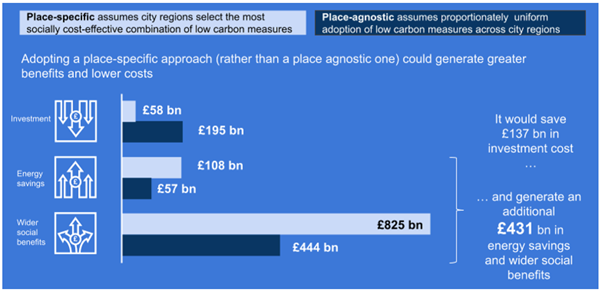
The research found that under a ‘place-specific’ scenario, assuming that city-regions would choose the most appropriate combination of low-carbon measures for their areas, it would take far less investment to meet net zero targets than a generic ‘place-agnostic’ approach – and deliver greater benefits.
With local energy- and carbon-savings measures working together in the right way – including heat pumps, electric vehicles, insulation and public transport changes – the place-specific approach could bring energy savings of £108 billion, compared to just £57 billion from a UK-wide one-size-fits-all strategy.
What is more, under the place-based model this would require just £58 billion of investment, rather than the £195 billion that would be needed for a common approach.
Climate progress, social progress
As well as the emissions-related and economic benefits, the research found that there are also very substantial social gains to be had.
An essential element in net zero transport planning is active travel, where car journeys are replaced or supported by public transport, walking or cycling. Such policies could have a major impact on the wellbeing of local populations, including better health, quieter and safer streets, lower air emissions and less congestion in built-up areas.
Retrofitting the UK’s millions of older homes and decarbonising their heating is one of the greatest challenges. Clearly, homes that are more energy- and carbon-efficient can make a significant difference to people’s wellbeing, both financially and physically.
And here it is especially clear that a ‘one-size-fits’ all national approach will simply not work. Housing stock and local circumstances vary hugely from place to place, and the right combination of heating system and insulation in one setting will be wrong in another.
Looking across the range of social benefits to be gained from climate measures, the PwC report estimates that over the next 30 years their value would be almost doubled if following a place-specific approach everywhere – to the tune of around £825 billion rather than £444 billion.
In reality of course, it will not be possible to achieve 100% optimisation for local conditions, nor would plans ever completely ignore local circumstances. But these scenarios show that the further down the path of place-based tailoring we can go, the lower the cost and the more striking the improvement in outcomes.
Collaboration is key
The Government’s Net Zero strategy notes the importance of local action. The new research supports this with further evidence on the prize to be had, and proposes a framework to support delivery that joins up national policy and local action. To make the response to net zero challenges as effective as possible, and deliver them at the pace and scale needed to achieve the necessary outcomes, this will be essential.
It is also clear that beyond national and local authorities, many other players have a part to play. Collaboration is key.
Investors and finance organisations need to look at the opportunities of local and regional net-zero projects, and develop new financial products and services that de-risk them. Industry needs to develop business and operational models to deliver on the objectives, and create supply chains with the right skills and capabilities. Innovators must continue the drive for new advances in digital and energy systems. Local communities need to champion what is possible and the benefits that local actions could bring.
For energy managers and policymakers wanting to investigate the potential of integrated local systems, there is plenty of inspiration and help available, much of it sponsored by UKRI – from the examples of the trial and demonstrator projects, to resources from the Energy Systems Catapult such as the Net Zero Go planning platform for local authorities, to the research output of the EnergyRev consortium.
The local system approach can be complex and may require a change in mindset, but we have the technology. The evidence is growing that creating energy-smart places can help the UK on the way towards greener, healthier and better-off communities in our net zero future.
- More about the Prospering from the Energy Revolution programme: https://www.ukri.org/what-we-offer/our-main-funds/industrial-strategy-challenge-fund/clean-growth/prospering-from-the-energy-revolution-challenge/
- Read the PwC report Accelerating Net Zero Delivery: unlocking the benefits of climate action in UK city-regions: https://www.ukri.org/publications/accelerating-net-zero-delivery/
- See analysis and studies from the EnergyRev research consortium: https://www.energyrev.org.uk/
- Access local authority resources from the Energy Systems Catapult: https://www.energyrev.org.uk/
