
2025 Industry Predictions

Andrew King

Andrew King, Founder of SGT

Energy Pricing and Supply Security

Due to geopolitical factors and fluctuations in the global energy
market, energy prices could remain volatile. There’s enough unrest with
the ongoing conflict between Russia & Ukraine and the Middle East to
have potential to drive pricing considerably higher. The UK’s strategy
will likely include hedging against such risks by diversifying energy
sources and encouraging demand-side measures. Consumers may also see a
push for more energy-efficient solutions and smart home technology to
mitigate high costs.

Expansion in Hydrogen

Existing projects, led by National Gas, to ensure Hydrogen plays an
increased role in the energy space, particularly by heavy industry.
There’s significant initiatives in place to repurpose parts of the
nationwide natural gas infrastructure for Hydrogen use. Green hydrogen
(produced from renewable energy sources) is anticipated to become more
prevalent, though blue hydrogen (from natural gas with carbon capture)
might also remain in the mix as the UK scales production capacity and
infrastructure.

Increased Investment in Nuclear

With recent approvals of projects like Hinkley Point C and further
support for small modular reactors (SMRs), the UK is reinforcing its
commitment to nuclear power. By 2025, initial developments on both large
and smaller nuclear projects will likely be underway, serving as a key
pillar in achieving long-term, low-carbon baseload power.

EV and Smart Charging infrastructure

The electric vehicle (EV) market in the UK is expected to grow
significantly, with the 2030 ban on new petrol and diesel cars spurring
demand. By 2025, investments in EV charging infrastructure and smart
charging solutions are expected to accelerate, with a focus on
integrating EVs into the grid as both load and storage assets. It’s
widely accepted that the charging infrastructure isn’t where it needs to
be and in order to meet the required demand, significant investments
must be made, sooner rather than later.

Increased Renewable Energy production

The UK will likely continue to expand its renewable energy
infrastructure, primarily in offshore wind, solar, and battery storage.
Offshore wind, in particular, is set to be a major focus, with a goal of
achieving 50 GW of offshore wind capacity by 2030. This push will help
the UK get closer to net-zero targets and reduce dependency on fossil
fuels.

Advancements in Energy Storage Technologies

With the growth of renewable energy, especially solar and wind, the UK
will likely see further investment in energy storage solutions, such as
lithium-ion and solid-state batteries, as well as pumped hydro storage.
This will help stabilize the grid and allow surplus renewable energy to
be stored and used during periods of high demand.

Long Term

These trends suggest that during 2025, the UK will be slowly progressing
toward its ambitious climate targets, with substantial investments in
clean energy, digital solutions, and energy security. The regulatory
landscape is expected to evolve to support this transition, aligning
with broader European and global sustainability goals.

Sustainability partnership leads to โ€œtremendous valueโ€ for The Langham Estate

A renowned property management and commercial real estate company has reported making โ€œsubstantial cost savingsโ€ as part of a proactive approach to sustainable growth.

The Langham Estate teamed up with leading energy and sustainability management company, Inteb, as part of their ongoing commitment to operational improvement.

And the business has now seen a 13% reduction in gas costs and an impressive 32% savings on electricity after Inteb led on a group tender for utility contracts within the wider group.

Richard Hillyard, Head of Sustainability at The Langham Estate, said: โ€œIn a short space of time, Inteb have added tremendous value and have delivered on their promises prior to appointment.

โ€œWe look forward to a long-term partnership with Inteb over the coming years and move into the next phase focusing on both data coverage and quality across the portfolio.โ€

Graeme Noot, Head of Facilities Management, said โ€œWe are now in planning stages together to look at our property planned maintenance and life cycle strategy with a sustainability bias and as part of this we will be implementing a fully managed smart meter roll out across our entire portfolio. We are already seeing the benefits of working with Inteb from an operational efficiency perspective.โ€

Under the partnership, The Langham Estate wanted to enhance their utility data management and streamline the handling of supplier invoices.as well as futureproof their energy procurement.

Andrew Snowball, Sales and Marketing Director at Inteb, said: โ€œRight from the very first conversation with The Langham Estate, I could see they shared the same passion for sustainability and their requirements perfectly aligned to our expertise. Itโ€™s such a pleasure working alongside them and I look forward to a long working relationship.โ€

With nearly a century of history, The Langham Estate is nestled in the West End neighbourhood of Fitzrovia, home to some of Londonโ€™s most diverse and progressive businesses.

For the past 30 years, their current owners have been dedicated to making this corner a vibrant area with offices and retail spaces in the heart of Fitzrovia Quarter, bordering Oxford Street to the south and Great Portland Street station to the north.

National Grid energises new Barking substation to help power local residents and rail services

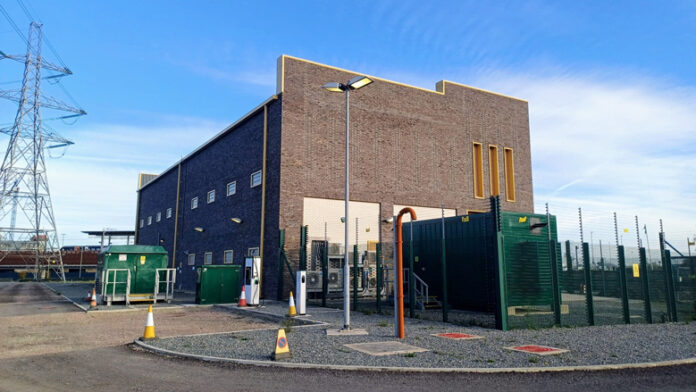
National Grid has energised a new substation in Barking, East London, to help power homes, businesses and rail services โ€“ including those forming part of the Barking Riverside regeneration of an area formerly occupied by a coal power station.

The new 132kV indoor substation connects the local grid operator UK Power Networks (UKPN) to National Gridโ€™s high voltage transmission network, delivering electricity for distribution to 20,000 homes in the area.

Local low carbon transport services are also supported by National Gridโ€™s new substation, with power delivered to a nearby Network Rail feeder station to support electrified train routes.

National Grid worked with its principal contractor Murphy to build the substation and transfer existing circuits and connections to the new facility, ensuring no interruption to supplies.

The substation replaces a previous 132kV facility that was built on an adjacent site in the 1950s to deliver electricity to the London grid area from the former Barking C power station. Built post-war, the original substation was designed to look inconspicuous to enemy aircraft.

The new facility replaces and reinforces the old infrastructure, and features 17 bays โ€“ the equipment which enables a connection to the grid โ€“ with room for future upgrades. It sits alongside National Gridโ€™s bigger 275kV/400kV substation to boost the resilience of electricity supply in East London as energy demands grow.

In August National Grid energised the first circuit on its London Power Tunnels 2 project, and in April it switched on its new Littlebrook substation in Dartford, Kent, to help connect millions of homes to clean power.

Laura Mulcahy, project director at National Grid Electricity Transmission, said:

โ€œOur new Barking substation is a crucial upgrade to the electricity network in East London, and will help future proof it as electricity demand in the capital grows.

โ€œBarking has played a crucial role powering London since its first power stations were built in the early twentieth century, and with these latest network upgrades our infrastructure in the area will continue to support the energy transition for decades to come.

โ€œItโ€™s been an exciting project to be a part of, and the team and I are delighted the new Barking substation is fully energised and connected to our network.โ€

Andrew White, programme manager, capital programme, UK Power Networks, said:

โ€œWeโ€™re delighted to work with National Grid on this major infrastructure project serving 20,000 locals in Barking and East London. This investment will benefit residential and industrial supplies and comes as part of our commitment to reinforcing reliable energy for many years ahead.โ€

Liam Corr, managing director for energy at Murphy, said:

โ€œOur company purpose is to improve life by delivering world-class infrastructure and this project is a great example of that โ€“ we are proud to have played our part in future proofing energy supplies for the local community.โ€

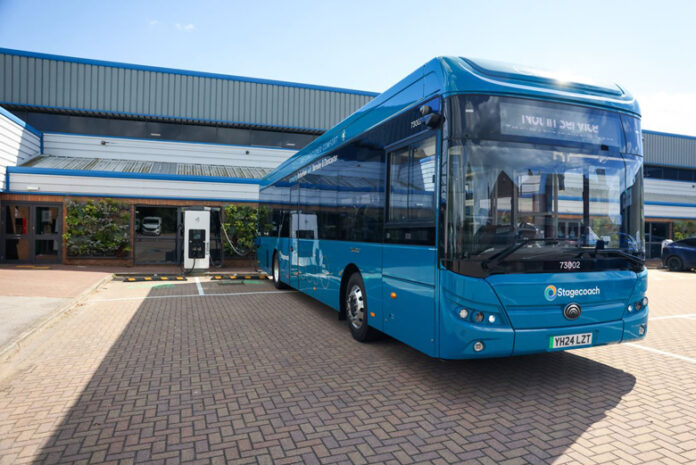
Stagecoach works with Schneider Electric to power greener bus journeys across the UKย 

Schneider Electric, the leader in the digital transformation of energy management and automation, is working with Stagecoach, the UKโ€™s largest transport operator, as it heads towards zero emission travel. 

Stagecoach is embarking on a nationwide programme to electrify its bus fleet and deliver greener public transport options. It is partnering with Schneider Electric to provide the critical electrical infrastructure, software, and services to support this move.  

The domestic transport sector emits the largest amount of greenhouse gases in the UK at 29.1% in 2023 according to government figures. Buses have a key role to play in meeting the UKโ€™s 2050 net-zero target and the move to zero emission transport alternatives is critical. 

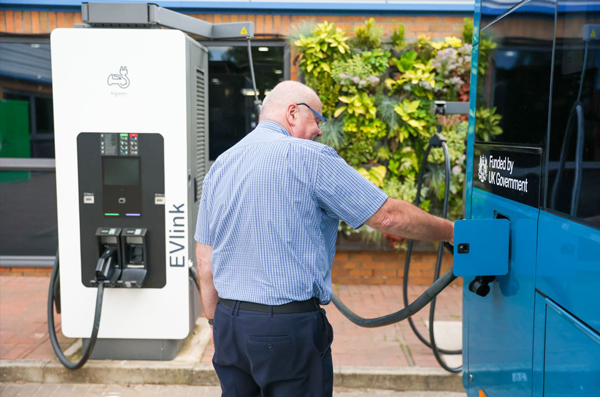
Schneider Electric is delivering its EcoStruxure for eMobility solution to multiple Stagecoach sites across the UK. This includes state-of-the-art ultra-rapid EV charging points, electrical distribution infrastructure, and EcoCare membership. This will ensure the smart, reliable charging of Stagecoachโ€™s electric bus fleet with a modular approach to meet future needs as Stagecoachโ€™s electric fleet grows. 

As an EcoCare member, Stagecoach will receive enhanced support allowing it to take a more proactive and optimised approach to maintenance. Thanks to remote monitoring 24/7, data insights to pre-empt alarms and prevent mission-critical issues, and condition-based maintenance, the risk of downtime is reduced and continued reliability of bus services ensured. 

Smart EV charging solutionย ย 

Schneider Electric is providing Stagecoach with:  

  • Medium Voltage/Low Voltage Package Substation โ€“ providing electricity from the grid in a single-source outdoor assembly tailored to Stagecoachโ€™s specific needsย 
  • LV Feeder Pillars โ€“ an outdoor low voltage switchboard to feed and control electricity supplyย 
  • EVlink Pro DC โ€“ a flexible next-generation of EV ultra-rapid charging stations that maximise energy efficiency and uptimeย 
  • EcoCare Membership โ€“ enhanced support through the harnessing of data analytics from connected assets, remote monitoring, and predictive maintenance by experts 24/7ย 

“Stagecoach is committed to zero emission transport and we are expanding our fleet of state-of-the art electric buses to meet our goals. As part of this transition, itโ€™s vital we have the infrastructure to ensure smart, reliable charging of our fleet,โ€ said Tony Cockcroft, Asset Management and Infrastructure Director, at Stagecoach. โ€œSchneider Electric is the obvious choice as our partner on this journey. It is a leader in energy transition across the public transport sector offering smart charging solutions which can adapt as we move towards the total electrification of our nationwide fleet.โ€ย ย 

โ€œOur services carry millions of passengers every day and a safe and reliable service is vital,โ€ Cockcroft continued. โ€œOur new approach to support and maintenance means we can take a more proactive, planned approach, working hand-in-hand with Schneider Electric experts. We can quickly identify possible issues before they become major headaches and plan our works with minimal impact on our bus services.โ€ย 

โ€œPicking up the pace of the electrification of public transport is critical as we head towards our net-zero targets. For many, it can be challenging to match operational needs with sustainability goals,โ€ย said David Hall, Schneider Electricโ€™s Vice President, Power Systems, UK&I. โ€œWe are working with Stagecoach to ensure it has the infrastructure, insights, and support it needs to ensure reliable, greener journeys for its passengers.โ€ย  www.se.comย ย 

A guide to preparing the public sector for heat network connections

Isabelle Jones

Isabelle Jones, Analyst โ€“ Sites, Energy Systems Catapult

Heat networks are integral to the UK government’s strategy for achieving the nationโ€™s Net Zero targets. They offer a compelling pathway for decarbonising buildings, providing low carbon heat on a scalable basis with the potential to reduce fuel bills. While today only 3% of the UKโ€™s heat requirement is met through heat networks, this could reach 20% by 2050.

Energy Systems Catapult was commissioned by the Department for Energy Security and Net Zero (DESNZ) to produce a comprehensive, non-technical guide to help the public sector better understand heat networks and how they impact heat decarbonisation plans.

The Catapult engaged extensively with industry stakeholders, including sector experts, public sector site owners, heat network developers, and local authorities to gain insights into the challenges of heat network connection from a site ownerโ€™s perspective. The guide provides an accessible introduction to heat networks, detailing the key elements that make up a heat network, the different types of heat networks, the sources of heat, and a simple description of how heat networks work.

The guide covers the following topics:

Benefits of heat network connection

Heat networks create a local marketplace for a diverse range of heat supply sources to meet demand in a cost-effective and sustainable manner.

The guide outlines the system-wide benefits of heat networks including future proofing heating supply systems, increasing overall energy efficiency and enhanced energy supply resilience. It highlights the benefits for the heat network customers, such as reduced space requirements for customer heating systems, less maintenance, and effective heat decarbonisation, while also addressing potential drawbacks such as less control over the primary fuel source (and therefore the carbon intensity of the heat), and responsibilities for remedial works. This balanced perspective is designed to support public sector organisations in making informed decisions about adopting heat networks.

Heat network regulation and zoning โ€“ what it means for you

The UK government plans to introduce heat network regulation and zoning that will impact existing and future heat networks. Heat network regulation is expected to significantly improve consumer rights and protections. This initiative aims to facilitate the widespread decarbonisation of heating in buildings. Through the implementation of zoning, specific types of buildings and low carbon heat sources can be mandated to connect to a heat network within a designated timeframe.

Stakeholder management โ€“ getting everyone on board

It is important to get the right stakeholders on board early in the process when investigating the feasibility of a heat network connection. This will help to ensure they are well-informed. You are also likely to need representation from legal, finance, energy, sustainability, and estates teams. The guide presents a five-step approach to managing internal and external stakeholder interactions to ensure the best chance of successfully delivering the heat network connection.

Customer journey to connect to a local heat network

Connecting to a heat network can seem overwhelming due to novelty and perceived uncertainties associated with the technology, and complexities around regulation and contractual arrangements. The guide simplifies the customer experience by breaking it into six steps: engaging with the local authority and heat network operator, undertaking a techno-economic and carbon impact assessment, negotiating contractual arrangements, heat substation design, and on-site system improvements, commissioning, metering and billing.

Customer rights and protections

Under new heat network regulations in the UK, heat network customers will soon receive protections on energy prices and service level guarantees comparable to those provided to customers connected to electricity and gas networks. Ofgem, the office for gas and electricity markets, has been named by the UK government as the future regulator of heat networks across England, Scotland and Wales. The guide outlines what can be expected in the upcoming regulations and what protections are available for heat network customers.

Grant funding available for heat networks

The Public Sector Decarbonisation Scheme provides capital grant funding for the decarbonisation of public buildings in England. The application portal is open from 9 October and will close on 25 November 2024. With the incoming heat network zoning regulations, the application has placed additional emphasis on the importance of considering heat networks within the range of low carbon heating technology options for applicants. The guide takes an in-depth look into funding sources for heat networks and what you will need to consider as part of making a robust application for funding.

Read the free Heat Network Guide and download other free guidance, toolkits and templates from the Catapultโ€™s Public Sector Decarbonisation Guidance website.


This article appeared in the Nov/Dec 2024 issue of Energy Manager magazine. Subscribe here.

Unveiling the true meaning of value engineering in commercial hot water

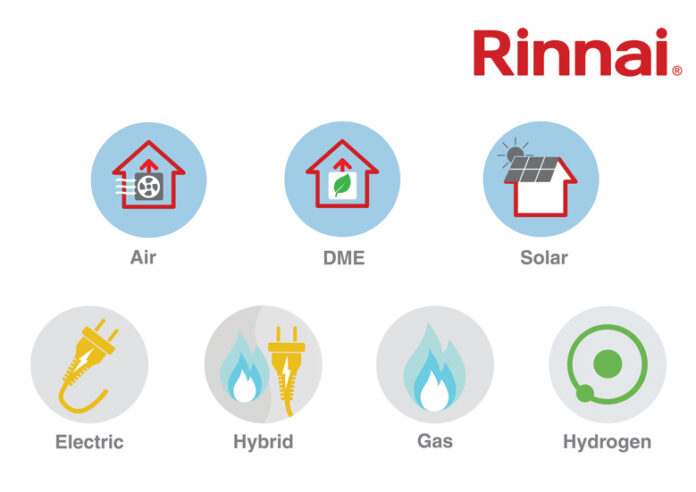
Rinnai has released another whitepaper – โ€œOptimizing Domestic Hot Water Systems for Archetype Care Homes: A Value Engineering Approachโ€ which, within the main body of the analysis, is a case study demonstrating the optimal solution for DHW provision in an archetype care home with specific requirements including a 20% reduction in carbon footprint, OPEX considerations and available space for only 2 heat pumps.

https://www.rinnai-uk.co.uk/contact-us/help-me-choose-product

There are five main solutions presented in this case study for optimal DHW requirements in an archetypal care home:

  1. ย Electric immersion cylinders
  2. ย Heat pumps
  3. High efficiency gas water heaters
  4. Hybrid system comprising of 20% heat pump and gas water heaters
  5. ย Hybrid system comprising of 40% heat pump and electric immersion cylinders.

Due to the requirements of the care home and assessing all possibilities against the pre-determined criteria, solutions 3,4 and 5 were viewed as being worthy of further analysis.

Step 4 of the value engineering methodology proposed by Rinnai UK, analyses solution against the current installed system of three non-condensing storage water heaters.

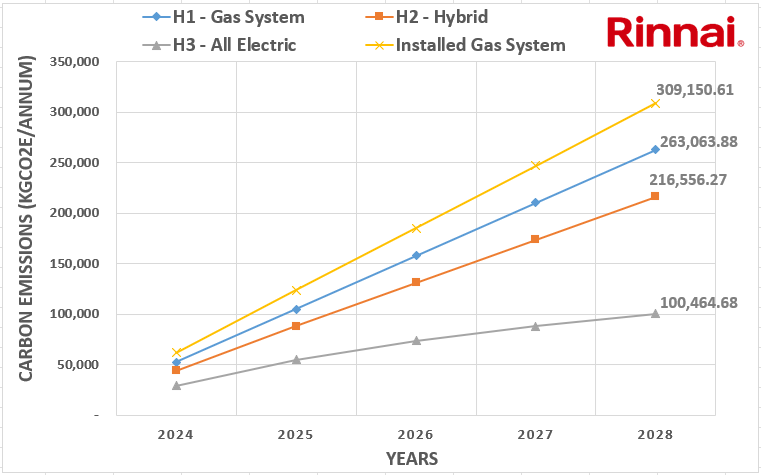
Figure 1 showcases the carbon performance of solutions 3, 4 and 5 as well as the currently installed system of three storage heaters. The colours of each system are highlighted at the top of the graph in blue (Solution 3), orange (Solution 4) and grey (Solution 5).

Graph showing the cost of gas
Figure 1: Carbon Emissions forecasted over 5 years.

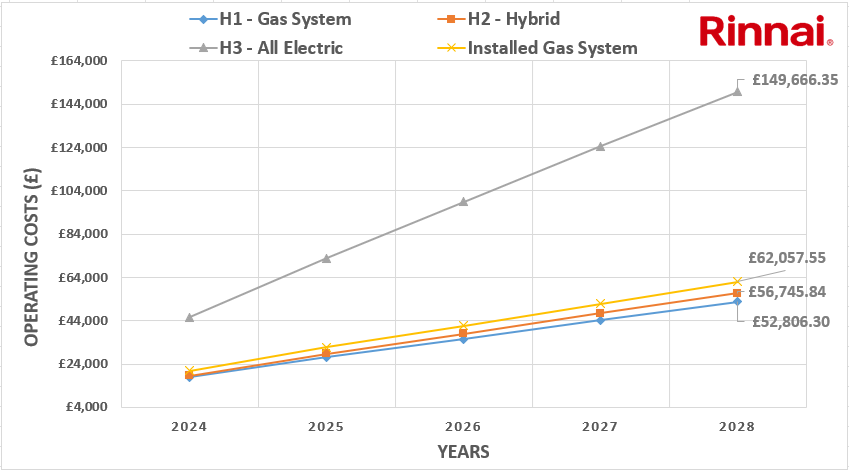
Figure 2 shows operating costs over 5 years for all three solutions (blue, orange and grey) and the currently employed gas storage system (yellow) is also provided below. Solution 3 highlighted in blue, the gas system costs ยฃ52,806. Solution 4, the hybrid system will cost ยฃ56,746, whilst solution 5, the all-electric system costs ยฃ149,666.

Graph showing operating costs forecasted over 5 years.
Figure 2: Operating costs forecasted over 5 years.

Of note is the costs of electricity in the UK which are being targeted by the government to fall by 2035 and be an integral part of cleaning the grid โ€“ and note that Figure 2 utilizes Govt forecast statistics.

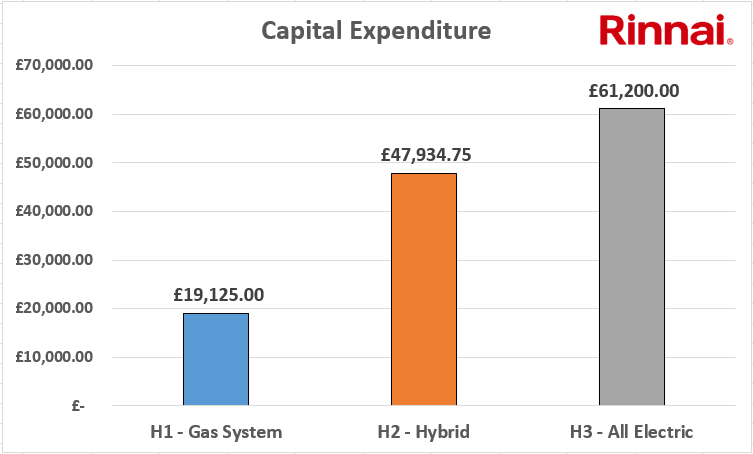
Figure 3, below, is a graph that illustrates the CAPEX costs associated with each solution. Solution 3 (blue), high-efficiency gas water heaters will cost ยฃ25,500. Solution 4 (orange), the hybrid system comprising of 20% heat pump and gas water heaters costs ยฃ63,913 and finally, solution 5 (grey) the all-electric system comprising of 40% heat pump and electric immersion cylinders will cost ยฃ81,600.

Graph showing capital expenditure required for each solution
Figure 3: Capital Expenditure required for each solution.
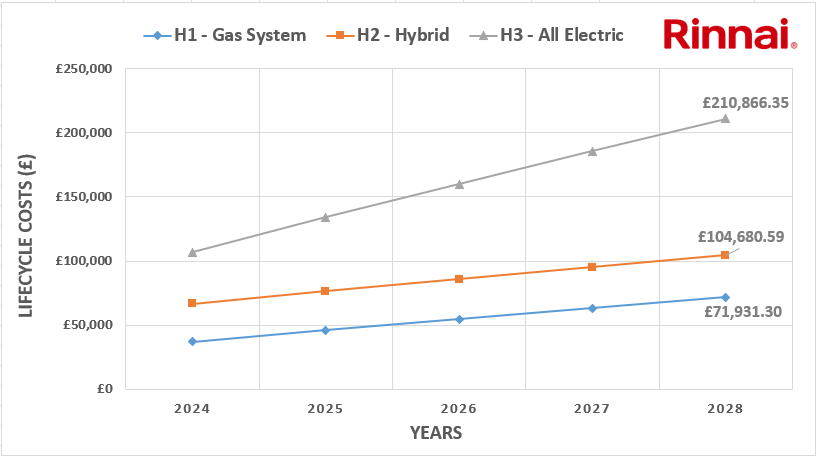
Graph showing lifecycle costs forecasted over 5 years.
Figure 4: Lifecycle costs forecasted over 5 years.

Figure 4 is the final graph that gives the 5-year life cycle costs associated with each system. Solution 3, the gas system (blue) will cost ยฃ78,306. 30. Solution 4, the hybrid system (orange) will be ยฃ120,658.54. And finally, Solution 5 (grey) – the all-electric system will cost ยฃ231,266.35. ย ย 

Therefore, the decisive question for the site is whether the reduced carbon emissions of Solution 5 is perceived as far more valuable than the lower lifecycle costs of Solution 4.

Due to the customerโ€™s brief of requirements to include: –

  • 20% reduction in carbon footprint
  • OPEX considerations
  • space for only two heat pumps โ€“

The optimal solution for DHW provision is the hybrid system that includes the 20% heat pump and gas water heaters. It delivers reduced carbon emissions and financial expenditure and can operate within a space limited environment.

Rinnai aims to demonstrate to specifiers, consultants and system designers that the companyโ€™s technology provides practical, technical and economic solutions for businesses and sites who wish to significantly reduce their carbon emissions.

www.rinnaiuk.com


This article appeared in the Nov/Dec 2024 issue of Energy Manager magazine. Subscribe here.

The Value of Energy Attribute Certificates (EACs)

Neon Steinecke

By Neon Steinecke, Director, ENGIE Impact

Energy Attribute Certificates (EACs) are often viewed as a costly option with limited impact for corporate decarbonization. However, when evaluated through the lens of internal carbon pricing (ICP) and cost per ton of carbon dioxide equivalent (CO2e), EACs can present a compelling financial and sustainability case.

Accordion Dropdown: What  is an Energy Attribute Certificate?

An Energy Attribute Certificate (EAC) is a contractual instrument conveying information (attributes) about a unit (MWh) of energy. Attributes may include when the MWh was produced, its source (renewable or fossil-fuel), and the location and age of the facility where the energy was generated. A typical EAC verifies the renewable origin of the energy produced or consumed. A producer may sell an EAC together with underlying power (bundled) or separately from it (unbundled). An EAC verifies a companyโ€™s own use of a MWh of renewable electricity and reduces its Scope 2 emissions (electricity bought from a supplier).

Guarantees of Origin (GOs) are a type of EAC commonly used in Europe. Renewable Energy Certificates (RECs) are a type of EAC commonly used in North America.

Comparing the Value of EACs

EACs provide flexibility in sourcing renewable energy and can be certified for quality โ€” ensuring it meets high environmental and consumer protection standards, adding more value to the investment (e.g. Green-e in the US, TรœV in Germany; RE100 requirements have also led to higher prices for EACs from younger assets). And compared to other decarbonization measures, like Power Purchase Agreements (PPAs) which provide key benefits but can be complex, EACs can offer a more straightforward way to achieve similar impacts.

One of the primary concerns we hear is understanding the future price of EACs and the reasons behind their price fluctuations. The price of EACs can vary significantly based on market demand, the type of renewable energy, and regional factors. But even with those fluctuations, when compared to carbon credits or considering a companyโ€™s internal carbon pricing (ICP) companies can better understand the value of EACs. Many companies use internal carbon pricing to guide their investment decisions. By setting a high internal carbon price, EACs become more attractive and the business case around investing in this tool to increase RE usage and reduce carbon footprint becomes easier to make.

EACs can be evaluated based on their cost per ton of CO2e avoided, and positioned in comparison to other options. When standardized around cost per ton of CO2e, these are typical costs of some common decarbonization projects (values to be considered as orders of magnitude):

  • Motors / Pumps renewal โ€“ 150โ‚ฌ/t
  • Tech Carbon Credits โ€“ 150โ‚ฌ/t
  • Industrial Heat Pump / Electrification โ€“ 100โ‚ฌ/t
  • Removal Carbon Credits โ€“ 30โ‚ฌ/t
  • EACs โ€“ high quality – 25โ‚ฌ/tย 
  • Avoidance Carbon Credits โ€“ 5โ‚ฌ/t
  • EACs โ€“ low quality – 5โ‚ฌ/tย 

It should be noted, while low quality avoidance credits and EACs are available on the market, their use can damage companies sustainability credibility and erode public trust in this important market mechanism. While more expensive in comparison, high quality EACs generate far more value, for the company and the renewable energy sector more generally.

Long-Term Benefits of EACs

Investing in EACs not only helps companies meet their sustainability goals but also improves the overall EAC ecosystem โ€” signaling a growing demand for these types of market-based instruments. The additional funding would help improve the entire EAC ecosystem โ€” developing a more transparent system of valuing high-quality EACs, to more accurately correlate consumption with the market price of production. It would also potentially lead to more renewable energy projects and electricity infrastructure, additional renewable capacity, new technologies for flexibility solutions like battery storage and demand-side response, and could provide signals to regulators to improvements improve grid infrastructure and interconnections โ€” all of which will be necessary to generate and more efficiently use larger amounts of renewable energy in future.

So while EACs may seem expensive at first glance, they can provide high value at a low price. By investing in EACs, companies can not only meet their sustainability goals but also contribute to the development of a more robust and reliable energy system based on renewables.


This article appeared in the Nov/Dec 2024 issue of Energy Manager magazine. Subscribe here.

TEAMโ€™s accreditation with the G-Cloud 14 Framework extending their support to public sector

Pete Morrell

TEAM Energy is pleased to have successfully been awarded a place on the latest iteration of the Crown Commercial Service (CCS) G-Cloud Framework.

This allocation will help it to continue to support public sector organisations with their energy management and carbon reduction strategy through the use of our cloud-based services.

As energy costs continue to affect organisations across the UK, those in the public sector will be prioritising energy management as they work to towards a target of being net zero by 2030.

With limited funding for decarbonisation and carbon reduction projects organisations may look to adopt digital solutions to support them with managing their energy, reduce costs and measure energy efficiency efforts. 

Using the G-Cloud 14 Framework, organisations can access TEAMโ€™s suite of cloud-based services including its innovative Sigma sustainability and energy management software and tenant billing solutions.

With Sigma Sustainability and Energy Management software, councils, local government departments, NHS and other public sector organisations can access a Monitoring and Targeting (M&T) framework that helps them take a systematic approach to the tracking, analysing, and optimising of energy use. The implementation of a M&T solution can empower organisations to monitor their energy data and secure energy efficiency gains, as well as measuring their Greenhouse Gas emissions and driving their carbon reduction targets. 

Commenting on the announcement, Sales Manager for TEAM, Pete Morrell said:

โ€œAs public sector organisations strive to meet their energy and sustainability goals by 2030, we recognise the challenges of managing large, diverse energy estates, understanding large volumes of data and working towards fast approaching emissions targets with restricted funding and resource.

โ€œThrough the latest version of G-Cloud framework, we can offer public sector organisations a more effective and cost-efficient route to adopting technology to support their energy and carbon management, hassle free.โ€

G-Cloud 14 is the latest iteration of the Government procurement framework that provides public sector customers with an alternative route to procuring digital services, helping them avoid traditional procurement processes that can often be lengthy and constrain buying decisions. Hosted via the Digital Marketplace, each iteration of the framework offers organisations innovative technology solutions to meet their unique industry challenges.

TEAMโ€™s profile can be accessed via the online Digital Marketplace here.

Discovering the technology that’s powering the energy transition

Energy Technology Live is a free to attend exhibition and conference on the 12th & 13th March 2025 at the NEC, Birmingham, and will welcome over 5000 visitors, 200 exhibitors and 150 speakers. It is set to be the UKโ€™s most important gathering of energy executives, users, engineers and the entire supply chain working towards the UKโ€™s transition to a clean, sustainable and efficient energy system.

The show is an end-to-end showcase of renewable and clean energy technologies and will incorporate the UKโ€™s leading flexible energy event The Distributed Energy Show and the inaugural The Energy Storage Show which is set to be the UKโ€™s largest gathering of its type.

Energy Technology Live provides a platform of the latest technologies and services including Batteries, Cabling, Combined Heat & Power, Demand Flexibility, Engineering Management Testing, Engineering Services, Fuel Cells, Renewable Generation, Smart Grid Technologies and many more.

With a commitment to innovation, collaboration and sustainability, Energy Technology Live will serve as the unrivalled platform for industry professionals, thought leaders, and innovators to explore the latest advancements, trends, and challenges shaping the UKโ€™s energy landscape.  

One Event, Two Shows!

The Distributed Energy Show is established as the UKโ€™s leading event for flexible, sustainable and decentralised energy systems. It is an opportunity for energy users from commercial and industrial sectors, local authorities, property developers and landowners to meet with the energy supply chain and find technologies and services to implement a flexible energy strategy. 

Launching in 2025, The Energy Storage Show will feature battery and energy storage systems for large-scale applications ranging from utility scale systems through to onsite and domestic technologies. Along with the full systems, the show will feature the components, services and technology to develop, install, operate and maintain them. 

Join The Energy Transition

Energy Technology Live will feature over 200 exhibiting companies displaying the latest technologies and services for both the distributed energy and energy storage sectors. The show will represent cutting-edge technologies, and the exhibitor community is made up of companies at the forefront of the energy transition. Companies set to exhibit at the show include AlphaESS, Bender UK, Bosch, Cheesecake Energy, Clarke Energy, Electricity North West (Construction & Maintenance), EWT DirectWind UK Ltd, Enspec, Flextricity, Himoinsa Power Solutions Ltd, Nibs, OVO, Power Responsive, Eddicy; A Schaltbau Brand, SSE Energy Solutions, Waxman Energy and many more.

The Leading Conference for the UK’s Energy Landscape

Set within the exhibition hall, Energy Technology Live will feature an educational conference across four theatres, with world renowned experts and industry leaders speaking in a range of keynotes, panels discussions, technical presentations, fireside chats and interviews. There will be theatres dedicated to The Distributed Energy Show and The Energy Storage Show, guaranteeing audiences will gain a comprehensive overview at the full energy supply chain.

Some industry leading companies have already confirmed to speak and include Siemens, ABB, Department for Energy, Security and Net-Zero, Scottish & Southern Electricity Networks, Bosch, Hemiko, Hydrostor, Ecotricity, Flexitricity, with many more to be announced soon.

Three out of the four theatres will feature a notable Keynote Address from field experts kicking off each day of insightful conference sessions, giving attendees an overarching view into the central themes driving the industry. Throughout the day, speakers will participate in panel discussions and fireside chats, and will engage in lively debate, compelling conversation and in-depth discussion, where attendees will have the chance to have their say and ask questions to the panel of experts.

New for 2025, the Innovation Theatre will host Technical Presentations from exhibitors showcasing their latest technologies to the attendees, providing them with specialised information and in-depth demonstrations.

The conference sessions will provide attendees with all the information they need to incorporate the latest energy distribution and storage systems into their facility and optimise strategies to reach Net-Zero targets.

Energy Technology Live Conference will focus on themes such as Net-Zero Targets, Long Duration Energy Storage, AI & Digital Innovation, District Heating, Regulation & Policy and much more. 

Some highlighted sessions not to be missed include โ€œPioneering Energy Smart Infrastructureโ€, โ€œTransforming the Energy Sector Through AI & Digital Innovationโ€, โ€œThe Future of Battery Reuse and Second Life Applicationsโ€ โ€œAssessing the Need for Long-Duration Energy Storage: Is It Essential for Our Future?โ€ and โ€œCan BESS continue being a Key Player in Renewable Energy Integration and Stability?โ€, to name a few.

To register for free or to find out more about Energy Technology Live, please visit www.energytechlive.com


This article appeared in the Nov/Dec 2024 issue of Energy Manager magazine. Subscribe here.

Why monitoring your carbon savings is essential in your climate change agenda

Jessica Ferris

Jessica Ferris – senior energy and carbon analyst at Salix Finance

The decarbonisation of buildings across the United Kingdom has become a hot topic within the governmentโ€™s net zero plans.

In 2019, buildings accounted for 30% of the UKโ€™s total emissions. This equates to roughly 136.4 MtCO2e of all UK emissions that come just from buildings.

Itโ€™s clear that the building sector will require drastic measures to reduce its carbon emissions down to what the UK government hopes to achieve in 2050. The fundamental plan to reduce carbon emissions is through building fabric improvements and the installation of low carbon heating systems. However, to be able to see if any of these improvements have had an impact, it is critical to measure the carbon emission reductions that come from these changes. It is quite a task but measuring and monitoring of carbon savings is more manageable than it seems.

So why is monitoring and reporting important? There are several key drivers, but the primary one being that monitoring and reporting on carbon emissions helps us to establish a baseline. One of the most leading initiatives in addressing climate action is the Science-based Targets Initiative (SBTi), which outlines key requirements for organisations to commit to net zero. They require organisations to establish an emission baseline which then allows for the development of short- and long-term emissions reduction plans. Without a baseline tailored to your project, it would be impossible to measure the progress.

For us at Salix, this is an issue that is given great emphasis and there are a few different ways to collect useable data for carbon reporting that are quite user-friendly. The easiest way is to keep record of your buildingโ€™s utility bills. The first step is to select a year that would have had a typical energy usage to act as your baseline. From then, it is useful to keep track of your annual energy usage via energy bills to compare from the baseline.

Once you have collected your annual energy usage, you will need to find an emission conversion factor. These factors are the simplest way to find the rough carbon emissions for your fuel type. A reliable source for factors is the UK government Greenhouse Gas Reporting Conversion Factors (Greenhouse gas reporting: conversion factors 2024 – GOV.UK (www.gov.uk)). Simply multiply the energy usage by the right emission conversion factor for your fuel to get your carbon emissions, being conscious that the measurements may need conversion. For example:

                           Baseline: 19,000 kWh of electricity use in 2019-2020

                                                       19,000 kWh x 0.20705

                                                       = 3,933.95 kg of C02

This type of monitoring and reporting is useful for internal project records, but also for any external work. At Salix, all of our projects have to go through the same reporting as mentioned here.

When a project finishes, the public sector organisation is required to provide us with their energy data for three years post project completion. This allows us to then look at their carbon savings and keep track of all the positive progress weโ€™ve made. Weโ€™ve created a very handy tool to track your carbon savings which you can find here on our Salix website. This might be useful for your internal tracking, or as a nice tool to base your own tracking on.

Now that youโ€™ve managed to determine your carbon savings, it is essential to use these figures to help set your short- and long-term sustainability goals. Referring back to the Science-based Targets Initiative procedures, organisations should set near-term targets and long-term targets. The former being a carbon saving goal that is achievable within the next five to ten years, whereas the former being up to 2050. These goals can and should encompass a wide range of ambitious that the organisation is hoping to achieve. Some great tips and guidelines can be found here within the Science-based Targets Initiative procedures.

Monitoring and reporting are critical within the sustainability journey. Without establishing a proper baseline figure, it is not possible to accurately measure your progress. Through proper monitoring, it allows you to set realistic goals and better establish plans on how you can improve your carbon savings without overhauling the whole system.

Not only that, but it makes it easier celebrate your carbon successes, which we all need to do from time to time!

References

Greenhouse gas reporting: conversion factors 2024 – GOV.UK (www.gov.uk)

HM Government โ€“ Heat and Buildings Strategy (publishing.service.gov.uk)

The Corporate Net-Zero Standard – Science Based Targets Initiative

SBTi Corporate Net-Zero Standard V1.2 (sciencebasedtargets.org)


This article appeared in the Nov/Dec 2024 issue of Energy Manager magazine. Subscribe here.