


Elliot Ajose, Regional Sales and Technical Manager, Chauvin Arnoux UK
Dalhousie Castle Hotel and Spa recently faced a critical infrastructure question. They didn’t know whether there was sufficient headroom on the main incoming supply fuse to safely install 40 electric radiators and electric heated towel rails throughout the property.
The risk was significant. Any miscalculation could overload the incoming supply and compromise guest experience. Concerned that proceeding with the upgrade could jeopardise the hotel and spa’s day-to-day operations, the management team reached out to Alan Chan (electrical specialist).
Site Overview
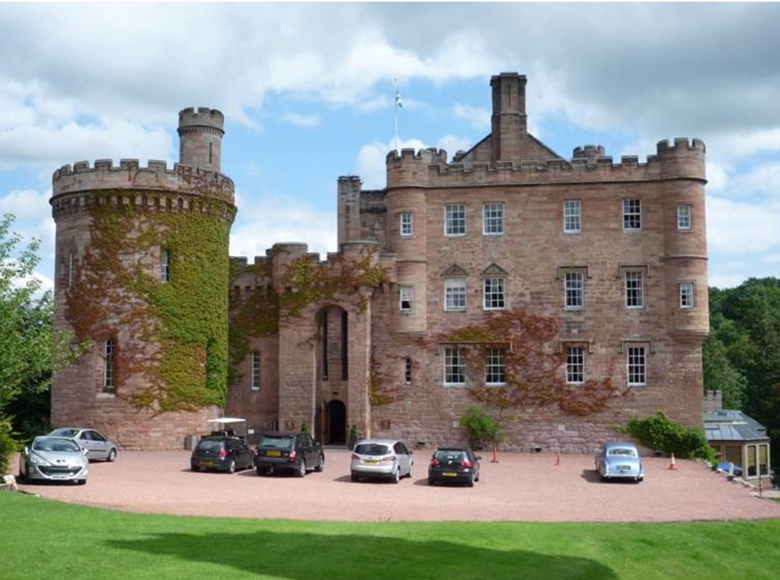
Dalhousie Castle is just eight miles south of Edinburgh city centre in Scotland. This 13th-century fortress is widely regarded as Scotland’s oldest continuously inhabited castle. It operates today as a hotel with 35 individually en-suite bedrooms and five function rooms/conference suites. On some occasions, it runs at full capacity, making it more important to determine whether the existing electrical capacity is sufficient for guest rooms, functions, and hotel operations.
The Challenge
The incoming supply was fused at 400 amps per phase and had been operating without issue for years. However, the hotel and spa had no visibility of their actual current consumption. That’s why they were uncertain about how much of the existing capacity was already in use.
The additional load from the proposed upgrade was considerable: 35 bedrooms at 1.5 kW each, 35 en-suite heated towel rails at 500 W each, five conference and function room radiators at 1.5 kW each, and a new commercial kitchen. This was a combined additional load of approximately 86.5 kW.
How the Challenge Was Addressed
Alan contacted Chauvin Arnoux UK to obtain four PEL113 Power and Energy Loggers for deployment across the site. As only current consumption needed to be logged, no voltage connections or exposure to live circuits was required.
Installation was straightforward. Flexible current sensors were looped around the meter tails, with one logger at the main incoming supply and the other three at downstream consumer units.
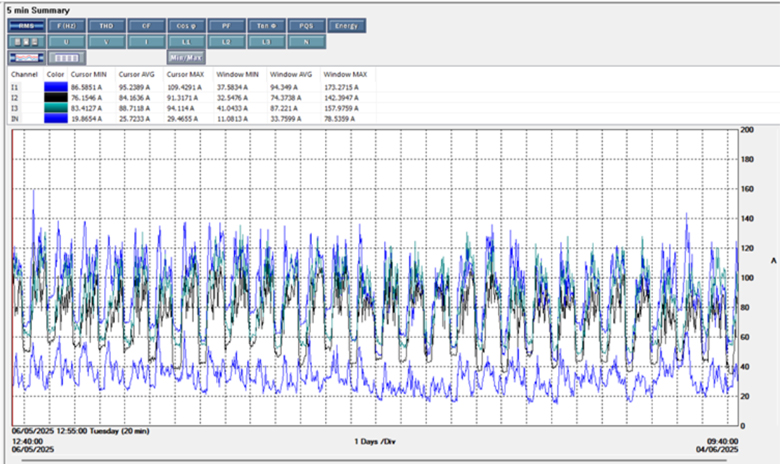
The loggers were set up on site for one week before retrieval. Data was downloaded to the PEL Transfer software. Five-minute aggregated readings from the main supply showed peak currents of 173A on L1, 142A on L2, and 157A on L3.
With the incoming supply rated at 400A per phase, the maximum recorded demand was well below half the fuse rating.
The Solution
Armed with a seven-day current log obtained from the four PEL113 power and energy loggers, Alan confirmed that the existing incoming supply had more than enough headroom to accommodate a new electric heating system across all 35 bedrooms, along with heated towel rails in every en-suite bathroom.
He provided the data as evidence. This meant that the Distribution Network Operator (DNO) did not require an upgrade to the supply. This also helped the hotel avoid a costly and disruptive intervention and allowed the project to move forward with minimal impact on hotel operations.
This is one of many cases where power and energy loggers prove their value in load expansion projects. Whether measuring maximum demand, identifying voltage excursions, investigating harmonics, or assessing other supply parameters, Chauvin Arnoux PELs provide reliable data to support informed, cost-effective decisions. They also deliver accurate measurements, giving engineers and clients the confidence to move ahead.
This article appeared in the May 2026 issue of Energy Manager magazine. Subscribe here.
