


Mark Homer is a Director of Progressive Property, a company he co-founded in 2007. He has developed more than 1000 units and his personal portfolio is valued over £40M. Predominantly private residential rooms, his company provide 1300+ tenants with properties around Peterborough.
With energy prices high, he’s acutely aware of the need to control consumption. Particularly where tenants enjoy all-inclusive rents.
Mark explains his experience of some tenants’ approach to heating control. “It’s quite simple, the thermostat gets put right up to maximum, which might be 30°C, then the room temperature is regulated by opening the window”.
A common occurrence in rented rooms, particularly student accommodation. But an increasing number of young professionals are opting for room or studio rental. These are typically Mark’s tenants.
Many decisions that affect return on investment are made when developing a property. For example, should heating be electric or gas powered?
Mark explains, “It depends on the development and what the M&E Consultant advises to meet the regulations. Wet systems historically, are cheaper to run. But issues with EPC/SAP calculations and capacity/availability of existing gas and electrical supply to the site, will determine the choice we make”.
Improvements in insulation and building techniques make electric more attractive, particularly the lower installation and maintenance costs. Changes to Part L of the building regulations make it easier for electric to comply.
Mark’s most recent project had electric heating, but he wanted to improve performance. He called the heater manufacturer for advice. “I had a couple of meetings with Atlantic, and they suggested I investigate Prefect Irus.”
“I watched loads of videos on their website. They were great, as they explain what Irus is in a nutshell. I’d seen the system in a Study Inn property and thought, ‘they are a good-sized student operator’. That gave me confidence.”
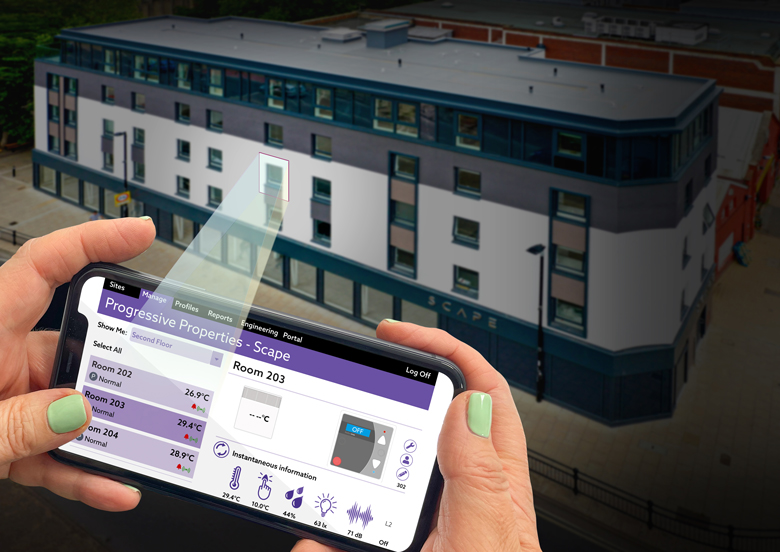
An Irus control unit, in each room, gathers information for environmental conditions – temperature, humidity, light, and sound pressure. It logs calls for heat, detects open windows and occupier absence – reducing input if rooms are empty. Existing electrical wiring communicates data to the portal, so installation is quick and inexpensive.
“We set time and temperature parameters on the portal. Our default is 18°C, with Boost to 24°C for 45 minutes. It then returns to default. I can see the temperature in each room, so if I receive a complaint about a cold room, I can check and assure them that it’s acceptable. A couple of times we’ve been alerted to temperatures exceeding our settings, one at 37°C! I asked Prefect, ‘what’s going on?’ They explained that a supplementary fan heater was being used. We had a word with the tenant, and it was removed, for energy and safety reasons”.
“Likewise, if there are complaints of noise, I can look on the system and find evidence. When presented to the offender, things change quite quickly!”
Parameters are adjusted remotely via the internet portal from anywhere, and data is interpreted in a variety of ways.
“The Central Control element is brilliant because we don’t have to go into a room to see if a tenant is still there; has abandoned the room; or is claiming not to be there but actually is. Instantly we can see what is happening from all sorts of data”.
There is a fine balance in managing rooms. Tenants must be comfortable, but over-consuming energy, either intentionally or unwittingly must be avoided.
Mark’s also reassessed control of water heating. Traditionally, cylinder elements work together to maintain water temperature. But integrated element thermostats are crude, imprecise and seldom adjusted after they are installed, meaning inaccurate indication of the temperature in the tank. Timing controls are rare, so invariably cylinders are fitted and forgotten.
With Irus, sensors measure the water temperature close to, but independent of the elements and feed data to the portal. Maximum efficiency profiles are set, and elements are switched independently depending on demand.
Mark was quick to maximise control, “I didn’t originally sign up for that, but I thought ‘that sounds like a good idea’. Instead of having both elements running almost constantly, Irus can switch them depending on need”. He continues, “There’s even a profile for monitoring DUoS” (Distribution Use of Service charges). Irus will switch elements on for 30 minutes before a DUoS red time band period and reduce input throughout.
Installation took place while rooms were occupied. Mark was surprised how little disruption there was, concluding, “Prefect did the whole project, end to end, for me, it’s not been stressful because they just do it all, and it works. Which is not that usual!”
