


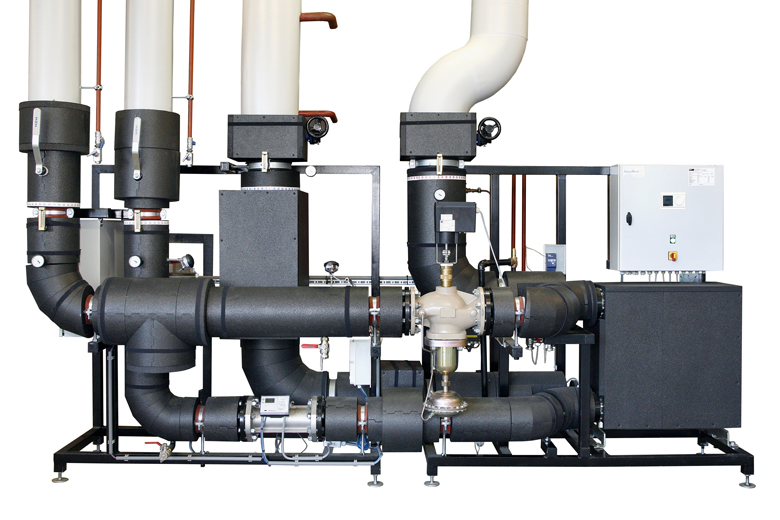
Developing, expanding and retrofitting heat networks to heat homes and organisations is a key part of the Government’s strategy to achieve net zero. Ian Robinson, Technical Manager – Multi-Occupancy and Heat Network Solutions at Baxi, reports on the latest developments to accelerate the growth of heat networks and ensure reliable performance standards
Heat networks are one of the most cost-effective ways of delivering affordable, low carbon heat to homes and organisations in high heat density areas. In simple terms, these systems traditionally operate by taking heat from a centralised heat source and distributing it throughout the network to end users via a network of underground pipes. By avoiding the need for households and workplaces to rely on individual, energy-intensive heating solutions, they can provide a versatile solution to reducing the carbon intensity of heat in buildings.
The heat source might be a facility that provides a dedicated supply to the heat network, such as heat pumps, a hydrogen-fed combined heat and power plant or boiler plant, or a hybrid system with a combination of different low / zero carbon (LZC) technologies. On a larger scale, heat networks can support local regeneration as they can also use heat from otherwise inaccessible renewable and recovered heat sources from industry and urban infrastructure such as data centres or natural sources like rivers and disused mines.
Optimising, developing and expanding heat networks is vital if the UK is to successfully deliver on its building decarbonisation goals. Today, heat networks provide about 2-3% of the heat used in UK buildings, but the aim is to grow this figure to around 18% by 2050.
Heat network zoning
One of the ways in which the UK government aims to accelerate the growth of heat networks is by designating prime areas for developing heat network systems as heat network zones where they provide the lowest cost and most effective method for supplying and decarbonising heat[1].
To this end, it has launched the Heat Network Zoning Pilot Programme which is being carried out in 28 English cities and towns. Working with local authority partners and key stakeholders, the aim is to devise and test a methodology for identifying heat network zones.
Bar some exemptions, once the heat network scheme is up and running, most buildings – whether currently heated by traditional boiler plant or through communal heat networks – will be required to connect.
Expanding heat networks
Typically, with current heat networks, energy flows in one direction and is kept within one network. This will inevitably change. Projecting forward, as networks expand, they will link to one another directly, if temperature and pressure regimes permit, or indirectly if not. Consequently, as the networks grow and merge with one another, they will become far more valuable as more and more users connect onto them. Further, as well as interconnecting networks as they expand and converge, energy could flow both ways as systems with energy that would normally go to waste can export it onto the larger networks.
In other words, heat networks become the thermal rails, connecting different users and providing systems with surplus heat a place to export it. This could be waste heat from industrial processes or data centres or surplus heat from microgeneration systems.
New regulatory framework
However, for heat networks to deliver on their potential, it is essential that they are designed, maintained and regulated in such a way that they reliably deliver affordable decarbonised heat.
While at present there is no regulation in place to protect heat network customers, the government is addressing this through the Energy Security Bill[2], which is passing through parliament at the time of writing.
The Bill introduces a new regulatory framework for heat networks and the introduction of the new Heat Network Regulations which will be overseen by Ofgem. The Bill also introduces powers to enable heat network zoning to ensure reliable, efficient, low carbon heat at a fair price.
Supporting this is the Heat Network Technical Assurance Scheme (HNTAS), which aims to improve the efficiency and resilience of heat networks in the UK. Work is now underway to design and develop a scheme that will provide assurance of heat network quality and performance and demonstrate compliance with minimum technical standards.
The renewed focus on performance, which comes off the back of work carried out by BESA to upgrade the test criteria of HIUs, aims to maximise reliability for consumers. The goal is to make it possible to deliver low carbon, affordable heat to communities via these systems and provide greater assurance of efficiency. The expectation is that it will legally enforce minimum technical standards for all heat network operators from as early as 2024.
In summary, the heat networks market is set to grow rapidly with the passing of the Energy Bill. The introduction of the Heat Network Regulations, the development of heat network zones and compliance with HTNAS will ensure a minimum level of performance to benefit all customers on the network. In this win-win scenario, heat networks could deliver greater benefits for all those linked to the networks at the same time as bringing us closer to our climate goals.
https://www.baxi.co.uk/about-us/the-future-of-heat
[1] https://www.gov.uk/government/publications/heat-networks-zoning-pilot
[2] https://www.gov.uk/government/publications/energy-security-bill-factsheets/energy-security-bill-factsheet-heat-networks-regulation-and-zoning
