


Ian Rose, Sales & Strategy Director at Passiv UK
Heat pumps are set to become the solution that will heat homes up and down the country, offering a cleaner, greener alternative as part of the drive toward decarbonisation. The success of this transition hinges on making heat pumps not just effective, but intuitive and effortless to use, ensuring they become a seamless part of everyday life.
Rather than focus on extensive homeowner education (after all, how many of us truly understand the intricacies of our gas boilers?) we can empower homeowners by prioritising simplicity. With well-designed, user-friendly heating controls, we can ensure that everyday interactions with heat pumps are seamless, paving the way for widespread adoption and making this vital shift in home heating as effortless as possible.
For housing associations, which own and manage 2.7 million homes for six million people in England alone, delivering this simplicity will be crucial to ensuring a smooth and successful transition. On average, social housing properties are more energy efficient than other UK houses[1]. This makes them ideal for heat pumps, which thrive in highly insulated properties. Even so, the scale of the challenge is no mean feat.
For social landlords, achieving this goal means not only improving the thermal fabric of homes but also replacing traditional gas boilers with heat pumps. This mission has been supported by government initiatives such as the Social Housing Decarbonisation Fund (SHDF), however according to the National Audit Office, heat pumps represent just under 3% of the decarbonisation measures installed in social housing. Why is this?
When it comes to heating controls, British homeowners have grown accustomed to gas boilers. Unlike gas boilers, which operate at higher flow temperatures, heat pumps operate at lower flow temperatures, meaning they take longer to heat a home – so having controls that are easy to use is really important.
Yet today’s heat pumps are far from user-friendly, with one study finding that just 23% of people are able to set up a heating schedule due to unintuitive user interfaces and a lack of clear messaging. This poses a particular challenge in social housing, where tenants often don’t choose to have a heat pump installed. In some cases, tenants are offered a heat pump but may not fully understand its benefits or operation, and this disconnect leads to lower engagement. Social housing demographics also skew older compared to the broader homeowner population, creating additional barriers to technology adoption.
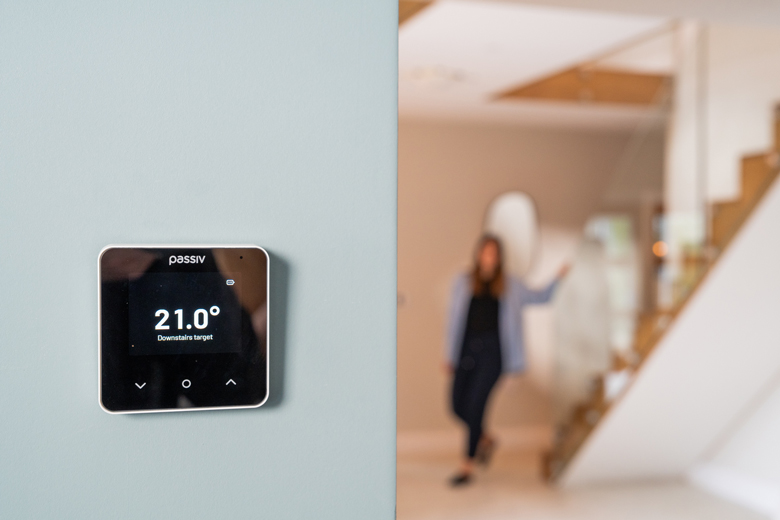
As a technology provider, we find ourselves one step removed from the end user, adding further complexity. For instance, an installer might set up the system, but it’s often the tenant liaison officer – already juggling numerous responsibilities – who ends up fielding tenant queries when they are having difficulty putting their heating on. The good news is that advancements in smart thermostat technology have been designed to address these challenges and are being developed with social tenants in mind. It is possible to help both tenants and tenant liaison officers with simple interfaces that make these systems as easy as possible to use.
By providing an interface for a heat pump that will be familiar to a boiler user, these smart solutions can simplify the currently complex or imprecise heating system controls. They provide a solution to controlling home comforts without the need for internet connection or a smartphone and can even lower heating bills.
Beyond user comfort, smart controls also allow tenants to earn additional income by providing flexibility to the electricity grid. In order to ensure the security of the UK’s electricity supply, heat pumps will have to form part of a smart, flexible energy system and be capable of adjusting their operation in response to national electricity requirements. Smart, connected controls make this possible by allowing heat pumps to respond dynamically to grid requirements. As a result, tenants with these advanced controls can benefit financially by participating in grid flexibility schemes, supporting grid stability while earning tenants’ money – a win win all round!
By empowering tenants with user-friendly controls, we can shift the perception of heat pumps to a more positive one and create an accessible solution to ensure no one is left behind.
[1] https://www.housing.org.uk/globalassets/files/climate-and-sustainability–energy-crisis/07085855-9cf8-456c-8099-9506a6839b5d.pdf
This article appeared in the Jan/Feb 2025 issue of Energy Manager magazine. Subscribe here.
