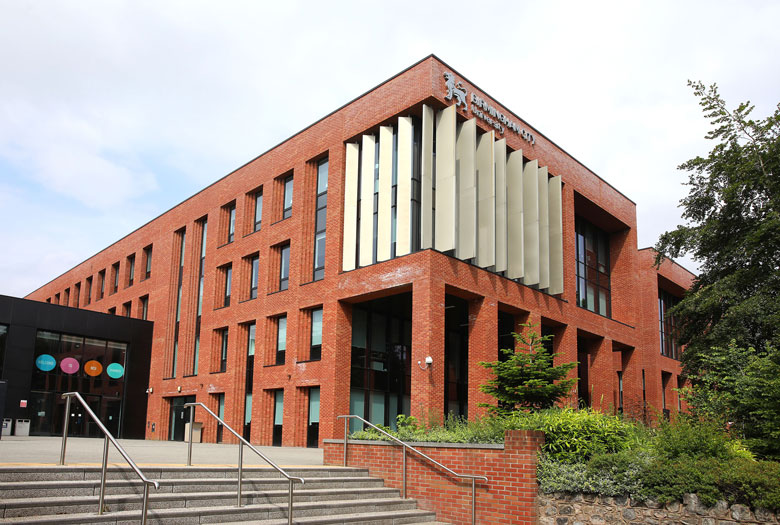


Birmingham City University has replaced the gas heating in its School of Health Sciences with heat pumps, as part of a wider £3.3 million decarbonisation programme across the university’s estate.
Delivered by principal contractor SHEco Renewable Systems in collaboration with wholesaler, Kooltech and heat pump manufacturer, Mitsubishi Electric, a two-month value-engineered process has enabled the university to reduce the project cost by £2 million against the original tender. The wider programme is supported by funding from the Public Sector Decarbonisation Scheme, managed by Salix.
The funding has enabled the University to replace ageing gas boilers and chillers at its City South Campus with a heat pump-led heating and cooling system. This provides more than 1MW of heating and 1MW of cooling, with 50kW solar array and extensive LED lighting upgrades to further reduce electricity consumption.
The measures support the university’s long-term sustainability strategy and carbon reduction commitments, marking one of the university’s first large-scale, heat pump-led decarbonisation projects and setting a clear benchmark for building transformation in the higher education sector.
“The University has a strategic goal of working towards zero carbon,” explained David Phillips, Senior Mechanical Engineer at Birmingham City University. “SHEco, Kooltech and Mitsubishi Electric had to work quickly to develop a solution that met the building’s requirements, while remaining within budget.”
The solution uses two Climaveneta NX2-Q air source heat pumps which provide simultaneous heating and cooling to the building. These also feed four EW-HT water-to-water heat pumps which boost the water temperatures to 70°C, avoiding the need to change any of the secondary-side heat emitters, which helped reduce the overall budget.
“Working closely with Kooltech and Mitsubishi Electric enabled us to protect the University’s core performance requirements while identifying significant opportunities to reduce costs, without compromising technical quality or performance,” added Adam Clark, Commercial Director at SHEco Group.
Specialist product support from Mitsubishi Electric also ensured the flow temperatures matched the cooling and heating loads for the building, while meeting the requirements for the Public Sector Decarbonisation Scheme and existing City South Campus buildings infrastructure.
“We’re really pleased with the result,” ended David Phillips. “The best thing I can say is that we hardly had to speak to them during the project as they’ve just carried on and provided us with solutions to any minor deviations that they came across.”
The project highlights how collaboration has helped turn ambitious decarbonisation plans into a practical solution for the university while adhering to tight budgets and timelines.
To watch a video of the project, click here.