

Andrew Leah, General Manager – Water Management Solutions at Duraproducts
Climate resilience has become a growing challenge for the construction industry. As temperatures continue to rise and weather patterns become increasingly unpredictable, infrastructure must be designed not only to withstand changing conditions but also to reduce its environmental impact throughout its lifecycle.
The UK faced an unprecedented heatwave in May 2026 with a record high temperature of 35.1 °C. This alarmingly high temperature serves as a reminder of the escalating climate crisis. The United Nations warned that the main culprit behind Europe’s scorching heat is the world’s dependence on fossil fuels and the release of greenhouse gases. For the construction sector, this creates a dual responsibility: reducing carbon emissions while delivering infrastructure capable of coping with future climate pressures.
Effective water management sits at the centre of this. Warmer air can hold more moisture, increasing the likelihood of intense rainfall and placing increased pressure on drainage networks. As urban areas continue to expand, the need for sustainable drainage solutions that can efficiently manage surface water runoff has never been greater.
The consequences of ineffective drainage extend beyond temporary surface water accumulation. Flooding can disrupt transport networks, damage infrastructure, increase maintenance costs and create safety risks for road users and pedestrians. As extreme weather events become more frequent, local authorities and developers are under pressure to deliver drainage systems that meet current performance requirements and accommodate future demands.
This has prompted a broader conversation around resilience within civil engineering. Rather than focusing solely on upfront costs, project teams are increasingly assessing whole-life performance, maintenance requirements and environmental impact when selecting infrastructure solutions. Drainage systems that combine operational efficiency with long-term durability are becoming a key component of sustainable urban design.
Rethinking drainage infrastructure
Traditional construction materials like concrete have typically been used for drainage systems, but growing attention is being paid to the environmental impact of material selection. From raw material extraction through to manufacturing, transportation and installation, every stage contributes to a project’s overall carbon footprint.
At Duraproducts, sustainability is embedded within product development; by utilising recycled polymer materials, Duradrain has been designed to provide an effective combined kerb and drainage solution while helping to reduce reliance on more carbon-intensive alternatives.
The lightweight nature of recycled polymer offers practical advantages throughout the installation process compared with traditional materials; units can be handled more efficiently on site, reducing the need for heavy lifting equipment and supporting lower fuel consumption during construction.
Designed for long-term performance
Alongside sustainability benefits, long-term durability remains essential for infrastructure projects. Drainage systems are expected to perform reliably for decades while being exposed to high traffic volumes, weathering and fluctuating environmental conditions.
Recycled polymer materials offer excellent resilience in demanding environments as their cellular structure helps maintain structural integrity over time, reducing the likelihood of damage that can lead to repair work or replacement. This durability supports a lower whole-life environmental impact by minimising material consumption and maintenance requirements throughout the product’s service life.
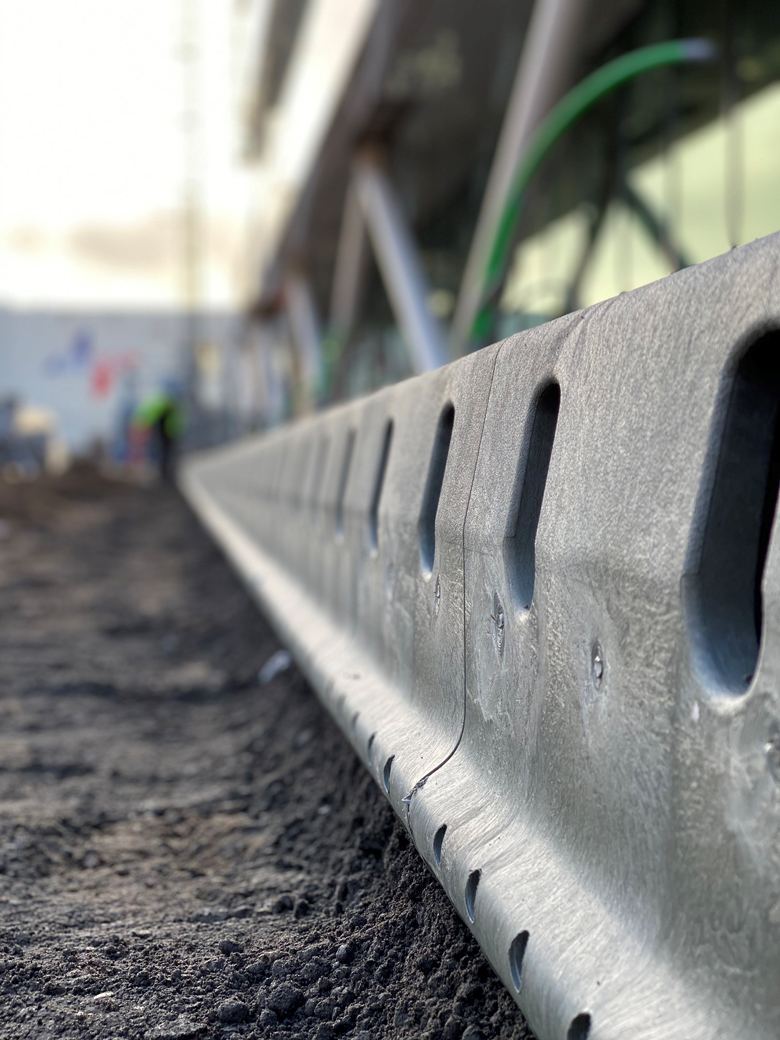
Duradrain’s shallow-profile design supports this approach by enabling smoother transitions between surfaces while maintaining efficient surface water collection. Acting as both a combined kerb and drainage solution, it can provide clear physical and visual separation between different areas of the highway while continuously capturing runoff along its length. By containing and directing water within the channel body rather than allowing flows to build across the surface, linear drainage can improve user safety, simplify site design and help protect surrounding infrastructure from the effects of increasingly intense rainfall events.
Duradrain has been specifically engineered to manage significant volumes of surface water runoff. Multiple inlet points along the kerb line allow water to enter the system efficiently, helping to protect roads, pavements and surrounding infrastructure during periods of heavy rainfall.
Supporting a more sustainable future
As the construction industry continues its journey towards net zero, material innovation will play an increasingly important role in balancing environmental responsibility with infrastructure performance.
Sustainable drainage solutions that combine effective water management, long service life and reduced embodied carbon can help project teams meet both environmental and operational objectives. By considering the whole-life impact of drainage infrastructure, designers, contractors and local authorities can make informed decisions that contribute to more resilient and sustainable built environments.
For Duraproducts, this approach reflects a long-standing commitment to developing practical construction solutions that support both climate resilience and circular economy principles, helping create infrastructure that is fit for the challenges of the future.
