


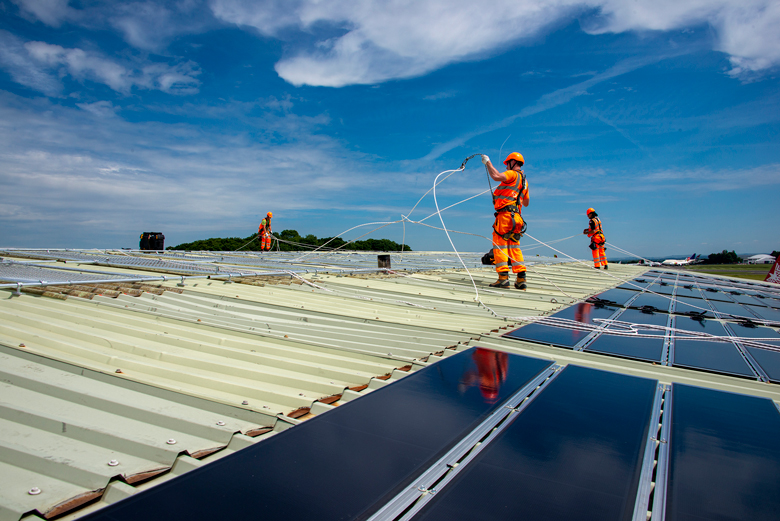

Here, Jo Parker-Swift, CEO and founder at Solivus explores the enormous solar potential for the UK’s unused commercial roof spaces and why it’s time to seize the opportunity.
A quick glance at the news will, most likely, reveal that the UK’s solar capacity continues to grow at a rapid pace. To put it into context, in 2010 just 28,211 households had solar panels. As of 2024, that figure stands at 1.4m homes. That’s a 4,862% increase in 14 years.1
But while certainly a positive step in the right direction for our new energy future, this is just part of the picture. Take a look at the commercial solar market and you’ll likely find a much less progressive stance. In fact, according to a recent analysis less than 10% of the UK’s non-domestic buildings are utilising their available rooftop space for solar energy.2
This is a colossal wasted opportunity on multiple counts. Foremost, there is vast, unused, unobstructed roof space on our schools, warehouses, factories and like and a quarter of a million hectares of it faces south.3
Second, by embracing solar energy, companies can achieve substantial cost savings. In fact, by fully utilising the available rooftop space it is estimated that commercial buildings could save £35 billion, with lifetime savings reaching £703 billion.In energy generation terms that translates to 117 TWh of electricity annually. That’s enough to power approximately 30 million homes for a year, more than the number of households we currently have in the UK.4
Thirdly and perhaps, most impactful of all, the Department for Energy Security and Net Zero sees commercial solar as vital to its clean power mission. To that end, the government-industry Solar Taskforce continues to point to the “untapped potential” of commercial solar.
Clearly then, the argument for commercial solarisation appears conclusive. So, why has there been so little uptake in the UK? In my experience of operating in the solar sector for almost a decade, there are two reasons. The first involves government policy. The second involves the complexities many commercial premises face when installing rooftop solar.
Over the past decade the government has introduced a number of initiatives designed to encourage businesses to transition to clean energy sources. But none have really stuck. For example, 2019 saw the widely-popular Feed-in Tariff come to a rather abrupt end, significantly reducing the financial incentives for new solar installations. Though we now have the Smart Export Guarantee which allows businesses to sell surplus energy back to the grid, the gains to be had are marginally lower.
This trend of stop-start green policy continues to bring uncertainty to the market. As we look to the coming years, the hope is policy evolves to become clearer, more consistent and provide long-term support for the commercial solar transition.
However, that doesn’t mean commercial businesses shouldn’t seize the solar opportunity today. After all, it is the early adopters that are already benefiting from a first-move advantage in terms of significant cost savings, emissions reductions and energy security while their competitors are playing ‘wait and see’.
At the same time, as an industry we must work together in greater collaboration, and with the policy and decision makers, to improve on best practices and foster the innovation needed to enable a bigger and better solar industry.
The other key problem has been the fact that there simply hasn’t been solar panelling light enough and effective enough to take advantage of the commercial space. It’s estimated that 40% of commercial buildings cannot support the weight of traditional solar panels. That equates to a vast 1,000 square miles of commercial roof space.5 The good news in 2024 is that we now have the lightweight solar technology to change this, and the impact for commercial operators, the country and green economy could be profound.
At Solivus, we’ve installed solar on airports, stadiums, warehouses and more. In my experience, the only regret that most commercial operators have is not going solar sooner.
Now our focus remains on taking the commercial solar opportunity to the entire market. Recent changes to development rights rules mean commercial buildings are able to install solar on their roof spaces without going through some of the typical planning obstacles.
The government has a clear target to increase solar capacity by nearly fivefold to 70GW by 2035 as part of wider plans to power up Britain with cleaner, cheaper and more secure energy sources. Unlocking the commercial solar opportunity will be a critical enabler and we remain committed to playing our part. We hope the government and industry do the same.
For more information please visit www.solivus.com
1https://www.sunsave.energy/solar-panels-advice/cities-and-regions/homes-with-solar
3 https://files.bregroup.com/bre-co-uk-file-library-copy/filelibrary/nsc/Documents%20Library/NSC%20Publications/123160-NSC-Solar-Roofs-Good-Practice-Guide-WEB.pdf
5 https://consent.yahoo.com/v2/collectConsent?sessionId=3_cc-session_8c07c2a6-f965-4ea1-b030-6f9ce25eec9b
This article appeared in the Nov/Dec 2024 issue of Energy Manager magazine. Subscribe here.
