


Geopolitical instability, fluctuating wholesale prices and pressure on the grid have made harnessing solar power more important than ever for energy-intensive businesses.
For many firms, uncertainty around electricity costs now shapes investment decisions, production planning and the commitments they can make to customers and suppliers.
This is bringing solar into sharper focus, not only as a route towards net zero but as a practical way to improve financial certainty and energy resilience.
Despite solar being traditionally seen as a niche energy source, attitudes are changing. Leading provider of commercial solar solutions, Power Zero, is experiencing increased demand for solar Power Purchase Agreements (PPAs) from energy-intensive industries such as manufacturing and automotive.
Sophie Lamb, head of solar delivery at Power Zero, explains what is driving this shift in demand and how Coster Aerosols, a multinational manufacturer specialising in aerosol packaging components, spray systems and filling machinery, is harnessing solar to take greater control of its energy needs.
Solar as a business decision
“Cutting carbon remains important, but cost control, business continuity and security of supply now carry just as much weight.
“Manufacturers operate in an environment where electricity costs can change quickly, yet production cannot simply stop when prices rise.
“Businesses cannot control global events or wholesale markets, but they can control more of how their electricity is generated, purchased and used. That is a key reason why we’re seeing high levels of interest in solar PPAs across Power Zero and the wider YLEM Group.”
Why businesses are turning to solar PPAs
Under a solar PPA, the provider funds, installs and maintains an on-site solar system, whilst the customer buys the electricity generated at an agreed rate.
This provides lower-cost, lower-carbon electricity without significant upfront investment, while reducing reliance on the grid and making a proportion of energy costs easier to forecast.
Sophie added: “Demand is particularly strong amongst organisations with large sites and consistent daytime electricity use, including manufacturing, automotive, chemicals, pharmaceuticals, logistics and food and drink.
“On-site generation can reduce grid purchases and demonstrate credible environmental progress to customers and supply-chain partners.”
Putting the strategy into practice
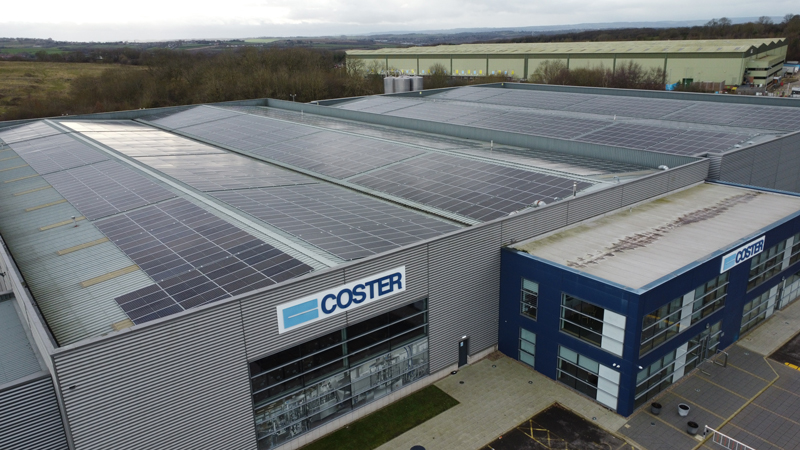
As part of a growth plan centred on sustainability and innovation, Coster entered a 15-year solar PPA with Power Zero for its Chesterfield site.
Power Zero funded and installed a 1.2MW rooftop solar array comprising 2,120 modules across seven roof aspects, supported by eight inverters.
The system is expected to meet approximately 25% of the site’s electricity demand and aims to prevent 236 tonnes of carbon dioxide emissions annually.
Gary Durant, financial controller, at Coster Aerosols, said: “The PPA helps us reduce emissions and makes a significant share of our electricity costs more predictable, without taking investment away from the wider business.
“It supports our sustainability commitments while giving us greater confidence to plan, operate and grow over the long term.”
Sophie added: “Coster shows how a solar PPA can address several priorities at once.
“Power Zero assumed responsibility for the system’s design, installation, performance and maintenance. This reduced Coster’s risk and allowed it to adopt solar without diverting capital from its growth plans.”
Would stable energy prices slow the shift?
Sophie explained: “Stable prices may reduce immediate pressure, but recent market shocks have shown how quickly conditions can change and how exposed businesses are when they rely heavily on grid power.
“A solar PPA is a long-term decision, not a response to one price spike. On-site generation, clearer costs and reduced emissions remain valuable when markets are calmer. Stability is an opportunity to plan, rather than a reason to delay.”
Changing perceptions of solar
Solar was once viewed as a niche sustainability measure, but its rapid growth is changing how businesses see the technology.
According to the International Energy Agency, solar PV was the single largest contributor to growth in global energy supply in 2025, accounting for more than a quarter of the increase. An additional 600 terawatt-hours of solar electricity was generated worldwide during the year—the largest annual increase recorded for any electricity-generation technology.
Sophie said: “Solar is no longer simply an environmental statement. It is proven technology that can make a measurable contribution to operational resilience and long-term planning for UK business.
“For energy-intensive companies with suitable space and consistent demand, it is becoming an increasingly practical commercial decision.”
Balancing resilience with net zero
Sophie concluded: “Cost control, continuity and net zero should not be treated as competing priorities. A well-planned solar strategy can support all three.
“No business can remove every risk created by global events, energy markets or grid constraints, but it can reduce its exposure.
“Coster demonstrates this in practice. Through a fully funded solar PPA, the company is gaining greater control over its energy costs while supporting its growth and sustainability ambitions.
“Energy resilience is about giving businesses the confidence and flexibility to keep operating and growing, whatever happens in the wider market.”
This article appeared in the October 2026 issue of Energy Manager magazine. Subscribe here.
