


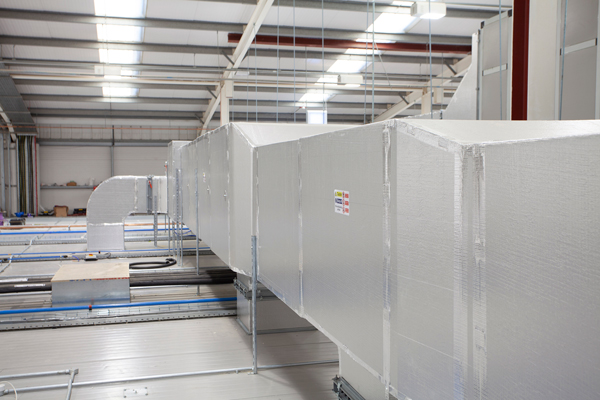
Marc Nickels, Business Development Manager Kingspan Technical Insulation
MEP services can account for a significant proportion of both operational emissions and embodied carbon in buildings. The embodied impact can be especially notable in office developments where spaces may undergo numerous Cat-A fit outs during the building’s lifespan.
Engineering specialist, Introba, has now released new research looking in more detail at how different specifications of MEP systems can impact embodied carbon. The research, commissioned by Kingspan Technical Insulation, looks at a typical office development. Its findings suggest that limiting use of metals (such as steel or aluminium) is a key factor in reducing embodied carbon from MEP systems, and that the use of pre-insulated phenolic ductwork over conventional lagged galvanised steel ductwork can be beneficial.
Research
The research looks at a typical 5-storey office building with a gross floor area of 10,000m2. They assessed three different HVAC scenarios:
- Variable refrigerant flow (VRF)
- Air source heat pump with fan coil units (ASHP with fan coil units)
- Air source heat pump with chilled beams (ASHP with chilled beams)
The research considered the total embodied carbon from all three MEP areas for both a Shell & Core and Cat-A fit out. In each case, the public health and electrical designs were kept constant. The embodied carbon for each scenario was calculated using the methodology in CIBSE TM65 – Embodied Carbon in Building Services: A calculation methodology (2021).
In all scenarios, it was assumed that the refrigerant used in all system options was R32 with a global warming potential of 675 kgCO2e. The leakage rates follow the recommendations in CIBSE TM65 with an annual leakage rate of 2% for the ASHPs and 6% for VRF and end of life rate of 1% for the ASHPs and 3% for VRF.
Modelled comparison
The outputs from the modelling are shown in the graph below.
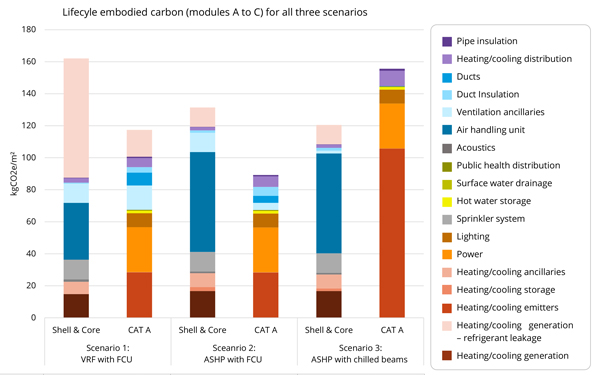
These showed that the combined embodied carbon from the Shell & Core and Cat-A approaches was lowest under the ASHP with fan coil units scenario. This also had by far the lowest embodied carbon for the CAT-A fit out.
The embodied carbon for the ASHP with chilled beams Shell & Core scenario was lower than the alternatives, however, its CAT-A fit out impact is far higher than for VRF and ASHP with fan coil units. This was mainly due to the high embodied carbon impact of the aluminium chilled beams. This meant that the embodied carbon from the heating/cooling emitters was over 4 times higher than for the other CAT-A fit outs.
Overall embodied carbon from the VRF scenario were the highest of the three which were examined. Refrigerant leakage contributed to 32% of the overall embodied carbon from the VRF scenario. In a high refrigerant leak emission scenario, the embodied carbon from the VRF specification could increase further.
Ductwork
In all scenarios, the ventilation systems were found to have a high embodied carbon impact primarily due to the steel used for the large air handling units and ductwork.
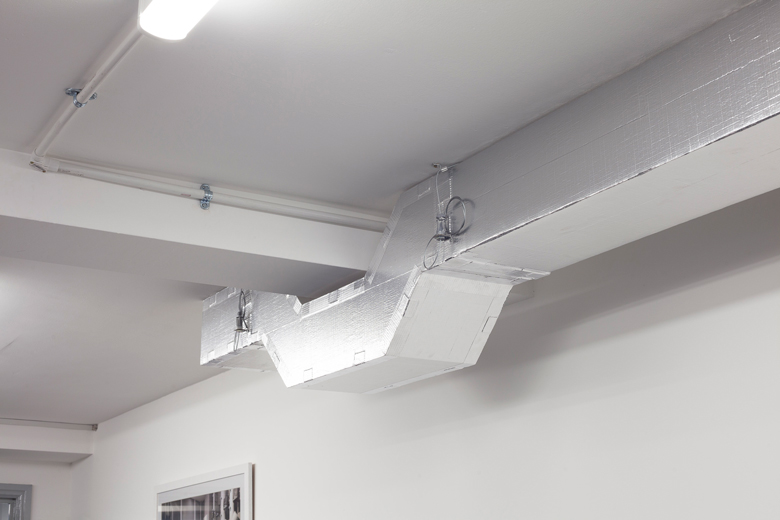
To investigate how reducing the volume of steel could impact embodied carbon, Introba carried out a further analysis. This involved switching from a galvanised steel ductwork specification lagged with phenolic duct insulation, to a pre-insulated phenolic ductwork system. The pre-insulated ductwork system is fabricated from rigid insulation panels with a foil facing – eliminating the need for galvanised steel ducting.
The results showed that this could have a particularly notable impact on the embodied carbon from the ventilation system for the ASHP with fan coil units scenario – reducing lifecycle embodied carbon from 100.2 kgCO2/m2 to 88.9 kgCO2/m2. This is a reduction of over 11%.
Embodied carbon emissions for the ventilation system in the VRF scenario also fell by 4.7 kgCO2/m2 whilst change for the ASHP with chilled beams was only 0.3 kgCO2/m2 due to the lower quantity of ductwork needed.
Pre-insulated ductwork also supports potential savings in operational emissions, due to its highly insulated and airtight design.
In summary
The research shows that the ASHP with fan coil units scenario had the lowest lifecycle embodied carbon emissions of the three that were examined for the office case study. The embodied carbon emissions for CAT-A fit out for this scenario were also notably lower than for the other approaches that were examined. It also highlighted that further reductions in embodied carbon could be achieved by switching from conventional lagged steel ductwork to pre-insulated phenolic ductwork – likely due to the reduction in steel used.
For more information: Tel: +44 (0) 1457 890 400 E-mail: info@kingspaninsulation.co.uk Website: www.kingspantechnicalinsulation.co.uk
