



Errol Bull, P.E., CSI, Application Development Leader at Momentive Performance Materials Inc. Member: IIBEC, ASTM C24, ISO TC59/SC8
In the world of data centre construction, the conversation is dominated by what happens inside the building. After all, that’s where you’ll find the high-performance computers and liquid cooling loops as energy managers discuss rack density and chip efficiency.
But there’s an equally important part of the energy equation missing – and one that provides the first line of defence against the elements.
The building envelope is frequently overlooked, yet it has a significant impact on operational efficiency. For those tasked with driving down Power Usage Effectiveness (PUE) and extending asset lifecycles, the roof is more than just weatherproofing – it is an active component that plays a key role in energy usage.
Specifying high-performance options like reflective silicone coatings is a strategic design choice that influences cooling loads and long-term ROI.
Solving the Energy Equation
Cooling is often one of the largest operating expenses for data centres, sometimes accounting for up to 40% of a facility’s total energy consumption. In the push for a lower PUE, construction teams often look inward by optimising airflow. However, an effective way to manage heat gain is to prevent it from entering the building in the first place.
Dark roofing materials act as massive heat sinks, absorbing solar radiation and transferring that thermal load directly into the structure. Reflective silicone coatings, designed to create a “cool roof” environment, are the opposite. By creating a white, seamless surface with high Solar Reflectance Index (SRI) values, these coatings provide both solar reflectance and thermal emissivity.
The financial implications can be significant. Industry data suggests that by lowering the ambient thermal load, these coatings can reduce cooling energy expenses by an estimated 10% to 50% depending on the environment. In real terms, this can translate to a 7-15% reduction in annual overall cooling costs. Furthermore, this reduces strain on HVAC systems, potentially allowing developers to downsize infrastructure during construction or extend the lifespan of existing equipment, thereby deferring significant capital expenditure.
The Solar Dilemma
As data centres increasingly integrate on-site solar panels to offset carbon footprints, a new challenge has emerged: the “lifecycle gap.” Solar panels typically have a service life of 25 to 30 years, whereas many traditional roofing membranes may require maintenance or invasive repairs every 7-10 years. This creates a logistical failure where functioning solar arrays must be decommissioned to repair the roof beneath them.
The right silicone coatings bridge this gap. Because silicone is inorganic, it is inherently resistant to UV degradation. When specified correctly, these coatings offer a service life that better aligns with the lifespan of the solar panels. Additionally, they provide the elasticity required to withstand the thermal shock and movement inherent in solar racking systems without cracking or delaminating, helping to create a unified, long-term asset lifecycle.
Protecting Valuable Assets
In a data centre, roof failure is a significant business risk. Water leaks above a server hall can lead to downtime that costs an immense amount of lost time and money. Liquid-applied silicone roof coatings provide a seamless membrane, creating a robust barrier against water ingress. Because it is applied as a liquid, it fills cracks and covers seams, ensuring the envelope – and the costly technology below – is protected.
Furthermore, silicone enables a “restore rather than replace” approach. Traditional roof tear-offs are highly disruptive, creating dust and vibration – two of the greatest enemies of sensitive server equipment. Silicone coatings are compatible with almost all roof types, including metal, single-ply and bitumen. This allows construction teams to save time and money while removing the risk of exposing interior hardware during renovation.
Alongside this, one of the trending topics for Energy Managers is dealing with “Embedded Carbon.” Replacing a roof creates massive waste (Scope 3 emissions); restoring it with silicone helps to delay, and reduce over time, the amount of waste to landfill.
Case in Point: Restoring Efficiency in Mexico
This approach was recently demonstrated for a leading global technology infrastructure provider in Mexico. The facility’s roof was only six years old, yet the existing single-ply PVC system had failed prematurely due to intense UV exposure and hail damage.
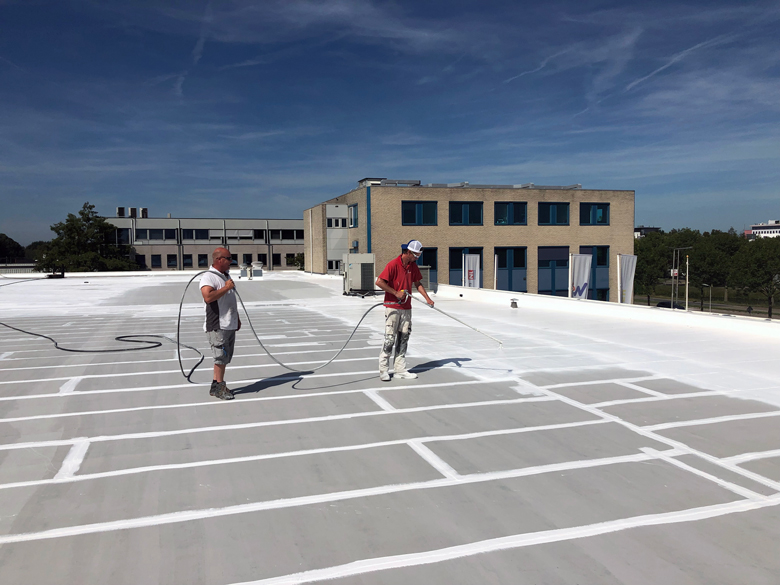
Rather than a disruptive replacement, the team applied a high-performance, 100% alkoxy silicone roof coating over the 170,000 sq. ft. (15,793 m2) surface. The result was a seamless, durable barrier that immediately protected the building. Crucially, the white finish restored the roof’s high solar reflectivity, bringing the facility’s temperature control capabilities back to an optimal state without losing any uptime.
A Strategic Investment
In an era where data centres are being built at a record pace, the building envelope should be viewed as a performance-enhancing component, not just a shell over expensive circuitry. A reflective silicone coating is a relatively small, strategic investment that provides long-term thermal performance, secures the building and provides a clear pathway to a more sustainable long-term PUE. As we design the next generation of data centres, silicone is an essential choice for a future-proofed facility.
For more information, visit: https://siliconesforbuilding.com/
