


John Calder, technical director at Dura Pump.
The Ministry of Justice (MOJ) has committed to achieving Net-Zero carbon emissions by 2050, but decarbonising prisons presents one of the toughest challenges in the public sector. With an ageing infrastructure operating 24/7 at near maximum capacity, these facilities are difficult to retrofit and expensive to maintain.
Yet within this complexity lies a critical, underused opportunity to upgrade inefficient pumping systems. As well as improving the resilience of existing infrastructure and reducing running costs, modern and intelligent pump systems can generate significant carbon reductions.
How old pumps are increasing carbon and cost
In many UK prisons, pump systems are decades old and use outdated control methods. They run at a fixed speed regardless of demand and their output is not adjusted to meet peaks and troughs. Meaningful forms of monitoring and feedback are not recorded which would allow efficiency and energy savings to be identified.
Running pump systems this way consumes far more energy than necessary and puts additional pressure on equipment, increasing wear and failure risk.
Given the pressure on His Majesty’s Prison and Probation Service (HMPPS) facilities and a £1.8 billion backlog in maintenance works, additional operational and financial strain caused by the failure of pump systems risks exacerbating the challenge.
Smarter and more modern pumps for improved control
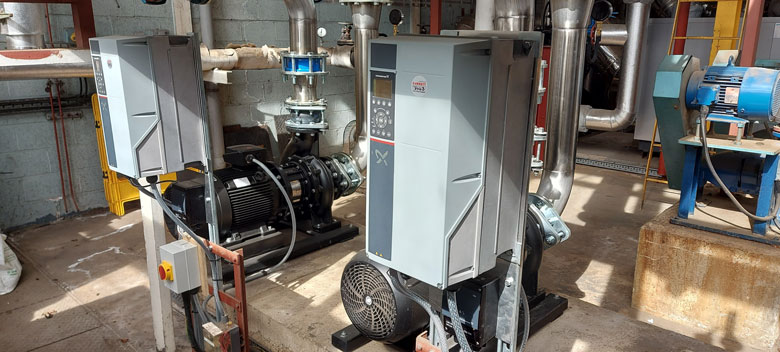
Modern intelligent pump systems now offer a clear way forward; they use variable speed drives (VSDs), monitoring sensors and control software to match output to real-time demand. This technology allows pumps to respond dynamically to demand, meaning that if less output is needed, the system uses less energy.
These smart pumps also monitor performance continuously, which gives teams visibility and helps them spot small issues before they become big failures. This reduces energy use but also extends the lifespan of the pump system and reduces the risk of failure. Fewer emergency breakdowns and unplanned costs contribute to more reliable operations. For facilities who are under pressure to reduce emissions and demonstrate progress, targeted pump upgrades can provide measurable improvements in the short term.
Installing VSDs alone can cut pump energy use by 30% to 60% depending on the system. For a prison running 24/7 this quickly adds up.
In most cases, upgrading a pump system does not mean starting from zero; VSDs can be retrofitted onto existing pumps. This keeps costs down and minimises disruption, two major considerations in a secure environment like a prison.
Contributing to meet MOJ’s 2050 targets
The road to Net Zero will take time, but that does not mean waiting to act. Energy use in pump systems is an area where the MOJ can make early progress. Pump upgrades can be rolled out to a planned programme, and each installation will make an immediate difference to energy use and emissions.
By modernising prison pump systems, the MOJ can gain a clear and measurable return on both carbon reduction and cost savings. With consistent design and implementation, these upgrades can be scaled across the estate. This helps future-proof assets and supports the MOJ’s wider sustainability goals.
Carbon savings are only one part of the benefit; reduced operational costs and increased systems resilience will support the success of the prison estate in the short, medium and long-term.
Data-driven control for better decisions
The data that smart pump systems offer is among their most important features. Prison estates can transition from reactive to proactive maintenance by monitoring energy consumption, system pressure and fault warnings in real time. Estates teams can identify patterns and problems early, before turning maintenance strategies into action, instead of waiting for a failure to happen.
With information on system performance available in real-time, decisions about replacements or upgrades can be made based on facts rather than guesswork, which is crucial in a high-pressure environment with tight budgets. They can also improve the control of the systems where the BMS is not fully functional.
Pump systems might not be the most visible part of a prison estate, but they are among the most evident pieces of infrastructure that can bring about change. Smart pump systems reduce energy use, cut emissions and improve reliability. With the constant pressure to meet Net Zero goals, prisons need solutions that deliver results without major disruption. Modernising pumping infrastructure is a smart, strategic step in that direction.