


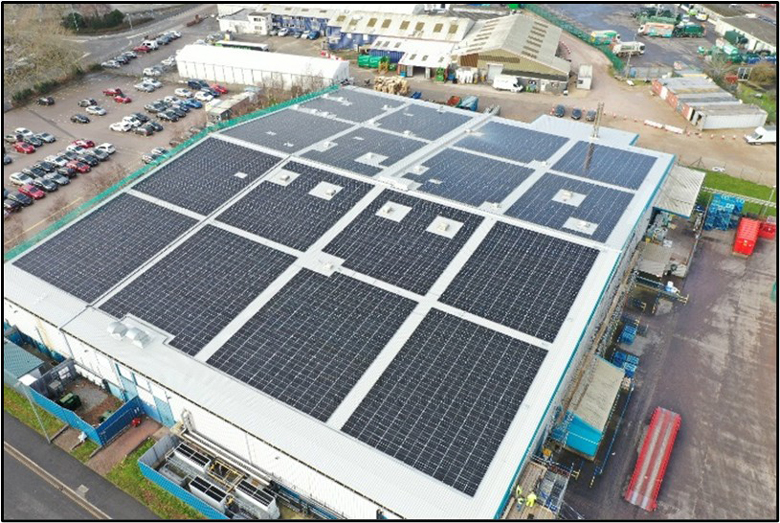
As more UK businesses look to solar energy to help them meet their carbon reduction goals and cut energy costs, safety is coming under increasing scrutiny. Here, Christelle Barnes, UK Country Manager of inverter and smart energy solution provider SolarEdgeTechnologies, explains what businesses need to know to safeguard both their people and property when investing in solar.
Improved economics and increased awareness of solar energy as a viable and sustainable alternative to grid power are leading more companies to go solar. With the potential to benefit businesses large and small, smart energy solutions are cropping up on unused rooftops of manufacturing plants, warehouses, retail outlets, data centres, airports and other transport hubs, and more. Much of the attraction is economic, especially in an environment of rising electricity consumption. However, there is also a strong altruistic motive in installing a solar power system. Lowering a company’s carbon footprint naturally benefits the environment by cutting down on CO2 emissions and helping to reduce the effects of climate change. Today, a forward-looking corporate environmental program, as part of a broader, robust ESG strategy, has become as essential as a balance sheet, with many leading UK companies promoting their own ambitious zero carbon targets.
Accordingly, solar PV (photovoltaic) systems are now viewed as long-term investments that need to be closely managed and monitored in order to maximise ROI and bottom line savings. As with any serious investment, stakeholders must ensure that the assets they are financing are safe and secure from physical harm. Commercial buildings are high-value assets, and in the event of a fire, property loss and business interruptions can be costly. Of even greater importance is the need to protect the people who work in and visit those buildings, as well as the wider community.
Putting Solar Safety First
With millions of systems installed worldwide, solar PV is proven to be a safe, reliable technology that does not inherently pose a risk to people or property. Commercial infrastructure fires can be caused by many things, including electrical malfunctions in heating systems, factory machinery or even lightning. While fires stemming from solar PV systems are rare, it is important to thoroughly evaluate the safety of any existing or planned installations, particularly when selecting or upgrading system components.
When a building fire is found to originate from a solar PV system, causes may include installation error or improper maintenance, particularly involving connector wear and tear. These errors may not cause a problem initially, but over time they can potentially lead to electrical faults, which, if not caught, can develop into something more serious. Fortunately, advances in solar system technology now enable effective detection and prevention of overheating at the connector level – a topic I’ll return to later in this article.
To support safer installations, many technology providers invest in ongoing training. For example, SolarEdge has trained thousands of installation professionals this year alone. However, even when installations are carried out flawlessly, external factors beyond anyone’s control, such as an animal chewing through a cable, can introduce faults. It is at this point that component selection becomes key.
Safety Begins at the Panel Level
To mitigate potential solar safety risks, it is important to understand how these systems work. The main components of solar systems are PV panels and inverters. The panels generate electrical power by converting solar radiation into direct current (DC). Inverters then convert the DC power to alternating current (AC) used to power homes, buildings and businesses.
As long as the sun is shining, solar panels and cables remain energised with high DC voltages, even if the main circuit breaker is shut off. In the event of a fire, firefighters typically disconnect the grid supply before intervening. They assume there is no risk of electrocution once the grid has been disconnected, allowing the spray of water and creation of holes in the roof so that heat and smoke can dissipate. However, this assumption is not true in the case of a typical PV roof system, as the system is creating its own electricity independent of the grid.
Traditional string inverters typically have limited safety functionality since they do not necessarily reduce the DC voltage when switched off. To meet safety standards, additional hardware may need to be purchased, adding more cost and labour to the installation.
Due to this and other limitations, there has been a notable shift away from traditional string inverters in favour of more advanced systems that leverage DC-optimisation. These systems split the functionality of a traditional string inverter and use Power Optimizers placed directly onto panels to monitor performance in real time. This not only increases energy production and provides more flexibility in system design and layout, but it also improves safety through embedded safety features that are capable of identifying and mitigating faults at a panel level.
There are two safety features in particular to look out for when investing in solar technology. The first is a SafeDC feature. This is a module-level safeguard which minimises the risk of electrocution during installation or standard system maintenance, or in the event of a fire. With traditional inverters, shutting down the inverter or the grid connection will terminate current flow, but DC voltage in the string cables will remain live for as long as the sun is shining, meaning the system still poses an electrocution risk. SafeDC overcomes this problem by automatically reducing the output voltage of each module to a touch-safe level.
The second feature is arc fault detection and prevention. Although rare, arc faults can be triggered by issues like false trips or loose connections and may result in heat buildup that, if undetected, could cause an arc fault to develop. DC-optimised systems monitor terminal blocks for abnormal heat buildup, quickly identifying the source and isolating it to prevent escalation.
Confidence in this technology extends to firefighters installing solar on the roofs of their own fire stations. In the UK, a fire and rescue service selected SolarEdge for 700kW of PV systems on 12 different fire stations and three headquarter buildings due to these and other embedded safety features.
Know Your Insurance Requirements
As investment in solar increases, safety regulations are being addressed by insurance companies, fire authorities, and utility companies. When planning to invest in solar, it is advisable to include your insurance company early on in the planning stage. Many leading international insurers have developed robust checklists that set out best practice and recommendations on installation methods, rooftop environments, system components, emergency response mechanisms, and other factors. Failure to meet these criteria can result in higher insurance premiums. The customer then has no choice but to retroactively fix the problem, adding considerable expense and a significant delay to the project.
In the UK, as well as globally, an increasing number of businesses are announcing their commitment to decarbonising their operations and achieving net zero. With governments making promises of their own, this signifies a shift to a low-carbon economy and an opportunity to encourage investment and innovation in renewable energy. As the solar industry evolves, so too do the financial opportunities and environmental benefits for commercial businesses. By putting solar safety first, UK businesses can move forward with their decarbonisation strategies with confidence.
This article appeared in the Jan/Feb 2026 issue of Energy Manager magazine. Subscribe here.
