

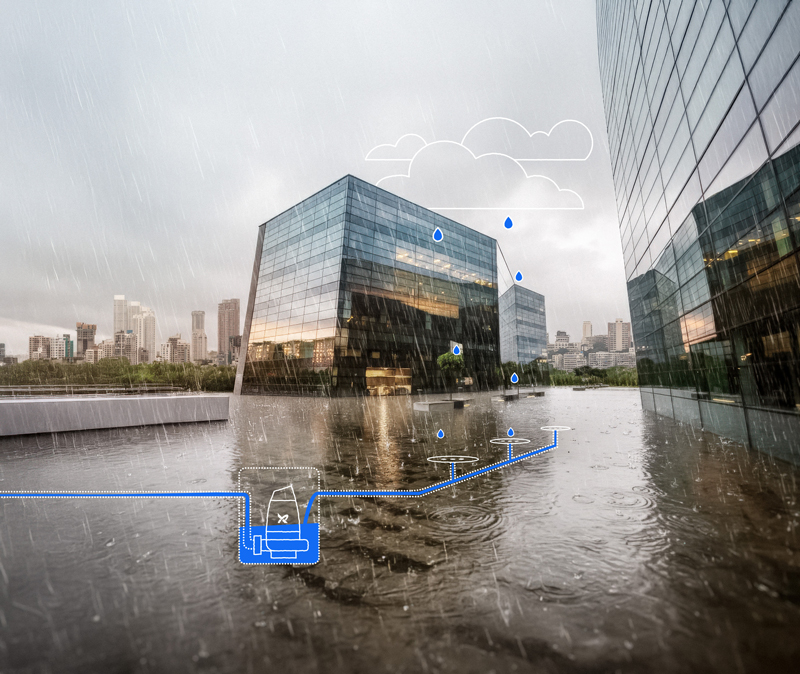
The UK has faced one of the wettest starts to a year since records began, with parts of the country experiencing more than fifty consecutive days of rainfall1 and twenty-six UK weather stations breaking rainfall records in January2.
With rainfall across the UK remaining persistent into March, commercial buildings are under growing pressure to cope with prolonged and often sudden inflows of rainwater. As extreme weather events become increasingly frequent, traditional drainage and wastewater systems – many designed decades ago for more stable weather patterns – are struggling to keep pace.
For this reason, global leader in advanced pump solutions and water technology, Grundfos, is urging businesses across the UK to take action, because the climate of the future requires smart solutions today.
Commercial buildings increasingly at risk
Glynn Williams, Senior Area Sales Director for UK & Ireland, Grundfos Commercial Building Services, says the scale and consistency of this winter’s rainfall is exposing longstanding structural vulnerabilities.
“Commercial buildings across the UK are facing conditions far beyond what many legacy drainage and wastewater systems were designed for. Heavy rainfall, rising groundwater and more frequent extreme weather events, magnified by rapid urbanisation and sealed surfaces, highlight the urgent need for modernised, resilient pumping and drainage solutions.
“Our role as a water and climate partner is to help customers strengthen their rainwater and wastewater management, ensuring their systems can manage sudden and sustained rainfall, protect building operations and maintain resilience as weather patterns continue to shift,” Williams says.
Grundfos research3 identifies commercial buildings as particularly vulnerable, as many house critical systems below ground, including electrical panels, HVAC systems and pump controls, making them susceptible to water ingress during heavy rainfall. Basements and rooftops frequently act as the first points of failure, and overloaded sewers can push water back into buildings through drains and vents.
To address these risks, Grundfos delivers intelligent pump systems, smart backflow protection, and high-efficiency drainage technologies designed to activate only when required, reducing both energy use and flooding risk. Rainwater now poses a greater risk to buildings than wastewater, with peak stormwater volumes often exceeding system design capacity by several multiples.
Grundfos calls for climate-ready water management
With modern cities depending on commercial buildings to keep daily life and business moving, Williams notes that this shift in weather patterns is accelerating demand for smarter, more efficient and more robust solutions that help buildings protect operational continuity during severe weather.
“Commercial buildings need strengthened drainage and pumping capacity to stay operational as extreme and prolonged rainfall becomes more common. We are supporting customers with integrated solutions that help manage sudden stormwater loads, reduce internal flooding risk and safeguard critical building functions.
Climate adaptation can no longer be something planned for the future – it must be prioritised today,” Williams concludes.
1 https://www.bbc.com/news/articles/c4g4dgr3p14o
2 https://www.metoffice.gov.uk/blog/2026/how-much-rain-have-we-had-in-february-and-winter
3 https://www.grundfos.com/content/dam/global/activity-assets/cbs/documents-and-cases/article/grundfos-commercial-buildings-wastewater-urban-flooding-article-2025-en.pdf
