


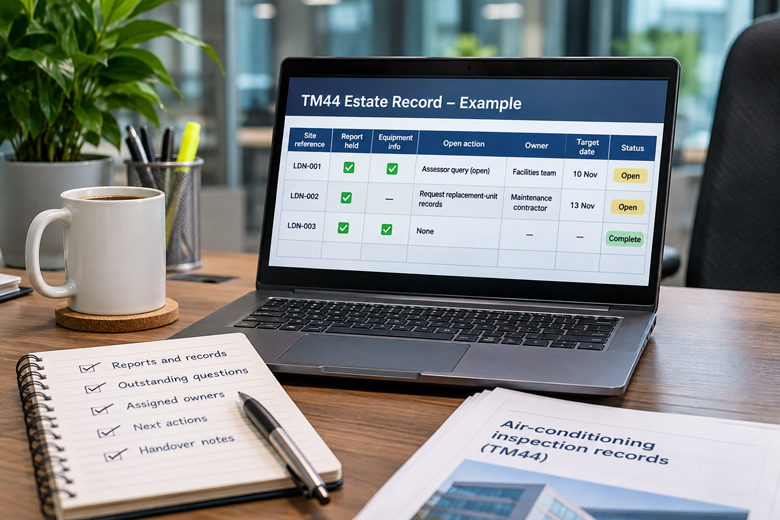
A shared register can help an estates team find its air-conditioning inspection records, understand what remains uncertain and give each follow-up a clear owner. Its value comes from the evidence behind each entry and how consistently the team maintains it.
Start with a record people can find
Give each building a stable site reference and nominate a person to coordinate its records. Store the complete inspection report in an agreed location, alongside relevant operating and maintenance information. Keep a link to the file in the register so a colleague can retrieve it without depending on one person’s inbox.
Government guidance for England and Wales explains that inspection reports should be kept securely and made available for subsequent inspections or a change of owner or manager. It also highlights the importance of providing available system documentation to the energy assessor before the visit. Scotland and Northern Ireland have separate requirements.
Separate documents held from questions resolved
Avoid using a single tick to represent several different tasks. A more useful register distinguishes between a report received, its building reference checked, the equipment information available and outstanding questions sent to the appropriate person.
For example, an entry might read: “Report held; building reference checked; replacement-unit records requested from the maintenance contractor; assessor query open.” This is a suggested administrative example, not a technical judgement about that building.
Keep uncertainty visible. If the team cannot identify which report relates to a site, record that question and the next step. Do not fill a blank field with a guessed date or assume that an older equipment schedule describes the current installation.
Give every open item an owner
A workable action record needs only a few fields: site reference, question or missing document, person responsible, target date and evidence of completion. The owner should be someone able to obtain the information or arrange the next conversation.
Use precise actions such as “request the complete report from the previous managing agent” or “ask the assessor which equipment records are needed”. These are easier to close than a general instruction to sort out compliance. When an answer arrives, retain the supporting reference and update the status.
Prepare the visit with the people who run the building
Ask the assessor what information is needed and agree access arrangements with the site team. Identify the contact who can explain operating schedules or obtain relevant building-management-system records. Share known restrictions and induction requirements before attendance.
Preparation should use existing information. An administrative worksheet is not a reason for staff to remove covers, operate unfamiliar controls or enter restricted areas. Keep door codes, alarm details and other sensitive security information out of a widely shared register.
Keep the handover active
After the report is delivered, store the complete version, record any assessor clarification and assign the next actions. Distinguish an action that has been allocated from one that has been completed with evidence. If responsibility changes, include the record location and unresolved questions in the handover.
An estates team can then review exceptions rather than repeatedly rebuilding the same file. The register remains an administrative tool: inspection scope, technical findings and building-specific requirements need the appropriate professional assessment.
Practical resource: TM44.uk’s estate-record worksheet provides a starting point for organising site information and open actions: https://tm44.uk/estate-compliance-snapshot
Official reference for England and Wales: https://www.gov.uk/government/publications/air-conditioning-inspections-for-buildings/a-guide-to-air-conditioning-inspections
