


Brendan Carroll – CEO EpiSensor
An Energy Savings Opportunity Scheme (ESOS) assessment is only as good as the 12 months of data behind it. On many estates, that data still includes supplies billed on estimated reads and large loads hidden behind a single main meter. Your assessor then has to apportion consumption that nobody measured, and every estimate needs a written justification. Fitting sub-meters and energy monitoring on the biggest loads now means significant consumption is measured rather than apportioned when the audit starts.
The Phase 4 qualification date is 31 December 2026. You still have time to change what your reference period captures.
Which 12 months will your Phase 4 numbers come from?
ESOS works with two data windows, and Phase 4 sets rules for each. Your total energy consumption needs one 12-month reference period, applied to every fuel your organisation uses, transport included. That period must include 31 December 2026 and end before the compliance date of 5 December 2027.
Read those limits closely and a useful margin appears. A reference period from 1 December 2026 to 30 November 2027 still complies, so meters commissioned in November can feed it with measured data.
Audit data follows separate rules. It must cover 12 consecutive months, measured in kWh rather than cost, and end on or before the compliance date. The period also can’t start more than 24 months before the audit itself, and you can’t reuse months that supported audits in Phase 3 or any earlier phase. An assessor who starts work in spring 2027 will need earlier data, so check now whether your current records cover your significant consumption.
Where estimates weaken an ESOS assessment
The Phase 4 guidance asks you to base the assessment on verifiable data, such as invoices and meter readings, wherever reasonably practicable. Estimates are allowed, but each one needs a recorded method in your evidence pack and a notification to the scheme administrator. Most estimates come from the same few weak points.
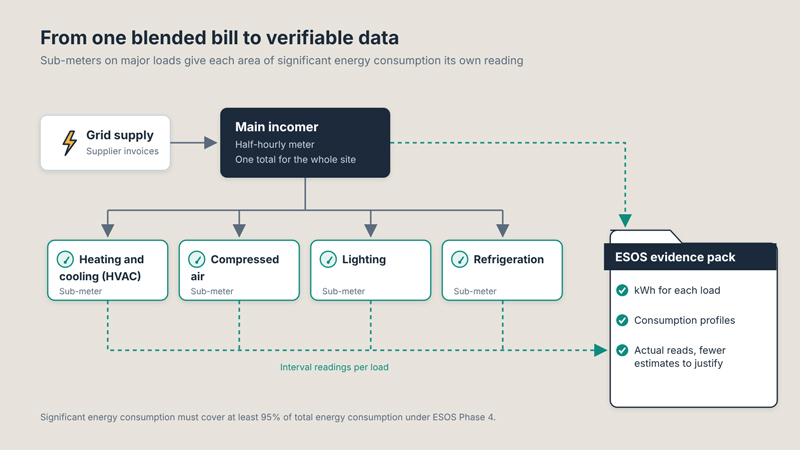
The diagram below shows how sub-meters on major loads turn one blended figure into separate records an assessor can verify.
Diagram of a commercial site’s main incomer and sub-meters on major loads, with data flowing into an ESOS evidence pack
Supplies billed on estimated reads
An estimated bill carries straight into the assessment as an estimate. Ask your supplier or meter operator for actual reads on every affected supply, and request half-hourly data wherever the meter records it. The guidance lists smart and half-hourly meter data as verifiable, so each supply you fix this way leaves one less estimate to justify.
A 95% boundary drawn from guesswork
Your areas of significant energy consumption must cover at least 95% of the total, which leaves no more than 5% as de minimis consumption you can exclude. The guidance lets you draw that line by site, asset, activity or fuel.
The trouble starts when the chiller plant and the air compressors share one incomer with the rest of the building. You can apportion the split, but you can’t show it. A sub-meter on each large load replaces the apportionment with a reading.
Consumption profiles you can’t build
Section 8.5 of the guidance expects energy consumption profiles where appropriate: a breakdown of how an asset’s energy use changes over time. Monthly bills can’t produce one.
Interval data from a half-hourly meter or a sub-meter can, and it shows the out-of-hours load that a monthly total hides. If you skip profiling, you have to notify the administrator and explain the method you used instead.
A data check to run before 31 December
Five checks close most data gaps before an assessor ever sees them. Each takes days now and far longer once the audit is under way.
1. List every supply. Record each meter point administration number (MPAN) and meter point reference number (MPRN), plus every other fuel, transport included, so the total has no missing lines.
2. Flag estimated reads. Mark every supply billed on estimates in the last six months and chase actual reads for each one.
3. Map significant users to meters. Match every large load inside your 95% to a meter that records it alone, and plan sub-meters where none does.
4. Recalculate intensity ratios. Your Phase 3 ratios are the expected baseline, so keep the same basis (for example, kWh per m² of gross internal area) and record any change with its reason.
5. Build the evidence pack as you go. Store invoices, reads and estimate methods together, because the pack has to be kept for the next two compliance periods.
Wrapping up
If most of your significant consumption already sits on half-hourly or sub-metered supplies, your assessor can start on the data you hold. If it doesn’t, fix the metering before December. The reference period will then run on measured data, and your evidence pack will carry far fewer estimates to defend.
