


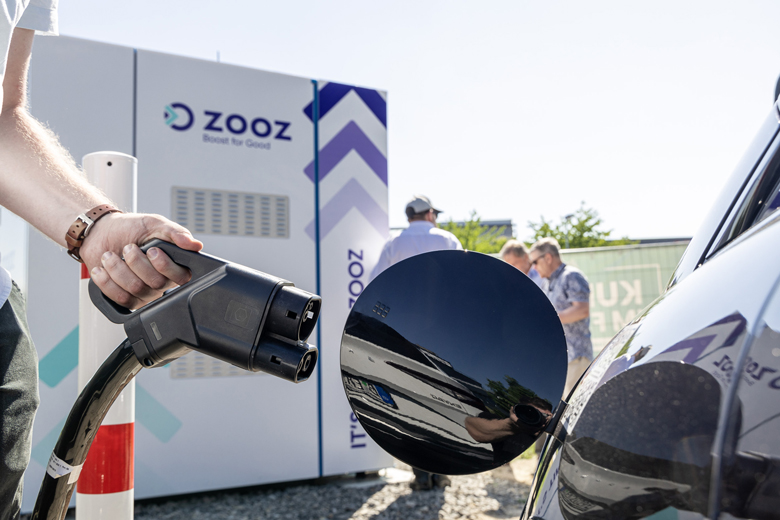
EVs are more efficient and more sustainable than combustion engine vehicles but public charging infrastructure often fails to deliver the short, convenient charging sessions that people expect, hampering their adoption. Limitations within the grid are often the problem, however flywheel technology can provide an intelligent solution.

Author: ZOOZ Power, VP Product, Udi Tzuri
As the number of EVs hitting the roads increases – another 815,399 in the first half of this year in Europe alone1 – charging infrastructure needs to catch up. The European Commission’s target is for 3.5 million by 20302, and the EVs that will be plugged into them will contribute to the 60% increase in electricity consumption within the same period3, and this will necessitate investments of around €584 billion in the grid3.
The scale of the investment is huge, and whether it can be delivered on time is another issue. The challenges are mirrored in many other locations around the world – California’s grid alone needs $50 billion by 20354 simply because it wasn’t designed with EVs in mind. So until upgrades can be rolled-out, which often means waiting years, EV drivers can experience slower than expected charging because the local grid simply can’t supply enough power to meet peak demand.
With the urgent need to rapidly expand public charging infrastructure and provide a reliable fast-EV charging experience ahead of grid upgrades, a flywheel power booster named ZOOZTER-100 is the ideal solution for this challenge. This kinetic power booster bridges the gap between the growing demand for ultra-fast charging and the constraints imposed by the grid. ZOOZTER-100 has already been installed at sites in the UK, US, Germany, and Israel, and additional installations are planned in other countries.
ZOOZTER-100 features our patented flywheel technology at its core. The system draws power from the grid at idle times and converts it to kinetic energy by running the flywheel up to 17,000rpm. When an EV is connected to the charger, the stored energy is converted back into power which boosts the grid, so that the EV receives the combined output of both. This approach enables the charger to operate at peak capacity. At our most recent installations in Germany, such as in Reiskirchen and Weiterstadt, a single ZOOZTER-100 at each location successfully doubled the available power to 200 kW in Reiskirchen and increased it to 350 kW in Weiterstadt.
The ZOOZTER-100’s Energy Management System (EMS) optimizes energy use at charging stations by managing power flow between the grid, ZOOZTER, and EVs. It dynamically adjusts distribution based on real-time demand and availability, maximizing efficiency, reducing charging times, and preventing grid overload. With predictive algorithms, the EMS enhances operational efficiency, supports grid stability, and ensures cost savings for charge point operators (CPOs).
The combination of all these capabilities enables (CPOs) to commission new sites in a relatively short time, without the high capital expenditure, lead times and disruption of grid enhancement, allowing them to quickly generate revenue and support the profitable long-term rollout of ultra-fast charging infrastructure. A single ZOOZTER-100 can support multiple charge points and takes up little space on-site.
Another benefit is that the units can be easily relocated in future to new sites that need boosting. These advantages are amplified in locations where very few chargers currently exist: not only do they have great future potential but are also key to the transition from ICE to EV by complementing – and then superseding – traditional filling stations.
Sales of new combustion engine vehicles will be banned in Europe from 2035, and by that date, adoption of EVs is estimated to have saved net CO2 emissions of around 2 Gt.5 But with public charging infrastructure being one of the most commonly cited reasons for consumers hesitating to make the switch from combustion engine vehicles to EVs, it is essential that everything possible to ensure that they have the confidence to do so, and that means ensuring that fast chargers can deliver the short charging times that consumers expect. The grid upgrades will come, but until they do, we offer a highly energy efficient, robust, and sustainable solution.
The transport sector in Europe is responsible for around a quarter of the region’s total greenhouse gas emissions6, and of those, three quarters come from road vehicles6. Electric vehicles are fundamental to reducing that share and enabling countries to meet their new-zero targets by 2050.
3 https://ec.europa.eu/commission/presscorner/detail/en/qanda_23_6045
4 https://docs.cpuc.ca.gov/PublishedDocs/Efile/G000/M508/K423/508423247.PDF
5 https://www.iea.org/reports/global-ev-outlook-2024/outlook-for-emissions-reductions
This article appeared in the October 2024 issue of Energy Manager magazine. Subscribe here.
