




With pilot projects planned to progress a data sharing infrastructure for the UK’s energy system – a ‘digital spine’ – Daniel Mardapittas, Market Strategist from Powerstar considers how businesses can harness the power of data and digital twins to inform their own Net Zero journey.
In January, the ESO signed a Memorandum of Understanding with the National Digital Twin Programme, and funding is secured to create a connected digital twin of Wales’ energy transmission and distribution network. The positive government response to the Digital Spine Feasibility Study[1], indicates an impetus to decarbonise the Grid by 2030[2]. Data and digitisation have a critical role, as highlighted in the government response,
“A decarbonised, flexible, and secure energy system needs to be managed in a modern, dynamic and accurate manner… a complex energy system will require access to trusted data, and new digital infrastructure.”[3]
This summer techUK launched a research projectexamining emerging business models and the economic impact of digital twins.[4] Nationally, the role of digital twins and the vital importance of data to the energy transition is recognised.
Businesses can reap immediate benefits while looking to the UK-wide 2050 Net Zero target: through microgrid technology and AI-driven energy data management, using a digital twin to justify investment. Crucially, companies can stagger implementation – commissioning individual assets, each designed for better power resilience and more flexible, affordable power while contributing to sustainability strategies.
Microgrid implementation is a major project, but the market is growing exponentially – global estimations of USD 37.6 billion this year, projected to grow to nearly $88 billion by 2029.[5] In the UK, the promise of a new industrial strategy demonstrates government commitment to meet clean energy targets.[6] For businesses, investing in microgrid technology can help provide area-wide power resilience; lower emissions through improved energy management, and reduced energy spend through access to better data.
At the heart of a microgrid is a Battery Energy Storage System (BESS), to maximise on-site renewable assets and – if incorporating Uninterruptible Power Supply (UPS) – provide essential power for short-term disruptions. This offers power resilience, while helping reduce emissions and energy spend. A modern BESS with UPS is far more efficient than traditional alternative – for one Powerstar client, switching to a modern BESS reduced spend by £225,000 p.a. saving 190 tonnes of CO2 emissions. With more distributed energy sources and intermittent generation, the capability to store on-site generated renewable energy makes a BESS a valuable asset for a resilient Net Zero pathway.
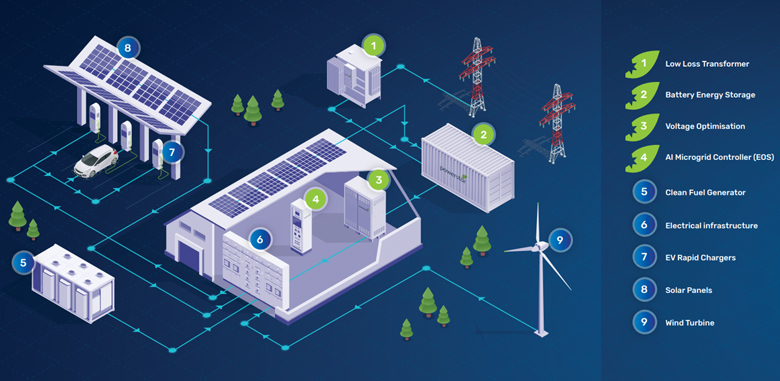
Data management is critical to the UK’s 2030 Grid decarbonisation ambition. For businesses considering a microgrid, accurate data is crucial. A neural network-based, AI-enabled microgrid controller – an Energy Management System (EMS) such as Powerstar’s proprietary Energy Optimisation System (EOS) – provides precise control, dynamically integrating energy technology assets, and forming a cohesive energy infrastructure network. The EMS continuously monitors load profile, allowing for strategic real-time planning and optimal performance across a combination of energy sources: Grid or on-site generated power. Intelligent decision-making, across all connected assets, allows changes, faults and disruptions to be detected and responded to in real-time, providing the data to help energy managers pinpoint areas of weakness / cost / unnecessary emissions. AI-driven software learns, based on automated data collection, and sensors and equipment across a site provide real-time information, enabling the EOS to actively learn: the more data, the more assets connected, the better the system performs.
There is a strong economic case for the growth of digital twins: any business needs confidence in Net Zero-driven infrastructure investment. Advanced modelling and simulation – a digital twin – can envisage a multitude of scenarios, enabling companies to establish the business case. New energy solutions can be mapped onto existing energy infrastructure profile prior to commissioning. Data allows for stress-testing: evaluating technologies across a host of conditions, whereby potential issues are identified at the design stage.
With a governmental will to decarbonise, businesses need to demonstrate clear Net Zero commitments. Companies can take incremental steps – starting with BESS, with the potential to grow later to a full microgrid solution – while digital twinning proves return on investment.
Fintan Slye, Executive Director of ESO commented at the 2024 Energy UK conference,
“Great Britain has made incredible progress in decarbonisation but there is still a huge amount for us to do to achieve Clean Power by 2030 and a net zero economy by 2050… we are committed to playing our part, but it requires all of us to do things differently, to act together and to act with urgency now.”[7]
Contact:
[1] https://assets.publishing.service.gov.uk/media/66bdd1600a079b65ea323e5f/digital-spine-feasibility-study-full-report.pdf
[2] https://assets.publishing.service.gov.uk/media/66bf20d2a44f1c4c23e5bd10/government-response-to-the-digital-spine-feasibility-study.pdf
[3] Ibid. p4
[4] https://www.techuk.org/resource/techuk-launches-major-study-on-the-future-of-digital-twin-technology.html
[5] https://www.marketsandmarkets.com/Market-Reports/micro-grid-electronics-market-917.html?utm_source=Stone+Junction&utm_medium=Opinion_piece&utm_campaign=KAT118_Flexibility+in+energy&utm_id=KAT118&utm_content=Earned
[6] https://www.businessgreen.com/news/4362799/build-rachel-reeves-promises-industrial-strategy-turbocharge-green-growth?utm_campaign=BusinessGreen%20Newsletters&utm_medium=email&_hsenc=p2ANqtz-9vd3dw4Kkhj3T6bpsMr3K7_CwuFzanGPZhj31VEyGmCA4iEEcluUaDefPACc0sQc2jpZ15hYjQ846k0rMUICKwFJf_XKXS-pRkN0ij1KMeCsaP5Cw&_hsmi=95439420&utm_content=95439420&utm_source=hs_email
[7] https://www.nationalgrideso.com/news/clean-power-2030-achievable-fintan-slye-executive-director-eso-addresses-energy-uk-conference
This article appeared in the October 2024 issue of Energy Manager magazine. Subscribe here.
