



What happens when 55 million people experiences total grid failure? “I briefly re-entered the pre-internet age” explains David Innes-Edwards, MD of Frontier Public Relations. This is his 12-hour diary of the Iberian blackout.
I am (just) old enough to remember pre-internet adult life, but it took the great Iberian blackout on 28th April to make me realise how dependent digital services now are on the electrical grid.
I’m fortunate to occasionally work remotely in Lisbon, Portugal’s beautiful capital city, where my wife is currently living and working.
Monday mornings at Frontier PR tend to be a series of planning meetings with staff and our clients, and I was partway through a Teams call when the power and internet suddenly went down.
Annoying and unusual, yes, but unheard of? No. It was 11.33am.
Within minutes, my wife confirmed, via WhatsApp, the same situation further across the city, moments before the messaging service collapsed – along with any remnants of my phone network connection.
This felt more unusual. It was 11.52am.
I walked up to the seventh-floor roof terrace of my coworking building and looking down I witnessed a well-meaning pedestrian trying valiantly to direct gridlocked traffic.
Fellow coworkers confirmed that this wasn’t just a Lisbon problem, but Portugal wide, and probably beyond.
I had a full charge on my laptop and phone, but there was no way of connecting to the internet, so I couldn’t use either to communicate.
For the first time in my ‘internet life’, myself, and everyone around me, were totally digitally disconnected.
No email. No way of making a phone call. All smartphone apps were useless.
I couldn’t let my clients, staff or family know what was going on or even contact my wife less than three kilometres away.
Slowly walking back to our apartment, I started to realise the enormity of the situation.
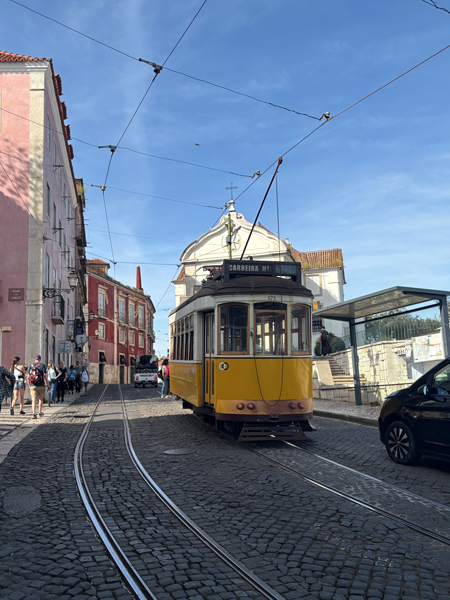
Metro trains were stuck between underground stations, the airport was closed, and even the famous yellow Lisbon trams stood, stranded at the point where the power failed – stoically guarded by their very bored-looking drivers.
Calling in a local grocery shop, I also realised we were back in a cash-only economy – but with no access to cash.
Electronic point of sales terminals were now redundant, and ATMs depend on continuous power and network links to banking systems.
I subsequently discovered that without a sizeable UPS (Uninterruptible Power Supply) or backup generators, most ATMs power off within seconds of losing mains electricity.
I decided to keep the €18 I had in my pocket and just go home.
It was now 1.25pm.
On arrival, my wife and neighbours informed me Spain was also down. What had happened?
As we all consumed media via digital cable TV, streaming services, and apps, we had no access to news or any way of knowing what was going on.
There were false rumours that Italy and France had also gone down. Was it a cyber-attack or even terrorism? One neighbour blamed Putin. All the Portuguese blamed Spain.
I would later learn that the cause was more mundane. Dense clouds over parts of Spain had cut 10GW of solar power in less than 2 minutes, triggering emergency protection systems.
These then automatically tripped several high-voltage transmission lines which isolated entire regions.
A lack of available gas or hydro power meant that dispatchable electricity was unable to ramp up quickly enough to compensate for the sudden drop in renewables.
In short, I couldn’t work, catch an Uber, or even phone my Mum, because it was unexpectedly cloudy in Spain!
By 6pm, power in parts of Spain and Portugal had started to return, but we had no way of knowing that.
Lisbon was still blacked out, and by 7pm, sat by candlelight, we resigned ourselves to our fate and opened a decent bottle of red wine.
11.30pm. Eureka! The power returned, and even though it had only been down for 12 hours, it had felt a lot longer. As the blackout dragged on, I was left wondering: what if? What if this lasted a few days? Or a week? What then?
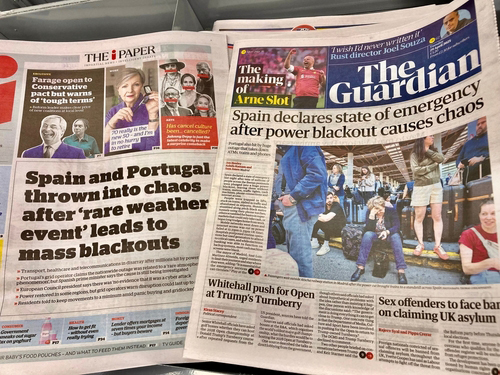
It brought it home to me that there will be unknown consequences as we transition to renewable sources of electricity, and although I’m sure big lessons have been learned, this will undoubtedly happen again somewhere, and we should be ready both at home and at work.
My reaction? I have bought an old-fashioned analogue radio and stashed it in a box with £100 in cash, a rechargeable lamp, powerpacks and candles (plus another good bottle of red – optional).
David Innes-Edwards is the Managing Director of Frontier Public Relations, a business-to-business PR consultancy specialising in the built environment.
