




Electrification of transport is critical if we are to meet net zero and – despite government plans to roll back on EV sales targets – there is increased funding to support businesses and public sector organisations switch to EV. But what happens if you don’t have the energy infrastructure to support this? James Hampshire, Principal Engineer at Powerstar, looks at latest funding support and explains how Battery Energy Storage can drive sustainability.
Supporting the energy transition
The Grid requires significant improvement to meet electrification demands. Transport poses a problem: it’s the UK’s highest-emitting sector, with cars and light vehicles making up 70% of these emissions[1]. There are now an estimated 2 million EVs on the roads in the UK,[2], and NESO forecast that EV demand for electricity may reach 60 TWh per year by 2035[3]. The UK’s high energy prices can hinder businesses’ investment in electrification generally, and particularly in decarbonising vehicle fleets. Government support can be critical to make the move to EVs viable.
£1 billion new funding and increase to existing support
The government has signalled a continued commitment to decarbonising transport through an extension to the Workplace Charging Scheme, covering up to 75% of purchase and installation of up to 40 charging points for eligible businesses; increasing the cap from £350 to £500, and extending funding until next April. And, in March, the Department for Transport and the Office for Zero Emission Vehicles announced a £1 billion funding package to support businesses operating trucks and vans. This includes up to £81,000 towards purchase of large-scale zero-emission trucks; up to 40% funding towards purchase price for eligible electric HGVs; continued discounts for van purchasers of up to £5,000, and up to £1 million (up to 70%) towards charging infrastructure for eHGVs, coaches, and vans. The Depot Charging Scheme has also been boosted with a further £170 million.
This support is aimed at removing high upfront costs, but it doesn’t solve the critical issue of grid capacity, which hampers decarbonisation and impacts business confidence. Nearly 40% of businesses state that the grid doesn’t provide the energy supply, connectivity, and future-proofing they need[4]. Where companies are looking to invest in additional grid connection – when installing EV charging may take them over agreed capacity with their DNO – costs can be prohibitive, with protracted timescales and some firms reporting connection dates in the mid-2030s or later. In this context, to utilise current EV funding schemes, Battery Energy Storage (BESS) can offer a solution.
Energy storage for improved sustainability and greater flexibility
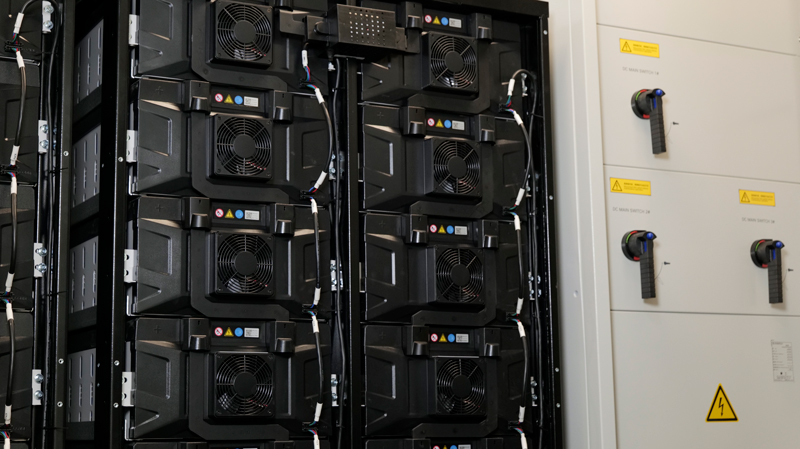
For EV charging, a BESS can reduce or totally mitigate the need for costly grid connection upgrades by buffering demand locally and discharging stored energy in the BESS to support charging during peak periods or low grid availability. Pairing the BESS asset with an intelligent Energy Management System (EMS) allows site operators to deliver higher charging power than the grid connection alone would support, without the time and expense of upgrading grid infrastructure. Flexible storage also helps manage exposure to charging costs, which is particularly valuable in today’s volatile energy market.
Where businesses have on-site renewable assets, a BESS stores energy as generated for use when most efficient or most needed, and can store grid energy purchased when prices are lowest – and generally less carbon-intensive – avoiding peak energy costs and improving sustainability. And engaging with grid payback schemes or Demand Side Response can provide a new income stream.
For one Powerstar customer – one of the UK’s largest telecoms companies, who wanted to electrify their fleet – an area where they operated was heavily grid constrained, meaning the network could not support the additional demand the rapid-charging facilities required. Installing a BESS has allowed the customer to electrify their fleet in a shorter time frame and at a reduced cost compared to increasing installed grid capacity. Optimising the site’s energy with Powerstar’s EMS allows better utilisation of flexible energy tariffs and has opened up a new revenue stream through grid contracts, while enabling rapid charging for their new EV fleet.
The UK faces significant infrastructure challenges if we are to transition fully to EVs. For businesses and organisations at any stage of their net zero journey, transportation is a major emissions contributor – hence the current funding. Grid constraints are an issue for the foreseeable future, making investment in BESS a compelling proposition for those looking to take advantage of government support, and to make the most of renewable assets while maximising savings on grid supply.
To find out more about how Powerstar help customers achieve their EV ambitions, contact us: www.powerstar.com E: info@powerstar.com T: 0114 257 6200
[1] https://www.energy-uk.org.uk/publications/ensuring-a-successful-transition-to-electric-vehicles/#:~:text=The%20Zero%20Emission%20Vehicle%20(ZEV,and%20van%20sales%20by%202035
[2] https://www.rac.co.uk/drive/electric-cars/choosing/road-to-electric/
[3] https://knowledge.energyinst.org/new-energy-world/article?id=139972
[4] https://www.britishchambers.org.uk/wp-content/uploads/2026/02/BCC_BRO9891_ENERGY_BILLS_V4_DIGITAL_compressed.pdf
This article appeared in the July/August 2026 issue of Energy Manager magazine. Subscribe here.
