


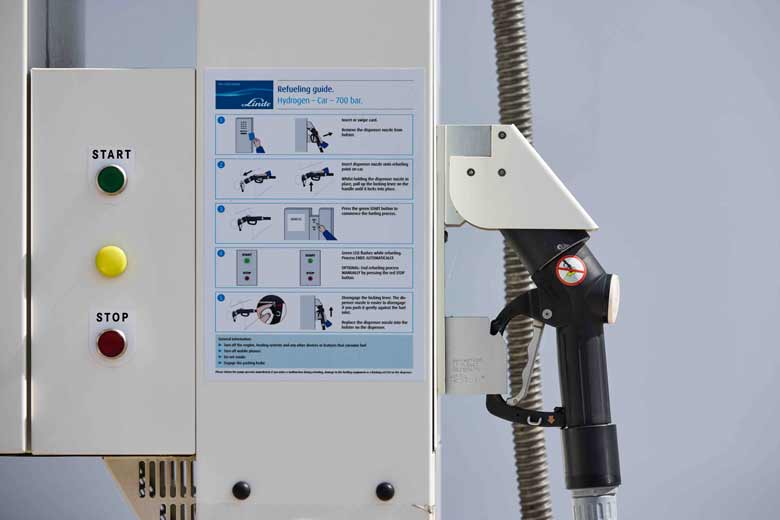
An innovative project sees Powerstar, leaders in power resilience, collaborating with Motive Fuels to explore the commercial potential for e-hydrogen in the construction sector.
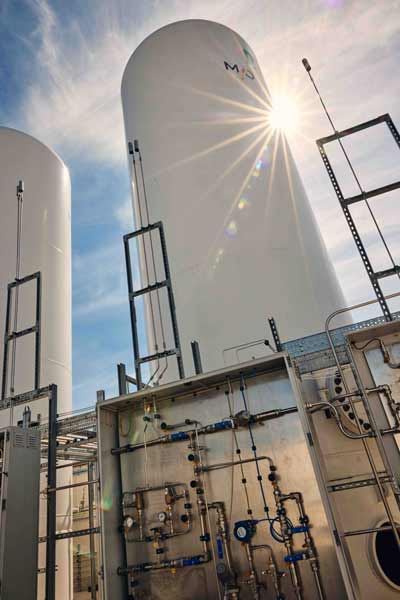
Motive Fuels have been successful in securing funding under the Red Diesel Replacement (RDR) competition funded by the UK Government’s Department for Business, Energy & Industrial Strategy. This will support Motive and their project partners to undertake a feasibility study and a front-end engineering and design (FEED) study for the building of an e-hydrogen production site powered by wind generation at BAM Nuttall’s site at Shipdham, Norfolk.
The impact on the construction industry of the removal of rebated red diesel is significant, both on costs and on cash flow. Red diesel attracted a rebate of 46.81 pence per litre (ppl), meaning an effective duty rate of 11.14ppl. With no rebate, DERV – white diesel – has a duty rate of 57.95ppl. A switch from red to white diesel, then, means an additional 46.81 pence on every litre of fuel used. The construction industry’s reliance on rebated red diesel is evident from headline emission statistics, as detailed in the Climate Change Committee’s Sixth Carbon Budget[1]. Non-road mobile machinery (NRMM) accounts for 15% of all UK diesel usage and 77% of current emissions from NRMM come from construction, with a further 12% from mining.
As part of the UK’s overarching Net Zero Innovation Portfolio, the BEIS Red Diesel Replacement competition represents £40million of grant funding to support the construction, mining and quarrying sectors, working towards the UK’s commitment to achieve net zero by 2050. This 2-phase funding will support the development and demonstration of low carbon fuel and system alternatives to red diesel for these high-impact sectors, aimed at decreasing the costs of decarbonisation.
The first phase of BEIS funding provided c£6.7million to 17 projects at technology readiness level (TRL) 4 and above. Motive, working with their partners Powerstar, BRE, Cenex and BAM, will provide design outputs, cost estimates and the safety case for e-hydrogen to be produced at scale for local distribution to the construction sector – the elements which are most critical in establishing the commercial viability of green alternatives.
A spin out of energy storage and clean fuel company ITM Power, Motive owns and operates a portfolio of 7 Hydrogen Refuelling Stations (HRS) assets, making it the largest HRS in the UK. James Cross, development manager at Motive, comments on the company’s success in winning funding,
“Our development of and investment in green hydrogen technology means we are perfectly placed to explore solutions to the challenges facing construction as it works to achieve net zero. A truly zero emission fuel, green hydrogen is generated using renewable energy and water, and the only by-product of hydrogen fuel is water. As a hard to decarbonise sector, construction is an obvious area where our expertise in green energy sources can help industry meet the UK’s climate change and air quality targets.”
One of the package leaders for the project, Powerstar will provide a range of outputs to inform the viability of this feasibility and FEED study. As leaders in the field of power resilience and energy solutions for net zero, Powerstar will play a vital role in establishing the feasibility of a commercial alternative to red diesel. They have an unrivalled capability to model the multiple power flows that exist in a behind-the-meter microgrid installation and work with commercial and industrial organisations across the UK to ensure that proposed changes to any on-site power systems work effectively, will deliver the assumed returns, and that the necessary permissions required can be achieved.
For this RDR project, Powerstar will undertake a full design study and simulation study. The critical element, here, is to de-risk the potential red diesel replacement solution. Powerstar will be looking at life cycle analysis and asset degradation, undertaking Failure Mode and Effects Analysis (FMEA) for the operation, and supply, wind and Battery Energy Storage (BESS) optimisation and sizing analysis. Undertaking FMEA from this earliest, conceptual, stage of the project will be a key element of the de-risking of the proposed solution. This will test the feasibility of introducing renewable wind energy and battery storage to enable the installation at BAM Nuttall to reduce their energy demand from and reliance on the Grid, while lowering both CO2 emissions and electricity costs. Solon Mardapittas, Chief Technical Officer at Powerstar, highlights the question of risk that is crucial to the feasibility study,
“A major risk in green hydrogen production is electricity cost. When looking to develop a commercially viable alternative to red diesel, especially for a sector as competitive and as historically dependent upon this fuel, this is a critical consideration. The model that is core to Motive’s project eliminates the risk of uncertain costs by installing the power generation locally, as this will then be depreciated over the lifetime of the asset at known rates.”
Commencing this month, the feasibility and FEED studies for this wind-powered e-hydrogen production site are due to be completed within the next seven months. In helping to de-risk alternatives to traditional fuels while reducing costs, this project may prove vital in helping the construction industry meet its net zero commitments.
For more information on this project, or to find out more about clean energy and power resilience, please contact:
Powerstar: www.powerstar.com E: info@powerstar.com T: 0333 230 1327
Motive Fuels: https://motivefuels.com E: enquiries@motivefuels.com T: 0345 548 0107
[1] https://www.theccc.org.uk/publication/sixth-carbon-budget/