


The UK’s largest net zero carbon housing development is putting integrated energy and utility infrastructure at the heart of its approach. GTC explains how collaboration with Barratt Redrow is helping turn net zero ambitions into a practical, scalable reality.
A development with a bigger ambition
As the housebuilding industry moves towards increasingly ambitious carbon reduction targets, the focus is shifting from individual technologies to how entire developments can operate more efficiently.
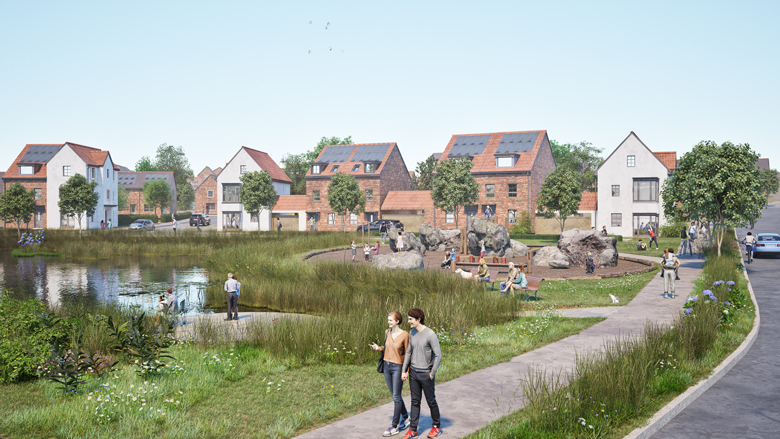
Cosmeston Farm in the Vale of Glamorgan provides an important case study. Being delivered by Barratt Redrow, the 576-home development is set to become the UK’s largest net zero carbon housing development, alongside a new primary school, extensive green space and active travel infrastructure.
This project demonstrates how the utility infrastructure behind a new development can play a much greater role in achieving its environmental ambitions.
GTC has been appointed to deliver the development’s Smart Home energy and utility infrastructure, bringing together heating, electricity, water, renewable generation, energy storage and smart controls as an integrated system.
Moving beyond the individual home
One of the key challenges in delivering low-carbon housing at scale is that technologies cannot be considered in isolation.
At Cosmeston Farm, a networked ground source heat pump solution is being deployed, using shared boreholes as a source of low-carbon heat. Each home will be fitted with a heat pump, alongside solar photovoltaic panels, battery storage and smart controls.
The result is an approach that looks beyond simply connecting homes to existing infrastructure. Instead, the infrastructure has been considered as part of the overall energy strategy for the community.
This distinction is increasingly important as electricity demand grows. Heat pumps, electric vehicles and other forms of electrification will place additional pressure on the electricity network, making the way energy is generated, stored and consumed within developments increasingly significant.
Making energy work smarter
The combination of renewable generation, battery storage and smart controls at Cosmeston is designed to help homes make better use of the energy they generate.
Solar generation can be stored in batteries rather than exported immediately, while smart controls can help manage when energy is consumed. In turn, this can help reduce peak demand and potentially enable residents to benefit from different electricity tariffs. This represents an important evolution in the role of utility infrastructure.
Rather than simply providing the connection between a home and the wider network, the infrastructure can become an active part of managing energy demand and improving the performance of the development.
The bigger lesson is that net zero housing requires an integrated approach, not simply a collection of low-carbon technologies installed independently.
Proving performance in the real world
An important element of the Cosmeston project is the emphasis on monitoring actual performance.
Data will be collected from the homes and infrastructure, including energy consumption and the performance of the heat pumps, solar PV, batteries and smart controls. This will provide an evidence base for assessing how the development performs once residents are living in their homes.
Cardiff University has also been appointed to independently assess and verify the performance data. That independent scrutiny is significant. The success of net zero housing ultimately cannot be judged solely by what is specified at design stage. It needs to be demonstrated through the experience and energy performance of occupied homes.
For the wider industry, developments such as Cosmeston could therefore provide valuable insight into the gap, if any, between designed and actual performance, and into which combinations of technologies deliver the greatest benefits.
A blueprint for future development?
Cosmeston Farm is significant not simply because of its size, but because it provides a real-world opportunity to test how integrated utility infrastructure can support the transition to net zero housing.
The lessons will be particularly relevant as the industry responds to the Future Homes Standard and wider pressure to reduce carbon emissions from new homes.
The challenge ahead is not necessarily about whether individual technologies are available. Heat pumps, solar panels, batteries and smart controls are already established technologies.
The greater challenge is understanding how these technologies can be designed, connected and managed as a single system – and how that system performs over the long term.
Cosmeston Farm provides an opportunity to demonstrate that infrastructure can be much more than a means of connecting new homes to existing networks. Properly integrated from the outset, it can become a fundamental part of how a community generates, manages and uses energy.
Ultimately, the success of net zero housing will be measured not by the technologies specified on a plan, but by how effectively they work together once people move in. Cosmeston Farm offers an opportunity to put that principle to the test.
