



Chris Bowden, founder and CEO of SQE (formerly Squeaky Energy)
Almost all energy procurement strategies across industrial and commercial (I&C) businesses are rooted in a world that no longer exists.
There was a time when the playbook was simple: stay compliant, drive incremental efficiency gains, and secure the “best price” through periodic tenders. It was a model built for stability, where wholesale markets moved within predictable bounds and risk could largely be managed through timing.
That world has gone.
From the COVID-19 pandemic to the war in Ukraine and now escalating instability in the Middle East, energy markets have been repeatedly disrupted. These are not isolated events, they are signals of a structurally more volatile era, and the idea that prices will “settle down” into a stable equilibrium is increasingly difficult to justify.
In August 2022, UK power prices reached a monthly average of £370/MWh, peaking at £571/MWh in a single day, before hitting record highs in September. At the time, this was seen as extraordinary.
But similar dynamics have already re-emerged. When tensions in the Middle East intensified, oil prices surged past $114 per barrel for the first time since 2022, with knock-on effects across global gas and power markets.
Volatility is no longer the exception, it’s the baseline and living in hope that markets will return to how they once were is not a strategy any energy buyer can fall back on.
Renewables are the foundation of stability
These repeated shocks are exposing a deeper truth than many people are willing to admit: energy security and the energy transition are not competing priorities.
Fossil fuel-based systems are inherently vulnerable. They depend on continuous extraction, transportation, and global trade, often through narrow and politically sensitive routes. When disruption occurs, the impact is far reaching.
Renewables change that dynamic. Once built, their operating costs are predictable and largely insulated from commodity price shocks. In a volatile world, that stability has real economic value.
The contrast across Europe makes that clear.
While many countries experienced sharp electricity price increases following recent geopolitical tensions, Spain has remained comparatively resilient. Since 2019, it’s doubled its wind and solar capacity – adding 40GW – and significantly reduced its reliance on gas-fired generation.
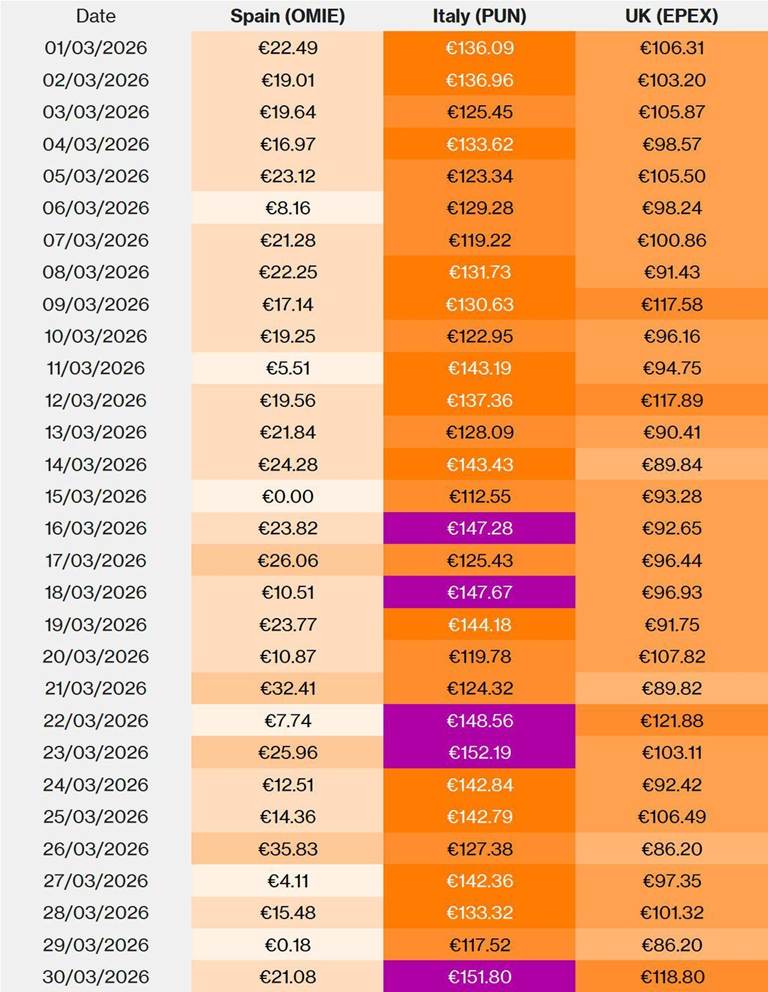
In marginal pricing markets like the UK, where gas often sets the price of electricity, this matters because when gas prices spike, the effect flows directly through to power prices.
From hedging to active load management
What this means at a system level is clear. The question for businesses is – how can they respond within it?
Hedging remains essential. Fixing prices in the forward market provides budget certainty and protects against extreme swings – it’s the foundation of any sound energy strategy. But it shouldn’t be the ceiling.
Smart organisations are now building on this foundation, treating their hedged position as a baseline, and layering active decision-making on top.
If a business can anticipate when short-term prices will spike, and it has the ability to reduce or shift consumption during those periods, it can effectively “sell-back” energy it no longer needs – capturing the difference between your hedged price and the higher market price.
This is where mechanisms like the GB day-ahead market, operated through the N2EX auction, become strategically important. The day-ahead price reflects what electricity will cost tomorrow, not what you agreed months ago, and for businesses with flexible contracts and operations, it provides a real-time signal.
Crucially, these buyers do not wait for prices to be published. Instead they use forecasting tools to anticipate market movements – tracking variables such as renewable generation, demand forecasts, gas prices, and system margins – which allows them to plan ahead.
Because operational decisions often require time, it’s often too late for a business to act if it waits until prices are confirmed.
But when it has the ability to forecast, it can position itself to take advantage. And when spreads between forward and day-ahead prices widen – as they often do during periods of stress – the financial impact can be significant.
This is how energy shifts from being purely a cost centre to something that can actively generate value.
What does it take to act?
This approach is not universal, but it is increasingly accessible. To implement it effectively, energy buyers must have three elements in place.
First, flexible load. Businesses need operations that can be adjusted within a day, whether that’s manufacturing processes, refrigeration, or large-scale energy systems. Where flexibility is limited, technologies like battery storage can play a role.
Second, the right contract structure. This typically means a flexible supply agreement with half-hourly settlement and the ability to vary consumption positions. Without this, participation is restricted.
Third, market intelligence. Acting without a clear view of likely price movements is not strategy, it’s speculation. Forecasting capability is essential to move from reactive to proactive decision-making.
It’s also important to be clear about what this approach is, and what it is not. This is not about a business exposing its entire energy position to volatile spot markets. The core demand remains hedged, providing price certainty.
What a business is doing here is selectively using flexibility to respond to short-term signals. In other words, capturing incremental value without compromising stability.
That distinction matters, particularly for those at board level. This is not a matter of increasing risk, it’s about managing it more intelligently.
Confidence without full capability
For many businesses, this level of market participation is still out of reach.
Research by SQE shows that 80% of energy buyers believe their current electricity supply arrangement is no longer suited to today’s market, with nearly a third strongly agreeing.
This gap is important, because it highlights that energy buyers recognise the landscape has changed, but most are still operating in structures that limit their ability to respond, or capitalise.
Notably, only 28% describe themselves as ‘very confident’ in managing wholesale price volatility.
The fundamental question should no longer be: how do I avoid the market? Instead it should be: does my contract allow me to participate in it?
Because a supply contract is not just a billing mechanism, it’s the framework that either enables a progressive strategy or blocks it. Too many organisations remain passive, treating volatility as something to endure rather than act on.
It can be hard to accept that disruption as the new norm. But the organisations that do – and build the capability to engage with it – will be the ones that come out ahead. Because in this market, inaction is not stability, it’s mounting risk.
This article appeared in the September 2026 issue of Energy Manager magazine. Subscribe here.
