


Europe’s electricity grid is under unprecedented strain. From the catastrophic Iberian Peninsula blackout that left 60 million people without power to substation fires that recently paralysed Heathrow Airport, the warning signs are mounting. As Britain races towards its 2035 target of 100% decarbonised electricity, a critical question emerges: how do we maintain grid stability whilst rapidly transitioning to renewable energy?
The answer lies in fundamentally reimagining how we manage and distribute electricity, with innovative battery energy storage systems proving transformational particularly when deployed at the grid edge where vulnerabilities are most acute.
The Perfect Storm of Grid Challenges
Britain’s electricity infrastructure faces a perfect storm. Approximately 40% of Europe’s distribution grids are over 40 years old, with the average UK transformer exceeding 60 years of age. This ageing infrastructure was designed for one-way power flow from large, centralised generators, not the bidirectional flows required by distributed renewable sources.
Traditional power plants provide crucial grid stability through inertia – the kinetic energy of spinning turbines that maintains the 50Hz frequency fundamental to grid stability. As renewables lack this stabilising effect, Britain’s grid becomes increasingly vulnerable to frequency fluctuations that can trigger cascading failures.
Recent events underscore these vulnerabilities. The 2019 UK blackout affected one million homes when both the Little Barford gas plant and Hornsea wind farm failed within minutes. Storm Arwen left nearly one million homes without power, with some enduring week-long outages. The Heathrow substation fire cost the UK economy an estimated £80 million in a single day.
As an island nation with limited synchronous interconnectors to continental Europe, Britain must largely solve these stability challenges independently. With asynchronous generation now reaching 66% of total UK generation, innovative solutions are urgently needed.
Beyond Traditional Thinking: Dynamic Flexibility
The conventional approach – throwing more infrastructure at the problem – is neither economically viable nor technically sufficient. The European Commission estimates €2-2.3 trillion will be needed by 2050 to upgrade European power networks, with nearly 80% required for distribution networks.
Instead, we need “dynamic flexibility” – a three-dimensional approach beyond traditional battery storage thinking.
The first dimension addresses grid service flexibility; how batteries replicate and enhance traditional stability services. Modern battery systems provide ultra-fast frequency response within milliseconds, delivering synthetic inertia and precisely controlling reactive power to maintain voltage stability.
The second dimension focuses on deployment flexibility – where and when storage is utilised. Unlike traditional grid infrastructure requiring years to build, advanced battery systems deploy as “drop and go” solutions, operational within minutes and strategically relocatable where grid support is needed most.
The third dimension enables network flexibility – transforming grid architecture. Rather than maintaining vulnerable centralised systems, battery storage enables interconnected microgrids capable of operating independently when necessary whilst working collaboratively during normal conditions.
The Grid-Edge Revolution
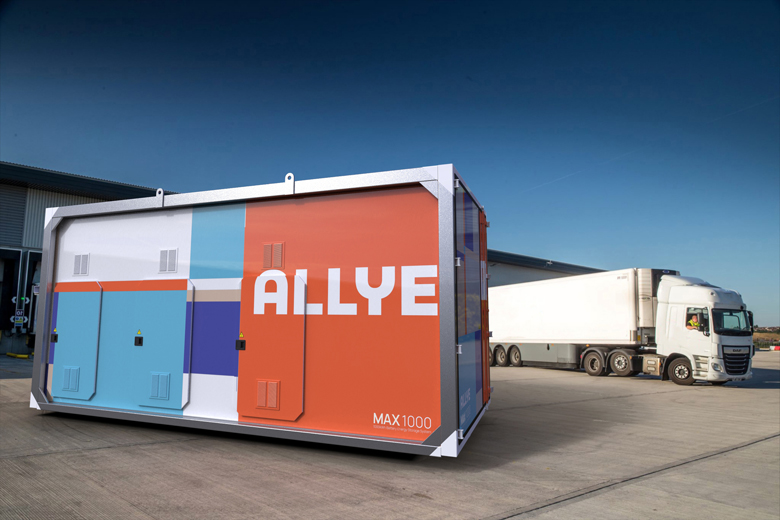
Allye Energy’s approach focuses on the grid edge – distribution networks where the greatest vulnerabilities exist – creating resilience close to communities and businesses where it matters most.
The recently launched MegaMAX range provides up to 1.5MWh of dispatchable energy with ultra-fast frequency response capabilities. These systems combine up to 18 repurposed EV battery packs with advanced AI-driven control systems, reducing embedded carbon by over 40% whilst providing industrial-grade reliability.
This approach creates a “network of networks” – interconnected microgrids with inherent redundancy. When one area experiences failure, it doesn’t cascade across the entire system. Each microgrid can isolate itself, maintain critical services, and reconnect once stability is restored.
Economic and Environmental Benefits
Grid-edge battery storage extends beyond reliability. These systems reduce energy costs by up to 50% whilst generating additional revenue through grid flexibility markets. Research suggests every pound spent on grid resilience today saves ten pounds in disaster recovery tomorrow.
Environmentally, the approach enables higher penetration of local renewable generation whilst reducing reliance on fossil fuel backup systems, accelerating the path to net zero whilst strengthening grid stability.
Building Tomorrow’s Grid Today
As Britain accelerates towards a renewable-powered future, the gap between clean energy ambitions and grid infrastructure capabilities will widen without decisive action. Countries embracing innovative grid flexibility approaches – particularly island nations like Britain – can transform vulnerability into leadership.
The technology exists today to bridge this resilience gap. What’s needed is collective commitment to reimagining energy infrastructure, supported by regulatory frameworks that properly value resilience and investment models recognising the multi-dimensional benefits of advanced battery storage.
Modern society depends on electricity flowing as reliably as oxygen. The time has come to ensure our grid infrastructure can breathe easily in a renewable-powered future.
This article appeared in the June 2025 issue of Energy Manager magazine. Subscribe here.
