


Energy managers get pitched “the answer” every week. Heat pumps. EVs. Insulation. Solar. Wind. Nuclear. CCS. Hydrogen. Each comes with its own unit, its own jargon, and its own sales curve. That makes it hard to test whether a plan is balanced, or whether it relies on a few wishful assumptions.
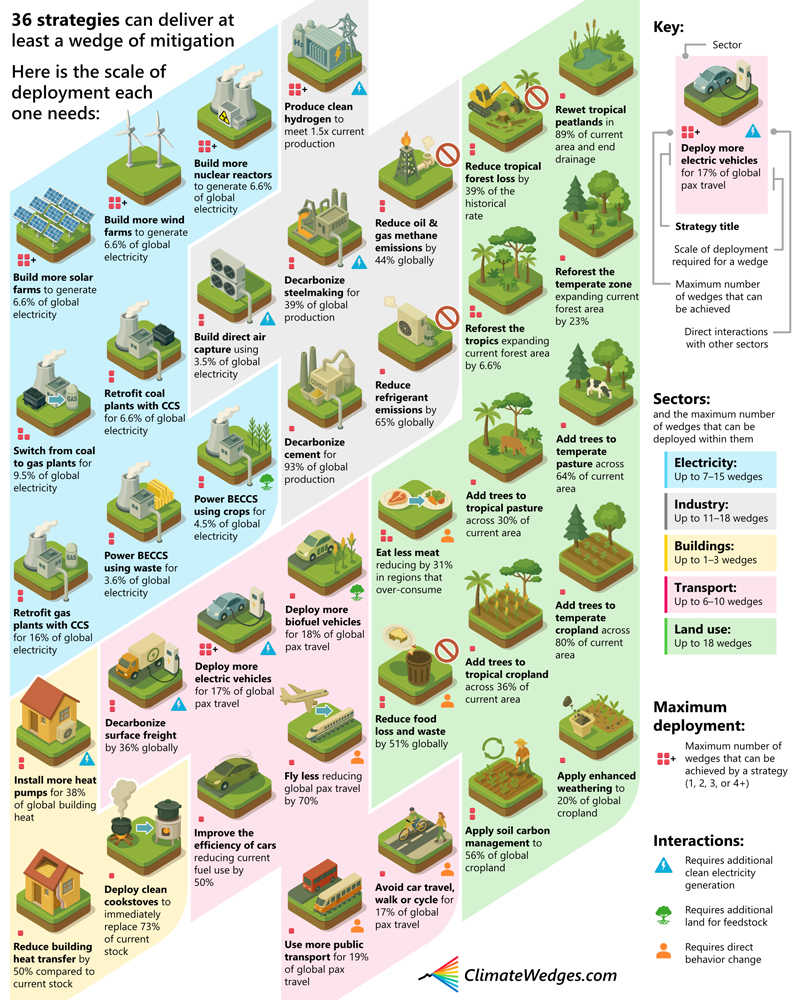
A new peer-reviewed research paper published in Science offers a simple fix: compare options using one common unit, then debate the trade-offs in plain view. The paper defines a “wedge” as a package of action that scales up from 2020 and avoids 2 billion tonnes of CO₂ equivalent per year by 2050. One wedge is the same climate outcome whether it comes from a building retrofit or an energy megaproject. The accompanying climate wedges website, is free and lets anyone build their own portfolio and see the implied scale of delivery.
Dr Nathan Johnson from Imperial College London puts the problem plainly: “Almost everything humans do contributes to climate change, meaning there are countless ways to reduce our impact. I can put solar panels on my roof, eat less meat, buy rainforest alliance certified products, or fly less.”
One unit, clearer arguments
A wedge does not tell you what to pick. It gives you a sanity-check. It helps you spot hidden dependencies, and compare options that normally sit in separate silos. It also shows why mixes matter. Some wedges compete for clean electricity, land, biomass, materials, workforce, or grid access. Some wedges also reduce the “space” for others. For example, insulation cuts heat demand, so the effect of adding heat pumps on top is smaller than a simple sum.
Dr Johnson frames the purpose like this: “People should have agency over how they live and what they vote for, but must be able to compare options to do so”.
What one wedge asks of eight familiar options
Below are eight wedges that show why “apples to oranges” comparisons break down, and why the delivery challenge differs across technologies.
- Solar power: One wedge means generating about 2,840 TWh of electricity per year in 2050, about 6.6% of global supply. The core trade-off is integration. Output follows daylight, so grids, flexibility, and storage carry more weight than the panel itself.
- Wind power: One wedge is the same electricity outcome as solar: about 2,840 TWh per year in 2050. The constraints differ. Siting, permitting, and grid connection shape pace and cost. Variability also shifts attention to system balancing and demand-side flexibility.
- Nuclear: One wedge again means about 2,840 TWh per year in 2050. The value is firm low-carbon power. The trade-offs sit in delivery risk, capital intensity, and long project timescales, plus governance, safety, and waste management.
- Heat pumps: One wedge means heat pumps supply about 5,050 TWh of heat per year in 2050, about 38% of global building heat. The wedge depends on clean electricity too. The definition implies about 1,300 TWh per year of additional clean power, around 0.4 of a “power wedge”. Fabric, controls, peak demand, and installer capacity set the real speed limit.
- Insulation: One wedge means roughly halving average heat transfer through building envelopes, from about 1.5 to about 0.75 W/m²K. The trade-off is disruption. Retrofit work is labour-heavy and easy to get wrong. The payback is system-wide. Better fabric lowers bills, reduces winter peaks, and cuts the amount of new generation and network reinforcement needed.
- Electric vehicles: One wedge means roughly 1 billion EVs are used to meet 17% of global passenger land travel. The wedge also pulls in clean electricity, around 2,000 TWh per year, about 0.7 of a power wedge. Charging infrastructure and grid capacity become part of the transport plan. Smart charging can turn that into a flexibility asset.
- Carbon capture and storage (CCS): A power-sector CCS wedge is a build programme, not a bolt-on. It implies retrofitting hundreds of gigawatts of plant by 2050, plus CO₂ transport and permanent storage. It also brings an energy penalty. The paper notes that CCS in the power sector is far behind the implied scale today, which is why CCS wedges feel “heavy” even when the engineering is well understood.
- Clean hydrogen: One wedge means producing about 150 million tonnes of clean hydrogen in 2050, about half of global supply. The wedge implies roughly 1.5 times today’s total production, and making it all clean. If most is made by electrolysis, it needs huge amounts of clean electricity, around 5,100 TWh per year, about 1.8 power wedges. The trade-off is conversion loss versus flexibility. Hydrogen can serve hard-to-electrify uses, but it needs new supply chains, storage, and end-use equipment.
Progress looks uneven, so portfolios matter
The wedges lens makes one contrast hard to avoid. Some options scale by repeating modular units, like solar panels, turbines, chargers, and heat pumps. Others depend on large sites, long lead items, and complex permitting. That tends to slow nuclear, and it raises the execution burden for CCS and hydrogen systems.
Dr Iain Staffell from Imperial College London summarises the option space: “Not every wedge is equally easy or acceptable, and people’s preferences differ strongly. Some don’t want to change their lifestyle, others oppose nuclear power. That’s ok, as there are trillions of workable mixes”.
Don’t forget complements beyond the energy system
The paper also includes behaviour change and nature-based options. These do not replace energy investment, but they can ease the build-out required elsewhere. Less food waste, lower meat consumption, and lower demand for high-carbon travel can reduce pressure on power and fuel supply. Protecting and restoring ecosystems can also contribute wedges, while bringing resilience co-benefits.
Practical takeaway for UK energy managers
Use wedges as a governance tool, not a spreadsheet trick. When a plan claims a major carbon impact, ask three questions.
- What does one wedge look like for this option, and what is the delivery rate implied?
- What enabling systems must scale at the same time, especially clean electricity and networks?
- What trade-offs does it create in cost, skills, space, public consent, and operational risk?
Then test your own mix at https://climatewedges.com and bring the outputs into stakeholder discussions. The aim is simple: stop comparing apples to oranges, and start comparing like with like.
The article draws on peer-reviewed research published in Science: “Democratizing climate change mitigation pathways using modernized stabilization wedges” by Dr Nathan Johnson and Dr Iain Staffell of Imperial College London (https://doi.org/10.1126/science.adr2118). The study defines a “wedge” as an action that scales up from 2020 to avoid 2 GtCO₂e per year in 2050, and it quantifies what it takes for 36 mitigation strategies to deliver one wedge. The authors also provide a free interactive tool at https://climatewedges.com so readers can build and compare their own pathways.
